
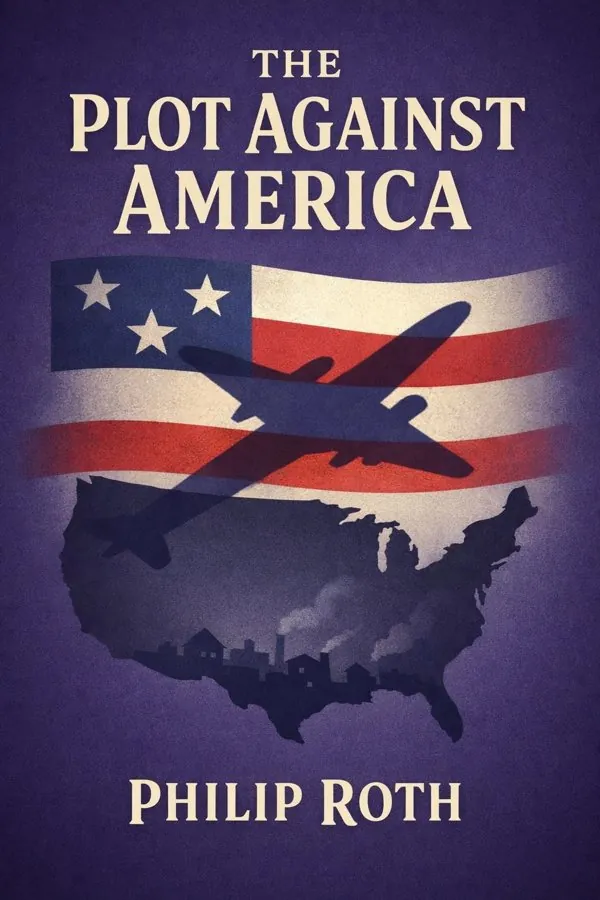
The Plot Against America: Summary & Key Insights
by Philip Roth
 10 min9 chaptersAudio available
Key Takeaways from The Plot Against America
The deepest political shocks are felt most sharply in places that once seemed safe.
A democracy can choose danger while believing it has chosen safety.
Political dread becomes most powerful when it invades private life.
Oppressive politics do not merely target communities; they divide them from within.
Assimilation can become coercive when the state decides your identity is a problem to be managed.
What Is The Plot Against America About?
The Plot Against America by Philip Roth is a bestsellers book spanning 6 pages. What if democracy did not collapse through a dramatic coup, but through elections, charm, and the public’s willingness to believe comforting lies? In The Plot Against America, Philip Roth imagines exactly that scenario. He rewrites American history so that Charles Lindbergh, the celebrated aviator and isolationist sympathizer, defeats Franklin D. Roosevelt and steers the United States toward authoritarianism, nativism, and anti-Semitism. But Roth does not tell this story from the top of power. He tells it from inside an ordinary Jewish household in Newark, New Jersey, where national politics becomes a daily source of fear, division, and moral pressure. That choice is what gives the novel its force. Instead of abstract ideology, we see how history enters the kitchen, the schoolyard, and the family argument. Roth, one of America’s most acclaimed novelists, draws on his own Newark childhood to create a narrative that feels intimate, plausible, and unsettlingly real. The book matters because it shows how fragile belonging can be, how quickly civic norms can erode, and how families struggle to stay humane when a nation begins redefining who counts as American.
This FizzRead summary covers all 9 key chapters of The Plot Against America in approximately 10 minutes, distilling the most important ideas, arguments, and takeaways from Philip Roth's work. Also available as an audio summary and Key Quotes Podcast.
The Plot Against America
What if democracy did not collapse through a dramatic coup, but through elections, charm, and the public’s willingness to believe comforting lies? In The Plot Against America, Philip Roth imagines exactly that scenario. He rewrites American history so that Charles Lindbergh, the celebrated aviator and isolationist sympathizer, defeats Franklin D. Roosevelt and steers the United States toward authoritarianism, nativism, and anti-Semitism. But Roth does not tell this story from the top of power. He tells it from inside an ordinary Jewish household in Newark, New Jersey, where national politics becomes a daily source of fear, division, and moral pressure.
That choice is what gives the novel its force. Instead of abstract ideology, we see how history enters the kitchen, the schoolyard, and the family argument. Roth, one of America’s most acclaimed novelists, draws on his own Newark childhood to create a narrative that feels intimate, plausible, and unsettlingly real. The book matters because it shows how fragile belonging can be, how quickly civic norms can erode, and how families struggle to stay humane when a nation begins redefining who counts as American.
Who Should Read The Plot Against America?
This book is perfect for anyone interested in bestsellers and looking to gain actionable insights in a short read. Whether you're a student, professional, or lifelong learner, the key ideas from The Plot Against America by Philip Roth will help you think differently.
- ✓Readers who enjoy bestsellers and want practical takeaways
- ✓Professionals looking to apply new ideas to their work and life
- ✓Anyone who wants the core insights of The Plot Against America in just 10 minutes
Want the full summary?
Get instant access to this book summary and 100K+ more with Fizz Moment.
Get Free SummaryAvailable on App Store • Free to download
Key Chapters
The deepest political shocks are felt most sharply in places that once seemed safe. At the beginning of The Plot Against America, young Philip lives in a world governed by routine, affection, and trust. His family in Newark is not wealthy or powerful, but it is stable. His father Herman is principled, hardworking, and fiercely committed to the idea that America, despite its imperfections, is a place where Jews can belong. His mother Bess protects the emotional center of the household with vigilance and tenderness. His older brother Sandy is imaginative and impressionable, while his cousin Alvin brings restlessness and volatility into the family orbit.
Roth spends time establishing this ordinary life because normalcy is the thing history later attacks. The family’s habits—meals, school, neighborhood relationships, vacation plans—create an emotional baseline. Newark feels not like a hiding place, but like home. This matters because authoritarian change rarely announces itself first as terror. It begins by destabilizing people who thought their routines were secure.
In practical terms, Roth reminds us that social trust is built from everyday repetition. We often recognize the value of institutions, neighborhoods, and family rituals only when they are threatened. A holiday dinner, a trusted newspaper, a predictable school day, a shared civic identity—these are not trivial comforts. They are part of the invisible architecture of democracy.
The takeaway is simple: protect ordinary stability before crisis arrives. Pay attention to the routines, relationships, and institutions that make a community feel livable, because once they are politicized, recovery becomes much harder.
A democracy can choose danger while believing it has chosen safety. Roth’s alternate history begins with Charles Lindbergh’s rise to the presidency, and his appeal is key to understanding the novel. Lindbergh is not presented as a ranting caricature. He is famous, admired, calm, and symbolically powerful. He flies himself from rally to rally, bypassing conventional politics with the glamour of celebrity and the language of reassurance. He promises peace, national pride, and freedom from foreign entanglements. To millions, he looks like a hero who can protect America from war.
That is what makes him dangerous. He packages exclusion as prudence and bigotry as realism. Anti-Semitism does not initially arrive as official persecution; it arrives as insinuation, coded suspicion, and the suggestion that some Americans have divided loyalties. Lindbergh’s administration makes prejudice respectable by embedding it inside patriotic rhetoric.
This dynamic remains relevant far beyond the novel’s historical frame. Public figures often gain power not by sounding extreme, but by making extreme outcomes seem like common sense. A leader may frame restrictions as order, scapegoating as security, and silence as maturity. People who would reject open hatred may still support policies that target vulnerable groups if those policies are wrapped in reassuring language.
Roth’s insight is that charisma can weaken democratic judgment. Admiration for status, confidence, or symbolic heroism can replace scrutiny of values and consequences. The actionable takeaway: never confuse personal prestige with moral fitness. Evaluate leaders by what they normalize, whom they blame, and how their promises reshape the boundaries of belonging.
Political dread becomes most powerful when it invades private life. One of Roth’s greatest achievements is showing how a national shift in mood transforms the emotional texture of a single household. Herman follows the news with mounting alarm. Bess worries not only about policy, but about what fear is doing to the family itself. Young Philip absorbs fragments of adult conversation and experiences politics not as theory but as anxiety, rumor, and bodily unease. The home remains physically intact, yet it no longer feels fully protected from the outside world.
This is how authoritarian pressure often works. It does not need immediate total control. It needs people to anticipate danger, censor themselves, second-guess neighbors, and imagine worst-case outcomes. In the novel, news stories, speeches, and public gestures ripple into family arguments and sleeplessness. The children are forced to interpret changes they cannot fully understand, while the adults struggle to distinguish prudence from panic.
In contemporary terms, the book offers a sharp lesson about emotional climate. A society does not become healthier just because institutions still stand on paper. If people feel that their citizenship is conditional, if children absorb the message that they are less safe or less wanted, damage has already begun. Families under political pressure often become crisis managers, devoting energy to survival instead of flourishing.
Roth suggests that clarity matters in fearful times. Naming what is happening is one form of resistance. Denial, by contrast, can deepen vulnerability. The takeaway: when public life begins producing private fear, do not dismiss that fear as overreaction. Discuss it honestly, verify facts carefully, and build circles of trust before isolation takes hold.
Oppressive politics do not merely target communities; they divide them from within. As Lindbergh’s America grows more hostile, the Roth family stops functioning as a unified moral unit. Herman becomes increasingly defiant and outspoken, convinced that silence would be complicity. Bess grows more cautious, focused on keeping the family physically safe. Sandy, attracted by the administration’s patriotic imagery and adventure, becomes susceptible to official narratives. Alvin rejects passive fear and seeks a more aggressive response, with disastrous consequences.
What makes these tensions compelling is that no one is entirely abstract. Each character embodies a different survival strategy. Resistance, accommodation, denial, escape, and emotional withdrawal all appear within the same extended family. This reflects a hard truth about political crisis: people who love one another may still disagree profoundly about risk. One person sees principle; another sees recklessness. One sees compromise; another sees surrender.
Roth’s portrait is useful because it warns against simplistic judgments. Under pressure, families rarely split along neat lines of courage and cowardice. They split because the cost of being wrong feels unbearable. Should you speak out and attract attention? Relocate before it is too late? Trust institutions to self-correct? Protect children from the truth or prepare them for it? These are not easy questions.
In practical life, families facing uncertainty benefit from discussing values before emergencies intensify. Shared language about what matters most—safety, integrity, truth, solidarity—can reduce destructive confusion later. The actionable takeaway: when the public world becomes unstable, make room for hard conversations at home. Honest disagreement is healthier than pretending everyone interprets danger the same way.
Assimilation can become coercive when the state decides your identity is a problem to be managed. One of the novel’s most chilling mechanisms is the government program known as Homestead 42, which relocates Jewish families from urban communities into other parts of the country under the guise of national integration. The policy sounds benign, even constructive. It promises opportunity, dispersion, and fuller Americanization. But beneath that language lies a clear intention: weaken Jewish communal bonds, scatter political resistance, and redefine Jewish distinctiveness as something suspect.
Roth is especially sharp in showing how soft power can be more insidious than overt violence. Homestead 42 is bureaucratic, administrative, and framed as benevolence. That framing makes resistance harder, because opponents can be portrayed as ungrateful or separatist. Yet the real purpose is control. The state is not helping minorities belong on their own terms; it is redesigning them into less visible, less connected, less powerful citizens.
This pattern has wide relevance. Governments and institutions often justify unequal treatment through the language of inclusion, modernization, or unity. A school may discourage cultural expression in the name of cohesion. A workplace may praise diversity while penalizing difference. A nation may celebrate pluralism while demanding silent conformity from targeted groups.
The novel teaches that belonging without dignity is not genuine belonging. Integration imposed from above can function as erasure. Communities need the freedom to define themselves, maintain their relationships, and participate in national life without having to dissolve their identity. The takeaway: whenever a policy claims to help a minority by weakening its own institutions, examine whose comfort is truly being served.
A regime grows stronger when respected insiders legitimize it. Rabbi Lionel Bengelsdorf is one of Roth’s most unsettling characters because he represents collaboration not from crude hatred, but from vanity, ambition, and self-deception. As a prominent Jewish public figure who aligns himself with Lindbergh’s administration, he becomes proof that the regime can point to when accused of anti-Semitism. His support helps create the illusion that everything remains within democratic norms.
Bengelsdorf matters because oppressive systems rarely rely only on true believers. They also depend on interpreters, spokespersons, and dignified intermediaries who reassure the public that targeted groups have nothing to fear. Such figures often tell themselves they are moderating power from within. In reality, they can become instruments for laundering cruelty into respectability.
Roth’s insight applies well beyond politics. Institutions under moral stress often elevate compliant representatives from vulnerable communities, then use their presence to deny structural harm. A company may highlight one minority executive while ignoring broad patterns of exclusion. A government may feature loyal insiders while dismissing the warnings of those directly affected. Symbolic inclusion then becomes a shield against accountability.
The novel does not suggest that all engagement with power is betrayal. It does suggest that motives matter, and so do outcomes. If access to authority requires minimizing real danger, blaming the vulnerable, or helping harmful policies appear reasonable, collaboration becomes complicity.
The actionable takeaway: judge public endorsements by consequences, not appearances. When leaders from a threatened community defend a powerful institution, ask whether their involvement reduces harm in practice or simply makes injustice easier to sell.
Once a society normalizes suspicion, disorder can arrive with terrifying speed. In the later movement of the novel, tension gives way to open chaos. Lindbergh disappears under mysterious circumstances, political authority weakens, and anti-Jewish violence erupts in different parts of the country. What was once coded and bureaucratic becomes more nakedly physical. The illusion that norms will quietly hold everything together is shattered.
Roth’s handling of this descent is important because it reveals how quickly a democratic culture can move from unease to emergency. Long before riots break out, the moral groundwork has been laid. Scapegoating has been repeated. Institutions have been bent. Trust has eroded. Some citizens have been taught that their neighbors are the source of national decline. By the time violence becomes visible, the deeper collapse has been underway for quite a while.
This arc offers a practical warning about early signs. People often wait for dramatic proof before responding to democratic backsliding, but dramatic proof usually means the damage is already severe. The novel argues indirectly for vigilance during the incremental phase: when leaders attack the press, vilify minorities, politicize bureaucracy, and invite citizens to divide the nation into real Americans and suspect ones.
It also shows how instability punishes the vulnerable first. Families already living with fear become exposed to displacement, rumor, and sudden danger. Survival depends not only on formal rights, but on whether social solidarity still exists.
The takeaway: treat low-level political dehumanization as a serious threat, not background noise. The line between hostile rhetoric and social breakdown is shorter than comfortable societies like to believe.
Children experience national crisis through symbols, fragments, and feelings before they can understand ideology. Because The Plot Against America is narrated through the consciousness of a young Philip, the novel captures how authoritarian drift reshapes a child’s sense of reality. He becomes fixated on stamps, maps, rumors, family quarrels, and imagined catastrophes. The adult world is only partially legible, which makes it more frightening. He knows enough to sense danger, but not enough to control it.
This perspective is central to the novel’s emotional power. Political transformation is often described through laws and leaders, yet Roth shows how it affects the developing mind. A child in such a climate learns that safety is conditional, that adults may not be able to explain events clearly, and that one’s home country can become unfamiliar without physically changing shape. That confusion leaves lasting marks.
There is also a broader lesson here about memory. Childhood experiences of exclusion or public menace can shape identity for decades. The child does not need to grasp every policy detail to absorb the emotional truth that the world has become less trustworthy. Families living through instability therefore face a double responsibility: they must manage immediate safety while also helping children interpret events in ways that preserve dignity and psychological coherence.
In practical terms, that means speaking honestly at an age-appropriate level, avoiding false reassurance, and reinforcing sources of belonging. Children do not benefit from total silence; they often imagine something worse. The actionable takeaway: when public events threaten a family’s security, explain enough for children to make sense of their fear, and pair truth with reassurance, routine, and connection.
Even when a political crisis ends, the people who lived through it do not simply return to innocence. By the novel’s conclusion, the alternate-history emergency recedes and the expected course of American politics is restored. On the surface, normalcy comes back. But Roth refuses to present that restoration as complete healing. The family has seen too much. The fantasy of guaranteed safety in America has been broken. What remains is knowledge: democracy can fail, neighbors can change, and respectability can mask persecution.
This ending is one of the book’s most important contributions. It rejects the comforting idea that history resets cleanly after danger passes. Trauma outlasts events. Once citizens understand how vulnerable institutions are, they may never again inhabit public life with the same trust. That loss is painful, but it can also become a form of maturity. A chastened faith in democracy may be more durable than naïve confidence, because it is tied to vigilance rather than myth.
The novel therefore does not end in despair. It ends in a more difficult form of citizenship. To live responsibly after a near-catastrophe means remembering what was possible and refusing to let memory be dismissed as exaggeration. Communities that survive intimidation often become guardians of democratic warning signs precisely because they know how ordinary people can be drawn into extraordinary wrong.
The actionable takeaway: do not aim to forget periods of civic breakdown. Preserve the memory of how they developed, discuss them across generations, and let that memory strengthen your commitment to pluralism, institutions, and democratic accountability.
All Chapters in The Plot Against America
About the Author
Philip Roth (1933–2018) was a major American novelist whose work explored identity, desire, politics, memory, and the contradictions of American life. Born in Newark, New Jersey, he often drew on Jewish American experience and on the tension between private selfhood and public expectation. Over a long and influential career, he wrote acclaimed novels including Portnoy’s Complaint, American Pastoral, Sabbath’s Theater, The Human Stain, and The Plot Against America. Roth’s fiction is known for its psychological precision, satirical force, and willingness to confront cultural unease without simplification. He received many of literature’s highest honors, including the Pulitzer Prize, the National Book Award, and the PEN/Faulkner Award. In The Plot Against America, Roth fused personal memory with political imagination to create one of his most enduring and urgently relevant novels.
Get This Summary in Your Preferred Format
Read or listen to the The Plot Against America summary by Philip Roth anytime, anywhere. FizzRead offers multiple formats so you can learn on your terms — all free.
Available formats: App · Audio · PDF · EPUB — All included free with FizzRead
Download The Plot Against America PDF and EPUB Summary
Key Quotes from The Plot Against America
“The deepest political shocks are felt most sharply in places that once seemed safe.”
“A democracy can choose danger while believing it has chosen safety.”
“Political dread becomes most powerful when it invades private life.”
“Oppressive politics do not merely target communities; they divide them from within.”
“Assimilation can become coercive when the state decides your identity is a problem to be managed.”
Frequently Asked Questions about The Plot Against America
The Plot Against America by Philip Roth is a bestsellers book that explores key ideas across 9 chapters. What if democracy did not collapse through a dramatic coup, but through elections, charm, and the public’s willingness to believe comforting lies? In The Plot Against America, Philip Roth imagines exactly that scenario. He rewrites American history so that Charles Lindbergh, the celebrated aviator and isolationist sympathizer, defeats Franklin D. Roosevelt and steers the United States toward authoritarianism, nativism, and anti-Semitism. But Roth does not tell this story from the top of power. He tells it from inside an ordinary Jewish household in Newark, New Jersey, where national politics becomes a daily source of fear, division, and moral pressure. That choice is what gives the novel its force. Instead of abstract ideology, we see how history enters the kitchen, the schoolyard, and the family argument. Roth, one of America’s most acclaimed novelists, draws on his own Newark childhood to create a narrative that feels intimate, plausible, and unsettlingly real. The book matters because it shows how fragile belonging can be, how quickly civic norms can erode, and how families struggle to stay humane when a nation begins redefining who counts as American.
More by Philip Roth

You Might Also Like
The Godfather
Mario Puzo
10 min
The Handmaid's Tale
Margaret Atwood
10 min
The Hunger Games
Suzanne Collins
10 min
The Nightingale
Kristin Hannah
10 min
The Seven Husbands of Evelyn Hugo
Taylor Jenkins Reid
10 min
Backwater Justice
Fern Michaels
10 minBrowse by Category
Ready to read The Plot Against America?
Get the full summary and 100K+ more books with Fizz Moment.