
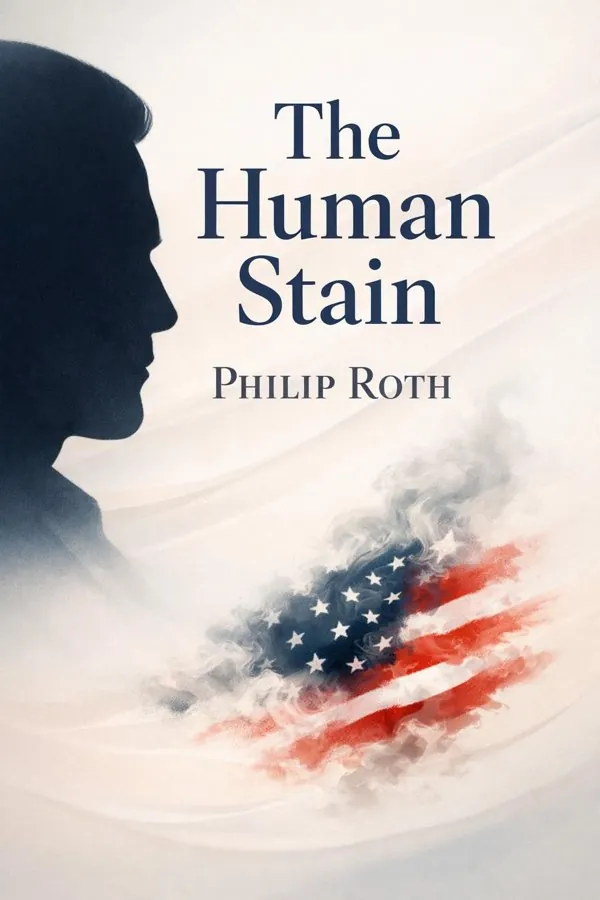
The Human Stain: Summary & Key Insights
by Philip Roth
 10 min9 chaptersAudio available
Key Takeaways from The Human Stain
A public downfall often begins long before the visible scandal.
Intimacy does not erase social pressure; it often intensifies it.
Identity can be both inheritance and invention, and The Human Stain examines that tension with unusual power.
A society obsessed with purity becomes blind to humanity.
No person is unstained, and Roth builds his novel around that unsettling truth.
What Is The Human Stain About?
The Human Stain by Philip Roth is a bestsellers book spanning 5 pages. Philip Roth’s The Human Stain is a brilliant, unsettling novel about the stories people tell the world and the secrets they hide even from those closest to them. Published in 2000 as the final volume in Roth’s acclaimed American trilogy, the book follows Coleman Silk, a respected classics professor whose career collapses after an offhand remark is interpreted as racist. What begins as a campus scandal opens into a far deeper tragedy involving desire, reinvention, class, race, shame, and the brutal ease with which a society can reduce a life to a single accusation. Narrated by Roth’s recurring alter ego, Nathan Zuckerman, the novel is set in late-1990s America, during the era of political spectacle, public moralizing, and heightened cultural suspicion. Yet its themes feel even more urgent today. Roth examines how identity can be performed, weaponized, concealed, and misunderstood, and how institutions often prefer judgment to complexity. As one of America’s most celebrated novelists, Roth brings extraordinary psychological depth, satirical precision, and moral seriousness to this story. The Human Stain matters because it confronts a timeless question: can any human life survive the simplifications imposed by society?
This FizzRead summary covers all 9 key chapters of The Human Stain in approximately 10 minutes, distilling the most important ideas, arguments, and takeaways from Philip Roth's work. Also available as an audio summary and Key Quotes Podcast.
The Human Stain
Philip Roth’s The Human Stain is a brilliant, unsettling novel about the stories people tell the world and the secrets they hide even from those closest to them. Published in 2000 as the final volume in Roth’s acclaimed American trilogy, the book follows Coleman Silk, a respected classics professor whose career collapses after an offhand remark is interpreted as racist. What begins as a campus scandal opens into a far deeper tragedy involving desire, reinvention, class, race, shame, and the brutal ease with which a society can reduce a life to a single accusation.
Narrated by Roth’s recurring alter ego, Nathan Zuckerman, the novel is set in late-1990s America, during the era of political spectacle, public moralizing, and heightened cultural suspicion. Yet its themes feel even more urgent today. Roth examines how identity can be performed, weaponized, concealed, and misunderstood, and how institutions often prefer judgment to complexity. As one of America’s most celebrated novelists, Roth brings extraordinary psychological depth, satirical precision, and moral seriousness to this story. The Human Stain matters because it confronts a timeless question: can any human life survive the simplifications imposed by society?
Who Should Read The Human Stain?
This book is perfect for anyone interested in bestsellers and looking to gain actionable insights in a short read. Whether you're a student, professional, or lifelong learner, the key ideas from The Human Stain by Philip Roth will help you think differently.
- ✓Readers who enjoy bestsellers and want practical takeaways
- ✓Professionals looking to apply new ideas to their work and life
- ✓Anyone who wants the core insights of The Human Stain in just 10 minutes
Want the full summary?
Get instant access to this book summary and 100K+ more with Fizz Moment.
Get Free SummaryAvailable on App Store • Free to download
Key Chapters
A public downfall often begins long before the visible scandal. In The Human Stain, Nathan Zuckerman serves as witness, interpreter, and moral investigator as he reconstructs the collapse of Coleman Silk, a retired classics professor whose life is shattered by a charge of racism. Zuckerman, living in seclusion after illness, is drawn into Coleman’s orbit after Silk is forced out of Athena College over a classroom remark about two absent students he called “spooks,” unaware that they were Black. What follows is not simply a dispute over language. It becomes a study of how institutions, colleagues, and communities can transform ambiguity into certainty and suspicion into condemnation.
Roth uses Zuckerman’s perspective to show that every story has gaps. Zuckerman does not know everything at first; he assembles Coleman’s life from conversations, memories, documents, and acts of imagination. That narrative method matters because it mirrors the book’s deeper concern: how quickly people construct moral verdicts from partial knowledge. Coleman is brilliant, arrogant, forceful, and often difficult, but he is not what his accusers decide he is. The scandal reveals less about his actual intentions than about the college’s eagerness to display virtue.
In practical terms, this idea speaks to modern workplaces, universities, and online culture. A poorly understood comment, stripped of context, can become a defining label. Roth urges readers to ask better questions before joining collective judgment. What was said? In what context? What assumptions are being projected onto the speaker? And who benefits from the outrage?
The actionable takeaway is simple: when someone is publicly condemned, pause before accepting the official narrative. Seek context, distinguish intention from interpretation, and resist the comfort of quick moral certainty.
Identity can be both inheritance and invention, and The Human Stain examines that tension with unusual power. The novel’s central revelation is that Coleman Silk, widely perceived and accepted as a white Jewish intellectual, was born into an African American family with light skin and chose, as a young man, to pass as white. This decision is the buried core of his life. It reshapes everything: his ambition, his estrangement from family, his marriage, his career, and the irony of his eventual accusation of racism.
Roth does not present Coleman’s passing as a simple act of betrayal or self-liberation. It is both. Coleman rejects the social limitations and humiliations imposed by race in America, but his reinvention comes at immense personal cost. He gains freedom, opportunity, and autonomy, yet he must sever himself from origins, memory, and kinship. His life becomes a disciplined performance sustained over decades. That performance is so complete that even those closest to him do not know who he was.
This is one of Roth’s boldest insights: identity is never merely personal, because society punishes and rewards bodies before individuals can define themselves. Coleman does not invent himself in a vacuum. He invents himself against a racist order. But once constructed, the invented self becomes another prison, requiring permanent secrecy.
The theme remains highly relevant. Many people today reinvent themselves across class, geography, gender expectations, culture, or profession. The details differ, but the pressure is familiar: to become legible, acceptable, or powerful in systems designed by others. Reinvention can be empowering, but it can also generate chronic fracture.
The actionable takeaway is to examine where your own identity is chosen, inherited, or performed. Understanding that tension can deepen empathy for others and reduce the impulse to force people into simplistic categories.
A society obsessed with purity becomes blind to humanity. Roth sets The Human Stain in the late 1990s, during the Clinton impeachment era, and uses that political backdrop to expose a culture drunk on accusation, spectacle, and righteous exposure. In this atmosphere, private failing becomes public theater, and complexity is treated as evasion. Coleman Silk’s college scandal is not isolated from national life; it is a smaller version of the same appetite for scandal that dominated the country.
Roth’s critique is not aimed at one ideology alone. He is interested in a broader cultural habit: the urge to simplify people into symbols of guilt or virtue. On campus, administrative caution and moral posturing replace honest inquiry. In politics, intimate details become proxies for public value. In the media, exposure becomes its own justification. The result is a world where motives are presumed, contexts ignored, and personal destruction rationalized as ethical necessity.
This idea feels contemporary because the mechanisms have only accelerated. Today, social media can amplify outrage in minutes. Reputations can be remade or ruined through edited fragments, rumors, or single statements detached from circumstance. Roth saw how easily public judgment can masquerade as moral seriousness while feeding on humiliation.
The novel does not argue that wrongdoing is unreal or that accountability should disappear. Instead, it insists that judgment without imagination becomes cruelty. When no one is allowed contradiction, privacy, weakness, or change, everyone becomes vulnerable to ideological misreading.
The actionable takeaway: practice moral seriousness without moral exhibitionism. Hold people accountable, but refuse mob certainty, demand evidence, and preserve room for ambiguity, context, and human imperfection.
No person is unstained, and Roth builds his novel around that unsettling truth. The title The Human Stain refers to the ineradicable mark of being human: desire, error, concealment, shame, selfishness, grief, and mortality. Coleman Silk is not innocent in any pure sense. He lies about his identity, abandons parts of his past, hurts people, and acts out of pride. Faunia also conceals, manipulates, and withholds. Their enemies are flawed too. Roth’s point is not that everyone is equally guilty, but that the fantasy of innocence is itself corrupting.
The novel becomes tragic because the characters are judged as though a single failing defines them completely. Coleman is reduced to an accusation. Faunia is reduced to class contempt and sexual rumor. Even those who believe themselves morally elevated are stained by vanity, resentment, or self-deception. Roth strips away the comforting distinction between contaminated others and clean selves.
This insight has practical weight. In personal relationships, families, institutions, and politics, people often divide the world into the guilty and the pure. But that binary encourages projection. We condemn in others what we cannot bear to recognize in ourselves. The healthier response is not cynicism but humility: accountability rooted in awareness of shared fallibility.
The novel’s tragic ending underscores how quickly hidden resentments, misread motives, and unresolved pain can turn catastrophic. Yet the phrase “human stain” is also oddly liberating. If imperfection is universal, then moral life begins not in denial but in honest reckoning.
The actionable takeaway is to replace purity-thinking with humility. Admit your own contradictions, judge others with proportion, and remember that maturity begins where fantasies of innocence end.
The secrets that protect us can also deform us. Throughout The Human Stain, secrecy functions as both shield and sentence. Coleman Silk’s hidden racial ancestry is the most dramatic example, but many characters live through strategic concealment. Faunia masks intelligence beneath cultivated simplicity. Nathan Zuckerman protects his solitude and bodily vulnerability through retreat. Even institutions hide behind euphemism and procedure, concealing ambition or cowardice beneath official language.
For Coleman, secrecy is not just deception. It is a technology of survival in a racist America that would have constrained his future had he remained publicly Black. His secret allows him to become the man he wants to be. Yet the cost is lifelong vigilance. Every relationship becomes partially staged. Every disclosure carries danger. Secrecy grants freedom from one kind of social definition while creating another kind of captivity.
Roth is keenly aware that modern life often rewards selective revelation. People curate identities at work, online, in romance, and in family life. We learn which parts of ourselves are marketable, acceptable, or safe. But the more distance there is between the performed self and the hidden self, the more energy is required to maintain the gap. Secrecy can preserve dignity, but it can also generate loneliness and distortion.
The novel does not demand full transparency. In fact, it respects privacy. Instead, it asks what kinds of secrets preserve agency and what kinds begin to consume the person keeping them. That distinction matters in everyday life, whether in leadership, friendship, or self-understanding.
The actionable takeaway: identify the secrets in your life that protect your integrity versus those that imprison you. Keep what is necessary for dignity, but confront what isolates you from truth, intimacy, or peace.
Society often notices people only when they violate expectations. Faunia Farley is one of Roth’s most powerful reminders that class shapes not just opportunity, but visibility itself. As a janitor at Athena College, Faunia exists on the edge of institutional life. Educated people project fantasies onto her: victim, seductress, fool, burden. Very few see her as a full person with intelligence, trauma, strategy, and inner life. Her social position makes her easy to use and easy to dismiss.
Roth contrasts elite academic culture with the brutalities of working-class existence. On campus, conversations revolve around language, offense, and principle. Outside that world lie domestic abuse, economic insecurity, military trauma, illiteracy, and emotional survival. The novel never claims one sphere is morally cleaner than the other. Instead, it reveals how privilege often mistakes itself for insight while remaining ignorant of harsher forms of vulnerability.
Faunia’s ex-husband, Lester Farley, intensifies this theme. A damaged Vietnam veteran consumed by paranoia and rage, he represents forms of suffering that polite institutions would rather not confront. He is dangerous, but he is also a product of historical neglect and psychic ruin. Roth refuses easy sentimentality, yet he insists that class and power determine whose pain is legible and whose remains threatening background noise.
This matters in contemporary life wherever educated or affluent groups speak confidently about justice while overlooking material hardship, labor invisibility, or trauma outside their own circles. Moral discourse can become abstract when disconnected from lived realities.
The actionable takeaway: broaden your understanding of social harm beyond symbolic issues. Pay attention to the people who clean, serve, endure, and disappear from elite narratives. Real empathy begins by noticing who is usually unseen.
Every life we judge is partly imagined by us. One of the most sophisticated features of The Human Stain is its narrative structure. Nathan Zuckerman tells much of Coleman Silk’s story after Coleman’s death, reconstructing scenes he did not witness and motives he cannot fully verify. This is not a flaw in the novel; it is one of its deepest meanings. Roth wants us to feel the instability of interpretation itself. We are always telling stories about other people with incomplete evidence.
Zuckerman is intelligent, sympathetic, and morally alert, but even he must invent connections, infer hidden feelings, and guess at what happened behind closed doors. That uncertainty matters because the novel is full of confident misreadings by others: administrators misread Coleman, colleagues misread his relationship, society misreads scandal, and people misread each other’s identities. The difference is that Zuckerman knows he is interpreting. His humility separates understanding from dogmatism.
In practical terms, this is a lesson in epistemic modesty. At work, in politics, in family conflict, and online, people regularly mistake interpretation for fact. We infer motives from fragments, then act as if our version is complete. Roth exposes the danger of this habit. A life is not reducible to what others can see.
The novel also suggests that storytelling itself is an ethical act. To narrate another person responsibly requires imagination disciplined by uncertainty. That balance matters for journalists, leaders, teachers, friends, and anyone trying to understand another life.
The actionable takeaway: when interpreting someone else’s behavior, separate observable facts from your assumptions. Ask what you know, what you infer, and what remains unknowable. Humility is a form of respect.
The freedom to reinvent yourself is one of America’s most seductive promises, and Roth shows how costly that freedom can be. Coleman Silk embodies a particularly American ideal: the self-made individual who refuses imposed identity and chooses his own destiny. He rejects the place assigned to him by birth and constructs a life of intellectual distinction, erotic vitality, and social authority. In one sense, he succeeds magnificently.
But The Human Stain asks a harder question: what happens when self-creation requires amputation? Coleman’s new life depends on severing family ties, suppressing memory, and living within a chosen fiction. Reinvention gives him power, but not wholeness. He becomes the author of his own destiny at the price of continuous disavowal. Roth neither condemns nor celebrates him simplistically. He shows reinvention as both heroic and tragic.
This tension extends beyond race. Many readers will recognize versions of Coleman’s choice in migration, class mobility, career transformation, sexual self-definition, or leaving behind communities that constrained them. Reinvention can be necessary and noble. Yet every transformation raises difficult questions: What must be left behind? What debts remain? What fragments of the former self continue to demand recognition?
Roth’s larger contribution is to challenge the fantasy that freedom means a clean break from history. We carry residues of origin, grief, desire, and guilt into every new identity. The past does not disappear because it is hidden.
The actionable takeaway: pursue reinvention consciously rather than romantically. Growth often requires change, but ask what costs you are accepting, what truths you are suppressing, and how to build a future without denying the complexity of your past.
All Chapters in The Human Stain
About the Author
Philip Roth (1933–2018) was a major American novelist whose work explored identity, sexuality, politics, aging, and the tensions of American life with rare intelligence and intensity. Born in Newark, New Jersey, he emerged as a distinctive literary voice in the late 1950s and gained wide attention with Portnoy’s Complaint. Over the course of his career, he wrote many acclaimed novels, including American Pastoral, I Married a Communist, The Human Stain, Sabbath’s Theater, and The Plot Against America. Roth was especially known for his psychologically probing prose, satirical force, and recurring narrator Nathan Zuckerman. His work earned numerous honors, including the Pulitzer Prize, the National Book Award, and the PEN/Faulkner Award. Today he is widely regarded as one of the defining American writers of his era.
Get This Summary in Your Preferred Format
Read or listen to the The Human Stain summary by Philip Roth anytime, anywhere. FizzRead offers multiple formats so you can learn on your terms — all free.
Available formats: App · Audio · PDF · EPUB — All included free with FizzRead
Download The Human Stain PDF and EPUB Summary
Key Quotes from The Human Stain
“A public downfall often begins long before the visible scandal.”
“Intimacy does not erase social pressure; it often intensifies it.”
“Identity can be both inheritance and invention, and The Human Stain examines that tension with unusual power.”
“A society obsessed with purity becomes blind to humanity.”
“No person is unstained, and Roth builds his novel around that unsettling truth.”
Frequently Asked Questions about The Human Stain
The Human Stain by Philip Roth is a bestsellers book that explores key ideas across 9 chapters. Philip Roth’s The Human Stain is a brilliant, unsettling novel about the stories people tell the world and the secrets they hide even from those closest to them. Published in 2000 as the final volume in Roth’s acclaimed American trilogy, the book follows Coleman Silk, a respected classics professor whose career collapses after an offhand remark is interpreted as racist. What begins as a campus scandal opens into a far deeper tragedy involving desire, reinvention, class, race, shame, and the brutal ease with which a society can reduce a life to a single accusation. Narrated by Roth’s recurring alter ego, Nathan Zuckerman, the novel is set in late-1990s America, during the era of political spectacle, public moralizing, and heightened cultural suspicion. Yet its themes feel even more urgent today. Roth examines how identity can be performed, weaponized, concealed, and misunderstood, and how institutions often prefer judgment to complexity. As one of America’s most celebrated novelists, Roth brings extraordinary psychological depth, satirical precision, and moral seriousness to this story. The Human Stain matters because it confronts a timeless question: can any human life survive the simplifications imposed by society?
More by Philip Roth



You Might Also Like

The Godfather
Mario Puzo
10 min
The Handmaid's Tale
Margaret Atwood
10 min
The Hunger Games
Suzanne Collins
10 min
The Nightingale
Kristin Hannah
10 min
The Seven Husbands of Evelyn Hugo
Taylor Jenkins Reid
10 min
Backwater Justice
Fern Michaels
10 minBrowse by Category
Ready to read The Human Stain?
Get the full summary and 100K+ more books with Fizz Moment.