
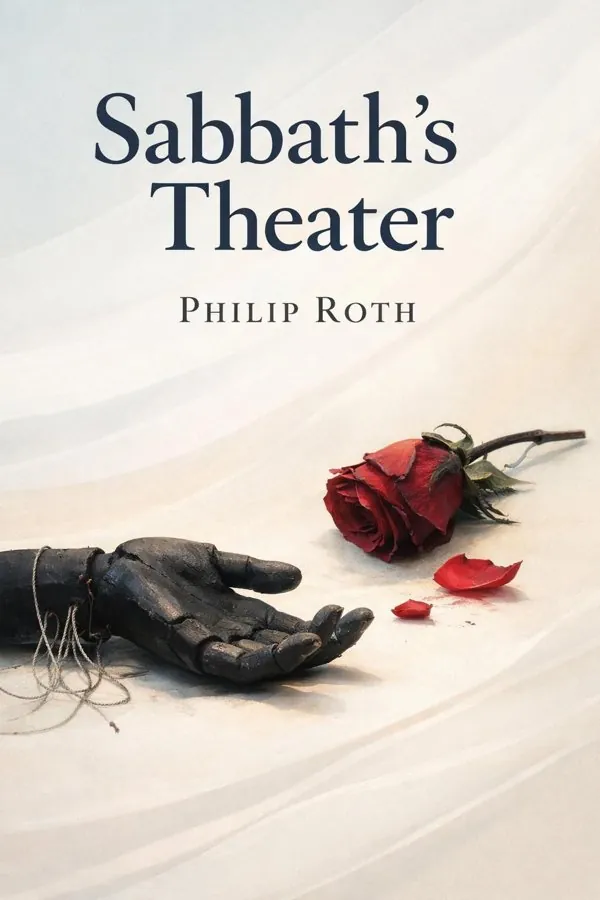
Sabbath’s Theater: Summary & Key Insights
by Philip Roth
 10 min9 chaptersAudio available
Key Takeaways from Sabbath’s Theater
A person can turn rebellion into an identity so completely that even self-destruction feels like a form of authorship.
Sometimes intimacy forms not through virtue, but through the shared refusal to pretend.
The past does not disappear simply because life keeps moving; it waits in the mind until grief gives it a new voice.
Conventional success can look like stability from a distance and spiritual suffocation up close.
Cities magnify inner states, turning private disorder into a public spectacle.
What Is Sabbath’s Theater About?
Sabbath’s Theater by Philip Roth is a classics book spanning 6 pages. Philip Roth’s Sabbath’s Theater is a furious, darkly comic, and morally unsettling novel centered on Mickey Sabbath, a disgraced former puppeteer who lurches through late middle age in a state of lust, grief, rage, and theatrical self-invention. After the death of his longtime lover Drenka Balich, Sabbath begins a reckless journey through memory, humiliation, and near self-annihilation, confronting not just the loss of another person but the collapse of the private drama that gave his life shape. What emerges is not merely a portrait of scandalous behavior, but an unflinching meditation on desire, aging, shame, freedom, and mortality. The novel matters because Roth refuses every comforting simplification. He does not redeem Sabbath, excuse him, or condemn him from a safe distance. Instead, he uses this outrageous, broken man to ask what remains of identity when beauty fades, intimacy rots, and death becomes impossible to ignore. Roth, one of America’s most formidable novelists, brings unmatched psychological daring, linguistic energy, and satirical precision to this inquiry. Sabbath’s Theater is challenging, abrasive, often hilarious, and profoundly alive: a classic that turns indecency into a vehicle for tragic truth.
This FizzRead summary covers all 9 key chapters of Sabbath’s Theater in approximately 10 minutes, distilling the most important ideas, arguments, and takeaways from Philip Roth's work. Also available as an audio summary and Key Quotes Podcast.
Sabbath’s Theater
Philip Roth’s Sabbath’s Theater is a furious, darkly comic, and morally unsettling novel centered on Mickey Sabbath, a disgraced former puppeteer who lurches through late middle age in a state of lust, grief, rage, and theatrical self-invention. After the death of his longtime lover Drenka Balich, Sabbath begins a reckless journey through memory, humiliation, and near self-annihilation, confronting not just the loss of another person but the collapse of the private drama that gave his life shape. What emerges is not merely a portrait of scandalous behavior, but an unflinching meditation on desire, aging, shame, freedom, and mortality.
The novel matters because Roth refuses every comforting simplification. He does not redeem Sabbath, excuse him, or condemn him from a safe distance. Instead, he uses this outrageous, broken man to ask what remains of identity when beauty fades, intimacy rots, and death becomes impossible to ignore. Roth, one of America’s most formidable novelists, brings unmatched psychological daring, linguistic energy, and satirical precision to this inquiry. Sabbath’s Theater is challenging, abrasive, often hilarious, and profoundly alive: a classic that turns indecency into a vehicle for tragic truth.
Who Should Read Sabbath’s Theater?
This book is perfect for anyone interested in classics and looking to gain actionable insights in a short read. Whether you're a student, professional, or lifelong learner, the key ideas from Sabbath’s Theater by Philip Roth will help you think differently.
- ✓Readers who enjoy classics and want practical takeaways
- ✓Professionals looking to apply new ideas to their work and life
- ✓Anyone who wants the core insights of Sabbath’s Theater in just 10 minutes
Want the full summary?
Get instant access to this book summary and 100K+ more with Fizz Moment.
Get Free SummaryAvailable on App Store • Free to download
Key Chapters
A person can turn rebellion into an identity so completely that even self-destruction feels like a form of authorship. That is the unsettling force of Mickey Sabbath, the novel’s central figure: a former puppeteer whose life has become an extension of his old stage craft. He manipulates, performs, provokes, and improvises, treating everyday life as theater and obscenity as a weapon against respectability. Sabbath is not merely vulgar for shock value. His vulgarity is a declaration of war against aging, decorum, and the demand to become manageable.
Roth presents him as a man shaped by appetite and art in equal measure. Once known for daring performances that blurred puppetry and erotic spectacle, Sabbath learned to treat identity as something staged rather than settled. That theatrical instinct survives the collapse of his career and relationships. Even in grief, he performs. Even in shame, he improvises. He refuses to become the subdued, diminished elderly man society expects. The result is both comic and tragic: his defiance keeps him vivid, but it also isolates him from tenderness, accountability, and peace.
This idea reaches beyond fiction. Many people build themselves around opposition: the rebel employee, the contrarian parent, the artist who must offend to feel authentic. Defiance can preserve individuality, but when it becomes the whole self, it leaves little room for growth. Sabbath shows what happens when resistance no longer serves freedom but replaces it.
Actionable takeaway: Ask yourself where rebellion still protects your individuality and where it has hardened into a performance that prevents honest change.
Sometimes intimacy forms not through virtue, but through the shared refusal to pretend. Drenka Balich, Sabbath’s longtime lover, is one of Roth’s most vivid creations: earthy, fearless, adulterous, playful, and unsentimental. Their affair is excessive, indecent, and often grotesquely funny, but it is also real in a way that more socially acceptable relationships in the novel often are not. With Drenka, Sabbath finds not redemption but recognition. She understands his appetites because she has her own. She does not ask him to become respectable; she joins him in building a private world where desire can be staged without apology.
This makes Drenka essential to the novel’s emotional core. She is not merely a sexual partner or symbol of excess. She is a co-conspirator in a form of companionship based on appetite, candor, and vitality. Their relationship becomes a theater inside the theater, full of games, confessions, fantasies, betrayals, and laughter. It is unstable and morally compromised, yet it gives Sabbath something like belonging. When she dies, he is not just bereaved. He loses the audience and collaborator who made his life legible to himself.
In practical terms, Roth is asking what people really seek from intimacy. Not perfection, often, but permission: permission to be foolish, hungry, contradictory, and alive. Healthy relationships require ethics, of course, but they also require honest recognition. People can feel lonelier in polite arrangements than in flawed but candid ones.
Actionable takeaway: In your closest relationships, look for where performance has replaced honesty, and practice one conversation built on candor rather than image management.
The past does not disappear simply because life keeps moving; it waits in the mind until grief gives it a new voice. One of the novel’s haunting emotional layers is Sabbath’s memory of Nikki, his first wife, whose disappearance and suffering remain unresolved forces in his inner life. If Drenka represents his last great accomplice in desire, Nikki represents an earlier catastrophe: love interrupted, meaning broken, history unfinished. Through these memories, Roth shows that Sabbath’s obscenity is not just appetite unleashed. It is also a response to loss that was never fully absorbed.
Nikki’s significance lies in how she exposes the fragility beneath Sabbath’s bravado. He may posture as invulnerable, but memory keeps revealing the wounds he cannot master theatrically. The vanished or damaged beloved becomes a private ghost, one that distorts future attachments. Sabbath returns to Nikki not as a stable source of insight, but as a site of confusion, guilt, longing, and self-accusation. Roth suggests that the self is never as autonomous as it imagines; it remains populated by the dead, the absent, and the unfinished.
This dynamic is recognizable in ordinary life. People often respond to old losses by becoming louder, busier, more sensual, more ironic, or more detached. Yet unresolved grief continues to shape choices, often invisibly. A failed marriage, a family rupture, a betrayal, or a death can become a hidden script driving later behavior.
Actionable takeaway: Identify one recurring emotional pattern in your life and ask which unprocessed memory may still be writing that scene from the background.
Conventional success can look like stability from a distance and spiritual suffocation up close. Through Sabbath’s encounter with Norman Cowan and the world of settled, respectable adulthood, Roth stages a comparison between two ways of living: one chaotic and indecent, the other disciplined and socially legible. Norman functions as a mirror, showing what Sabbath did not become and perhaps could never become. In that comparison, the novel refuses easy moral arithmetic. Respectability is not automatically hypocrisy, and disorder is not automatically freedom. Yet Sabbath sees in conventional life a deadening obedience to social scripts.
The tension matters because Roth is not simply celebrating transgression. Instead, he examines the cost of each arrangement. Norman’s world offers order, continuity, and social acceptance, but it can also feel emotionally airless. Sabbath’s life offers intensity, improvisation, and unruly self-expression, but it leaves wreckage behind. The novel’s brilliance lies in forcing readers to see that both lives contain evasions. The respectable conceal desire; the defiant conceal vulnerability.
In practical life, many people live this conflict. One sibling follows the established path of career, marriage, and caution; another pursues risk, reinvention, and volatility. Each may envy and judge the other. Roth invites us to look past those surface judgments and ask what each style of life defends against. Often, order protects against chaos, while chaos protects against despair.
Actionable takeaway: Examine one area where you are following convention by choice and another where you reject it reflexively; then ask what fear is hidden in both decisions.
Cities magnify inner states, turning private disorder into a public spectacle. In Sabbath’s Theater, New York City becomes more than a setting; it is a stage on which Sabbath’s psychic unraveling plays out amid noise, anonymity, temptation, and relentless motion. The city’s energy suits his theatrical instincts, but it also strips him of illusions. In a place dense with bodies, history, and appetite, he cannot easily retreat into a stable self-image. He becomes one more aging man among crowds, memories, and vanished ambitions.
Roth uses the urban landscape to intensify the novel’s central questions about exposure and insignificance. Sabbath has spent his life trying to remain singular, outrageous, unforgettable. But the city confronts him with the indifference of the world. His dramas matter profoundly to him, yet they unfold within a social environment too vast to grant permanent centrality to anyone. This contrast between private melodrama and public indifference deepens the book’s tragic comedy.
There is also a practical insight here about place and identity. Environments can sustain certain versions of ourselves. Some people thrive in bustling contexts that keep them stimulated and unguarded; others are overwhelmed by them. A city can intensify desire, loneliness, ambition, comparison, and reinvention all at once. It does not create a person’s crisis, but it can sharpen its contours.
Actionable takeaway: Notice how your environment amplifies your habits, and make one deliberate change in routine or setting that supports reflection instead of automatic performance.
Aging becomes unbearable when a person has built identity on potency, performance, and seduction. One of the most powerful dimensions of Sabbath’s Theater is its refusal to sentimentalize late life. Sabbath is sixty-four, and he experiences aging not as wise mellowing but as insult, diminishment, and exposure. The body weakens, erotic power shifts, social tolerance narrows, and death is no longer abstract. For a man who has lived through appetite and theatrical command, this is not merely inconvenient. It is existentially intolerable.
Roth captures the bitterness of aging with unusual honesty. Sabbath does not want serenity; he wants intensity. He resents the expectation that older people should become dignified, restrained, or morally improved. That refusal gives the novel much of its energy. Yet Roth also reveals the pathos beneath it. Sabbath’s obscenity is partly a desperate attempt to prove he still exists in full force. His transgressions become anti-aging rituals, ways of refusing social erasure.
This theme resonates widely because aging often involves identity crisis, not just physical change. The executive who loses authority, the athlete who loses speed, the parent whose children no longer need them, the artist whose audience shifts: all confront versions of the same problem. When a role shrinks, who remains?
The novel does not offer comfort, but it offers clarity. The answer is not to deny aging through performance forever. It is to develop forms of selfhood not entirely dependent on vanished powers.
Actionable takeaway: List the roles or abilities you most rely on for self-worth, and begin strengthening one source of identity that can endure when those inevitably change.
What shocks us often reveals less about depravity than about the boundaries we are desperate to protect. Roth fills the novel with obscenity, sexual excess, and deliberately offensive material, but these elements are never mere decoration. They function as instruments of exposure. Sabbath uses indecency to mock social piety, to resist being controlled, and to drag hidden impulses into the open. Yet obscenity in the novel cuts both ways. It liberates and humiliates. It attacks hypocrisy, but it also reveals the emptiness of endless transgression.
Shame is therefore central. Sabbath appears shameless, but the book shows that shamelessness is often a mask worn over deeper humiliation. He is ashamed of aging, dependence, grief, failure, and abandonment. Sexual theater gives him temporary escape, but it cannot abolish self-knowledge. Roth’s genius lies in showing how moral exposure happens even in people who pride themselves on violating moral codes. No one entirely escapes judgment, if not from society then from memory and self-awareness.
In everyday life, obscenity need not be literal. It can take the form of provocative humor, relentless irony, hostile candor, or boundary-breaking behavior used to maintain control. Such tactics can feel freeing, but they often conceal fragility. The question is whether transgression opens deeper truth or merely becomes a defensive habit.
Actionable takeaway: The next time you feel tempted to provoke for effect, pause and ask whether you are expressing truth, seeking connection, or simply trying to outrun shame.
Death becomes most terrifying not when it arrives, but when all the familiar distractions stop working. After Drenka’s death, Sabbath moves increasingly toward the abyss, entertaining self-annihilation while also recoiling from it. This tension gives the novel its late gravity. What begins as scandalous comedy turns into a confrontation with mortality stripped of spiritual consolation. Sabbath has lived through sensation, parody, and defiance, but none of these can finally cancel death. He can mock propriety; he cannot mock extinction into irrelevance.
Roth handles this with extraordinary emotional complexity. Sabbath does not discover peace, wisdom, or religious redemption. Instead, he oscillates between exhaustion and stubborn attachment to life. Even at his most suicidal, he remains implicated in the world by memory, desire, resentment, and curiosity. This is one of the novel’s most profound insights: the life instinct does not always appear noble. Sometimes it survives as vulgar persistence, the refusal to stop despite degradation and despair.
Readers can recognize this in less extreme forms. People often try to escape mortality through busyness, status, pleasure, legacy projects, or perpetual reinvention. These efforts can be meaningful, but they can also become avoidance. The novel suggests that the honest response to death is neither denial nor tidy acceptance, but a difficult, ongoing reckoning with finitude.
Actionable takeaway: Spend time identifying which of your daily pursuits are genuinely life-giving and which mainly function as distractions from deeper fears about loss, aging, and impermanence.
A human being can be obscene, cruel, funny, grieving, intelligent, self-aware, and helplessly alive all at once. Sabbath’s Theater endures because it refuses to flatten contradiction into a lesson. The novel’s final force lies in its vision of life as a last theater where no neat separation exists between comedy and tragedy, appetite and despair, freedom and ruin. Sabbath is both repellent and deeply human. Roth does not ask readers to admire him. He asks them to confront how much of life remains resistant to moral simplification.
This is what makes the novel a classic rather than merely a provocation. It enlarges the reader’s tolerance for complexity. We are used to stories in which transgression is either glamorized or punished, grief either ennobles or destroys, and old age either dignifies or diminishes. Roth rejects these patterns. Sabbath persists in all his contamination, neither purified nor fully defeated. The result is a harsher but truer vision of personhood.
Practically speaking, the novel offers a demanding kind of wisdom. It reminds us that understanding another person often requires enduring discomfort, ambiguity, and divided judgment. Leaders, parents, therapists, artists, and readers all benefit from that capacity. Real people rarely align with the categories by which they are socially managed.
Actionable takeaway: Practice holding one difficult person in your mind without collapsing them into either villain or victim, and notice how that shift deepens your understanding of human complexity.
All Chapters in Sabbath’s Theater
About the Author
Philip Roth (1933–2018) was a major American novelist whose work transformed postwar literary fiction through its daring treatment of sexuality, identity, power, and the unstable nature of selfhood. Born in Newark, New Jersey, Roth drew repeatedly on American life, Jewish experience, political anxiety, and the tensions between private desire and public expectation. He first gained wide attention with Goodbye, Columbus and later became internationally famous for Portnoy’s Complaint. Over a long and celebrated career, he produced landmark novels including Sabbath’s Theater, American Pastoral, I Married a Communist, The Human Stain, and The Plot Against America. Known for his verbal intensity, satirical brilliance, and psychological boldness, Roth received many major honors, including the Pulitzer Prize, and remains one of the defining novelists of modern American literature.
Get This Summary in Your Preferred Format
Read or listen to the Sabbath’s Theater summary by Philip Roth anytime, anywhere. FizzRead offers multiple formats so you can learn on your terms — all free.
Available formats: App · Audio · PDF · EPUB — All included free with FizzRead
Download Sabbath’s Theater PDF and EPUB Summary
Key Quotes from Sabbath’s Theater
“A person can turn rebellion into an identity so completely that even self-destruction feels like a form of authorship.”
“Sometimes intimacy forms not through virtue, but through the shared refusal to pretend.”
“The past does not disappear simply because life keeps moving; it waits in the mind until grief gives it a new voice.”
“Conventional success can look like stability from a distance and spiritual suffocation up close.”
“Cities magnify inner states, turning private disorder into a public spectacle.”
Frequently Asked Questions about Sabbath’s Theater
Sabbath’s Theater by Philip Roth is a classics book that explores key ideas across 9 chapters. Philip Roth’s Sabbath’s Theater is a furious, darkly comic, and morally unsettling novel centered on Mickey Sabbath, a disgraced former puppeteer who lurches through late middle age in a state of lust, grief, rage, and theatrical self-invention. After the death of his longtime lover Drenka Balich, Sabbath begins a reckless journey through memory, humiliation, and near self-annihilation, confronting not just the loss of another person but the collapse of the private drama that gave his life shape. What emerges is not merely a portrait of scandalous behavior, but an unflinching meditation on desire, aging, shame, freedom, and mortality. The novel matters because Roth refuses every comforting simplification. He does not redeem Sabbath, excuse him, or condemn him from a safe distance. Instead, he uses this outrageous, broken man to ask what remains of identity when beauty fades, intimacy rots, and death becomes impossible to ignore. Roth, one of America’s most formidable novelists, brings unmatched psychological daring, linguistic energy, and satirical precision to this inquiry. Sabbath’s Theater is challenging, abrasive, often hilarious, and profoundly alive: a classic that turns indecency into a vehicle for tragic truth.
More by Philip Roth



You Might Also Like






Browse by Category
Ready to read Sabbath’s Theater?
Get the full summary and 100K+ more books with Fizz Moment.