
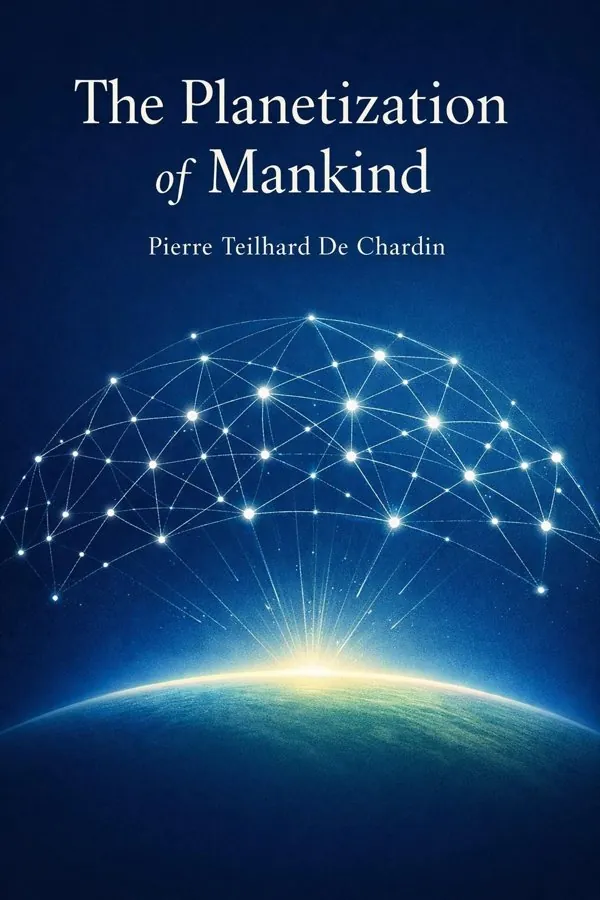
The Planetization of Mankind: Summary & Key Insights
 10 min9 chaptersAudio available
Key Takeaways from The Planetization of Mankind
The universe, Teilhard insists, is not a static arrangement of things but a drama of increasing complexity.
A remarkable threshold is crossed when life begins not only to live, but to know that it lives.
After the geosphere of rock and the biosphere of life, Teilhard proposes a third layer of reality: the noosphere, the sphere of thought encircling the planet.
Humanity becomes planetary not simply by occupying the same globe, but by entering into active communication.
Behind social and technological integration, Teilhard sees something even more powerful at work: spiritual energy.
What Is The Planetization of Mankind About?
The Planetization of Mankind by Pierre Teilhard De Chardin is a western_phil book spanning 10 pages. What happens when human evolution no longer depends primarily on biology, but on consciousness, communication, and shared destiny? In The Planetization of Mankind, Pierre Teilhard de Chardin argues that humanity is entering a new evolutionary phase in which individuals, societies, and cultures are being drawn into ever-greater connection across the globe. This is not merely a political or technological trend for him; it is a deep cosmic development. Just as matter once organized into life, and life into reflective thought, thought itself is now gathering into a planetary layer of mind that he famously calls the noosphere. This short but ambitious essay matters because it offers a sweeping framework for understanding globalization, technological interdependence, spiritual longing, and the future of civilization. Teilhard writes as both a scientist and a Jesuit thinker, bringing together paleontology, evolutionary theory, philosophy, and Christian theology. His authority lies not in narrow specialization alone, but in his rare attempt to interpret humanity’s future as a single coherent story. The result is a bold vision of human unity that remains strikingly relevant in an age of networks, crises, and global consciousness.
This FizzRead summary covers all 9 key chapters of The Planetization of Mankind in approximately 10 minutes, distilling the most important ideas, arguments, and takeaways from Pierre Teilhard De Chardin's work. Also available as an audio summary and Key Quotes Podcast.
The Planetization of Mankind
What happens when human evolution no longer depends primarily on biology, but on consciousness, communication, and shared destiny? In The Planetization of Mankind, Pierre Teilhard de Chardin argues that humanity is entering a new evolutionary phase in which individuals, societies, and cultures are being drawn into ever-greater connection across the globe. This is not merely a political or technological trend for him; it is a deep cosmic development. Just as matter once organized into life, and life into reflective thought, thought itself is now gathering into a planetary layer of mind that he famously calls the noosphere.
This short but ambitious essay matters because it offers a sweeping framework for understanding globalization, technological interdependence, spiritual longing, and the future of civilization. Teilhard writes as both a scientist and a Jesuit thinker, bringing together paleontology, evolutionary theory, philosophy, and Christian theology. His authority lies not in narrow specialization alone, but in his rare attempt to interpret humanity’s future as a single coherent story. The result is a bold vision of human unity that remains strikingly relevant in an age of networks, crises, and global consciousness.
Who Should Read The Planetization of Mankind?
This book is perfect for anyone interested in western_phil and looking to gain actionable insights in a short read. Whether you're a student, professional, or lifelong learner, the key ideas from The Planetization of Mankind by Pierre Teilhard De Chardin will help you think differently.
- ✓Readers who enjoy western_phil and want practical takeaways
- ✓Professionals looking to apply new ideas to their work and life
- ✓Anyone who wants the core insights of The Planetization of Mankind in just 10 minutes
Want the full summary?
Get instant access to this book summary and 100K+ more with Fizz Moment.
Get Free SummaryAvailable on App Store • Free to download
Key Chapters
The universe, Teilhard insists, is not a static arrangement of things but a drama of increasing complexity. If we step back from daily life and look through the lens of deep time, we see a pattern: matter becomes more organized, life emerges from matter, and eventually consciousness emerges from life. Evolution is therefore not only about survival or adaptation in a narrow biological sense. It is also a movement toward richer structures, more interiority, and greater capacity for relation.
This is one of the essay’s most important foundations. Teilhard does not treat humans as an accidental side effect of natural history. Instead, he sees humanity as part of a larger cosmic tendency toward concentration and integration. The appearance of increasingly complex organisms, nervous systems, and reflective beings suggests that the universe has a directional character. Complexity and consciousness grow together.
This idea changes how we understand progress. Instead of measuring advancement only in terms of wealth, power, or technical control, Teilhard invites us to ask whether human systems are becoming more integrated, more aware, and more capable of meaningful cooperation. For example, a society with advanced tools but fragmented trust may be less evolved in a deeper sense than one that fosters solidarity, creativity, and mutual recognition.
In practical terms, this perspective encourages us to value institutions and habits that increase constructive complexity: interdisciplinary learning, global coordination, and social systems that unite rather than isolate. The actionable takeaway is simple: judge development not merely by expansion, but by whether it produces deeper organization, awareness, and connection.
A remarkable threshold is crossed when life begins not only to live, but to know that it lives. For Teilhard, the emergence of reflective thought marks a decisive turning point in evolution. Animals may perceive and react, but human beings can turn inward, examine themselves, imagine futures, and consciously reshape their environment. Thought is not a minor feature added onto biology; it is a revolutionary deepening of existence.
This is why humanity occupies such an important place in Teilhard’s vision. Once reflection appears, evolution changes its mode. Biological change continues, of course, but the leading edge shifts toward culture, symbolism, science, ethics, and collective memory. Human beings inherit not only genes but languages, institutions, technologies, and spiritual traditions. Evolution begins to work through education, communication, and conscious collaboration.
We can see this in everyday life. A child does not merely mature physically; they are initiated into a world of meanings. A community does not simply reproduce itself biologically; it transmits values, stories, techniques, and aspirations. Entire civilizations rise from accumulated thought. The internet, universities, legal systems, and global research networks are all examples of reflection extending itself beyond the individual mind.
Teilhard’s point is not that thought makes us superior in a crude sense, but that it makes us responsible. To think is to participate in evolution knowingly. We are no longer carried by blind processes alone; we help direct what comes next. The actionable takeaway: treat your mind as an evolutionary instrument by cultivating reflection, learning continuously, and using thought to create more conscious forms of life together.
After the geosphere of rock and the biosphere of life, Teilhard proposes a third layer of reality: the noosphere, the sphere of thought encircling the planet. This is not a mystical metaphor detached from reality. It names the actual web of human reflection, culture, communication, invention, and shared awareness that grows wherever minds interact. Once thought emerges in enough density, it forms a new envelope around Earth, just as life once transformed the planet’s surface.
The noosphere helps explain why human history cannot be reduced to separate tribes or isolated nations. Our ideas accumulate and circulate. One scientific discovery in one region can alter medicine worldwide. A philosophical insight can influence ethics across generations. A political event can reshape the consciousness of millions. Human minds are increasingly linked in a common field.
Today, this concept feels especially prescient. Global media, digital platforms, international institutions, and transnational movements all illustrate how thought now operates at planetary scale. Yet Teilhard’s point goes deeper than technology. The noosphere is not merely information transfer; it is the progressive weaving together of human interiority. It includes memory, imagination, conflict, aspiration, and spiritual search.
This concept also carries a warning. A noosphere can become more coherent, but it can also become chaotic, manipulative, or superficial if flooded with noise rather than genuine understanding. We strengthen it when we contribute truth, clarity, and empathy instead of confusion and division. The actionable takeaway: participate in the noosphere responsibly by sharing ideas that deepen collective intelligence rather than merely amplifying reaction.
Humanity becomes planetary not simply by occupying the same globe, but by entering into active communication. Teilhard sees transportation, trade, science, media, and dialogue as signs of a deeper convergence at work. The more human beings exchange ideas, goods, symbols, and experiences, the less they remain isolated units. Contact generates interdependence, and interdependence pushes consciousness toward a new scale.
This does not mean all differences disappear. In fact, Teilhard’s vision depends on distinct peoples and perspectives coming into relation without being flattened into sameness. Convergence is not uniformity. It is the coordination of diversity into a more complex whole. A healthy global civilization would resemble a living organism, where varied organs perform different functions while serving one life.
We can observe this dynamic everywhere. Climate science requires data from many nations. Supply chains tie distant economies together. Public health crises reveal how quickly local events become global concerns. Cultural forms such as music, film, literature, and activism now circulate across borders almost instantly. Humanity increasingly thinks and reacts at once, even when it disagrees.
But communication alone does not guarantee wisdom. Faster connection can spread hatred as easily as insight. Teilhard’s challenge is to transform contact into communion. The goal is not endless connectivity, but meaningful relation. In practical life, this means listening across ideological lines, building institutions for cooperation, and learning how to disagree without disintegrating.
The actionable takeaway is to use communication as a tool of integration: seek conversations, communities, and platforms that increase understanding, not just exposure. Real convergence begins when exchange becomes mutual growth.
Behind social and technological integration, Teilhard sees something even more powerful at work: spiritual energy. He often speaks in terms that surprise modern readers because he does not believe matter and spirit are opposed realms. Instead, he sees inwardness, desire, and love as real forces within evolution. Humanity does not move toward unity by mechanics alone. It is drawn forward by attraction, by the longing to relate, to know, and to transcend isolation.
This is why love occupies such a central place in his thought. For Teilhard, love is not merely a private emotion or romantic ideal. It is the energy that personalizes and unites at the same time. It allows beings to come together without losing their uniqueness. Coercion can create mass organization, but only love can generate higher-order union that preserves interior freedom.
This insight has practical significance. Families endure not because they are efficient systems, but because bonds of care hold them together. Teams function best when trust and shared purpose go beyond contractual obligation. Social movements become transformative when they are animated by dignity and solidarity rather than pure resentment. Even international cooperation depends, at some level, on the moral recognition that others are not disposable.
Teilhard’s language may be spiritual, but the principle is observable: durable unity requires affective and ethical investment. People do not truly converge through systems alone; they converge through commitment. The actionable takeaway is to cultivate forms of connection grounded in respect, loyalty, and compassion, because the future of human unity depends not only on networks, but on the quality of the energy flowing through them.
Teilhard’s idea of planetization describes a historical shift in which humanity becomes aware of itself as a single species sharing one destiny. This is more than globalization in the economic sense. It is an evolutionary threshold. Separate civilizations, once divided by geography and slow contact, are now being compressed into one planetary field of action. The human story is no longer regional in its consequences; it has become global in structure.
This threshold can be seen in the kinds of problems we now face. Climate change, nuclear risk, pandemics, migration, financial instability, and artificial intelligence all exceed local control. They force us to think at the scale of the planet. They reveal that humanity has entered a stage where survival and flourishing depend on coordinated consciousness. In this sense, global crises are not interruptions to planetization; they are some of its clearest signs.
Teilhard does not imagine this transition as easy or automatic. Greater unity also intensifies friction. When peoples, classes, religions, and ideologies are brought into close contact, conflict can sharpen. Yet he believes this turbulence belongs to a larger labor of synthesis. Humanity is being pushed toward institutions, moral frameworks, and symbolic horizons adequate to planetary life.
For modern readers, this makes the essay feel prophetic. It helps explain why national solutions often fail in a world of intertwined systems. It also suggests that isolationism is not a return to an earlier stability, but resistance to an irreversible stage of evolution.
The actionable takeaway: begin making decisions with planetary awareness, asking not only what benefits your group today, but what strengthens humanity’s shared future.
When human beings become deeply interconnected, old moral frameworks become insufficient. Teilhard argues that ethical life must expand along with the scale of human association. If our actions increasingly affect people across continents and generations, then our responsibilities must also widen. A morality built only around individual conduct or local loyalty cannot fully guide a planetized humanity.
This does not mean abandoning personal virtue. Rather, it means embedding virtue in a broader field. Honesty matters not only in private character but in media ecosystems. Justice matters not only in local courts but in global supply chains. Responsibility matters not only in family life but in energy policy, technological design, and environmental stewardship. The more integrated the human system becomes, the more every domain acquires ethical weight.
Teilhard’s vision encourages a shift from isolated moralism to systemic conscience. Consider how consumption choices connect to labor conditions abroad, or how online behavior shapes public trust, or how scientific research raises questions about the human future. Ethics can no longer remain abstract or narrowly personal. It must become planetary in imagination while remaining concrete in practice.
This is especially relevant in leadership, education, and citizenship. Institutions need values that can sustain complexity without collapsing into either tribalism or bureaucracy. Individuals need the capacity to think beyond immediate self-interest without dissolving their particular commitments.
The actionable takeaway is to enlarge your moral horizon. Before acting, ask three questions: Who is affected beyond my immediate circle? What long-term system does this reinforce? Does this choice contribute to fragmentation or to a more just and conscious human whole?
One of Teilhard’s boldest contributions is his refusal to separate scientific understanding from spiritual meaning. As a paleontologist, he took evolution seriously. As a Jesuit, he also believed the universe carried a spiritual destiny. Rather than choosing one side, he tried to think both together. For him, science describes the processes by which the cosmos unfolds, while faith interprets the deeper significance and direction of that unfolding.
This integration matters because modern people often feel forced into false alternatives: either accept a mechanistic universe without ultimate purpose, or embrace religion by denying evolutionary reality. Teilhard rejects both options. He sees no contradiction in affirming natural development while also believing that development tends toward greater consciousness and fulfillment in God.
Even readers who do not share his theology can appreciate the intellectual ambition here. He models a way of thinking that resists fragmentation. Facts and values, explanation and meaning, observation and aspiration all belong to one world. A scientist can ask how complexity arises; a philosopher or theologian can ask what such complexity is for. Teilhard wants these questions to illuminate each other.
This has practical relevance beyond religion. In education, it encourages interdisciplinary thinking. In public life, it reminds us that data alone does not tell us what kind of future is worth building. In personal life, it offers a framework for holding rigor and wonder together.
The actionable takeaway: do not let specialized knowledge shrink your horizon. Seek a worldview that honors evidence while still asking larger questions about purpose, value, and human destiny.
If evolution has a trajectory, where is it leading? Teilhard’s answer is the Omega Point: the ultimate state of convergence in which consciousness reaches its fullest unity without erasing personhood. Omega is not merely the end of chronological history. It is the highest pole of attraction, the future fullness toward which the entire process of cosmic and human development is drawn. In Christian terms, Teilhard associates this with the cosmic Christ.
This is easily misunderstood. Omega is not a prediction of a utopian political order or a technical singularity produced by machines. It is a metaphysical and spiritual horizon. Teilhard believes that the drive toward union, complexity, and consciousness cannot be completed at a merely material level. It requires a transcendent center capable of gathering all persons into meaningful fulfillment.
Whether or not one accepts this theology, the concept performs an important philosophical function. It gives history intelligibility. Without some horizon of fulfillment, convergence could seem like random accumulation or oppressive massification. Omega ensures that unity is measured by personal deepening, not by absorption into a faceless collective. The future, in other words, should make us more fully personal, not less.
In practical terms, Omega asks us to evaluate systems by what kind of human beings they are forming. Do they increase depth, freedom, and relation, or do they reduce persons to functions? The actionable takeaway: orient your work and commitments toward forms of unity that preserve dignity and interior growth. True progress gathers people together while making them more fully themselves.
All Chapters in The Planetization of Mankind
About the Author
Pierre Teilhard de Chardin (1881–1955) was a French Jesuit priest, trained scientist, and philosophical theologian whose work sought to unite evolutionary science with Christian belief. Educated in both religious and scientific traditions, he became a respected paleontologist and participated in important fossil research in Asia, including work associated with Peking Man. Alongside his scientific career, he developed a sweeping vision of cosmic and human evolution, arguing that the universe moves toward greater complexity, consciousness, and spiritual unity. His ideas, including the noosphere and the Omega Point, were controversial during his lifetime and often restricted from formal publication. After his death, however, his writings gained wide influence across theology, philosophy, spirituality, and cultural theory. He remains a major thinker for readers interested in evolution, meaning, and humanity’s collective future.
Get This Summary in Your Preferred Format
Read or listen to the The Planetization of Mankind summary by Pierre Teilhard De Chardin anytime, anywhere. FizzRead offers multiple formats so you can learn on your terms — all free.
Available formats: App · Audio · PDF · EPUB — All included free with FizzRead
Download The Planetization of Mankind PDF and EPUB Summary
Key Quotes from The Planetization of Mankind
“The universe, Teilhard insists, is not a static arrangement of things but a drama of increasing complexity.”
“A remarkable threshold is crossed when life begins not only to live, but to know that it lives.”
“After the geosphere of rock and the biosphere of life, Teilhard proposes a third layer of reality: the noosphere, the sphere of thought encircling the planet.”
“Humanity becomes planetary not simply by occupying the same globe, but by entering into active communication.”
“Behind social and technological integration, Teilhard sees something even more powerful at work: spiritual energy.”
Frequently Asked Questions about The Planetization of Mankind
The Planetization of Mankind by Pierre Teilhard De Chardin is a western_phil book that explores key ideas across 9 chapters. What happens when human evolution no longer depends primarily on biology, but on consciousness, communication, and shared destiny? In The Planetization of Mankind, Pierre Teilhard de Chardin argues that humanity is entering a new evolutionary phase in which individuals, societies, and cultures are being drawn into ever-greater connection across the globe. This is not merely a political or technological trend for him; it is a deep cosmic development. Just as matter once organized into life, and life into reflective thought, thought itself is now gathering into a planetary layer of mind that he famously calls the noosphere. This short but ambitious essay matters because it offers a sweeping framework for understanding globalization, technological interdependence, spiritual longing, and the future of civilization. Teilhard writes as both a scientist and a Jesuit thinker, bringing together paleontology, evolutionary theory, philosophy, and Christian theology. His authority lies not in narrow specialization alone, but in his rare attempt to interpret humanity’s future as a single coherent story. The result is a bold vision of human unity that remains strikingly relevant in an age of networks, crises, and global consciousness.
More by Pierre Teilhard De Chardin
You Might Also Like
A Little History of Philosophy
Nigel Warburton
10 min
Areopagitica
John Milton
10 min
How To Think Like A Philosopher: Essential Principles For Clear Thinking
Peter Cave
10 min
Language, Truth and Logic
A. J. Ayer
10 min
The Age of Reason
Thomas Paine
10 min
The Essays
Michel De Montaigne
10 minBrowse by Category
Ready to read The Planetization of Mankind?
Get the full summary and 100K+ more books with Fizz Moment.