
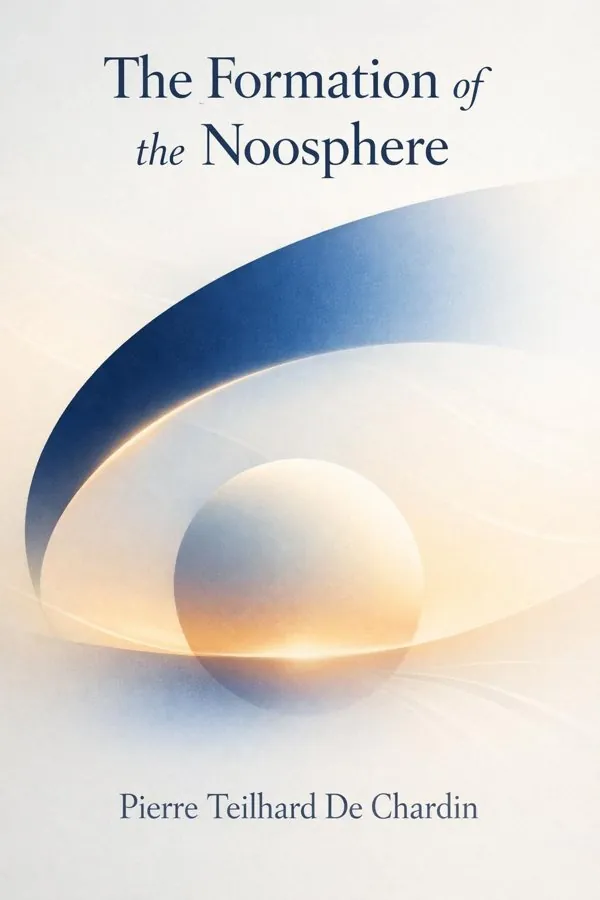
The Formation of the Noosphere: Summary & Key Insights
 10 min8 chaptersAudio available
Key Takeaways from The Formation of the Noosphere
Teilhard asks us to view the cosmos as a story of increasing complexity and inwardness.
A powerful shift occurs when Teilhard moves from life as biology to thought as a planetary force.
One of Teilhard’s most important distinctions is between simple consciousness and reflection.
Teilhard saw long before the digital age that technology would do more than make life convenient.
Teilhard’s originality lies not only in describing collective consciousness, but in giving evolution spiritual significance.
What Is The Formation of the Noosphere About?
The Formation of the Noosphere by Pierre Teilhard De Chardin is a western_phil book spanning 7 pages. What if human history is not just a sequence of wars, inventions, and social changes, but part of a much larger evolutionary process moving toward greater consciousness? In The Formation of the Noosphere, Pierre Teilhard de Chardin offers exactly that bold vision. He argues that evolution does not stop with biological life. After matter gave rise to life, and life gave rise to reflective thought, humanity began forming a new planetary layer: the noosphere, a sphere of mind, culture, communication, and shared awareness surrounding the Earth. This short but ambitious philosophical and theological essay matters because it anticipates many modern concerns: globalization, technological interconnection, collective intelligence, and the ethical challenges of an increasingly unified world. Teilhard’s central claim is that human beings are not isolated individuals drifting through history, but participants in a deep cosmic movement toward higher forms of unity. Teilhard writes with unusual authority because he stood at the crossroads of science and religion. A Jesuit priest, paleontologist, and philosopher, he sought to reconcile evolutionary theory with spiritual meaning, creating one of the twentieth century’s most original visions of humanity’s future.
This FizzRead summary covers all 8 key chapters of The Formation of the Noosphere in approximately 10 minutes, distilling the most important ideas, arguments, and takeaways from Pierre Teilhard De Chardin's work. Also available as an audio summary and Key Quotes Podcast.
The Formation of the Noosphere
What if human history is not just a sequence of wars, inventions, and social changes, but part of a much larger evolutionary process moving toward greater consciousness? In The Formation of the Noosphere, Pierre Teilhard de Chardin offers exactly that bold vision. He argues that evolution does not stop with biological life. After matter gave rise to life, and life gave rise to reflective thought, humanity began forming a new planetary layer: the noosphere, a sphere of mind, culture, communication, and shared awareness surrounding the Earth.
This short but ambitious philosophical and theological essay matters because it anticipates many modern concerns: globalization, technological interconnection, collective intelligence, and the ethical challenges of an increasingly unified world. Teilhard’s central claim is that human beings are not isolated individuals drifting through history, but participants in a deep cosmic movement toward higher forms of unity.
Teilhard writes with unusual authority because he stood at the crossroads of science and religion. A Jesuit priest, paleontologist, and philosopher, he sought to reconcile evolutionary theory with spiritual meaning, creating one of the twentieth century’s most original visions of humanity’s future.
Who Should Read The Formation of the Noosphere?
This book is perfect for anyone interested in western_phil and looking to gain actionable insights in a short read. Whether you're a student, professional, or lifelong learner, the key ideas from The Formation of the Noosphere by Pierre Teilhard De Chardin will help you think differently.
- ✓Readers who enjoy western_phil and want practical takeaways
- ✓Professionals looking to apply new ideas to their work and life
- ✓Anyone who wants the core insights of The Formation of the Noosphere in just 10 minutes
Want the full summary?
Get instant access to this book summary and 100K+ more with Fizz Moment.
Get Free SummaryAvailable on App Store • Free to download
Key Chapters
The most provocative idea in this book is that consciousness is not an accident added late to an otherwise meaningless universe, but a continuation of a deep evolutionary movement already present in matter. Teilhard asks us to view the cosmos as a story of increasing complexity and inwardness. First there is matter: atoms, molecules, stars, planets. Then, under the right conditions, matter organizes itself into living systems. Then life, through further development, becomes capable of sensation, intelligence, and eventually reflection. Human thought, in this view, is not a break from nature but nature becoming aware of itself.
This perspective changes how we understand evolution. Instead of seeing it only as external adaptation, Teilhard emphasizes an interior dimension. As structures become more complex, they also become more centered, more capable of experience and awareness. Humanity represents a threshold because we do not merely live; we know that we live. We can study the universe, shape culture, and consciously participate in our own development.
You can see this principle in everyday life. A rock has structure but no awareness. A plant responds to its environment without reflection. An animal perceives and reacts. A human being can ask questions, create symbols, preserve memory, and imagine futures that do not yet exist. Scientific institutions, legal systems, and artistic traditions are extensions of this reflective power.
Teilhard’s point is not that evolution is simple or guaranteed, but that it has direction in the sense of increasing organization and consciousness. Whether one accepts his spiritual conclusions or not, his framework encourages us to take human thought seriously as a major evolutionary event.
Actionable takeaway: When you study history, science, or society, ask not only what changed materially, but how consciousness itself became more organized, shared, and self-aware.
A powerful shift occurs when Teilhard moves from life as biology to thought as a planetary force. Before the noosphere can exist, there must be a biosphere: the living envelope of Earth made up of plants, animals, ecosystems, and the countless interactions that sustain life. Teilhard adopts and extends the scientific idea of the biosphere by arguing that reflective humanity creates a further layer above it, a sphere of thought. The noosphere is not a mystical cloud floating over the planet. It is the total network of consciousness produced by human beings through language, memory, institutions, education, art, religion, science, and communication.
This idea remains strikingly relevant. Today, we experience the noosphere whenever knowledge travels globally in seconds, when discoveries in one country reshape medicine in another, or when digital platforms allow millions to collaborate on shared problems. Libraries, universities, legal traditions, news systems, and online networks are all expressions of this mental layer wrapping around Earth.
Teilhard’s key insight is that humanity alters the planet not only by agriculture, industry, or technology, but by thought itself. The spread of ideas changes landscapes, economies, and moral expectations. A new scientific theory, a political ideology, or a religious movement can transform civilization as deeply as any physical force.
At the same time, the noosphere is fragile. Misinformation, fragmentation, and mass distraction can degrade it. If thought forms a planetary layer, then the quality of that layer matters. Are we generating wisdom or noise, cooperation or division, truth or manipulation?
Actionable takeaway: Treat every act of learning, teaching, and communication as part of a larger human environment. Contribute to the noosphere by creating clarity rather than confusion.
One of Teilhard’s most important distinctions is between simple consciousness and reflection. Many living beings are conscious in the sense that they perceive and respond. Humans are different because we can turn awareness back upon itself. We do not merely see; we know that we see. We do not merely act; we can examine motives, compare values, and revise our behavior according to ideals. This reflective capacity is the engine that makes the noosphere possible.
Reflection does more than produce individual self-awareness. It also enables collective thought. Because humans use symbols, language, writing, and shared memory, one person’s insight can become part of a larger body of knowledge available to others across time and space. Reflection therefore accumulates. Civilizations remember. Science advances. Moral consciousness deepens. Institutions preserve and transmit lessons that no single individual could rediscover alone.
Think about medicine. One doctor’s observation becomes a published article, which informs a research program, which changes hospital practice, which saves lives globally. Or consider law: societies reflect on justice, codify principles, amend them, and gradually build more sophisticated norms. Reflection becomes social, historical, and planetary.
Teilhard believes this cumulative mental life marks a new stage in evolution. Once thought becomes collective, humanity is no longer developing only through genes or bodies, but through culture, communication, and intentional cooperation. The future of the species increasingly depends on how well minds connect.
This also means isolation is not our highest state. While individuality remains vital, our reflective powers reach their full significance when they enter dialogue and mutual enrichment. Genuine progress comes from minds that meet without collapsing into sameness.
Actionable takeaway: Strengthen your reflective capacity by journaling, discussing ideas deeply, and building on the knowledge of others instead of remaining trapped in private opinion.
Teilhard saw long before the digital age that technology would do more than make life convenient. It would tighten the weave of humanity itself. In his view, tools of transport, communication, and information do not merely connect preexisting individuals; they intensify the formation of the noosphere by drawing minds into closer contact, faster exchange, and more coordinated action. The more humanity links itself, the more collective consciousness becomes a practical reality.
This insight is astonishingly contemporary. The internet, social media, global research databases, satellite communications, and artificial intelligence all function as amplifiers of the noosphere. A scientific breakthrough can circulate worldwide overnight. Citizens can witness distant conflicts in real time. Global markets react instantly to political decisions. Online communities can mobilize around a disease outbreak, climate event, or humanitarian crisis within hours.
But Teilhard is not celebrating connectivity in a naive way. Interconnection increases both power and responsibility. Technology can deepen collaboration, but it can also spread panic, hatred, conformity, and manipulation. Networks do not guarantee wisdom. They only intensify consequences. A planet connected without moral growth becomes more dangerous, not less.
In practical terms, this means digital life should be judged not only by efficiency or entertainment value, but by whether it contributes to richer consciousness. Does a platform help human beings think more clearly, empathize more deeply, and coordinate more justly? Or does it fragment attention and reward outrage?
Teilhard’s broader point is that communication infrastructure is part of human evolution. Roads, print, telegraph, television, and now the internet each compress distance and thicken the sphere of thought. The challenge is to ensure that increased connection leads toward meaningful unity rather than chaotic crowd behavior.
Actionable takeaway: Use technology as a tool for depth, learning, and constructive collaboration, not merely for stimulation or reactive consumption.
Teilhard’s originality lies not only in describing collective consciousness, but in giving evolution spiritual significance. For him, evolution is not a purely mechanical process without interior purpose. It is the unfolding of creation toward greater complexity, greater consciousness, and ultimately greater union. Matter, life, and spirit are not separate worlds but successive dimensions of a single cosmic drama. Human beings matter because they carry evolution into the realm of freedom, meaning, and love.
This theological interpretation does not reject science. On the contrary, Teilhard takes evolutionary science seriously and then asks what kind of universe such a process implies. If consciousness emerges within the cosmos, perhaps the cosmos is not spiritually empty. If reality tends toward increasing interiority and relation, perhaps the deepest truth of existence is not fragmentation but communion.
This view can reshape ordinary experience. Work, education, creativity, friendship, and moral struggle are no longer trivial episodes in private lives. They become ways in which the universe continues its movement toward fuller awareness. Even suffering can be understood, not as automatically good, but as something that may be integrated into a larger process of growth and unification.
For religious readers, Teilhard offers a way to reconcile faith with evolution. For secular readers, he provides a language of meaning that avoids reducing humanity to biological machinery alone. In both cases, he insists that development is not merely outward progress. True evolution includes an increase in interior depth.
The danger, of course, is mistaking progress in technique for progress in spirit. A society may become more advanced technologically while becoming morally coarser. Teilhard calls us to a richer measure of development: not power alone, but consciousness directed toward unity.
Actionable takeaway: Evaluate progress in your own life and community by asking whether it increases not just capability, but also meaning, responsibility, and depth of relationship.
Perhaps the boldest concept in Teilhard’s vision is the Omega Point, the ultimate horizon toward which evolution tends. Omega is not simply the end of history in a chronological sense. It is the highest possible unification of consciousness: a state in which multiplicity is not erased, but fulfilled in a deeper center of convergence. For Teilhard, evolution does not culminate in scattered intelligence or endless diffusion. It moves toward concentration, personal fulfillment, and spiritual union.
This idea serves several purposes in the book. First, it gives direction to the noosphere. If minds are increasingly linking across the planet, what is that process for? Teilhard answers: for a fuller integration of humanity into a higher form of conscious unity. Second, Omega prevents collective evolution from being reduced to mass uniformity. The destination is not a faceless hive mind. Individuals become more, not less, personal as they approach true unity. Third, Omega grounds hope. The confusion and fragmentation of history are real, but they do not exhaust the meaning of the process.
In practical terms, Omega can be understood as a guiding ideal even by readers who do not share Teilhard’s Christian metaphysics. It represents the aspiration toward a world where knowledge, love, justice, and personhood are harmonized rather than opposed. It challenges us to think beyond short-term competition and toward a larger human destiny.
The concept also warns against false unities. Systems that demand total conformity may look like convergence, but they actually suppress personhood. For Teilhard, authentic unity intensifies freedom and relationship rather than crushing them.
Actionable takeaway: Measure any movement, institution, or ideology by whether it creates deeper personal dignity and richer human solidarity, not mere control or uniformity.
If humanity is creating a planetary sphere of thought, then ethics can no longer be treated as a private accessory. Teilhard implies that moral responsibility scales with interdependence. The more connected we become, the more each action reverberates through the whole. Economic decisions affect distant workers. Political rhetoric influences global stability. Scientific advances reshape the future of the species. In a noosphere, ethics becomes structural.
This is one of the book’s most urgent lessons for modern readers. It is not enough for civilization to become smarter; it must also become wiser. Intelligence without ethical orientation can produce weapons, surveillance systems, ecological destruction, and psychological manipulation on unprecedented scales. The noosphere can elevate humanity, but it can also magnify its failures.
Teilhard’s answer is not withdrawal from complexity. It is moral maturation within it. Love, cooperation, truthfulness, and responsibility are not sentimental additions to evolution; they are conditions for healthy convergence. A civilization held together only by force, profit, or technical control cannot complete the movement toward higher unity. It requires freely given participation rooted in respect for persons.
You can apply this insight in many contexts. In business, it means considering social and ecological impact, not only efficiency. In education, it means teaching discernment alongside information. In media, it means resisting the incentives that reward distortion. In citizenship, it means recognizing that democracy depends on shared reality and mutual restraint.
Teilhard pushes us to understand ethics as evolutionary stewardship. We are not passive passengers in history. We are shaping the quality and direction of humanity’s collective future through ordinary choices repeated at scale.
Actionable takeaway: Before acting, ask how your decision affects the wider web of human life, and choose the option that strengthens trust, truth, and long-term flourishing.
A common fear about collective consciousness is that it will dissolve individuality. Teilhard directly challenges this assumption. In his view, the deepest forms of unity do not erase the person; they complete the person. Isolation can create the illusion of independence, but it often leaves human capacities underdeveloped. We become fully ourselves through relation, exchange, and mutual recognition. The noosphere, at its best, is not a mass mind swallowing individuals, but an environment where persons are intensified through connection.
This is a subtle but important claim. Many modern debates assume a choice between individual freedom and collective belonging. Teilhard suggests that the opposition is false when unity is rightly understood. A musician becomes more fully a musician in ensemble, not in permanent solitude. A scholar grows through dialogue with other minds. A citizen becomes more responsible in participation with a community. Love itself is the clearest example: in genuine relationship, identity is not lost but enriched.
The principle also clarifies what counts as unhealthy collectivism. Systems that suppress dissent, flatten difference, or demand ideological conformity do not produce true union. They produce compression. Authentic convergence depends on preserving centers of freedom that can enter into creative relation. Unity must be differentiated, not homogenized.
This idea has practical relevance for family life, teamwork, education, and politics. Healthy institutions build shared purpose while honoring distinct gifts. Strong communities cultivate belonging without suffocating originality. Even online collaboration works best when diverse contributors unite around a common aim without becoming identical.
Teilhard therefore offers a hopeful anthropology: the future need not force us to choose between selfhood and solidarity. Properly ordered, each requires the other.
Actionable takeaway: Seek communities that challenge and enlarge you while respecting your distinct voice, and contribute your individuality to shared purposes rather than retreating into isolation.
All Chapters in The Formation of the Noosphere
About the Author
Pierre Teilhard de Chardin (1881–1955) was a French Jesuit priest, paleontologist, theologian, and philosopher whose work sought to bring evolutionary science and Christian thought into a single coherent vision. Trained in both religion and science, he participated in important paleontological research and became deeply interested in what evolution revealed about humanity’s place in the cosmos. Teilhard argued that the universe develops through increasing complexity and consciousness, culminating in the emergence of reflective human thought and the growth of the noosphere, or sphere of mind. His writings were controversial in his lifetime because of their theological originality, and several were published only after his death. Today, he is widely read as a major twentieth-century thinker on evolution, spirituality, and the future of human civilization.
Get This Summary in Your Preferred Format
Read or listen to the The Formation of the Noosphere summary by Pierre Teilhard De Chardin anytime, anywhere. FizzRead offers multiple formats so you can learn on your terms — all free.
Available formats: App · Audio · PDF · EPUB — All included free with FizzRead
Download The Formation of the Noosphere PDF and EPUB Summary
Key Quotes from The Formation of the Noosphere
“Teilhard asks us to view the cosmos as a story of increasing complexity and inwardness.”
“A powerful shift occurs when Teilhard moves from life as biology to thought as a planetary force.”
“One of Teilhard’s most important distinctions is between simple consciousness and reflection.”
“Teilhard saw long before the digital age that technology would do more than make life convenient.”
“Teilhard’s originality lies not only in describing collective consciousness, but in giving evolution spiritual significance.”
Frequently Asked Questions about The Formation of the Noosphere
The Formation of the Noosphere by Pierre Teilhard De Chardin is a western_phil book that explores key ideas across 8 chapters. What if human history is not just a sequence of wars, inventions, and social changes, but part of a much larger evolutionary process moving toward greater consciousness? In The Formation of the Noosphere, Pierre Teilhard de Chardin offers exactly that bold vision. He argues that evolution does not stop with biological life. After matter gave rise to life, and life gave rise to reflective thought, humanity began forming a new planetary layer: the noosphere, a sphere of mind, culture, communication, and shared awareness surrounding the Earth. This short but ambitious philosophical and theological essay matters because it anticipates many modern concerns: globalization, technological interconnection, collective intelligence, and the ethical challenges of an increasingly unified world. Teilhard’s central claim is that human beings are not isolated individuals drifting through history, but participants in a deep cosmic movement toward higher forms of unity. Teilhard writes with unusual authority because he stood at the crossroads of science and religion. A Jesuit priest, paleontologist, and philosopher, he sought to reconcile evolutionary theory with spiritual meaning, creating one of the twentieth century’s most original visions of humanity’s future.
More by Pierre Teilhard De Chardin
You Might Also Like
A Little History of Philosophy
Nigel Warburton
10 min
Areopagitica
John Milton
10 min
How To Think Like A Philosopher: Essential Principles For Clear Thinking
Peter Cave
10 min
Language, Truth and Logic
A. J. Ayer
10 min
The Age of Reason
Thomas Paine
10 min
The Essays
Michel De Montaigne
10 minBrowse by Category
Ready to read The Formation of the Noosphere?
Get the full summary and 100K+ more books with Fizz Moment.