
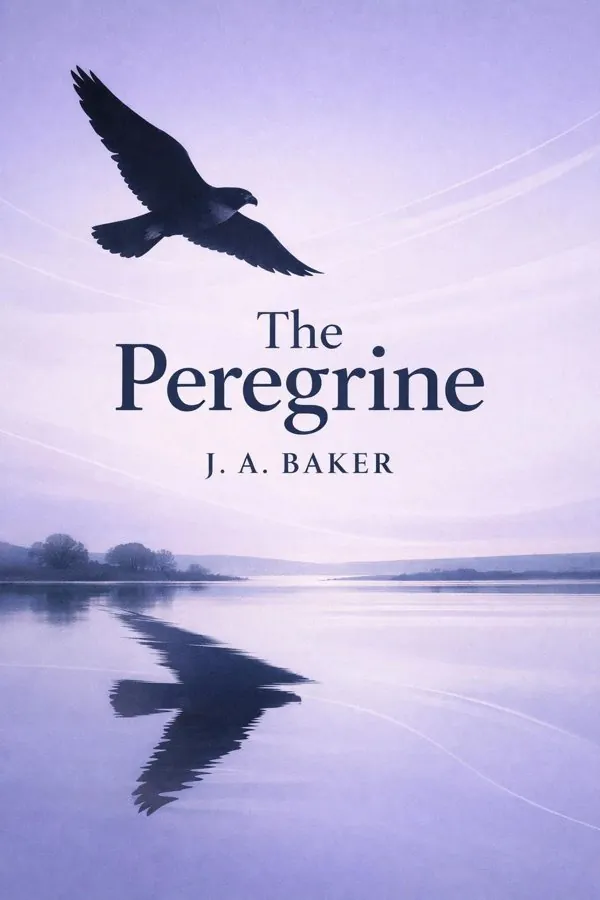
The Peregrine: Summary & Key Insights
by J. A. Baker
 10 min9 chaptersAudio available
Key Takeaways from The Peregrine
The return of the peregrines in autumn is not just a seasonal event; it is the reopening of a world.
Real seeing begins where casual looking ends.
Cold weather strips away softness.
The peregrine’s grace cannot be separated from its brutality.
To watch intensely is to risk becoming altered by what you watch.
What Is The Peregrine About?
The Peregrine by J. A. Baker is a environment book spanning 9 pages. The Peregrine is one of the most extraordinary works of nature writing ever published: a fierce, lyrical record of J. A. Baker’s years spent tracking peregrine falcons across the marshes, estuaries, woods, and winter skies of eastern England. More than a bird book, it is a study in radical attention. Baker watches the peregrine so closely, and for so long, that the boundaries between observer and observed begin to blur. What emerges is a portrait not only of a magnificent predator, but of a landscape shaped by season, weather, violence, beauty, and loss. The book matters because it shows what deep looking can reveal in an age of distraction. Baker writes with unusual authority: not as a distant academic, but as a patient field observer whose knowledge was earned through repetition, hardship, and devotion. His prose is intensely poetic, yet rooted in exact detail—flight paths, hunting tactics, changing light, mud, frost, and blood. The result is both intimate and unsettling. The Peregrine remains essential reading for anyone interested in nature, environmental consciousness, animal behavior, or the transforming power of sustained attention.
This FizzRead summary covers all 9 key chapters of The Peregrine in approximately 10 minutes, distilling the most important ideas, arguments, and takeaways from J. A. Baker's work. Also available as an audio summary and Key Quotes Podcast.
The Peregrine
The Peregrine is one of the most extraordinary works of nature writing ever published: a fierce, lyrical record of J. A. Baker’s years spent tracking peregrine falcons across the marshes, estuaries, woods, and winter skies of eastern England. More than a bird book, it is a study in radical attention. Baker watches the peregrine so closely, and for so long, that the boundaries between observer and observed begin to blur. What emerges is a portrait not only of a magnificent predator, but of a landscape shaped by season, weather, violence, beauty, and loss.
The book matters because it shows what deep looking can reveal in an age of distraction. Baker writes with unusual authority: not as a distant academic, but as a patient field observer whose knowledge was earned through repetition, hardship, and devotion. His prose is intensely poetic, yet rooted in exact detail—flight paths, hunting tactics, changing light, mud, frost, and blood. The result is both intimate and unsettling. The Peregrine remains essential reading for anyone interested in nature, environmental consciousness, animal behavior, or the transforming power of sustained attention.
Who Should Read The Peregrine?
This book is perfect for anyone interested in environment and looking to gain actionable insights in a short read. Whether you're a student, professional, or lifelong learner, the key ideas from The Peregrine by J. A. Baker will help you think differently.
- ✓Readers who enjoy environment and want practical takeaways
- ✓Professionals looking to apply new ideas to their work and life
- ✓Anyone who wants the core insights of The Peregrine in just 10 minutes
Want the full summary?
Get instant access to this book summary and 100K+ more with Fizz Moment.
Get Free SummaryAvailable on App Store • Free to download
Key Chapters
The return of the peregrines in autumn is not just a seasonal event; it is the reopening of a world. Baker begins in October, when migration sharpens the air and alters the mood of the land. The estuaries fill with birds, the fields grow colder and barer, and the sky seems suddenly charged with possibility. In this suspended landscape between abundance and decay, the peregrine reappears as both hunter and signal—a presence that makes every movement in the marsh meaningful.
Baker shows that migration is not only about birds arriving and leaving. It is about timing, ecological rhythms, and the way one species reorganizes the behavior of many others. When peregrines return, ducks bunch more tightly, pigeons rise more nervously, and the watcher himself becomes alert to signs he might otherwise miss: disturbed flocks, a sudden stillness, a rush of wings. The landscape becomes legible through the predator’s influence.
There is a practical lesson here for modern readers, especially those interested in nature observation or environmental awareness. To understand a place, do not begin with abstract ideas. Begin with seasonal change. Notice what appears, what disappears, and what behaviors shift when weather turns. A local park, shoreline, or field can become far more vivid when watched through the calendar of returning life.
Baker’s autumn is also emotional. The season carries beauty, but also foreknowledge of hardship and death. The peregrine embodies both. It arrives as a marvel, yet it survives by killing. That tension gives the book its force from the start.
Actionable takeaway: Choose one local place and observe it weekly through a season, noting how weather and returning species change the behavior of everything around them.
Real seeing begins where casual looking ends. One of the central achievements of The Peregrine is its demonstration that close observation is a discipline, not a mood. Baker does not stumble upon insight; he earns it through repetition, patience, and endurance. He walks long distances in bad weather, studies maps, returns to the same sites, records flight lines, and learns how to interpret tiny disturbances in the land and sky. His method is simple, but it is exacting.
What makes this important is that Baker turns observation into a form of practice. He is not collecting facts in a detached way. He is training his senses to become more precise. Over time, he learns where the birds perch, how they use wind, when they stoop, how prey species react, and how a winter landscape hides or reveals movement. This is fieldwork at its most intimate. It depends on humility: the observer must adapt to the bird, not the other way around.
The broader application extends beyond birdwatching. In any domain—creative work, science, teaching, leadership, even relationships—depth comes from sustained attention. Patterns reveal themselves only after repeated contact. Baker’s method reminds us that expertise is often built from returning, revising, and noticing what first escaped us.
His devotion also has a warning in it. Obsession can sharpen perception, but it can also isolate the observer from ordinary life. Baker’s commitment gives the book its intensity, yet readers also sense the cost of such focus.
Actionable takeaway: Build a small observation ritual—carry a notebook, revisit the same place or subject regularly, and record specific details until patterns begin to emerge.
Cold weather strips away softness. In The Peregrine, winter is not just a backdrop but a force that exposes the essential conditions of life. Frost hardens fields, flooded ditches shine like metal, daylight contracts, and every animal must spend energy carefully. Baker’s prose makes the winter landscape feel both beautiful and severe. There is clarity in it, but no comfort. The land is reduced to necessities: shelter, hunger, speed, endurance.
This matters because the peregrine is best understood against such harshness. Its power becomes more vivid when the world around it is constrained. In winter, prey is more visible, more vulnerable, and often more desperate. The hunter’s movements stand out against skeletal trees and emptied skies. Baker captures how weather shapes behavior: birds feed differently in frost, gather differently in wind, and react differently when visibility changes. Nature is not static; it is always negotiating conditions.
For readers, this chapter offers a practical way to think about ecology. Landscapes are often romanticized in their most colorful moments—spring bloom, summer abundance, autumn spectacle. Baker insists that winter teaches more. Scarcity reveals structure. When resources thin out, you can see what truly sustains life and what threatens it.
The same principle can be applied in human terms. Difficult conditions often reveal hidden dependencies and real priorities. What remains when comfort disappears? Which habits endure under pressure? Baker’s winter suggests that adversity clarifies.
Actionable takeaway: Visit a familiar outdoor place in its least inviting season and ask what becomes visible only when abundance is gone.
The peregrine’s grace cannot be separated from its brutality. Baker refuses sentimental nature writing by showing predation in full: the explosive attack, the panic of prey, the feathers falling through cold air, the speed with which life ends. Yet he does not treat this violence as cruelty in a human moral sense. Instead, he presents it as part of the elemental structure of the wild. The same bird that seems almost pure in flight survives by killing with astonishing efficiency.
This is one of the book’s most challenging insights. Many readers want nature to reassure them, to offer peace, innocence, or balance. Baker offers something truer and less comforting. In the peregrine, beauty and death are inseparable. The bird’s perfection lies in its fitness as a hunter—its vision, acceleration, timing, and power. To admire it fully means facing the cost of that excellence.
There is practical value in this unsentimental view. It helps readers think more clearly about ecosystems. Predators are not optional ornaments; they shape populations, behavior, and habitat use. Their presence can strengthen ecological systems by preventing overconcentration and forcing prey species into adaptive patterns. Baker’s attention to the hunt reveals a living network, not isolated animals.
On a personal level, the chapter invites us to mature in how we perceive difficult truths. Not everything admirable is gentle. Not everything natural is comforting. Wisdom sometimes begins when we stop forcing reality into sentimental categories.
Actionable takeaway: When observing nature—or any complex system—resist the urge to simplify it into good or bad, and instead ask how conflict, pressure, and adaptation create the whole.
To watch intensely is to risk becoming altered by what you watch. As The Peregrine progresses, Baker’s attention grows so concentrated that the book starts to record a transformation of the observer himself. He does not merely gather knowledge about peregrines; he tries to enter their world, to think through their speed, fearlessness, and estrangement from human life. The act of observation becomes a kind of imaginative migration away from ordinary identity.
This transformation is not mystical in a simple sense. It arises from repetition, solitude, and emotional investment. Baker spends so long attuning himself to the falcon’s movements that his own perceptions change. Human concerns fade. He grows more sensitive to light, weather, silence, sudden motion, and the geography of pursuit. The self narrows and sharpens around one overwhelming object of attention.
Readers can apply this idea more broadly. Deep study changes the student. Whether one is learning music, gardening, medicine, painting, or a landscape, prolonged attention does not only produce external knowledge. It reshapes internal habits of mind. One becomes more patient, more attuned to nuance, more aware of complexity. The object studied becomes a lens that alters perception itself.
But Baker also hints at danger. Identification with the wild can become alienation from the human world. His transformation is exhilarating, yet at times unsettling, because it edges toward erasure of the ordinary self.
Actionable takeaway: Notice how your deepest interests shape your perception, and choose at least one pursuit worthy of changing how you see the world.
No creature in Baker’s world stands outside the turning year. One of the book’s quiet but powerful achievements is showing how seasonal cycles organize behavior, vulnerability, and possibility. The peregrine’s hunting, the movements of ducks and pigeons, the visibility of fields, the texture of mud, the availability of cover, the length of daylight—all are linked. Baker does not treat nature as a collection of separate episodes. He writes as if every life is woven into a larger calendar.
This perspective matters because it restores a sense of ecological time. Modern life often encourages us to think in schedules detached from place: workdays, deadlines, digital notifications. Baker returns us to older rhythms in which frost, migration, rain, tide, and light determine what can happen. The peregrine is majestic, but it is not exempt from conditions. Its success depends on timing and adaptation.
There is a practical lesson here for environmental literacy. If you want to understand a habitat, track recurring patterns rather than isolated moments. Which birds appear after a cold snap? Which areas flood after rain? When do prey species become concentrated? What changes when daylight shortens? Such questions build an ecological intelligence rooted in time.
Seasonal thinking also helps in personal life. Energy, creativity, focus, and rest often move cyclically rather than linearly. Baker’s landscape suggests that health depends not on resisting cycles but on recognizing them.
Actionable takeaway: Keep a seasonal journal for one place or one area of life, noting recurring patterns over months rather than judging each day in isolation.
What makes Baker’s devotion especially poignant is his awareness that the peregrine is under threat. The book was written during a period when peregrine populations in Britain suffered severe decline, much of it linked to pesticides and broader human disturbance. This gives the narrative an elegiac undertone. Baker is not merely documenting a magnificent bird; he is writing in the shadow of possible disappearance.
This environmental dimension is crucial to the book’s lasting relevance. The Peregrine is often praised for its prose, but its emotional power also comes from ecological grief. Baker understands that wildness can seem timeless while being acutely vulnerable. A top predator may appear invincible in the moment of flight, yet still be threatened by toxins, habitat degradation, persecution, and the hidden consequences of industrial society.
The lesson for readers is clear: admiration without protection is not enough. To love nature abstractly is easy. To recognize the specific mechanisms of decline—and to respond—is harder. Baker’s work models the first step: pay close enough attention that loss becomes personal, not statistical.
In modern terms, this idea applies far beyond peregrines. Pollinator collapse, wetland drainage, ocean warming, and urban fragmentation all show how quickly ecological systems can unravel when human pressure is ignored. The book reminds us that witness can lead to responsibility.
Actionable takeaway: Turn appreciation into action by supporting one concrete conservation effort—local habitat restoration, bird monitoring, pesticide reduction, or an environmental organization tied to species protection.
Sustained attention creates narrative even without conventional plot. Although The Peregrine is nonfiction, Baker shapes his observations into a mounting intensity, especially in his depictions of the hunt. Repeated encounters accumulate emotional force. Each sighting carries memory of previous flights, failed followings, vanished birds, sudden attacks, and the changing winter landscape. By the later sections, the reader feels not simply informed, but drawn into a drama of pursuit.
The climax of the hunt is not a single event so much as an achieved state of perception. Baker has looked so long and so closely that the peregrine’s world becomes vivid in flashes of terrifying immediacy: a stoop from height, a burst through frightened flocks, the instantaneous decision of hunter and prey. These scenes crystallize the book’s larger themes—speed, mortality, precision, obsession, and the thin line between distance and identification.
What readers can learn from this is that meaning often emerges through accumulation rather than summary. Repetition does not have to be dull; when attention deepens, recurring events become more charged. This applies to writing, research, and even daily practice. A subject gains power when revisited enough times for subtle differences to matter.
Baker’s climactic scenes also remind us that real drama in nature is usually unscripted and unresolved. There are no moral speeches, no neat endings, only momentary revelations of how life is contested.
Actionable takeaway: In your own work, trust accumulation—return to a subject repeatedly and let significance build from layered observation rather than rushing to conclusions.
Great nature writing often ends not with resolution, but with a deepened sense of mystery. The epilogue of The Peregrine carries exactly that effect. After months of pursuit, Baker cannot claim mastery over the bird or closure for his own longing. Instead, what remains is a mixture of wonder, fatigue, grief, and reverence. The peregrine has been seen closely, yet it is not possessed. The landscape has been entered, yet not exhausted. The observer has changed, but not been cured of his hunger.
This ending matters because it rejects the modern instinct to convert experience into completion. Baker does not reduce the wild to takeaway facts or emotional consolation. He allows it to remain other—glimpsed, intimate, and still beyond full understanding. That honesty is part of the book’s greatness. The epilogue acknowledges that the most meaningful encounters in life often leave residues rather than conclusions.
Practically, this is a useful model for readers, writers, and thinkers. Not every worthwhile project ends in mastery. Sometimes the value lies in sharpened perception, richer language, moral urgency, or transformed attention. Baker’s epilogue shows that unfinished understanding can still be profound.
For environmental readers in particular, the ending lingers as both tribute and warning. To witness beauty under threat is to carry it differently afterward. The book closes, but responsibility does not.
Actionable takeaway: Let meaningful experiences remain open-ended—after finishing a book, project, or journey, ask not only what you learned, but how your perception has changed.
All Chapters in The Peregrine
About the Author
J. A. Baker (1926–1987) was an English writer and naturalist whose reputation rests largely on one extraordinary book, The Peregrine. Living in Essex, Baker spent years observing the birds and landscapes of eastern England with unusual dedication, producing a form of nature writing that combined field precision with haunting poetic intensity. Little is publicly known about many aspects of his personal life, which has only deepened the aura surrounding his work. Yet his influence has been immense. The Peregrine, first published in 1967, is widely regarded as a landmark of British nature literature and has shaped generations of writers interested in wildness, attention, and environmental consciousness. Baker remains admired for showing how patient observation can become both art and witness.
Get This Summary in Your Preferred Format
Read or listen to the The Peregrine summary by J. A. Baker anytime, anywhere. FizzRead offers multiple formats so you can learn on your terms — all free.
Available formats: App · Audio · PDF · EPUB — All included free with FizzRead
Download The Peregrine PDF and EPUB Summary
Key Quotes from The Peregrine
“The return of the peregrines in autumn is not just a seasonal event; it is the reopening of a world.”
“Real seeing begins where casual looking ends.”
“In The Peregrine, winter is not just a backdrop but a force that exposes the essential conditions of life.”
“The peregrine’s grace cannot be separated from its brutality.”
“To watch intensely is to risk becoming altered by what you watch.”
Frequently Asked Questions about The Peregrine
The Peregrine by J. A. Baker is a environment book that explores key ideas across 9 chapters. The Peregrine is one of the most extraordinary works of nature writing ever published: a fierce, lyrical record of J. A. Baker’s years spent tracking peregrine falcons across the marshes, estuaries, woods, and winter skies of eastern England. More than a bird book, it is a study in radical attention. Baker watches the peregrine so closely, and for so long, that the boundaries between observer and observed begin to blur. What emerges is a portrait not only of a magnificent predator, but of a landscape shaped by season, weather, violence, beauty, and loss. The book matters because it shows what deep looking can reveal in an age of distraction. Baker writes with unusual authority: not as a distant academic, but as a patient field observer whose knowledge was earned through repetition, hardship, and devotion. His prose is intensely poetic, yet rooted in exact detail—flight paths, hunting tactics, changing light, mud, frost, and blood. The result is both intimate and unsettling. The Peregrine remains essential reading for anyone interested in nature, environmental consciousness, animal behavior, or the transforming power of sustained attention.
You Might Also Like
A Life on Our Planet: My Witness Statement and a Vision for the Future
David Attenborough
10 min
A Sky Full Of Birds
Matt Merritt
10 min
Carbon Zero: Imagining Cities That Can Save the Planet
Alex Steffen
10 min
Eaarth: Making a Life on a Tough New Planet
Bill McKibben
10 min
The Social Contract and Environmental Governance
Various Editors
10 min
The Wild Places
Robert Macfarlane
10 minBrowse by Category
Ready to read The Peregrine?
Get the full summary and 100K+ more books with Fizz Moment.