
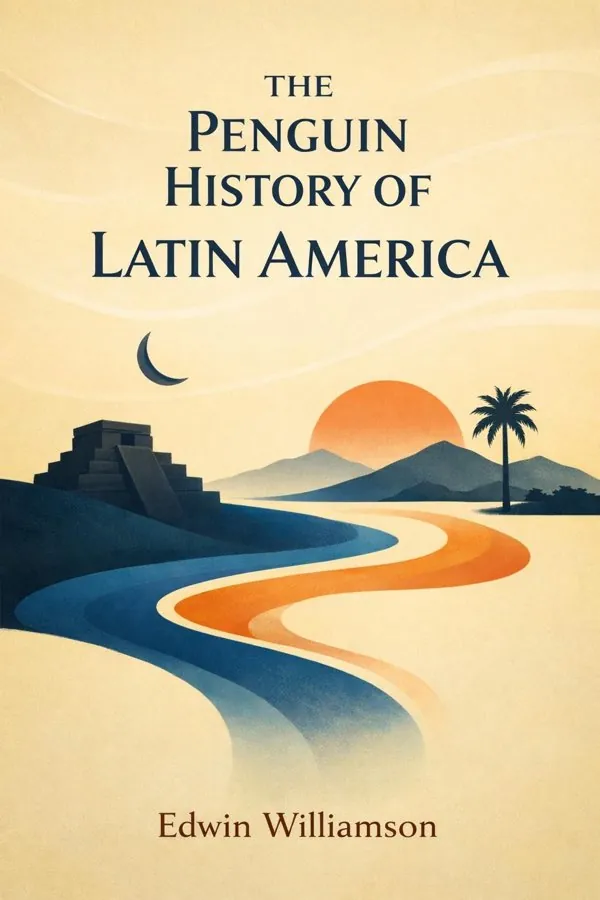
The Penguin History of Latin America: Summary & Key Insights
 10 min12 chaptersAudio available
What Is The Penguin History of Latin America About?
The Penguin History of Latin America by Edwin Williamson is a world_history book spanning 12 pages. This comprehensive history traces Latin America from pre-Columbian civilizations through European conquest, colonial rule, independence movements, and modern political and cultural developments. Edwin Williamson offers a panoramic view of the region’s social, economic, and ideological transformations, emphasizing the interplay between indigenous, European, and African influences that shaped Latin American identity.
This FizzRead summary covers all 12 key chapters of The Penguin History of Latin America in approximately 10 minutes, distilling the most important ideas, arguments, and takeaways from Edwin Williamson's work. Also available as an audio summary and Key Quotes Podcast.
The Penguin History of Latin America
This comprehensive history traces Latin America from pre-Columbian civilizations through European conquest, colonial rule, independence movements, and modern political and cultural developments. Edwin Williamson offers a panoramic view of the region’s social, economic, and ideological transformations, emphasizing the interplay between indigenous, European, and African influences that shaped Latin American identity.
Who Should Read The Penguin History of Latin America?
This book is perfect for anyone interested in world_history and looking to gain actionable insights in a short read. Whether you're a student, professional, or lifelong learner, the key ideas from The Penguin History of Latin America by Edwin Williamson will help you think differently.
- ✓Readers who enjoy world_history and want practical takeaways
- ✓Professionals looking to apply new ideas to their work and life
- ✓Anyone who wants the core insights of The Penguin History of Latin America in just 10 minutes
Want the full summary?
Get instant access to this book summary and 100K+ more with Fizz Moment.
Get Free SummaryAvailable on App Store • Free to download
Key Chapters
Before Europeans arrived, vast and varied civilizations flourished across Latin America. Among them, the Aztec Empire in Mexico, the Maya in Central America, and the Inca Empire straddling the Andes each developed elaborate systems of governance, art, and religion that reflected sophisticated understandings of the cosmos. The Aztec world revolved around a cyclical conception of time, sustained through ritual and sacrifice; the Maya built towering city-states whose hieroglyphs recorded feats of kings and gods; the Incas constructed an empire bound not by writing but by the khipu—knotted cords that encoded bureaucratic data—and by an intricate network of roads linking mountains and valleys.
What connects these cultures is not uniformity but diversity, anchored in their environments. The Andes demanded organization and reciprocity: the ayllu, or community, functioned through collective labor that mirrored cosmic order. The Mesoamerican civilizations, by contrast, placed divine kingship at the center of political life. All, however, shared the belief that the spiritual and material worlds were intertwined, that balance required human participation in cosmic renewal. This metaphysical framework would later collide violently with Christian monotheism but would never entirely disappear, surviving within popular religious practices to this day.
Approaching these societies as dynamic civilizations, rather than as static prefaces to European conquest, allows us to see how Latin America inherited not only land but mental landscapes: hierarchies of power, communal traditions, and a profound sense of sacred geography.
The European incursions of the late fifteenth and early sixteenth centuries transformed the Americas irreversibly. Columbus’s voyages, sponsored by Spain, opened the door to conquests that followed swiftly under Cortés in Mexico and Pizarro in Peru. Yet conquest was not merely the result of superior arms; it relied equally on alliances with discontented indigenous factions, the devastating impact of Old World disease, and the psychological shock of the European invasion—a force that presented itself as both military and spiritual.
Spain’s justification combined the pursuit of wealth with crusading zeal. The Requerimiento, read to bewildered natives, declared Spain’s divine right to rule; conversion to Christianity was both a moral duty and a political strategy. Portugal, confined at first to Brazil, spread through coastal settlements that would later be transformed by the sugar economy. The old worlds of the Aztec and Inca gave way to viceroyalties and encomiendas, where spiritual conquest accompanied physical domination. Yet even here, the conquered were not entirely silenced. Indigenous practices persisted, often masked by Catholic ritual, and native nobles found ways to integrate into colonial hierarchies, maintaining a fragile thread of continuity.
In the aftermath of conquest, Latin America became part of a new global order—an Atlantic system linking Europe, Africa, and the New World in a web of exchange, exploitation, and faith. The conqueror’s vision of civilization laid the foundation for what would become one of the world’s most enduring cultural syntheses.
+ 10 more chapters — available in the FizzRead app
All Chapters in The Penguin History of Latin America
About the Author
Edwin Williamson is a British historian and literary scholar specializing in Spanish and Latin American studies. He has taught at the University of Oxford and is known for his works on Latin American history and Spanish literature, including studies on Jorge Luis Borges.
Get This Summary in Your Preferred Format
Read or listen to the The Penguin History of Latin America summary by Edwin Williamson anytime, anywhere. FizzRead offers multiple formats so you can learn on your terms — all free.
Available formats: App · Audio · PDF · EPUB — All included free with FizzRead
Download The Penguin History of Latin America PDF and EPUB Summary
Key Quotes from The Penguin History of Latin America
“Before Europeans arrived, vast and varied civilizations flourished across Latin America.”
“The European incursions of the late fifteenth and early sixteenth centuries transformed the Americas irreversibly.”
Frequently Asked Questions about The Penguin History of Latin America
The Penguin History of Latin America by Edwin Williamson is a world_history book that explores key ideas across 12 chapters. This comprehensive history traces Latin America from pre-Columbian civilizations through European conquest, colonial rule, independence movements, and modern political and cultural developments. Edwin Williamson offers a panoramic view of the region’s social, economic, and ideological transformations, emphasizing the interplay between indigenous, European, and African influences that shaped Latin American identity.
You Might Also Like
The Age of Capital
Eric Hobsbawm
10 min
The Gulag Archipelago
Aleksandr Solzhenitsyn
10 min
Jerusalem: The Biography
Simon Sebag Montefiore
10 min
The Anglo-Saxons
James Campbell
10 min
The Boer War
Thomas Pakenham
10 min
The Industrial Revolutionaries: The Making of the Modern World 1776–1914
Gavin Weightman
10 minBrowse by Category
Ready to read The Penguin History of Latin America?
Get the full summary and 100K+ more books with Fizz Moment.