
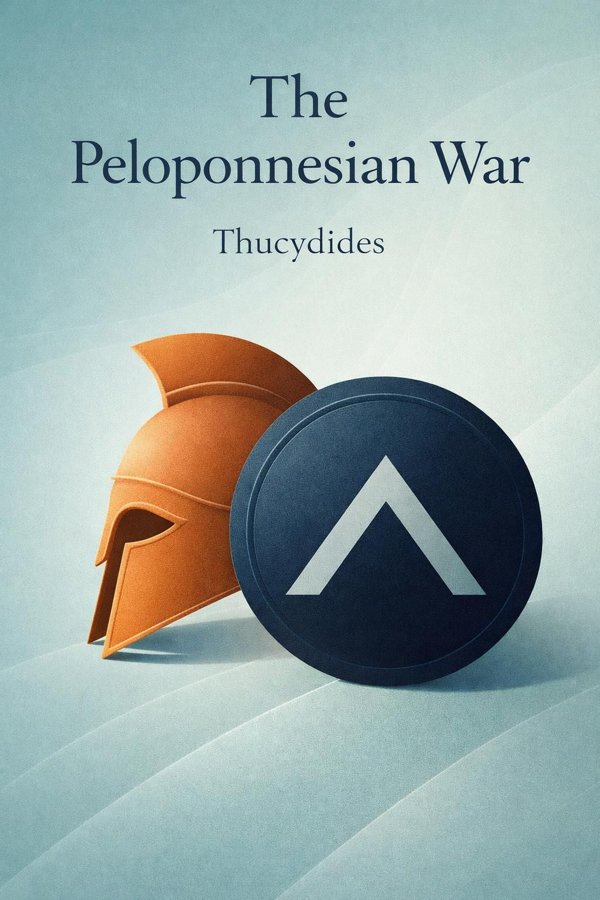
The Peloponnesian War: Summary & Key Insights
by Thucydides
 10 min10 chaptersAudio available
What Is The Peloponnesian War About?
The Peloponnesian War by Thucydides is a world_history book spanning 10 pages. Thucydides' "The Peloponnesian War" is one of the most significant historical works of antiquity. It chronicles the conflict between Athens and Sparta (431–404 BCE), focusing on the political, military, and moral dimensions of the war. As an eyewitness and general, Thucydides sought to present events with precision and objectivity, establishing the foundation of historical methodology through critical analysis of sources.
This FizzRead summary covers all 10 key chapters of The Peloponnesian War in approximately 10 minutes, distilling the most important ideas, arguments, and takeaways from Thucydides's work. Also available as an audio summary and Key Quotes Podcast.
The Peloponnesian War
Thucydides' "The Peloponnesian War" is one of the most significant historical works of antiquity. It chronicles the conflict between Athens and Sparta (431–404 BCE), focusing on the political, military, and moral dimensions of the war. As an eyewitness and general, Thucydides sought to present events with precision and objectivity, establishing the foundation of historical methodology through critical analysis of sources.
Who Should Read The Peloponnesian War?
This book is perfect for anyone interested in world_history and looking to gain actionable insights in a short read. Whether you're a student, professional, or lifelong learner, the key ideas from The Peloponnesian War by Thucydides will help you think differently.
- ✓Readers who enjoy world_history and want practical takeaways
- ✓Professionals looking to apply new ideas to their work and life
- ✓Anyone who wants the core insights of The Peloponnesian War in just 10 minutes
Want the full summary?
Get instant access to this book summary and 100K+ more with Fizz Moment.
Get Free SummaryAvailable on App Store • Free to download
Key Chapters
The roots of this vast war lay not in a single incident, but in the inevitable opposition between power rising and power fearing. After the Persian Wars, Athens grew not only in physical strength but in confidence and ambition. Its leadership of the Delian League turned from partnership into dominion; its immense revenues from allies made it the seat of innovation and wealth. Sparta watched this growth with unease. A city devoted to discipline and tradition could not but fear the brash, expansive nature of Athens. That fear became the true cause of war.
From the small quarrels in distant colonies to the strife between Corinth and Corcyra, from disputes in Potidaea to the Megarian Decree, the crisis deepened. To many, these seemed like minor matters, but behind each lay the struggle for dominance between land and sea, oligarchy and democracy, order and liberty. Athens, under Pericles’ guidance, would not yield its dignity; Sparta, pressed by its allies and its own pride, could not remain passive. Thus, the outbreak of hostilities was less a failure of diplomacy than the natural outcome of human rivalry, when fear and ambition can neither coexist nor compromise.
As I wrote, Sparta’s fear of Athens’ greatness was the most fundamental cause of all. The war’s explanation is therefore not bound to treaties or accidents, but to the psychological laws by which states act: when power grows unchecked, others must rise against it. I sought to show not merely what happened, but why it had to happen.
When war at last began, the balance between the two powers was stark. Sparta and her allies commanded the might of infantry and controlled most of the Peloponnesus; Athens ruled the sea, its walls embracing the city like a steel shell. Pericles, my fellow Athenian, understood that direct confrontation with Sparta on land would be our ruin. His strategy was endurance: to shelter behind the Long Walls, to rely on our fleet and empire, and to wait until the enemy’s strength faded.
This strategy demanded patience—a virtue rare among free men. Each summer, the Spartan king Archidamus led his forces into Attica, burning crops and villages, while Athenians looked on from behind their walls. But the sea was ours. The Athenian navy raided Peloponnesian coasts, secured grain routes, and struck fear into allies of Sparta.
It was then, amid this hard endurance, that calamity struck. A plague swept through Athens, ravaging a crowded populace confined within its walls. I was among the sufferers. Its horror I recorded without exaggeration: bodies piled in temples, customs forgotten, and even the fear of gods consumed by despair. The plague broke the spirit of the city and showed how fragile civilization can be when misfortune tests it. Pericles, still firm amid crisis, counselled the people to remain steadfast, to trust the strategy of defense. Yet even his wisdom could not withstand disease and death; he too succumbed. With his death, Athens lost not only its leader but its restraint.
+ 8 more chapters — available in the FizzRead app
All Chapters in The Peloponnesian War
About the Author
Thucydides (c. 460–c. 400 BCE) was an Athenian historian and general. He is regarded as the father of scientific historiography due to his methodological approach and emphasis on causality in historical events. His work profoundly influenced Western historical and political thought.
Get This Summary in Your Preferred Format
Read or listen to the The Peloponnesian War summary by Thucydides anytime, anywhere. FizzRead offers multiple formats so you can learn on your terms — all free.
Available formats: App · Audio · PDF · EPUB — All included free with FizzRead
Download The Peloponnesian War PDF and EPUB Summary
Key Quotes from The Peloponnesian War
“The roots of this vast war lay not in a single incident, but in the inevitable opposition between power rising and power fearing.”
“When war at last began, the balance between the two powers was stark.”
Frequently Asked Questions about The Peloponnesian War
The Peloponnesian War by Thucydides is a world_history book that explores key ideas across 10 chapters. Thucydides' "The Peloponnesian War" is one of the most significant historical works of antiquity. It chronicles the conflict between Athens and Sparta (431–404 BCE), focusing on the political, military, and moral dimensions of the war. As an eyewitness and general, Thucydides sought to present events with precision and objectivity, establishing the foundation of historical methodology through critical analysis of sources.
More by Thucydides

You Might Also Like

The Age of Capital
Eric Hobsbawm
10 min
The Gulag Archipelago
Aleksandr Solzhenitsyn
10 min
Jerusalem: The Biography
Simon Sebag Montefiore
10 min
The Anglo-Saxons
James Campbell
10 min
The Boer War
Thomas Pakenham
10 min
The Industrial Revolutionaries: The Making of the Modern World 1776–1914
Gavin Weightman
10 minBrowse by Category
Ready to read The Peloponnesian War?
Get the full summary and 100K+ more books with Fizz Moment.