
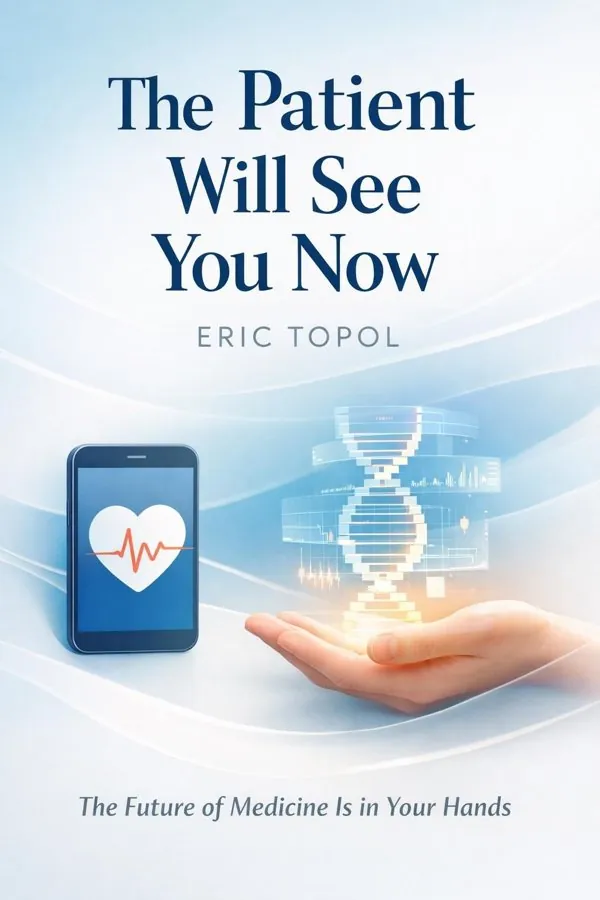
The Patient Will See You Now: The Future of Medicine Is in Your Hands: Summary & Key Insights
by Eric Topol
 10 min7 chaptersAudio available
What Is The Patient Will See You Now: The Future of Medicine Is in Your Hands About?
The Patient Will See You Now: The Future of Medicine Is in Your Hands by Eric Topol is a health_med book spanning 7 pages. In this groundbreaking work, cardiologist and digital medicine pioneer Eric Topol explores how smartphones, big data, and artificial intelligence are transforming healthcare. He argues that the power of medicine is shifting from doctors to patients, who can now access their own medical data, monitor their health in real time, and make informed decisions. The book envisions a future where medicine is more personalized, transparent, and democratized.
This FizzRead summary covers all 7 key chapters of The Patient Will See You Now: The Future of Medicine Is in Your Hands in approximately 10 minutes, distilling the most important ideas, arguments, and takeaways from Eric Topol's work. Also available as an audio summary and Key Quotes Podcast.
The Patient Will See You Now: The Future of Medicine Is in Your Hands
In this groundbreaking work, cardiologist and digital medicine pioneer Eric Topol explores how smartphones, big data, and artificial intelligence are transforming healthcare. He argues that the power of medicine is shifting from doctors to patients, who can now access their own medical data, monitor their health in real time, and make informed decisions. The book envisions a future where medicine is more personalized, transparent, and democratized.
Who Should Read The Patient Will See You Now: The Future of Medicine Is in Your Hands?
This book is perfect for anyone interested in health_med and looking to gain actionable insights in a short read. Whether you're a student, professional, or lifelong learner, the key ideas from The Patient Will See You Now: The Future of Medicine Is in Your Hands by Eric Topol will help you think differently.
- ✓Readers who enjoy health_med and want practical takeaways
- ✓Professionals looking to apply new ideas to their work and life
- ✓Anyone who wants the core insights of The Patient Will See You Now: The Future of Medicine Is in Your Hands in just 10 minutes
Want the full summary?
Get instant access to this book summary and 100K+ more with Fizz Moment.
Get Free SummaryAvailable on App Store • Free to download
Key Chapters
For most of modern history, medicine has been defined by authority—not accessibility. Physicians were the sole interpreters of the body’s mysteries, gatekeepers of laboratories, imaging, and journals. When patients entered an examination room, they entered a domain governed by knowledge asymmetry. This imbalance, while fostering respect for expertise, also created dependency. The medical record was restricted, the information flow unilateral. Patients were encouraged to trust, not to question.
This structure emerged logically from scarcity: for centuries, medical knowledge was limited and highly specialized. Data storage was physical, distributed across paper charts and institutional archives. The complexity of human biology, combined with the slow transmission of medical literature, made centralized control seem practical. Yet such concentration of authority also bred paternalism. Medicine was built on one-way communication.
In the twentieth century, revolutions in imaging, pharmacology, and genetics added sophistication to healthcare, but not transparency. Even as computers entered hospitals, the traditional hierarchy remained intact. Electronic health records, ironically, became barriers rather than bridges: designed more for billing and compliance than for sharing. Patients rarely saw the contents of their own files, and even fewer understood their implications. Power accrued to institutions, not individuals.
This historical context matters because it explains the inertia against which digital transformation now presses. The medical profession’s deeply rooted philosophy of control—born of legitimate concern for safety—has unintentionally inhibited openness. But technology, by its very nature, subverts closed systems. The moment smartphones could measure blood pressure or detect atrial fibrillation, the exclusivity of medical data began to dissolve. We are witnessing the end of one era and the start of another: one driven not by secrecy, but by accessibility.
The smartphone changed everything. It’s an instrument of communication, computation, and now medical evaluation. When cellular processors and sensors merged, the possibility of self-monitoring leapt from science fiction to daily life. Today, your phone can serve as a diagnostic lab, a heart monitor, and an imaging console. When I describe this moment as medicine democratized, I mean it literally: the threshold for participation has dropped from medical school to app download.
During my cardiology practice, I’ve witnessed patients detect arrhythmias using handheld electrocardiogram devices tethered to their phones, sometimes catching conditions before clinic tests did. Photoplethysmography sensors can measure pulse and oxygen saturation; camera-based tools can assess blood pressure using facial analysis; cloud platforms let patients upload results to remote physicians instantly. Data once locked inside hospital infrastructure is now a commodity accessible to everyone.
This shift is not merely technological—it is cultural. When patients collect their own data, they begin to interpret and question. That curiosity breeds literacy. With that comes accountability. Instead of waiting to be told what’s wrong, they seek understanding proactively. Medicine becomes conversational rather than hierarchical.
Self-quantification may feel disruptive to clinicians used to controlling diagnostic workflow. Yet the implications are overwhelmingly positive. A hypertensive patient can monitor blood pressure at home instead of relying on sporadic office readings; a diabetic person can continuously track glucose and dietary correlations. Smartphones transform snapshots of care into continuous stories—rich with context and pattern.
The result is empowerment. In the same way that the printing press turned readers into thinkers, mobile medical tools turn patients into participants. The barriers between professional expertise and personal engagement dissolve.
+ 5 more chapters — available in the FizzRead app
All Chapters in The Patient Will See You Now: The Future of Medicine Is in Your Hands
About the Author
Eric Topol is an American cardiologist, geneticist, and digital medicine researcher. He is the founder and director of the Scripps Research Translational Institute and a leading voice in the field of digital health and precision medicine. Topol has authored several influential books on the intersection of technology and healthcare.
Get This Summary in Your Preferred Format
Read or listen to the The Patient Will See You Now: The Future of Medicine Is in Your Hands summary by Eric Topol anytime, anywhere. FizzRead offers multiple formats so you can learn on your terms — all free.
Available formats: App · Audio · PDF · EPUB — All included free with FizzRead
Download The Patient Will See You Now: The Future of Medicine Is in Your Hands PDF and EPUB Summary
Key Quotes from The Patient Will See You Now: The Future of Medicine Is in Your Hands
“For most of modern history, medicine has been defined by authority—not accessibility.”
“It’s an instrument of communication, computation, and now medical evaluation.”
Frequently Asked Questions about The Patient Will See You Now: The Future of Medicine Is in Your Hands
The Patient Will See You Now: The Future of Medicine Is in Your Hands by Eric Topol is a health_med book that explores key ideas across 7 chapters. In this groundbreaking work, cardiologist and digital medicine pioneer Eric Topol explores how smartphones, big data, and artificial intelligence are transforming healthcare. He argues that the power of medicine is shifting from doctors to patients, who can now access their own medical data, monitor their health in real time, and make informed decisions. The book envisions a future where medicine is more personalized, transparent, and democratized.
More by Eric Topol
You Might Also Like

On Immunity
Eula Biss
10 min
The Three-Body Problem
Liu Cixin
10 min
Community Health Volunteer Toolkit: Training and Practical Activities
World Health Organization
10 min
Healing Back Pain: The Mind-Body Connection
John E. Sarno
10 min
Health Literacy for All: Practical Guides to Communicate Health Information (Compilations)
World Health Organization
10 min
The Complete Guide to Sports Supplements: An Evidence-Based Review
Anita Bean
10 minBrowse by Category
Ready to read The Patient Will See You Now: The Future of Medicine Is in Your Hands?
Get the full summary and 100K+ more books with Fizz Moment.