
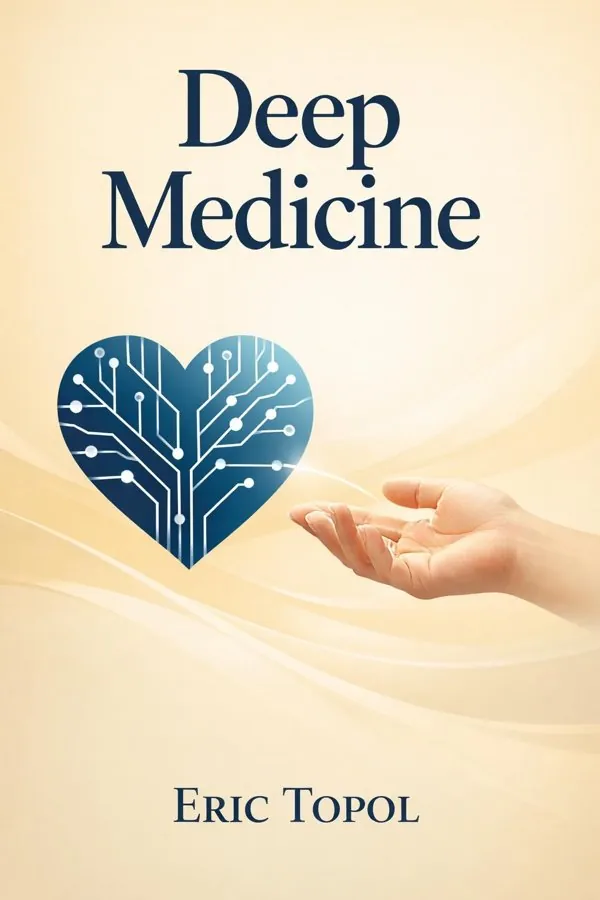
Deep Medicine: How Artificial Intelligence Can Make Healthcare Human Again: Summary & Key Insights
by Eric Topol
 10 min5 chaptersAudio available
What Is Deep Medicine: How Artificial Intelligence Can Make Healthcare Human Again About?
Deep Medicine: How Artificial Intelligence Can Make Healthcare Human Again by Eric Topol is a health_med book spanning 5 pages. Deep Medicine explores how artificial intelligence can transform healthcare by restoring the human connection between doctors and patients. Eric Topol argues that AI can relieve physicians from administrative burdens, enhance diagnostic accuracy, and enable more empathetic, personalized care. The book examines the intersection of technology and compassion, offering a vision of medicine that is both data-driven and deeply humane.
This FizzRead summary covers all 5 key chapters of Deep Medicine: How Artificial Intelligence Can Make Healthcare Human Again in approximately 10 minutes, distilling the most important ideas, arguments, and takeaways from Eric Topol's work. Also available as an audio summary and Key Quotes Podcast.
Deep Medicine: How Artificial Intelligence Can Make Healthcare Human Again
Deep Medicine explores how artificial intelligence can transform healthcare by restoring the human connection between doctors and patients. Eric Topol argues that AI can relieve physicians from administrative burdens, enhance diagnostic accuracy, and enable more empathetic, personalized care. The book examines the intersection of technology and compassion, offering a vision of medicine that is both data-driven and deeply humane.
Who Should Read Deep Medicine: How Artificial Intelligence Can Make Healthcare Human Again?
This book is perfect for anyone interested in health_med and looking to gain actionable insights in a short read. Whether you're a student, professional, or lifelong learner, the key ideas from Deep Medicine: How Artificial Intelligence Can Make Healthcare Human Again by Eric Topol will help you think differently.
- ✓Readers who enjoy health_med and want practical takeaways
- ✓Professionals looking to apply new ideas to their work and life
- ✓Anyone who wants the core insights of Deep Medicine: How Artificial Intelligence Can Make Healthcare Human Again in just 10 minutes
Want the full summary?
Get instant access to this book summary and 100K+ more with Fizz Moment.
Get Free SummaryAvailable on App Store • Free to download
Key Chapters
To understand where medicine is heading, we must first look at where it’s been. The story of medicine’s evolution is full of breakthroughs—stethoscopes, antibiotics, imaging, genetic sequencing—but every leap has come with unintended consequences. As we advanced scientifically, we began replacing relationships with records, stories with data points. Once, clinicians knew their patients intimately. Today, they often know them only as entries in a digital chart.
The shift accelerated with the digital revolution. Electronic medical records promised seamless integration of care but became bureaucratic monoliths that fractured attention. The clinical gaze now flickers between patient and screen. Physicians spend more time documenting encounters than engaging in them. What we practice too often is what I call 'shallow medicine'—a system obsessed with throughput, metrics, and billing codes instead of the human experience of illness.
This degradation has moral and emotional costs. Studies show empathy erodes during medical training, replaced by survival tactics to manage workload. Burnout rates soar past fifty percent. Patients sense the disconnect—they feel unseen and unheard. I wanted to trace this trajectory not to lament progress, but to show how digital tools, when used mindfully and redesigned with empathy at the center, can reverse the trend. AI, paradoxically, may be the very means by which we recover what has been lost.
Artificial intelligence in healthcare is often cloaked in mystique, but at its heart, it’s a method of pattern recognition at unprecedented scale. Deep learning, a subset of AI inspired by neural networks, has ushered in a revolution in medical capability. Through layers of algorithms, a machine can learn to interpret medical images, detect anomalies in pathology slides, or predict disease risk based on genomes, lab results, or even voice and movement patterns.
Unlike rule-based systems of the past, modern AI learns from example—it ingests millions of data points and autonomously refines its predictive power. In radiology, this means identifying subtle features on CT or MRI scans imperceptible to human eyes. In genomics, it can parse terabytes of sequence data to find mutations linked to rare diseases. But the breakthrough is not the technology itself—it’s what the technology allows. When a computer can read a chest X-ray as well as or better than a radiologist, or flag suspicious lesions from millions of colonoscopy images, it doesn’t end radiology or gastroenterology. It liberates their practitioners to focus on judgment, context, and communication.
The technical underpinnings—neural networks, backpropagation, supervised and unsupervised learning—serve the same goal: to augment human cognition. But the path to responsible AI rests on data integrity, transparency, and clinical validation. Every algorithm trained on biased data risks perpetuating inequities. Every unexplained result risks eroding trust. Deep education, as much as deep learning, must guide this transformation.
+ 3 more chapters — available in the FizzRead app
All Chapters in Deep Medicine: How Artificial Intelligence Can Make Healthcare Human Again
About the Author
Eric Topol is an American cardiologist, geneticist, and digital medicine researcher. He is the founder and director of the Scripps Research Translational Institute and a leading voice in the field of digital health and medical innovation. Topol has authored several influential books on the future of medicine and technology.
Get This Summary in Your Preferred Format
Read or listen to the Deep Medicine: How Artificial Intelligence Can Make Healthcare Human Again summary by Eric Topol anytime, anywhere. FizzRead offers multiple formats so you can learn on your terms — all free.
Available formats: App · Audio · PDF · EPUB — All included free with FizzRead
Download Deep Medicine: How Artificial Intelligence Can Make Healthcare Human Again PDF and EPUB Summary
Key Quotes from Deep Medicine: How Artificial Intelligence Can Make Healthcare Human Again
“To understand where medicine is heading, we must first look at where it’s been.”
“Artificial intelligence in healthcare is often cloaked in mystique, but at its heart, it’s a method of pattern recognition at unprecedented scale.”
Frequently Asked Questions about Deep Medicine: How Artificial Intelligence Can Make Healthcare Human Again
Deep Medicine: How Artificial Intelligence Can Make Healthcare Human Again by Eric Topol is a health_med book that explores key ideas across 5 chapters. Deep Medicine explores how artificial intelligence can transform healthcare by restoring the human connection between doctors and patients. Eric Topol argues that AI can relieve physicians from administrative burdens, enhance diagnostic accuracy, and enable more empathetic, personalized care. The book examines the intersection of technology and compassion, offering a vision of medicine that is both data-driven and deeply humane.
More by Eric Topol
You Might Also Like

On Immunity
Eula Biss
10 min
The Three-Body Problem
Liu Cixin
10 min
Community Health Volunteer Toolkit: Training and Practical Activities
World Health Organization
10 min
Healing Back Pain: The Mind-Body Connection
John E. Sarno
10 min
Health Literacy for All: Practical Guides to Communicate Health Information (Compilations)
World Health Organization
10 min
The Complete Guide to Sports Supplements: An Evidence-Based Review
Anita Bean
10 minBrowse by Category
Ready to read Deep Medicine: How Artificial Intelligence Can Make Healthcare Human Again?
Get the full summary and 100K+ more books with Fizz Moment.