
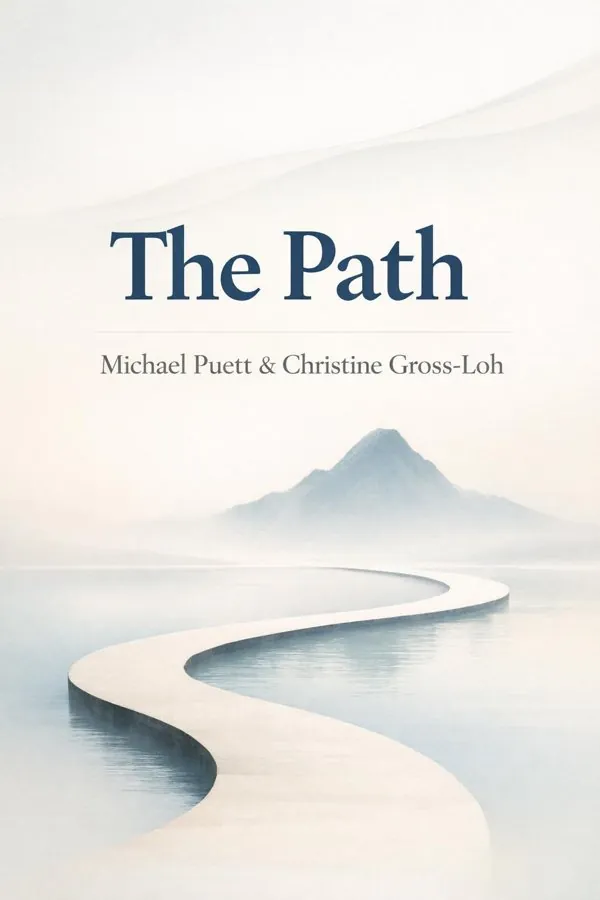
The Path: What Chinese Philosophers Can Teach Us About the Good Life: Summary & Key Insights
by Michael Puett, Christine Gross-Loh
 10 min9 chaptersAudio available
What Is The Path: What Chinese Philosophers Can Teach Us About the Good Life About?
The Path: What Chinese Philosophers Can Teach Us About the Good Life by Michael Puett & Christine Gross-Loh is a eastern_wisdom book spanning 9 pages. In this book, Harvard professor Michael Puett and writer Christine Gross-Loh reinterpret the teachings of ancient Chinese philosophers such as Confucius, Mencius, Laozi, and Zhuangzi. They argue that these thinkers offer practical wisdom for modern life, challenging Western notions of authenticity and self-expression. The authors show how small, deliberate actions and rituals can transform one’s relationships, work, and sense of purpose, leading to a more fulfilling and ethical life.
This FizzRead summary covers all 9 key chapters of The Path: What Chinese Philosophers Can Teach Us About the Good Life in approximately 10 minutes, distilling the most important ideas, arguments, and takeaways from Michael Puett & Christine Gross-Loh's work. Also available as an audio summary and Key Quotes Podcast.
The Path: What Chinese Philosophers Can Teach Us About the Good Life
In this book, Harvard professor Michael Puett and writer Christine Gross-Loh reinterpret the teachings of ancient Chinese philosophers such as Confucius, Mencius, Laozi, and Zhuangzi. They argue that these thinkers offer practical wisdom for modern life, challenging Western notions of authenticity and self-expression. The authors show how small, deliberate actions and rituals can transform one’s relationships, work, and sense of purpose, leading to a more fulfilling and ethical life.
Who Should Read The Path: What Chinese Philosophers Can Teach Us About the Good Life?
This book is perfect for anyone interested in eastern_wisdom and looking to gain actionable insights in a short read. Whether you're a student, professional, or lifelong learner, the key ideas from The Path: What Chinese Philosophers Can Teach Us About the Good Life by Michael Puett & Christine Gross-Loh will help you think differently.
- ✓Readers who enjoy eastern_wisdom and want practical takeaways
- ✓Professionals looking to apply new ideas to their work and life
- ✓Anyone who wants the core insights of The Path: What Chinese Philosophers Can Teach Us About the Good Life in just 10 minutes
Want the full summary?
Get instant access to this book summary and 100K+ more with Fizz Moment.
Get Free SummaryAvailable on App Store • Free to download
Key Chapters
Confucius taught that rituals—li—were not empty customs or formalities but practices of transformation. In a world of chaos and moral disorder, Confucius believed that humans could cultivate goodness by engaging in deliberate acts of respect, kindness, and order. When we bow to another person, when we speak with courtesy, or when we honor a meal through mindful attention, we participate in rituals that reshape not just our behavior but our inner world.
Western thought often mistrusts ritual, seeing it as mechanical repetition that suppresses the self. But in Confucius’s vision, ritual is precisely what frees us. By performing acts that extend beyond our spontaneous impulses, we train our emotions and refine our instincts. Confucius did not claim we are automatically good; rather, he insisted that through proper conduct, we learn to become good. Ritual becomes an intentional exercise in empathy and awareness.
Imagine interacting with a colleague you dislike. The usual tendency is to act according to genuine feeling—to stay cold or defensive. Confucius would say: act as if you were respecting them fully. Over time, through these gestures, your emotions may shift. Ritual creates possibility—it allows you to move beyond the confines of a fixed personality.
When Confucius spoke of the junzi, or noble person, he described someone who did not chase external rewards but cultivated internal harmony through practice. Every ritual is an experiment in self-cultivation. Through ritualized behavior, we begin to relate differently, to feel differently, and ultimately to become different. In a world obsessed with authenticity, Confucius reminds us that transformation, not expression, is the greater path to freedom.
Mencius deepened Confucius’s insight by asserting that humans are innately inclined toward goodness. He used vivid metaphors to describe moral growth, comparing the heart’s moral sprouts to tender shoots that require nurturing. Just as a sprout grows only if water and sunlight reach it, goodness blooms only when we consciously cultivate our caring impulses.
Mencius saw the heart as morally intelligent—it feels the pain of others naturally, yet these feelings can be buried under distraction or selfish desire. When we feed greed, indifference, or anger, we neglect the part of us that is most human. Mencius’s philosophy invites us to recover our natural tenderness through deliberate reflection and disciplined kindness.
In modern life, we often judge people by outcomes—success, wealth, recognition—but Mencius would urge us to look at moral tendency: are our actions expanding empathy or narrowing it? Each moment gives us the chance to practice generosity, to listen better, to cultivate compassion for strangers. This practice restores the natural goodness that exists within everyone.
Mencius’s world was uncertain and politically unstable, yet he insisted that moral progress begins in the heart. If we abandon our innate benevolence, society decays; if we nurture it, we create harmony. His message today is the same: do not despair over your flaws—treat them as neglected shoots waiting for care. Life’s path is about continual cultivation, because goodness, once tended, expands outward endlessly.
+ 7 more chapters — available in the FizzRead app
All Chapters in The Path: What Chinese Philosophers Can Teach Us About the Good Life
About the Authors
Michael Puett is a professor of Chinese history at Harvard University, known for his popular course on classical Chinese philosophy. Christine Gross-Loh is a journalist and author who writes about education, culture, and parenting. Together, they bring ancient Eastern wisdom into contemporary relevance.
Get This Summary in Your Preferred Format
Read or listen to the The Path: What Chinese Philosophers Can Teach Us About the Good Life summary by Michael Puett & Christine Gross-Loh anytime, anywhere. FizzRead offers multiple formats so you can learn on your terms — all free.
Available formats: App · Audio · PDF · EPUB — All included free with FizzRead
Download The Path: What Chinese Philosophers Can Teach Us About the Good Life PDF and EPUB Summary
Key Quotes from The Path: What Chinese Philosophers Can Teach Us About the Good Life
“Confucius taught that rituals—li—were not empty customs or formalities but practices of transformation.”
“Mencius deepened Confucius’s insight by asserting that humans are innately inclined toward goodness.”
Frequently Asked Questions about The Path: What Chinese Philosophers Can Teach Us About the Good Life
The Path: What Chinese Philosophers Can Teach Us About the Good Life by Michael Puett & Christine Gross-Loh is a eastern_wisdom book that explores key ideas across 9 chapters. In this book, Harvard professor Michael Puett and writer Christine Gross-Loh reinterpret the teachings of ancient Chinese philosophers such as Confucius, Mencius, Laozi, and Zhuangzi. They argue that these thinkers offer practical wisdom for modern life, challenging Western notions of authenticity and self-expression. The authors show how small, deliberate actions and rituals can transform one’s relationships, work, and sense of purpose, leading to a more fulfilling and ethical life.
You Might Also Like
A New Earth
Eckhart Tolle
10 min
The Daily Stoic
Ryan Holiday, Stephen Hanselman
10 min
Buddhism: Plain and Simple
Steve Hagen
10 min
Enchiridion
Epictetus
10 min
The Book of Tea
Kakuzō Okakura
10 min
The Light We Give: How Sikh Wisdom Can Transform Your Life
Simran Jeet Singh
10 minBrowse by Category
Ready to read The Path: What Chinese Philosophers Can Teach Us About the Good Life?
Get the full summary and 100K+ more books with Fizz Moment.