
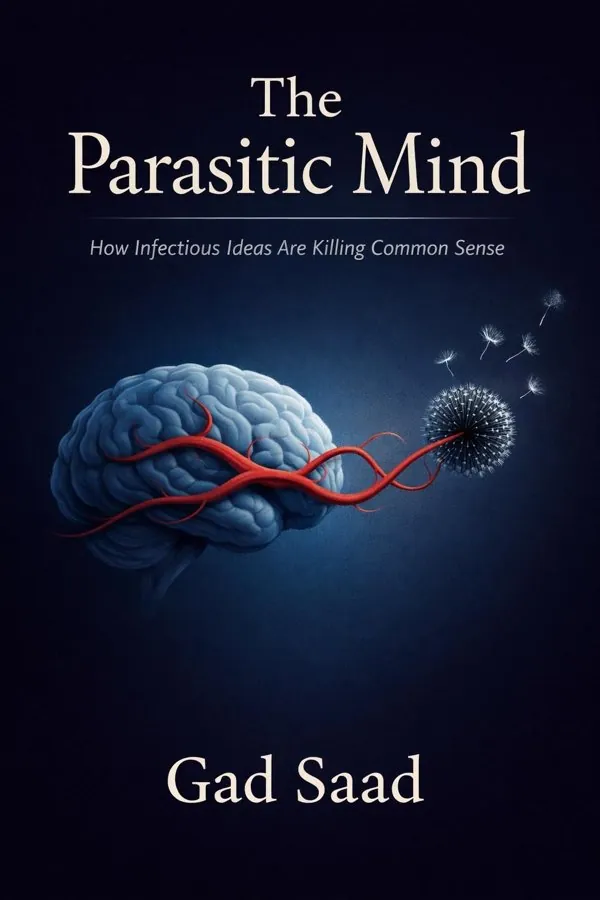
The Parasitic Mind: How Infectious Ideas Are Killing Common Sense: Summary & Key Insights
by Gad Saad
 10 min4 chaptersAudio available
What Is The Parasitic Mind: How Infectious Ideas Are Killing Common Sense About?
The Parasitic Mind: How Infectious Ideas Are Killing Common Sense by Gad Saad is a psychology book spanning 4 pages. In this provocative work, evolutionary behavioral scientist Gad Saad argues that certain ideas—what he calls 'idea pathogens'—have spread through academia and culture, undermining reason, science, and free thought. Drawing on evolutionary psychology, he explores how these ideological viruses infect minds and societies, and offers strategies for inoculating ourselves against them through critical thinking and evidence-based reasoning.
This FizzRead summary covers all 4 key chapters of The Parasitic Mind: How Infectious Ideas Are Killing Common Sense in approximately 10 minutes, distilling the most important ideas, arguments, and takeaways from Gad Saad's work. Also available as an audio summary and Key Quotes Podcast.
The Parasitic Mind: How Infectious Ideas Are Killing Common Sense
In this provocative work, evolutionary behavioral scientist Gad Saad argues that certain ideas—what he calls 'idea pathogens'—have spread through academia and culture, undermining reason, science, and free thought. Drawing on evolutionary psychology, he explores how these ideological viruses infect minds and societies, and offers strategies for inoculating ourselves against them through critical thinking and evidence-based reasoning.
Who Should Read The Parasitic Mind: How Infectious Ideas Are Killing Common Sense?
This book is perfect for anyone interested in psychology and looking to gain actionable insights in a short read. Whether you're a student, professional, or lifelong learner, the key ideas from The Parasitic Mind: How Infectious Ideas Are Killing Common Sense by Gad Saad will help you think differently.
- ✓Readers who enjoy psychology and want practical takeaways
- ✓Professionals looking to apply new ideas to their work and life
- ✓Anyone who wants the core insights of The Parasitic Mind: How Infectious Ideas Are Killing Common Sense in just 10 minutes
Want the full summary?
Get instant access to this book summary and 100K+ more with Fizz Moment.
Get Free SummaryAvailable on App Store • Free to download
Key Chapters
To explain how our collective reasoning became so vulnerable to viral nonsense, I turn to evolutionary psychology—the only framework that truly integrates our biological heritage with our cultural behavior. We evolved complex cognitive systems for survival and reproduction, but those same systems can malfunction when exposed to environments far removed from our ancestral past.
Consider the concept of *mismatch theory*: adaptations that served us well on the savannas of Africa may misfire in the modern information ecosystem. Our moral sentiments, for instance, evolved for tight-knit tribes in which empathy and conformity ensured social cohesion. In today’s global village, those same impulses lead people to embrace moral posturing, status signaling, and identity-based affiliations detached from empirical truth. When beliefs spread because they signal virtue rather than reflect reality, we become fertile hosts for ideological contagion.
Evolution also explains why some ideas replicate regardless of their veracity. Memes—units of cultural transmission—thrive when they appeal to emotions or tribal instincts. Postmodern skepticism of truth taps into our fear of exclusion; radical egalitarianism feeds our evolved disdain for hierarchy; and identity politics weaponizes empathy by moralizing compulsion. These memes may feel altruistic, but their cumulative effect is epistemic rot.
Understanding this gives us both diagnosis and remedy. Knowing our susceptibility allows us to strengthen our mental immunity. Just as a doctor recognizes how parasites exploit weaknesses in the body, so must we recognize how idea pathogens exploit our cognitive biases—the desire for belonging, the fear of offense, the yearning for moral certainty. Evolutionary thinking gives us the vocabulary to describe not only *what* is happening to our culture, but *why* it is happening in the first place.
The Enlightenment liberated humankind from superstition by enthroning reason and empirical inquiry. Think of it as the moment we collectively recognized that our minds, properly disciplined, could understand the universe without appeal to authority or dogma. Yet for all its brilliance, that legacy has been undermined from within. Western academics, the very custodians of Enlightenment values, began importing epistemological viruses disguised as compassionate progress.
Postmodernism emerged first, declaring that there is no objective truth—only narratives shaped by power. This notion, seductive in its moral intention to uplift marginalized voices, eroded confidence in science itself. Once truth becomes a social construct, data and evidence lose their authority. The infection spread to pedagogy and journalism, where intellectual rigor gave way to ideological conformity and emotional validation.
Radical feminism followed, reinterpreting biological differences between the sexes as oppressive hierarchies rather than evolved complementarities. Identity politics extended that reasoning, dividing society into moral tribes ranked by victimhood rather than character or achievement. These frameworks do not merely challenge prejudice—they redefine reality, reducing the complexity of human behavior to a single axis of oppression and privilege. Such ideas kill nuance, discourage dialogue, and punish dissent.
I watched this new orthodoxy take hold in universities, where students once encouraged to question everything were now trained to feel offense as proof of moral superiority. The same contagion reached corporations, where hiring, advertising, and research increasingly cater to ideological purity rather than competence or truth.
This is what I call *endarkenment*: a reversal of our intellectual evolution. In place of evidence-based humility, we now have dogmatic certainty. In place of open debate, enforced silence. The Enlightenment was our greatest inoculation against folly; abandoning it leaves us mentally defenseless.
+ 2 more chapters — available in the FizzRead app
All Chapters in The Parasitic Mind: How Infectious Ideas Are Killing Common Sense
About the Author
Gad Saad is a Lebanese-Canadian evolutionary behavioral scientist, professor of marketing at Concordia University, and a popular public intellectual known for applying evolutionary psychology to consumer behavior and cultural analysis. He is also the host of 'The Saad Truth' podcast and a frequent commentator on issues of free speech and scientific integrity.
Get This Summary in Your Preferred Format
Read or listen to the The Parasitic Mind: How Infectious Ideas Are Killing Common Sense summary by Gad Saad anytime, anywhere. FizzRead offers multiple formats so you can learn on your terms — all free.
Available formats: App · Audio · PDF · EPUB — All included free with FizzRead
Download The Parasitic Mind: How Infectious Ideas Are Killing Common Sense PDF and EPUB Summary
Key Quotes from The Parasitic Mind: How Infectious Ideas Are Killing Common Sense
“We evolved complex cognitive systems for survival and reproduction, but those same systems can malfunction when exposed to environments far removed from our ancestral past.”
“The Enlightenment liberated humankind from superstition by enthroning reason and empirical inquiry.”
Frequently Asked Questions about The Parasitic Mind: How Infectious Ideas Are Killing Common Sense
The Parasitic Mind: How Infectious Ideas Are Killing Common Sense by Gad Saad is a psychology book that explores key ideas across 4 chapters. In this provocative work, evolutionary behavioral scientist Gad Saad argues that certain ideas—what he calls 'idea pathogens'—have spread through academia and culture, undermining reason, science, and free thought. Drawing on evolutionary psychology, he explores how these ideological viruses infect minds and societies, and offers strategies for inoculating ourselves against them through critical thinking and evidence-based reasoning.
More by Gad Saad

You Might Also Like

The Body Keeps the Score
Bessel van der Kolk
10 min
Surrounded by Idiots
Thomas Erikson
10 min
Emotional Intelligence
Daniel Goleman
10 min
Attached
Amir Levine
10 min
Why Does He Do That
Lundy Bancroft
10 min
Women Who Run with the Wolves
Clarissa Pinkola Estés
10 minBrowse by Category
Ready to read The Parasitic Mind: How Infectious Ideas Are Killing Common Sense?
Get the full summary and 100K+ more books with Fizz Moment.