
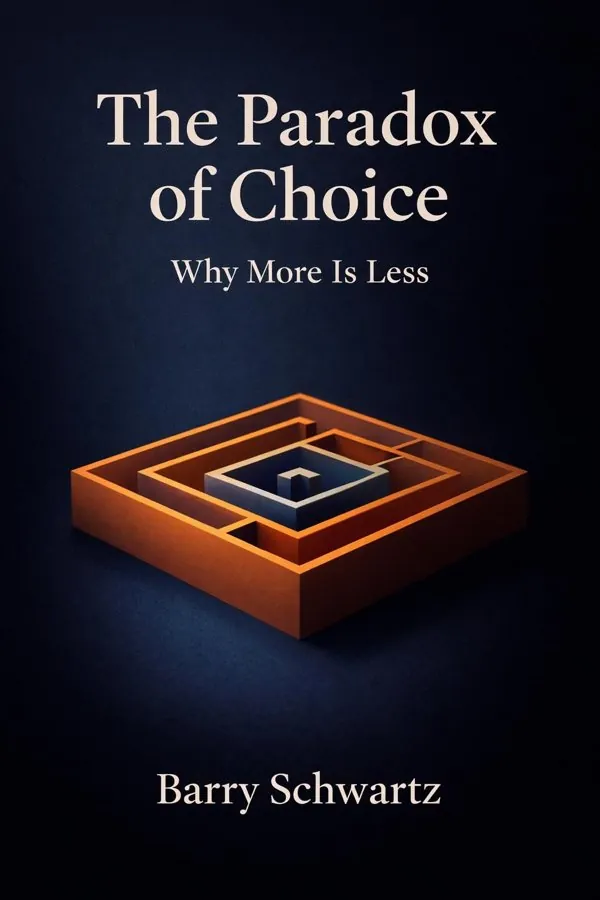
The Paradox of Choice: Why More Is Less: Summary & Key Insights
 10 min9 chaptersAudio available
Key Takeaways from The Paradox of Choice: Why More Is Less
We usually assume that more freedom automatically improves life, but Schwartz asks a disruptive question: what if freedom, beyond a certain point, starts to weigh us down?
A supermarket aisle packed with possibilities looks like progress, yet Schwartz argues that abundance often carries invisible costs.
One of Schwartz’s most powerful observations is that excessive choice does not merely make decisions harder; it can stop decisions altogether.
Not everyone experiences choice in the same way.
The more options we have, the more opportunities we have to imagine that another path would have been better.
What Is The Paradox of Choice: Why More Is Less About?
The Paradox of Choice: Why More Is Less by Barry Schwartz is a psychology book spanning 9 pages. In modern life, freedom is often measured by how many options we have: more products, more careers, more entertainment, more lifestyles, and more ways to design a life that feels uniquely our own. Yet Barry Schwartz argues that this abundance, far from liberating us, often leaves us anxious, exhausted, and less satisfied with the choices we make. In The Paradox of Choice: Why More Is Less, Schwartz brings together psychology, behavioral economics, and everyday observation to explain why having too many options can produce decision paralysis, regret, inflated expectations, and chronic dissatisfaction. What makes this book enduringly relevant is how clearly it describes a problem that has only intensified in the digital age. From streaming platforms and online shopping to dating apps and career paths, we face a constant stream of decisions that demand time, energy, and emotional bandwidth. Schwartz, a distinguished psychologist and professor emeritus at Swarthmore College, offers not only a diagnosis but also a practical framework for making wiser, calmer choices. This is a book about freedom, happiness, and the hidden costs of endless possibility.
This FizzRead summary covers all 9 key chapters of The Paradox of Choice: Why More Is Less in approximately 10 minutes, distilling the most important ideas, arguments, and takeaways from Barry Schwartz's work. Also available as an audio summary and Key Quotes Podcast.
The Paradox of Choice: Why More Is Less
In modern life, freedom is often measured by how many options we have: more products, more careers, more entertainment, more lifestyles, and more ways to design a life that feels uniquely our own. Yet Barry Schwartz argues that this abundance, far from liberating us, often leaves us anxious, exhausted, and less satisfied with the choices we make. In The Paradox of Choice: Why More Is Less, Schwartz brings together psychology, behavioral economics, and everyday observation to explain why having too many options can produce decision paralysis, regret, inflated expectations, and chronic dissatisfaction.
What makes this book enduringly relevant is how clearly it describes a problem that has only intensified in the digital age. From streaming platforms and online shopping to dating apps and career paths, we face a constant stream of decisions that demand time, energy, and emotional bandwidth. Schwartz, a distinguished psychologist and professor emeritus at Swarthmore College, offers not only a diagnosis but also a practical framework for making wiser, calmer choices. This is a book about freedom, happiness, and the hidden costs of endless possibility.
Who Should Read The Paradox of Choice: Why More Is Less?
This book is perfect for anyone interested in psychology and looking to gain actionable insights in a short read. Whether you're a student, professional, or lifelong learner, the key ideas from The Paradox of Choice: Why More Is Less by Barry Schwartz will help you think differently.
- ✓Readers who enjoy psychology and want practical takeaways
- ✓Professionals looking to apply new ideas to their work and life
- ✓Anyone who wants the core insights of The Paradox of Choice: Why More Is Less in just 10 minutes
Want the full summary?
Get instant access to this book summary and 100K+ more with Fizz Moment.
Get Free SummaryAvailable on App Store • Free to download
Key Chapters
We usually assume that more freedom automatically improves life, but Schwartz asks a disruptive question: what if freedom, beyond a certain point, starts to weigh us down? Western culture has long linked freedom of choice with dignity, autonomy, and self-determination. This belief is not wrong. Having options protects us from coercion and allows us to shape our lives according to our values. The problem begins when the number of choices expands so dramatically that deciding itself becomes stressful.
Schwartz shows that choice is beneficial up to a point. A few meaningful options can help people feel in control and respected. But when every decision is surrounded by dozens or hundreds of alternatives, the process changes. We spend more time comparing, researching, and second-guessing. The mental effort rises, and the emotional stakes rise with it. Instead of feeling empowered, we feel burdened by the responsibility to choose perfectly.
This dynamic appears everywhere: selecting a phone plan, picking a retirement portfolio, choosing a college major, or even deciding what to watch at night. The abundance of options creates the sense that a better choice is always out there, just one more search away. As a result, choosing becomes less an expression of freedom and more a source of pressure.
The key insight is that freedom is not just about having options; it is also about being able to live well with the option you choose. Actionable takeaway: when faced with many choices, deliberately narrow the field by defining what matters most before you begin comparing alternatives.
One of Schwartz’s most powerful observations is that excessive choice does not merely make decisions harder; it can stop decisions altogether. This is the phenomenon of choice paralysis. When people confront too many alternatives, the fear of making the wrong choice grows, and doing nothing starts to feel safer than choosing imperfectly.
Schwartz draws on psychological research showing that people are often more likely to act when offered a limited, manageable set of options. The classic example involves consumer behavior: shoppers are more attracted to displays with many varieties, but they are more likely to actually buy when the number of options is smaller. A large assortment creates interest, yet a smaller assortment makes commitment easier.
The same pattern appears in more consequential areas. Employees delay choosing retirement plans when faced with too many investment funds. Students struggle to begin projects when assignment topics are overly broad. Job seekers postpone applications when they feel they must compare every possible path before moving forward. The issue is not laziness; it is overload.
Too many options increase the cost of comparison. Each alternative must be measured against the others, and each unchosen option becomes a possible source of future regret. The mind, trying to avoid error, stalls. This paralysis can quietly shape lives by encouraging procrastination, indecision, and missed opportunities.
Schwartz’s lesson is that action often requires constraint. A narrower set of options can make it easier to commit, learn, and adapt over time. Actionable takeaway: if you feel stuck, impose a decision limit—choose from your top three options, set a deadline, and commit rather than endlessly expanding the search.
Not everyone experiences choice in the same way. Schwartz introduces a crucial distinction between maximizers and satisficers. Maximizers want the absolute best outcome. They compare extensively, search widely, and feel compelled to examine as many options as possible before deciding. Satisficers, by contrast, look for an option that meets their criteria and is good enough. Once they find it, they stop searching.
This difference in style has major consequences for well-being. Maximizers may sometimes achieve objectively better outcomes, but they are often less happy with those outcomes. Because they invest so much effort in searching, they remain aware of the alternatives they rejected. They also raise the bar for what counts as a satisfying result. Even after making a strong choice, they may wonder if another option would have been slightly better.
Satisficers are not careless or unambitious. They simply define their needs in advance and accept that perfection is rarely attainable. This allows them to preserve time, attention, and peace of mind. In daily life, this might mean choosing a restaurant that looks appealing instead of reading 200 reviews, or accepting a job that fits one’s values rather than conducting an endless hunt for the ideal role.
Schwartz’s insight is not that standards are bad, but that relentless optimization can become self-defeating. A life organized around always finding the best can produce chronic dissatisfaction, even when life is objectively going well.
Actionable takeaway: before making an important decision, write down your core criteria and decide in advance what “good enough” means, so you are not seduced into endless maximizing.
The more options we have, the more opportunities we have to imagine that another path would have been better. Schwartz argues that regret is one of the central emotional costs of abundant choice. In a world of limited options, disappointment is easier to absorb because alternatives are few. In a world overflowing with possibilities, every decision carries a shadow: all the other outcomes that might have been.
Regret is closely tied to opportunity cost. Choosing one thing means giving up many others, and modern choice environments make those lost possibilities highly visible. Book a vacation, and social media shows you better beaches. Buy a laptop, and another model goes on sale the next day. Accept a job, and you continue to wonder about the opportunities you declined. This mental comparison weakens satisfaction with the option you actually chose.
What makes regret especially corrosive is that it can turn good outcomes into bad feelings. Even if your choice works well, knowing that another option might have been marginally better can leave you dissatisfied. The abundance of alternatives feeds counterfactual thinking: if only I had chosen differently. As Schwartz explains, this dynamic makes us less likely to feel grateful and more likely to dwell on imperfections.
Reducing regret does not mean making perfect decisions. It means recognizing that every choice closes off other paths and that no decision can preserve all possibilities. Mature decision-making involves accepting trade-offs rather than resenting them.
Actionable takeaway: after making a decision, stop comparison shopping and practice closure—focus on the benefits of your chosen option instead of revisiting the alternatives you rejected.
Abundance does not just give us more options; it teaches us to expect extraordinary outcomes from every choice. Schwartz argues that when people believe the perfect product, partner, career, or lifestyle must be available somewhere, their expectations rise faster than reality can satisfy. As options expand, standards expand too.
At first glance, high expectations seem beneficial. Shouldn’t people want the best? Schwartz’s answer is nuanced. Standards can motivate improvement, but they also alter the emotional benchmark for satisfaction. If we expect excellence in every domain, then merely good experiences begin to feel like disappointments. More choice creates the impression that settling for less than ideal is a personal failure rather than an unavoidable feature of life.
This is especially visible in modern self-development culture. People are encouraged to build the perfect career, maintain the perfect body, find the perfect relationship, optimize their productivity, and curate the perfect identity online. With enough options and enough information, it seems reasonable to expect ideal outcomes. But life is lived in conditions of uncertainty, limitation, and trade-off. Perfection is usually imagined, not achieved.
The consequence is that objective improvements in living standards do not necessarily increase happiness. If expectations rise in parallel, satisfaction can stay flat or even decline. The issue is not that people have too much ambition. It is that they have too little room for imperfection.
Actionable takeaway: consciously lower the demand for perfection in everyday choices by asking, “Would this be good enough to serve me well?” rather than “Is this the absolute best possible option?”
Too much choice is not only a consumer problem; it is a social and personal one. Schwartz argues that when individuals are told they can choose nearly every aspect of their lives, responsibility for outcomes shifts inward. If there are countless paths to success, happiness, love, and meaning, then any disappointment can feel like evidence of personal failure. More choice expands not only possibility, but also self-blame.
This burden is especially visible in identity formation. People now face enormous freedom in designing their careers, lifestyles, values, and communities. While this can be liberating, it can also create chronic uncertainty. Instead of inheriting a stable role, people are expected to construct themselves from a wide menu of possibilities. The result can be insecurity and pressure rather than empowerment.
Relationships also suffer under conditions of excessive choice. When alternatives seem endless, commitment can become harder. People may evaluate partners, friends, or communities with a consumer mindset, always alert to the possibility that something better is available. This does not deepen connection; it weakens loyalty and satisfaction.
Schwartz’s broader point is that a culture obsessed with personal choice can erode acceptance, gratitude, and commitment. Human flourishing depends not only on open options but also on stable attachments and durable decisions.
In practical terms, this means resisting the temptation to treat every domain of life as an optimization problem. Some of the most meaningful parts of life grow through investment, not endless comparison.
Actionable takeaway: strengthen commitment in key relationships and life roles by spending less time evaluating alternatives and more time deepening the value of the choices you have already made.
If modern markets merely offered choices, the problem would be significant enough. But Schwartz notes that advertising and media intensify the paradox by constantly expanding desire and redefining what counts as acceptable. We are not just presented with options; we are taught to feel incomplete without the best possible option.
Advertising works by linking products to identity, status, happiness, and belonging. It suggests that the right purchase can solve emotional problems or express a more desirable self. In a world already crowded with alternatives, this messaging pushes people to keep searching. The ordinary becomes inadequate because media continuously displays upgraded versions of life.
This creates a cycle of dissatisfaction. First, we are exposed to a wide field of options. Then advertising raises our expectations by implying that one special choice will transform our lives. Finally, when the outcome is merely decent, we feel underwhelmed. The problem is not only manipulation by marketers; it is the internalization of a mindset in which satisfaction always lies elsewhere.
Digital platforms amplify this effect. Personalized recommendations, curated lifestyles, and targeted ads make alternatives impossible to ignore. Every click reveals another possibility, and every possibility hints that your current choice may be inferior. Schwartz helps us see that the psychological economy of attention is tightly linked to consumer dissatisfaction.
To resist this dynamic, people need habits of discernment. Not every desire deserves pursuit, and not every option deserves evaluation. Freedom requires limits.
Actionable takeaway: reduce exposure to decision-triggering media when possible, and pause before purchases to ask whether the desire comes from genuine need or from comparison-driven dissatisfaction.
Schwartz does not propose eliminating choice. His real solution is more subtle: create structures, habits, and values that protect you from the excesses of endless possibility. The goal is not to become indifferent, but to make decisions in a way that preserves satisfaction and sanity.
One of his most useful recommendations is to embrace constraints. Standards, routines, rules of thumb, and defaults all reduce the cognitive burden of choosing. This may sound limiting, but in reality these tools make freedom usable. A person who has a simple wardrobe strategy, a default savings plan, or a shortlist of trusted stores can reserve mental energy for the decisions that truly matter.
Schwartz also emphasizes the value of accepting trade-offs. Every choice involves loss as well as gain, and mature decision-making requires peace with that fact. Trying to choose without sacrifice is what leads to endless searching and regret. In addition, he recommends reducing opportunities for comparison after the choice is made. Satisfaction grows when we commit fully rather than revisit alternatives.
Underlying these practices is a deeper idea Schwartz later connects to practical wisdom: good judgment is contextual, humane, and guided by values, not by the fantasy of perfect optimization. Better decisions come not from considering everything, but from knowing what deserves consideration.
In everyday life, this might mean limiting online research, creating nonnegotiable criteria for major decisions, or adopting simple habits for small ones. These are not restrictions on freedom; they are tools for protecting it.
Actionable takeaway: design a personal decision system—use defaults, cap your research time, and separate high-stakes choices from low-stakes ones so not every decision receives the same exhausting attention.
All Chapters in The Paradox of Choice: Why More Is Less
About the Author
Barry Schwartz is an American psychologist, author, and professor emeritus of psychology at Swarthmore College. He is widely recognized for his work on decision-making, motivation, morality, and the relationship between psychology and economics. Schwartz became internationally known through The Paradox of Choice, in which he examined how excessive options can undermine happiness and satisfaction. He has also written influential works on practical wisdom, work, and the limitations of incentive-driven systems. Beyond academia, Schwartz is known for his widely viewed TED Talks, where he brought complex psychological ideas to a broad public audience. His writing combines research, philosophical reflection, and everyday examples, making him one of the most accessible and insightful voices on how modern social systems shape human behavior and well-being.
Get This Summary in Your Preferred Format
Read or listen to the The Paradox of Choice: Why More Is Less summary by Barry Schwartz anytime, anywhere. FizzRead offers multiple formats so you can learn on your terms — all free.
Available formats: App · Audio · PDF · EPUB — All included free with FizzRead
Download The Paradox of Choice: Why More Is Less PDF and EPUB Summary
Key Quotes from The Paradox of Choice: Why More Is Less
“We usually assume that more freedom automatically improves life, but Schwartz asks a disruptive question: what if freedom, beyond a certain point, starts to weigh us down?”
“A supermarket aisle packed with possibilities looks like progress, yet Schwartz argues that abundance often carries invisible costs.”
“One of Schwartz’s most powerful observations is that excessive choice does not merely make decisions harder; it can stop decisions altogether.”
“Not everyone experiences choice in the same way.”
“The more options we have, the more opportunities we have to imagine that another path would have been better.”
Frequently Asked Questions about The Paradox of Choice: Why More Is Less
The Paradox of Choice: Why More Is Less by Barry Schwartz is a psychology book that explores key ideas across 9 chapters. In modern life, freedom is often measured by how many options we have: more products, more careers, more entertainment, more lifestyles, and more ways to design a life that feels uniquely our own. Yet Barry Schwartz argues that this abundance, far from liberating us, often leaves us anxious, exhausted, and less satisfied with the choices we make. In The Paradox of Choice: Why More Is Less, Schwartz brings together psychology, behavioral economics, and everyday observation to explain why having too many options can produce decision paralysis, regret, inflated expectations, and chronic dissatisfaction. What makes this book enduringly relevant is how clearly it describes a problem that has only intensified in the digital age. From streaming platforms and online shopping to dating apps and career paths, we face a constant stream of decisions that demand time, energy, and emotional bandwidth. Schwartz, a distinguished psychologist and professor emeritus at Swarthmore College, offers not only a diagnosis but also a practical framework for making wiser, calmer choices. This is a book about freedom, happiness, and the hidden costs of endless possibility.
More by Barry Schwartz
You Might Also Like
The Body Keeps the Score
Bessel van der Kolk
10 min
Surrounded by Idiots
Thomas Erikson
10 min
Emotional Intelligence
Daniel Goleman
10 min
Attached
Amir Levine
10 min
Why Does He Do That
Lundy Bancroft
10 min
Women Who Run with the Wolves
Clarissa Pinkola Estés
10 minBrowse by Category
Ready to read The Paradox of Choice: Why More Is Less?
Get the full summary and 100K+ more books with Fizz Moment.