
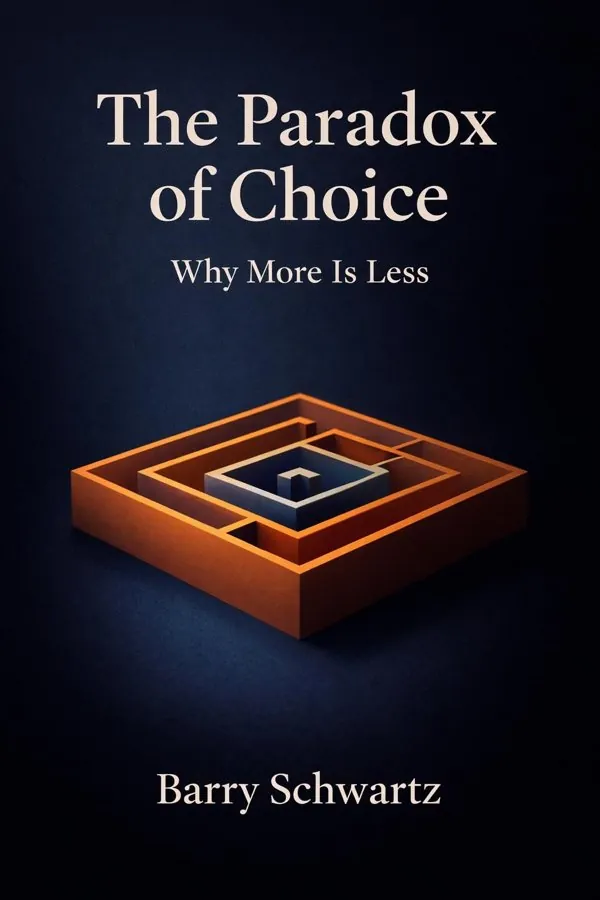
The Paradox of Choice: Summary & Key Insights
 10 min9 chapters
Key Takeaways from The Paradox of Choice
Choice gives us control, and control can be empowering.
Sometimes the hardest part of choosing is not selecting poorly, but selecting anything at all.
A powerful contribution of The Paradox of Choice is Schwartz’s distinction between maximizers and satisficers.
One reason abundant choice backfires is that it raises expectations.
Every decision closes off alternatives, and the more alternatives we can imagine, the more loss we feel alongside any gain.
What Is The Paradox of Choice About?
The Paradox of Choice by Barry Schwartz is a psychology book published in 2020 spanning 13 pages. More choice seems like an unquestionable good. The more options we have, the freer we are, and the more likely we are to find exactly what we want. Barry Schwartz challenges that comforting assumption in The Paradox of Choice, arguing that while some choice is essential to autonomy and well-being, too much of it can overwhelm us, drain our energy, increase regret, and leave us less satisfied with the decisions we make. From buying jeans and choosing careers to selecting health plans and romantic partners, modern life confronts us with a flood of options that our minds are not always equipped to handle well. Schwartz, a renowned psychologist and professor known for translating behavioral science into practical insight, shows how abundance can quietly produce anxiety, perfectionism, self-blame, and decision paralysis. Instead of making us happier, unlimited choice often raises expectations and makes every decision feel loaded with missed possibilities. This book matters because it helps explain why people living in affluent, option-rich societies often feel stressed, dissatisfied, and mentally exhausted. More importantly, it offers a way forward: not by rejecting freedom, but by learning how to choose better, simplify wisely, and seek satisfaction rather than perfection.
This FizzRead summary covers all 9 key chapters of The Paradox of Choice in approximately 10 minutes, distilling the most important ideas, arguments, and takeaways from Barry Schwartz's work.
The Paradox of Choice
More choice seems like an unquestionable good. The more options we have, the freer we are, and the more likely we are to find exactly what we want. Barry Schwartz challenges that comforting assumption in The Paradox of Choice, arguing that while some choice is essential to autonomy and well-being, too much of it can overwhelm us, drain our energy, increase regret, and leave us less satisfied with the decisions we make. From buying jeans and choosing careers to selecting health plans and romantic partners, modern life confronts us with a flood of options that our minds are not always equipped to handle well.
Schwartz, a renowned psychologist and professor known for translating behavioral science into practical insight, shows how abundance can quietly produce anxiety, perfectionism, self-blame, and decision paralysis. Instead of making us happier, unlimited choice often raises expectations and makes every decision feel loaded with missed possibilities. This book matters because it helps explain why people living in affluent, option-rich societies often feel stressed, dissatisfied, and mentally exhausted. More importantly, it offers a way forward: not by rejecting freedom, but by learning how to choose better, simplify wisely, and seek satisfaction rather than perfection.
Who Should Read The Paradox of Choice?
This book is perfect for anyone interested in psychology and looking to gain actionable insights in a short read. Whether you're a student, professional, or lifelong learner, the key ideas from The Paradox of Choice by Barry Schwartz will help you think differently.
- ✓Readers who enjoy psychology and want practical takeaways
- ✓Professionals looking to apply new ideas to their work and life
- ✓Anyone who wants the core insights of The Paradox of Choice in just 10 minutes
Want the full summary?
Get instant access to this book summary and 100K+ more with Fizz Moment.
Get Free SummaryAvailable on App Store • Free to download
Key Chapters
We tend to assume that more choice automatically improves our lives, but one of Schwartz’s central insights is that abundance often creates psychological costs that are easy to overlook. Choice gives us control, and control can be empowering. Yet when the number of options grows too large, choosing becomes difficult, tiring, and emotionally loaded. Instead of feeling liberated, we feel burdened.
This is the paradox: the same variety that promises freedom can also produce confusion and dissatisfaction. Think of walking into a store to buy a simple item like toothpaste. Faced with dozens of brands, formulas, sizes, and claims, you may spend extra time comparing them, worry about making the wrong pick, and still leave uncertain. The same pattern becomes far more serious with larger decisions such as choosing a college, a mortgage, a job offer, or a health insurance plan.
More options also expand opportunity costs. Every choice means rejecting alternatives, and when there are many attractive alternatives, it becomes harder to feel at peace with what we selected. Instead of enjoying our decision, we mentally revisit what might have been better. This weakens satisfaction even when the decision itself was objectively good.
Schwartz does not argue that choice is bad. Rather, he argues that there is an optimal range. Too little choice can feel oppressive, but too much can become disabling. The challenge is recognizing when added options stop serving us and start exhausting us.
Actionable takeaway: When possible, reduce your choice set before deciding. Create a short list of 3-5 viable options instead of evaluating everything available.
Sometimes the hardest part of choosing is not selecting poorly, but selecting anything at all. Schwartz explains that when people are confronted with too many alternatives, they often delay decisions, avoid them, or abandon them completely. This is choice overload in action: the mind becomes so busy processing possibilities that action stalls.
The problem is not a lack of intelligence. It is a mismatch between human cognitive limits and the complexity of modern markets and lifestyles. Every option must be evaluated against others. Each comparison requires attention, memory, prediction, and emotional energy. As the number of possibilities rises, so does the mental burden. Eventually, the effort required to choose outweighs the expected benefit of making the perfect decision.
This shows up everywhere. A person scrolling endlessly through streaming platforms may spend more time browsing than watching. A graduate comparing dozens of career paths may keep researching without committing. A shopper choosing among too many retirement plans may postpone enrolling altogether, even though inaction carries real costs. In many cases, excessive choice does not lead to better decisions; it leads to avoidance.
Schwartz highlights an important consequence: if a decision becomes too difficult, people may default to what is easiest rather than what is best. They may stick with the status quo, choose the most familiar brand, or let others decide for them. This can create a strange kind of passive life, where freedom exists in theory but is too overwhelming to use well.
Actionable takeaway: Set decision deadlines and use clear criteria in advance. Limiting time and defining what matters most can prevent endless comparison and help you move from analysis to action.
A powerful contribution of The Paradox of Choice is Schwartz’s distinction between maximizers and satisficers. Maximizers want the absolute best. They compare extensively, research obsessively, and aim to optimize every decision. Satisficers, by contrast, seek an option that is good enough according to their standards. Once they find it, they stop searching.
At first glance, maximizing sounds admirable. Who would not want the best deal, best partner, best school, or best career? But Schwartz shows that the pursuit of the best often carries hidden emotional costs. Maximizers spend more time deciding, experience more stress, and are less happy with the outcomes they achieve, even when those outcomes are objectively excellent. Why? Because they keep wondering whether something better was out there.
Imagine two people buying a laptop. The maximizer reads reviews for weeks, compares dozens of models, waits for the perfect sale, and still worries after purchasing. The satisficer defines a budget, identifies a few must-have features, buys a strong option, and moves on. The maximizer may end up with a marginally better machine, but also with more regret, fatigue, and lingering doubt.
This distinction extends beyond shopping. In work, relationships, and personal goals, maximizing can become a chronic mindset. It turns decisions into performances and life into an endless search for superior alternatives. Satisficing, on the other hand, protects time, energy, and peace of mind.
Schwartz’s point is not that standards should be low. Good enough is not careless or lazy. It means knowing what matters, setting a threshold, and accepting a strong option without demanding perfection.
Actionable takeaway: For recurring decisions, define your “good enough” criteria before you begin. Once an option meets them, choose it and stop searching.
One reason abundant choice backfires is that it raises expectations. When the world offers endless possibilities, we start to believe that the perfect option must exist and that we should be able to find it. As expectations climb, satisfaction becomes harder to reach. Even positive outcomes can feel disappointing if they fail to match the ideal image in our minds.
Schwartz argues that rising expectations are one of the most important but least discussed consequences of modern abundance. In earlier eras, people often judged experiences against modest standards. Today, we compare every purchase, vacation, meal, and life decision against polished alternatives, online ratings, social media images, and marketing promises. We no longer ask, “Is this good?” We ask, “Is this the best it could possibly be?”
This shift changes how we experience ordinary life. A restaurant meal may be genuinely enjoyable, but if you expected a transformative dining experience because of glowing reviews, you may leave feeling underwhelmed. A new job may offer decent pay, meaningful work, and kind colleagues, but if you imagined a role that also delivered perfect purpose, prestige, flexibility, and excitement, you may focus on what is missing rather than what is present.
High expectations can also intensify entitlement and self-criticism. If the ideal seems available in principle, then anything less feels like failure. This erodes gratitude and makes contentment feel almost naive.
The solution is not cynicism. Schwartz suggests that happiness depends partly on managing expectations wisely. Lowering unrealistic standards does not reduce joy; it often makes joy possible by letting us appreciate reality without measuring it against fantasy.
Actionable takeaway: Before major decisions or experiences, write down realistic expectations. Afterward, evaluate the outcome against those expectations rather than an imagined ideal.
Every decision closes off alternatives, and the more alternatives we can imagine, the more loss we feel alongside any gain. Schwartz emphasizes that abundant choice magnifies opportunity costs: when we choose one path, product, or partner, we become more aware of all the other attractive possibilities we left behind. That awareness can quietly poison satisfaction.
This is why people often feel uneasy even after making a strong choice. A person who buys a house may keep noticing homes with better kitchens or lower prices. Someone who accepts a job may continue imagining companies that offer more prestige, better work-life balance, or faster advancement. The chosen option may still be excellent, but attention shifts to what was sacrificed.
Regret grows in this environment because modern life makes alternatives highly visible. Reviews, rankings, social media, and online marketplaces constantly remind us of roads not taken. Instead of settling into our choices, we keep reopening them mentally. This weakens commitment and makes us less able to enjoy what we have.
Schwartz also notes that regret is especially strong for maximizers, who feel personally responsible for not identifying the absolute best option. In an age of abundant information, it can seem that if we chose imperfectly, we simply did not work hard enough. That belief turns ordinary trade-offs into personal shortcomings.
Yet every meaningful choice involves loss. To choose is to exclude. Peace comes not from eliminating trade-offs, but from accepting them as unavoidable. Mature decision-making means understanding that a good choice is not one with zero downside, but one whose downsides you can live with.
Actionable takeaway: After making a decision, stop tracking rejected alternatives. Redirect attention toward making your chosen option work well rather than evaluating what you missed.
When options are limited, disappointment is easier to attribute to circumstances. But when options seem endless, failure feels personal. Schwartz argues that one of the most painful effects of modern choice is that it shifts responsibility inward. If you could have chosen differently, then any unsatisfying outcome appears to be your fault.
This is a major psychological burden. In a world that celebrates freedom and individual control, people are encouraged to believe that the right choices can produce the right life. If your job is unfulfilling, your relationship is strained, or your purchase disappoints, the culture of choice implies that you selected badly. Instead of recognizing complexity, luck, constraints, or uncertainty, you blame yourself.
This is especially visible in life decisions. Career paths, educational choices, parenting styles, diets, and lifestyles are presented as endlessly customizable. That can be empowering, but it also creates an exhausting sense that every outcome reflects personal decision quality. A person who struggles may not think, “This is hard.” They may think, “I failed to choose correctly.”
Schwartz connects this dynamic to rising dissatisfaction and even depression. The problem is not simply that life contains hardship; it is that people increasingly interpret hardship as evidence of personal incompetence. Ironically, more freedom can produce more shame.
A healthier perspective recognizes that no amount of research or effort can remove uncertainty from life. Good decisions can still lead to disappointing outcomes. Circumstances change. Information is incomplete. People are limited. Accepting these truths reduces self-attack and supports resilience.
Actionable takeaway: When a decision turns out poorly, evaluate the quality of the process rather than only the result. Ask whether you chose reasonably with the information available at the time.
Even when choice helps us obtain something desirable, happiness often fades quickly. Schwartz draws attention to two forces that make satisfaction unstable: adaptation and social comparison. We adapt to improvements, and we compare ourselves to others. Together, these habits make it difficult to feel lasting contentment.
Adaptation means that what once delighted us soon becomes normal. The new phone, bigger apartment, or exciting promotion quickly turns into the baseline. Once that happens, the emotional boost disappears, and we begin looking for the next upgrade. In a world full of options, this cycle accelerates because there is always another version available.
Comparison intensifies the effect. It is no longer enough to have something good; we want reassurance that it is at least as good as what others have. If a friend gets a better deal, a colleague lands a more impressive title, or an influencer appears to live more stylishly, our own satisfaction shrinks. Choice-rich environments make these comparisons constant and often irresistible.
This matters because happiness depends not just on outcomes, but on how we interpret them. A perfectly solid decision can feel inadequate if we immediately compare it against superior alternatives or adapt to it too fast. The issue is not greed in a simple sense. It is the psychological structure of human judgment in environments saturated with visible options.
Schwartz suggests that contentment requires active resistance. Gratitude, lowered expectations, and reduced exposure to endless comparison can protect well-being. Otherwise, abundance trains us to look away from what we have and toward what we lack.
Actionable takeaway: Build a post-decision gratitude habit. For any major choice, regularly name three benefits of what you selected to counter comparison and adaptation.
One of the book’s most surprising ideas is that limits can sometimes enhance freedom rather than diminish it. We usually think of constraints as obstacles, but Schwartz shows that rules, habits, defaults, and self-imposed boundaries often make life more manageable and satisfying. Without them, every decision becomes a fresh burden.
Consider routines. Wearing similar work clothes, rotating a few favorite meals, or automating savings may appear restrictive, yet these constraints preserve mental energy for more important choices. Likewise, social norms and institutional structures can reduce uncertainty. A clear retirement default, for example, may help people act in their own interest when too many plan options would otherwise lead to procrastination.
On a deeper level, constraints also help shape identity. A person who commits to certain values, relationships, or long-term projects gains direction. Endless openness can seem attractive, but if every possibility remains available, commitment becomes fragile. Meaning often depends on saying no to many options in order to build something coherent.
This does not mean surrendering autonomy. It means recognizing that disciplined limits can protect us from the exhausting demand to optimize constantly. In a culture obsessed with customization, choosing constraints may be one of the most liberating acts available.
Schwartz’s broader lesson is that freedom is not simply the absence of limits. Real freedom includes the ability to function, to commit, and to enjoy one’s life without endless second-guessing. Sometimes we become freer by deciding what we will not decide anymore.
Actionable takeaway: Identify one area of life where too much choice drains you, then create a stable rule or routine that removes repeated decision-making from that domain.
If too much choice can make us miserable, the answer is not to retreat from modern life entirely. Schwartz’s practical message is more balanced: choose deliberately, but stop demanding perfect certainty. Better decision-making comes from clarity, limits, and acceptance, not from endless searching.
A healthy approach begins by identifying what truly matters. Not every decision deserves maximum effort. We should reserve deep analysis for high-stakes choices and simplify the rest. It also helps to distinguish reversible decisions from irreversible ones. If a choice can be adjusted later, there is little reason to treat it like a life-defining event. Much anxiety comes from assigning exaggerated importance to decisions that are not final.
Schwartz also encourages satisficing, managing expectations, minimizing comparison, and resisting the temptation to revisit decisions after they are made. These habits do not guarantee perfect outcomes, but they improve the experience of choosing and increase the likelihood of satisfaction afterward. In many cases, happiness depends less on finding the best option than on being able to embrace a good one.
This principle applies broadly. Parents can simplify family routines instead of optimizing every detail. Professionals can define what a good job means for their actual lives rather than chasing prestige by default. Consumers can ignore most of the market and choose from a trusted shortlist. People in relationships can stop evaluating their partners against hypothetical alternatives and invest in what they have.
The deepest wisdom of the book is that a good life is not built through flawless selection. It is built through thoughtful commitment.
Actionable takeaway: For your next important decision, decide on your top three criteria, choose from a limited set, and make a rule not to revisit the decision unless new information truly changes the situation.
All Chapters in The Paradox of Choice
About the Author
Barry Schwartz is an American psychologist, academic, and author known for his influential work on decision-making, human behavior, and the hidden costs of modern freedom. He taught for many years at Swarthmore College, where he became a respected voice in psychology and social theory. Schwartz is especially skilled at connecting academic research to ordinary life, showing how systems, expectations, and culture shape our daily experiences. In addition to The Paradox of Choice, he is known for writing about practical wisdom, motivation, and why common assumptions about incentives and choice often fail in real life. His work has reached a broad audience through books, lectures, and public talks, making him one of the most accessible and insightful thinkers in contemporary psychology.
Get This Summary in Your Preferred Format
Read or listen to the The Paradox of Choice summary by Barry Schwartz anytime, anywhere. FizzRead offers multiple formats so you can learn on your terms — all free.
Available formats: App · Audio · PDF · EPUB — All included free with FizzRead
Download The Paradox of Choice PDF and EPUB Summary
Key Quotes from The Paradox of Choice
“We tend to assume that more choice automatically improves our lives, but one of Schwartz’s central insights is that abundance often creates psychological costs that are easy to overlook.”
“Sometimes the hardest part of choosing is not selecting poorly, but selecting anything at all.”
“A powerful contribution of The Paradox of Choice is Schwartz’s distinction between maximizers and satisficers.”
“One reason abundant choice backfires is that it raises expectations.”
“Every decision closes off alternatives, and the more alternatives we can imagine, the more loss we feel alongside any gain.”
Frequently Asked Questions about The Paradox of Choice
The Paradox of Choice by Barry Schwartz is a psychology book that explores key ideas across 9 chapters. More choice seems like an unquestionable good. The more options we have, the freer we are, and the more likely we are to find exactly what we want. Barry Schwartz challenges that comforting assumption in The Paradox of Choice, arguing that while some choice is essential to autonomy and well-being, too much of it can overwhelm us, drain our energy, increase regret, and leave us less satisfied with the decisions we make. From buying jeans and choosing careers to selecting health plans and romantic partners, modern life confronts us with a flood of options that our minds are not always equipped to handle well. Schwartz, a renowned psychologist and professor known for translating behavioral science into practical insight, shows how abundance can quietly produce anxiety, perfectionism, self-blame, and decision paralysis. Instead of making us happier, unlimited choice often raises expectations and makes every decision feel loaded with missed possibilities. This book matters because it helps explain why people living in affluent, option-rich societies often feel stressed, dissatisfied, and mentally exhausted. More importantly, it offers a way forward: not by rejecting freedom, but by learning how to choose better, simplify wisely, and seek satisfaction rather than perfection.
More by Barry Schwartz
You Might Also Like
The Body Keeps the Score
Bessel van der Kolk
10 min
Surrounded by Idiots
Thomas Erikson
10 min
Emotional Intelligence
Daniel Goleman
10 min
Attached
Amir Levine
10 min
Why Does He Do That
Lundy Bancroft
10 min
Women Who Run with the Wolves
Clarissa Pinkola Estés
10 minBrowse by Category
Ready to read The Paradox of Choice?
Get the full summary and 100K+ more books with Fizz Moment.