
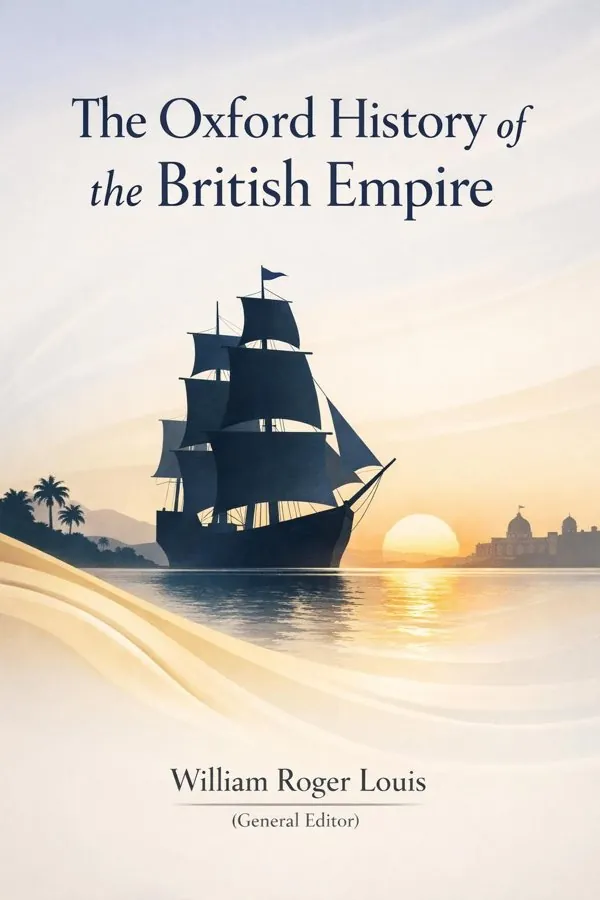
The Oxford History of the British Empire: Summary & Key Insights
by William Roger Louis (General Editor)
 10 min5 chaptersAudio available
What Is The Oxford History of the British Empire About?
The Oxford History of the British Empire by William Roger Louis (General Editor) is a world_history book spanning 5 pages. The Oxford History of the British Empire is a comprehensive five-volume scholarly series that examines the history, impact, and legacy of the British Empire from its origins in the sixteenth century to the end of the twentieth century. Each volume covers a distinct chronological period and thematic focus, written by leading historians and published by Oxford University Press. The series provides an authoritative account of imperial expansion, administration, economics, culture, and decolonization.
This FizzRead summary covers all 5 key chapters of The Oxford History of the British Empire in approximately 10 minutes, distilling the most important ideas, arguments, and takeaways from William Roger Louis (General Editor)'s work. Also available as an audio summary and Key Quotes Podcast.
The Oxford History of the British Empire
The Oxford History of the British Empire is a comprehensive five-volume scholarly series that examines the history, impact, and legacy of the British Empire from its origins in the sixteenth century to the end of the twentieth century. Each volume covers a distinct chronological period and thematic focus, written by leading historians and published by Oxford University Press. The series provides an authoritative account of imperial expansion, administration, economics, culture, and decolonization.
Who Should Read The Oxford History of the British Empire?
This book is perfect for anyone interested in world_history and looking to gain actionable insights in a short read. Whether you're a student, professional, or lifelong learner, the key ideas from The Oxford History of the British Empire by William Roger Louis (General Editor) will help you think differently.
- ✓Readers who enjoy world_history and want practical takeaways
- ✓Professionals looking to apply new ideas to their work and life
- ✓Anyone who wants the core insights of The Oxford History of the British Empire in just 10 minutes
Want the full summary?
Get instant access to this book summary and 100K+ more with Fizz Moment.
Get Free SummaryAvailable on App Store • Free to download
Key Chapters
The first volume begins with exploration—the restless energy that drove English ships across the Atlantic, around Africa, and toward the riches of the East. I wanted readers to sense the uncertainty and improvisation that characterized these early ventures. England’s first overseas experiments were as much acts of imagination as of navigation. The seafarers of the sixteenth century pursued trade and settlement amid fierce competition from Spain and Portugal, while domestic mercantile interests learned to tie distant gains to political influence at home.
By the seventeenth century, colonies had taken root in North America and the Caribbean. These were not planned empires but evolving organisms, shaped by private investment and royal favor. Mercantilist theory emerged as the intellectual frame: colonies existed to enrich the mother country through controlled flows of goods. The Navigation Acts and chartered companies—like the East India Company—embodied this logic, fusing commerce with authority. In this, I emphasize how imperial origins rested upon negotiation between state and private power.
Africa and Asia entered Britain’s imperial world through trade rather than conquest. The slave trade, regrettably central to this era, linked the Atlantic economies into a system of forced labor that underwrote early prosperity. The moral and economic implications are inseparable; slavery was both business and ideology, a system rationalized by those who saw profit as proof of divine sanction. The empire’s beginnings, therefore, were marked by contradiction: aspirations of liberty abroad coexisted with oppression.
What I hope readers grasp here is that empire grew not from grand design, but from cumulative actions—ventures of risk, monopoly, and innovation. Its foundation was maritime mobility, the willingness to imagine global commerce and to reorder traditional society around it. In essence, the British Empire’s origins were the story of a small nation envisioning a world transformed by economic ambition and cultural diffusion.
The eighteenth century saw the empire crystallize into a complex global organism. The Seven Years’ War, often called the first world war, defined imperial boundaries and ambition. In this volume, I trace how conflict brought coherence to the imperial system—Britain’s victory over France confirmed its maritime supremacy and expanded its territorial claims in India and North America. Yet success bred strain: maintaining empire required new forms of administration, finance, and justification.
The imperial state became more systematized through bureaucratic and military structures. Reforms in colonial governance mirrored domestic political evolution, binding colonies more tightly to the metropolis even as settlers chafed under regulation. Economic integration deepened. Sugar plantations, slave labor, and transatlantic trade wove a web of dependency linking London to Kingston, Calcutta, and Quebec. The Atlantic economy was both triumph and trap—a dynamic engine that powered Britain’s global dominance and moral unease.
Cultural transformation accompanied material growth. Migration diversified colonial societies, while slavery and indenture created profound cultural exchanges on every shore. The empire became a crucible for hybrid identities—creole cultures in the Caribbean, Anglo-Indian elites in India, and settler cosmopolitanism in North America. Here, empire was not merely administration but experience, a social environment where the relationship between master and subject shaped art, literature, and religion.
I place particular emphasis on the intellectual life that justified this system. Enlightenment ideals of progress and civilization were often invoked to defend empire as a moral enterprise. Yet beneath the rhetoric lay anxiety: the rebellion of American colonies exposed the fragility of imperial unity. The eighteenth century thus marked both consolidation and the dawning realization that empire carried seeds of its own dissolution.
+ 3 more chapters — available in the FizzRead app
All Chapters in The Oxford History of the British Empire
About the Author
William Roger Louis is an American historian specializing in British imperial history. He served as the Kerr Professor of English History and Culture at the University of Texas at Austin and was the founding director of the British Studies Program. Louis is widely recognized for his contributions to the study of decolonization and the British Empire.
Get This Summary in Your Preferred Format
Read or listen to the The Oxford History of the British Empire summary by William Roger Louis (General Editor) anytime, anywhere. FizzRead offers multiple formats so you can learn on your terms — all free.
Available formats: App · Audio · PDF · EPUB — All included free with FizzRead
Download The Oxford History of the British Empire PDF and EPUB Summary
Key Quotes from The Oxford History of the British Empire
“The first volume begins with exploration—the restless energy that drove English ships across the Atlantic, around Africa, and toward the riches of the East.”
“The eighteenth century saw the empire crystallize into a complex global organism.”
Frequently Asked Questions about The Oxford History of the British Empire
The Oxford History of the British Empire by William Roger Louis (General Editor) is a world_history book that explores key ideas across 5 chapters. The Oxford History of the British Empire is a comprehensive five-volume scholarly series that examines the history, impact, and legacy of the British Empire from its origins in the sixteenth century to the end of the twentieth century. Each volume covers a distinct chronological period and thematic focus, written by leading historians and published by Oxford University Press. The series provides an authoritative account of imperial expansion, administration, economics, culture, and decolonization.
You Might Also Like
The Age of Capital
Eric Hobsbawm
10 min
The Gulag Archipelago
Aleksandr Solzhenitsyn
10 min
Jerusalem: The Biography
Simon Sebag Montefiore
10 min
The Anglo-Saxons
James Campbell
10 min
The Boer War
Thomas Pakenham
10 min
The Industrial Revolutionaries: The Making of the Modern World 1776–1914
Gavin Weightman
10 minBrowse by Category
Ready to read The Oxford History of the British Empire?
Get the full summary and 100K+ more books with Fizz Moment.