
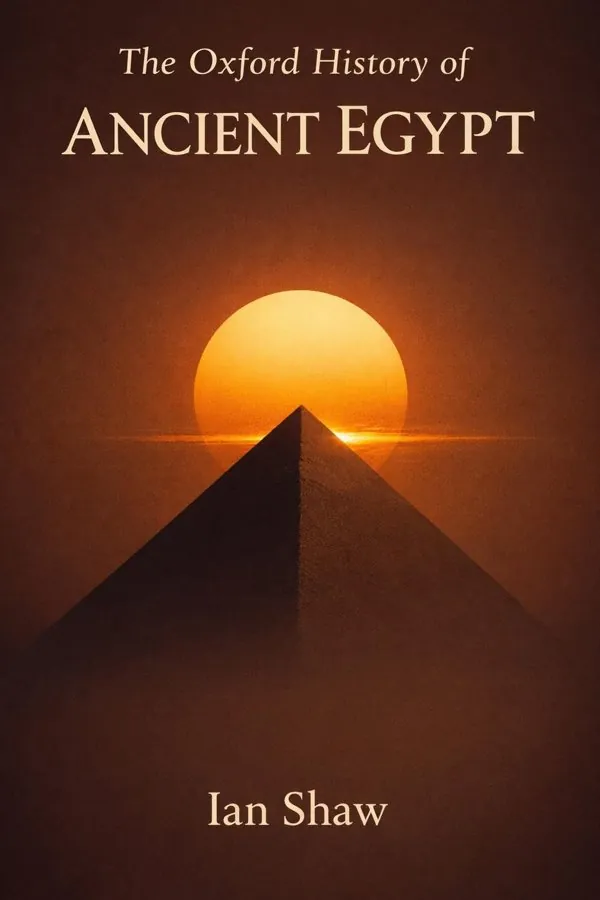
The Oxford History of Ancient Egypt: Summary & Key Insights
by Ian Shaw
 10 min10 chaptersAudio available
What Is The Oxford History of Ancient Egypt About?
The Oxford History of Ancient Egypt by Ian Shaw is a world_history book spanning 10 pages. This comprehensive volume traces the history of ancient Egypt from its prehistoric origins through the Greco-Roman period. Edited by Egyptologist Ian Shaw, it brings together leading scholars to present a detailed and accessible account of Egypt’s political, cultural, and social development over more than three millennia. The book covers major dynasties, archaeological discoveries, and the evolution of art, religion, and governance, offering readers a definitive overview of one of the world’s most influential civilizations.
This FizzRead summary covers all 10 key chapters of The Oxford History of Ancient Egypt in approximately 10 minutes, distilling the most important ideas, arguments, and takeaways from Ian Shaw's work. Also available as an audio summary and Key Quotes Podcast.
The Oxford History of Ancient Egypt
This comprehensive volume traces the history of ancient Egypt from its prehistoric origins through the Greco-Roman period. Edited by Egyptologist Ian Shaw, it brings together leading scholars to present a detailed and accessible account of Egypt’s political, cultural, and social development over more than three millennia. The book covers major dynasties, archaeological discoveries, and the evolution of art, religion, and governance, offering readers a definitive overview of one of the world’s most influential civilizations.
Who Should Read The Oxford History of Ancient Egypt?
This book is perfect for anyone interested in world_history and looking to gain actionable insights in a short read. Whether you're a student, professional, or lifelong learner, the key ideas from The Oxford History of Ancient Egypt by Ian Shaw will help you think differently.
- ✓Readers who enjoy world_history and want practical takeaways
- ✓Professionals looking to apply new ideas to their work and life
- ✓Anyone who wants the core insights of The Oxford History of Ancient Egypt in just 10 minutes
Want the full summary?
Get instant access to this book summary and 100K+ more with Fizz Moment.
Get Free SummaryAvailable on App Store • Free to download
Key Chapters
We begin in the deep prehistory of Egypt, a time before pharaohs and monumental stone. The land was fertile and rich with promise as people who once roamed as hunters and gatherers began to settle along the Nile’s banks. Here, the story of civilization takes shape—not abruptly, but through the slow mastery of resources, technology, and social coordination. Farming emerged from experimentation with cereals and livestock; pottery evolved as a mirror of daily practice and artistic expression; trade linked Upper and Lower Egypt, bringing materials like copper and lapis lazuli that stimulated social differentiation. Archaeological sites such as Hierakonpolis and Naqada reveal communities transitioning toward centralization. Burial customs became more elaborate, reflecting emerging hierarchy and belief in an afterlife. The Early Dynastic Period marks the culmination of this process: the unification of Egypt under Narmer around 3100 BCE, symbolized in the famous palette depicting his victory over northern foes. This was not only political amalgamation but conceptual unity—the birth of the pharaoh as the living embodiment of divine order, or *maat*. Writing emerged in service of administration, and Memphis rose as a capital linking north and south. In these centuries, the blueprint of Egypt’s political and cultural identity took form: centralized kingship, divine legitimacy, bureaucratic order, and an enduring faith in the ordered cosmos. It was here that Egypt began to define itself not merely as a land but as an idea—the kingdom of eternity.
With the Old Kingdom, we enter the golden age of pyramid building—a period that crystallized the ideology of divine kingship. Under the rulers of the Third to Sixth Dynasties, Egypt was a unified and confident state whose resources were directed toward monumental expression. The Step Pyramid of Djoser at Saqqara marked a revolution in architecture and state propaganda, a testament to the genius of Imhotep. Later, at Giza, Khufu, Khafre, and Menkaure raised structures that defied imagination, embodying the eternal aspirations of the royal house. Yet these pyramids were not mere tombs; they were political statements asserting cosmic balance and the pharaoh’s ability to maintain order on earth. Behind these masterpieces lay a complex state apparatus: skilled laborers, administrators, scribes, and an evolving economy capable of sustaining vast projects. In texts like the Pyramid Texts, we glimpse the intimate connection between religion and governance, the pharaoh’s ascent to the heavens as continuation of his rule on earth. By the late Old Kingdom, however, cracks appeared—famines and weakened central control revealed the fragility of such concentrated power. Still, the Old Kingdom’s legacy persisted: the conviction that through the pharaoh’s will, Egypt mirrored cosmic harmony.
+ 8 more chapters — available in the FizzRead app
All Chapters in The Oxford History of Ancient Egypt
About the Author
Ian Shaw is a British Egyptologist and archaeologist, known for his extensive research on ancient Egyptian society, technology, and material culture. He has taught at the University of Liverpool and the University of Oxford and has authored and edited several key works on Egyptology, including 'The Oxford History of Ancient Egypt' and 'Ancient Egyptian Materials and Technology.'
Get This Summary in Your Preferred Format
Read or listen to the The Oxford History of Ancient Egypt summary by Ian Shaw anytime, anywhere. FizzRead offers multiple formats so you can learn on your terms — all free.
Available formats: App · Audio · PDF · EPUB — All included free with FizzRead
Download The Oxford History of Ancient Egypt PDF and EPUB Summary
Key Quotes from The Oxford History of Ancient Egypt
“We begin in the deep prehistory of Egypt, a time before pharaohs and monumental stone.”
“With the Old Kingdom, we enter the golden age of pyramid building—a period that crystallized the ideology of divine kingship.”
Frequently Asked Questions about The Oxford History of Ancient Egypt
The Oxford History of Ancient Egypt by Ian Shaw is a world_history book that explores key ideas across 10 chapters. This comprehensive volume traces the history of ancient Egypt from its prehistoric origins through the Greco-Roman period. Edited by Egyptologist Ian Shaw, it brings together leading scholars to present a detailed and accessible account of Egypt’s political, cultural, and social development over more than three millennia. The book covers major dynasties, archaeological discoveries, and the evolution of art, religion, and governance, offering readers a definitive overview of one of the world’s most influential civilizations.
You Might Also Like
The Age of Capital
Eric Hobsbawm
10 min
The Gulag Archipelago
Aleksandr Solzhenitsyn
10 min
Jerusalem: The Biography
Simon Sebag Montefiore
10 min
The Anglo-Saxons
James Campbell
10 min
The Boer War
Thomas Pakenham
10 min
The Industrial Revolutionaries: The Making of the Modern World 1776–1914
Gavin Weightman
10 minBrowse by Category
Ready to read The Oxford History of Ancient Egypt?
Get the full summary and 100K+ more books with Fizz Moment.