
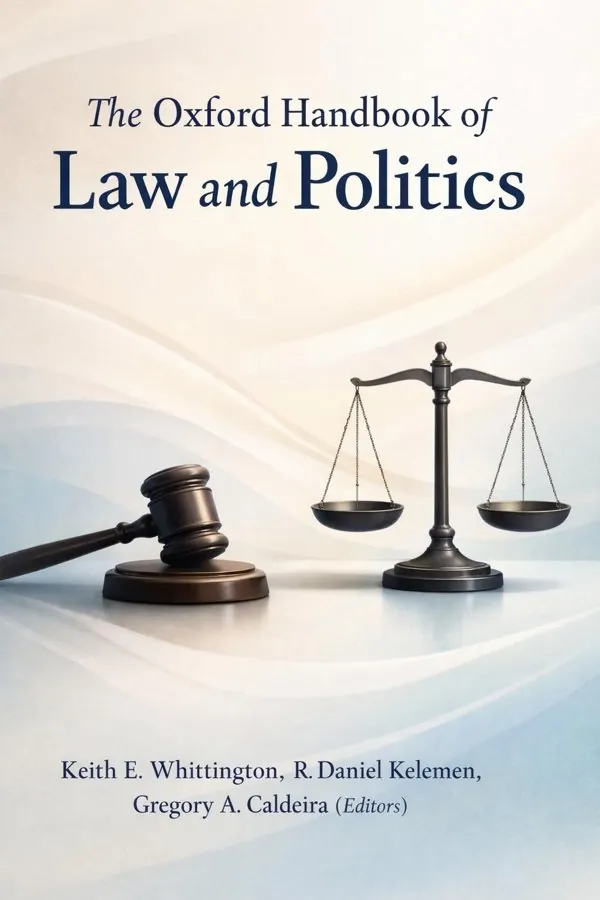
The Oxford Handbook of Law and Politics: Summary & Key Insights
by Keith E. Whittington, R. Daniel Kelemen, Gregory A. Caldeira (Editors)
 10 min9 chaptersAudio available
What Is The Oxford Handbook of Law and Politics About?
The Oxford Handbook of Law and Politics by Keith E. Whittington, R. Daniel Kelemen, Gregory A. Caldeira (Editors) is a law_crime book spanning 9 pages. This comprehensive volume explores the intersection of law and politics, offering a multidisciplinary examination of how legal institutions, political behavior, and constitutional frameworks interact across different systems. It includes contributions from leading scholars addressing topics such as judicial review, constitutional design, comparative legal systems, and the role of courts in democratic governance.
This FizzRead summary covers all 9 key chapters of The Oxford Handbook of Law and Politics in approximately 10 minutes, distilling the most important ideas, arguments, and takeaways from Keith E. Whittington, R. Daniel Kelemen, Gregory A. Caldeira (Editors)'s work. Also available as an audio summary and Key Quotes Podcast.
The Oxford Handbook of Law and Politics
This comprehensive volume explores the intersection of law and politics, offering a multidisciplinary examination of how legal institutions, political behavior, and constitutional frameworks interact across different systems. It includes contributions from leading scholars addressing topics such as judicial review, constitutional design, comparative legal systems, and the role of courts in democratic governance.
Who Should Read The Oxford Handbook of Law and Politics?
This book is perfect for anyone interested in law_crime and looking to gain actionable insights in a short read. Whether you're a student, professional, or lifelong learner, the key ideas from The Oxford Handbook of Law and Politics by Keith E. Whittington, R. Daniel Kelemen, Gregory A. Caldeira (Editors) will help you think differently.
- ✓Readers who enjoy law_crime and want practical takeaways
- ✓Professionals looking to apply new ideas to their work and life
- ✓Anyone who wants the core insights of The Oxford Handbook of Law and Politics in just 10 minutes
Want the full summary?
Get instant access to this book summary and 100K+ more with Fizz Moment.
Get Free SummaryAvailable on App Store • Free to download
Key Chapters
The first part of the Handbook situates the reader in the theoretical landscape connecting law and political science. We start by tracing the evolution of institutionalism, behavioralism, and rational choice theory as the principal frameworks for integrating legal and political analysis. Institutionalism reminds us that politics unfolds within structured systems—constitutions, courts, legislatures—that create both constraints and opportunities. Law, in this sense, is not an afterthought but a key dimension of the political environment. Behavioralism, by contrast, shifts our focus to empirical patterns of behavior: how judges make decisions, how citizens perceive legality, and how political actors strategize within legal rules. Finally, rational choice theory introduces a model of strategic calculation, where judges and legislators pursue their preferences within legal constraints, resulting in an interplay of formal norms and tactical reasoning.
These frameworks do not compete so much as they complement. The field has increasingly embraced methodological pluralism. Scholars now seek to combine normative insights about justice with positive theories about behavior. The point is not to reduce law to politics, nor to elevate law above politics, but to appreciate the mutual constitution of the two. As we edited these chapters, we were conscious of a central message: theoretical clarity is indispensable, but so is humility. Legal and political life are complex, and no single model can capture that entirety.
This section enters the heart of the law–politics nexus: constitutionalism and judicial review. Constitutions embody both political bargains and normative commitments. They define who rules, how power is distributed, and what constraints are binding. Yet every constitution faces a paradox—it seeks to bind political actors while being a product of political will. Judicial review serves as the institutional mechanism that keeps this tension alive and productive. Courts interpret constitutional provisions, asserting authority over elected branches while professing fidelity to democratic principles.
Through comparative perspectives, contributors explore how different systems—from the United States and Europe to emerging democracies—approach the idea of constitutional supremacy. Judicial review, we learn, is not a uniform institution but a flexible concept that adapts to political environments. In some regimes, it performs a protective role for minority rights; in others, it operates as an arbiter of political conflict. The political dynamics surrounding appointment processes, court design, and interpretative philosophies reveal how judicial power is never just legal—it is political authority stabilized through legitimacy.
+ 7 more chapters — available in the FizzRead app
All Chapters in The Oxford Handbook of Law and Politics
About the Authors
Keith E. Whittington is a professor of politics at Princeton University specializing in constitutional theory and American political development. R. Daniel Kelemen is a professor of political science and law at Rutgers University focusing on comparative politics and European Union law. Gregory A. Caldeira is a professor of political science at Ohio State University known for his research on judicial politics and public opinion.
Get This Summary in Your Preferred Format
Read or listen to the The Oxford Handbook of Law and Politics summary by Keith E. Whittington, R. Daniel Kelemen, Gregory A. Caldeira (Editors) anytime, anywhere. FizzRead offers multiple formats so you can learn on your terms — all free.
Available formats: App · Audio · PDF · EPUB — All included free with FizzRead
Download The Oxford Handbook of Law and Politics PDF and EPUB Summary
Key Quotes from The Oxford Handbook of Law and Politics
“The first part of the Handbook situates the reader in the theoretical landscape connecting law and political science.”
“This section enters the heart of the law–politics nexus: constitutionalism and judicial review.”
Frequently Asked Questions about The Oxford Handbook of Law and Politics
The Oxford Handbook of Law and Politics by Keith E. Whittington, R. Daniel Kelemen, Gregory A. Caldeira (Editors) is a law_crime book that explores key ideas across 9 chapters. This comprehensive volume explores the intersection of law and politics, offering a multidisciplinary examination of how legal institutions, political behavior, and constitutional frameworks interact across different systems. It includes contributions from leading scholars addressing topics such as judicial review, constitutional design, comparative legal systems, and the role of courts in democratic governance.
You Might Also Like

Abortion and the Law in America: Roe v. Wade to the Present
Mary Ziegler
10 min
Black Edge: Inside Information, Dirty Money, and the Quest to Bring Down the Most Wanted Man on Wall Street
Sheelah Kolhatkar
10 min
Blood Feud: The Man Who Blew the Whistle on One of the Deadliest Prescription Drugs Ever
Kathleen Sharp
10 min
Catch and Kill: Lies, Spies, and a Conspiracy to Protect Predators
Ronan Farrow
10 min
Chaos: Charles Manson, the CIA, and the Secret History of the Sixties
Tom O'Neill with Dan Piepenbring
10 min
Code and Other Laws of Cyberspace
Lawrence Lessig
10 minBrowse by Category
Ready to read The Oxford Handbook of Law and Politics?
Get the full summary and 100K+ more books with Fizz Moment.