
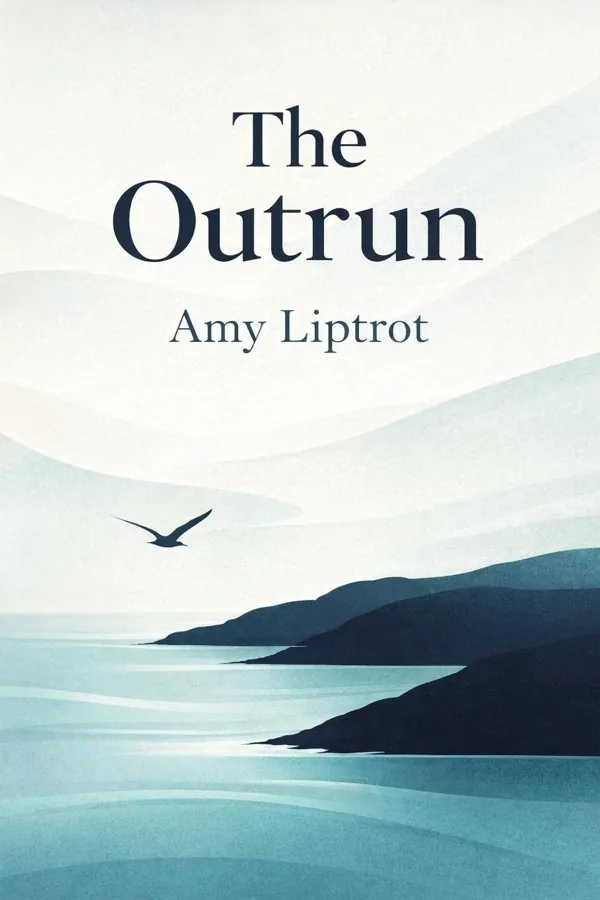
The Outrun: Summary & Key Insights
by Amy Liptrot
 10 min9 chaptersAudio available
Key Takeaways from The Outrun
Sometimes the first step in recovery is not progress but exposure.
Addiction rarely begins at the moment of the first drink; it grows in older soil.
What looks like liberation can quietly become captivity.
Addiction promises expansion but delivers narrowing.
Healing is less like a revelation and more like a practice.
What Is The Outrun About?
The Outrun by Amy Liptrot is a biographies book spanning 8 pages. The Outrun is a memoir of addiction, recovery, and return, but its power lies in how Amy Liptrot refuses to tell that story in a familiar, tidy way. After years of chaotic drinking and self-destruction in London, Liptrot moves back to Orkney, the remote Scottish islands where she grew up. There, amid sea winds, cliffs, rain, birds, and long stretches of solitude, she begins the difficult work of rebuilding a life. What follows is not a simple redemption narrative, but a deeply honest account of relapse, shame, family history, mental illness, and the slow, uneven process of becoming present again. The book matters because it shows recovery not as a dramatic breakthrough, but as attention: to landscapes, weather, memory, routine, and the body. Liptrot writes with rare authority because she has lived every part of this journey, and because she pairs that experience with the precision of a gifted nature writer. The result is a memoir that feels intimate and expansive at once, offering readers both a personal story and a profound meditation on how place can help heal a fractured self.
This FizzRead summary covers all 9 key chapters of The Outrun in approximately 10 minutes, distilling the most important ideas, arguments, and takeaways from Amy Liptrot's work. Also available as an audio summary and Key Quotes Podcast.
The Outrun
The Outrun is a memoir of addiction, recovery, and return, but its power lies in how Amy Liptrot refuses to tell that story in a familiar, tidy way. After years of chaotic drinking and self-destruction in London, Liptrot moves back to Orkney, the remote Scottish islands where she grew up. There, amid sea winds, cliffs, rain, birds, and long stretches of solitude, she begins the difficult work of rebuilding a life. What follows is not a simple redemption narrative, but a deeply honest account of relapse, shame, family history, mental illness, and the slow, uneven process of becoming present again. The book matters because it shows recovery not as a dramatic breakthrough, but as attention: to landscapes, weather, memory, routine, and the body. Liptrot writes with rare authority because she has lived every part of this journey, and because she pairs that experience with the precision of a gifted nature writer. The result is a memoir that feels intimate and expansive at once, offering readers both a personal story and a profound meditation on how place can help heal a fractured self.
Who Should Read The Outrun?
This book is perfect for anyone interested in biographies and looking to gain actionable insights in a short read. Whether you're a student, professional, or lifelong learner, the key ideas from The Outrun by Amy Liptrot will help you think differently.
- ✓Readers who enjoy biographies and want practical takeaways
- ✓Professionals looking to apply new ideas to their work and life
- ✓Anyone who wants the core insights of The Outrun in just 10 minutes
Want the full summary?
Get instant access to this book summary and 100K+ more with Fizz Moment.
Get Free SummaryAvailable on App Store • Free to download
Key Chapters
Sometimes the first step in recovery is not progress but exposure. When Amy Liptrot returns to Orkney after the chaos of London, she does not find comfort waiting for her. She finds wind, emptiness, old memories, and a landscape too honest to flatter her. The islands strip away distraction. In London, alcohol had been woven into nightlife, identity, romance, and routine. Back in Orkney, there are fewer places to hide and fewer ways to perform a version of herself that feels exciting but false. That starkness matters. Recovery begins when the noise drops and a person can no longer avoid what is broken.
Liptrot shows that place is not just background; it shapes consciousness. Orkney’s weather, sea cliffs, and long distances force her to slow down and pay attention. The landscape does not cure her, but it creates conditions in which healing becomes possible. Its isolation is difficult, yet that same isolation interrupts destructive patterns. Instead of bars and blurred nights, there are ferries, farm roads, birds, and changing tides. This shift reveals a practical truth: changing an environment can be a powerful tool when trying to change a life.
Readers can apply this idea without moving to a remote island. Recovery from any harmful habit often requires altering the settings that reinforce it. That might mean avoiding certain social scenes, building quieter routines, or spending more time in places that encourage reflection rather than impulse. Liptrot’s return to Orkney reminds us that healing often starts when we stop seeking stimulation and begin facing reality.
Actionable takeaway: Identify one environment in your life that intensifies unhealthy behavior, and replace it this week with a setting that supports calm, clarity, and honesty.
Addiction rarely begins at the moment of the first drink; it grows in older soil. In The Outrun, Amy Liptrot traces her struggles back through the emotional patterns of childhood, revealing how family life, inherited instability, and the atmosphere of home shape adult vulnerability. Her father’s severe mental illness, her mother’s religious faith, and the peculiar intensity of island life all leave deep marks. Orkney is beautiful, but it is also enclosed, scrutinized, and full of forces larger than any one person. Liptrot learns early that life can be both wondrous and frightening, sacred and chaotic.
This complexity matters because memoirs of addiction often focus too narrowly on individual choices. Liptrot broadens the frame. She does not excuse her behavior, but she places it in context. Her emotional life has roots in fear, longing, displacement, and the unstable rhythms of her family. The result is a more compassionate and truthful portrait of how people become who they are. We inherit stories, habits, silences, and emotional reflexes before we ever make conscious decisions about them.
For readers, this idea offers a practical shift in self-understanding. When trying to change damaging patterns, it helps to ask not only, “Why am I doing this now?” but also, “What earlier experience taught me to cope this way?” A person who overworks, numbs out, or seeks chaos may be replaying old forms of survival. Looking backward can create understanding without turning into blame.
Liptrot also shows that revisiting childhood is not about romantic nostalgia. It is about recognizing the foundations beneath adult behavior. Once those foundations are seen, they can be questioned.
Actionable takeaway: Write down one recurring emotional pattern in your life and trace it back to an early memory, family dynamic, or belief that may have helped create it.
What looks like liberation can quietly become captivity. In London, Amy Liptrot experiences the excitement of urban freedom: parties, relationships, jobs, nightlife, and the electric feeling of becoming someone new. The city offers anonymity and reinvention, especially to someone arriving from a remote rural background. But the same energy that makes London thrilling also makes it dangerous for a person vulnerable to addiction. Drinking is social currency, entertainment, escape, and self-medication all at once. What begins as participation slowly hardens into dependence.
Liptrot’s account is especially sharp because she does not demonize the city. London is not evil, and pleasure is not the enemy. The problem is escalation. In a culture where excess can look glamorous, it becomes difficult to notice when fun turns compulsive. The city rewards intensity: staying out later, being more daring, feeling more alive. Yet addiction thrives in exactly that confusion between vitality and self-destruction. Liptrot captures how easy it is to mistake being overstimulated for being fully alive.
This idea has broad relevance beyond alcohol. Modern life often glorifies overextension, whether through work, social media, dating, spending, or substance use. Environments built around stimulation can normalize imbalance. A practical lesson from Liptrot’s story is to examine whether a habit still serves joy or has begun to demand sacrifice. If you repeatedly wake with regret, blur your boundaries, or need more intensity to feel okay, the pattern may no longer be freedom.
The city in The Outrun becomes a symbol of modern temptation: endless options, endless distraction, and endless opportunities to avoid oneself. Recognizing that dynamic is the start of reclaiming choice.
Actionable takeaway: Review one habit that feels exciting in your life and ask whether it leaves you energized, depleted, or dependent; then set one firm boundary around it.
Addiction promises expansion but delivers narrowing. In The Outrun, Amy Liptrot describes how alcohol first enlarges social life, confidence, and sensation, then gradually reduces everything to a single need. Relationships fray, work becomes unstable, memory fractures, and self-respect erodes. The addict’s world does not remain wide and glamorous; it contracts around obtaining relief. This is one of the memoir’s clearest insights: addiction is not simply too much pleasure. It is the slow replacement of a full life with a repetitive cycle of craving, acting, regretting, and repeating.
Liptrot writes candidly about blackout drinking, emotional chaos, and collapse. She does not sanitize the humiliations or romanticize the damage. Importantly, she shows that addiction distorts time. Instead of moving toward the future, the person becomes trapped in urgent presents and painful aftermaths. Long-term thinking disappears. Commitments, ambitions, and even identity begin to disintegrate. What remains is compulsion.
This idea is useful because it helps people assess harmful patterns by their effects on range. Is your world expanding or shrinking? Are you becoming more capable, more connected, and more present, or more secretive, repetitive, and isolated? This question can reveal dependency even when a person is still functioning outwardly. A life organized around one coping mechanism may look busy, but it is already becoming smaller.
Liptrot’s honesty also encourages compassion. Collapse is not usually one dramatic event; it is a cumulative wearing down of body, mind, and possibility. Seeing addiction as narrowing helps explain why recovery requires rebuilding many dimensions of life, not just removing a substance.
Actionable takeaway: List three areas of your life—relationships, work, and health—and note whether a habit is helping each one grow or causing each one to contract.
Healing is less like a revelation and more like a practice. One of the most important truths in The Outrun is that recovery does not arrive as a single triumphant decision. Amy Liptrot returns to Orkney and begins the painstaking work of staying sober through routines, structure, and repeated acts of restraint. There are no magical transformations. Instead, there are days. Weather to endure, cravings to outlast, distances to walk, jobs to do, and moments to survive without surrendering to old patterns.
This focus on repetition makes the memoir especially credible. Liptrot does not present recovery as a clean upward line. It is uncomfortable, lonely, and often anticlimactic. Yet the monotony itself becomes restorative. In addiction, life was driven by compulsion and intensity. In recovery, value returns through steadiness. Getting up, doing the next right thing, observing rather than acting on an urge—these are the humble mechanics of change.
Readers can apply this insight to any effort at rebuilding. Whether someone is recovering from burnout, heartbreak, anxiety, or substance abuse, the mind often waits for motivation before acting. Liptrot’s story suggests the reverse: action creates momentum. Recovery may begin before belief catches up. A person need not feel transformed to behave differently. Stability can be assembled through repeated choices that seem small but accumulate into identity.
The Outrun therefore reframes strength. It is not dramatic willpower but sustained willingness. A sober day may not feel impressive, but hundreds of such days remake a life. That is both less glamorous and more hopeful than many recovery narratives.
Actionable takeaway: Choose one stabilizing daily behavior—such as a walk, a bedtime, a journal entry, or a support call—and commit to repeating it for the next seven days without exception.
To notice the natural world is, in part, to step outside the tyranny of the self. In Orkney, Amy Liptrot becomes deeply attentive to birds, tides, weather systems, moonlight, and the subtle life of the islands. This is not decorative nature writing added onto a recovery memoir; it is central to the healing process. Addiction traps attention inside craving, shame, and obsession. Nature offers a different scale of perception. It draws the mind outward. A corncrake’s call, a storm front, the habits of seabirds—these phenomena are real, immediate, and not organized around personal drama.
Liptrot’s immersion in the wild helps rebuild her capacity for presence. Observation becomes both discipline and relief. By learning the names, patterns, and behaviors of what surrounds her, she regains concentration that addiction had scattered. This has practical importance. Recovery often depends on replacing compulsive attention with grounded attention. The mind needs something to do besides circle itself.
Nature also offers a model of change that is neither sentimental nor punitive. Storms pass. Seasons turn. Harshness and beauty coexist. Liptrot does not imagine the landscape as gentle therapy. Orkney can be brutal. But its indifference is clarifying. The world is larger than one person’s crisis, and that recognition can be strangely freeing.
Readers do not need access to remote islands to benefit from this lesson. The practical application is intentional observation. Walking in a park, watching birds from a window, learning local plants, or simply noticing sky and weather can interrupt mental fixation. Attention, when directed outward with care, becomes restorative.
Actionable takeaway: Spend 15 minutes each day this week observing one element of the natural world without your phone, and record what you notice in increasing detail.
Many people fear solitude because it removes distraction, but that is exactly why it can transform us. In The Outrun, Amy Liptrot enters long periods of aloneness on Orkney—sometimes by necessity, sometimes by choice. After the hyper-social atmosphere of London and the false intimacy of drinking culture, solitude initially feels stark. Yet over time it becomes a space where she can hear her own mind more clearly and learn to exist without constant external validation.
Liptrot distinguishes solitude from loneliness in a subtle but important way. Loneliness is a painful disconnection; solitude can become an active relationship with one’s surroundings and inner life. On the islands, she works, walks, observes wildlife, and spends time in remote places where there is little to do except attend. In that emptiness, old cravings and anxieties surface, but so does a new sturdiness. She begins to discover that being alone does not mean being abandoned.
This idea is especially relevant in a culture saturated with stimulation. Many harmful habits survive because silence feels unbearable. We reach for our phones, noise, alcohol, busyness, or other people before we have to feel ourselves directly. Liptrot shows that some degree of solitude is necessary for recovery because it reveals both discomfort and capacity. It teaches a person that difficult emotions can be endured without immediate escape.
Practically, this does not mean isolating oneself completely. Healthy solitude is bounded and intentional. It might mean a walk without headphones, an evening offline, or time spent doing something absorbing alone. The goal is not deprivation but familiarity with one’s own company.
Actionable takeaway: Create one short period of intentional solitude this week—30 to 60 minutes without screens, substances, or social contact—and notice what thoughts or feelings emerge when there is nothing to mute them.
Modern life allows us to be constantly connected while remaining deeply estranged from ourselves. In The Outrun, Amy Liptrot reflects on the role of technology, internet culture, and mediated experience in her life on Orkney. Even in remote landscapes, she remains linked to digital worlds. This creates an intriguing tension: physical isolation coexists with virtual access, and simplicity is never absolute. Technology can soothe loneliness, provide information, and open communities, but it can also fragment attention and offer yet another way to avoid direct experience.
Liptrot’s insight is not anti-technology. Rather, she notices how screens can become a substitute for embodiment. A person may scroll, message, search, or post instead of fully inhabiting the immediate world. For someone recovering from addiction, this matters because compulsive habits often migrate rather than disappear. If alcohol no longer dominates consciousness, another form of escape can take its place. The underlying issue is the urge to leave the present.
This makes her reflections especially contemporary. Recovery in the digital age is not just about eliminating substances; it is about guarding attention. We live amid systems designed to capture and redirect focus. Liptrot’s commitment to birdwatching, outdoor labor, and sensory awareness becomes a quiet resistance to disembodied living.
Readers can apply this lesson by examining when technology serves genuine connection and when it merely fills emotional gaps. Useful questions include: Does this make me more present or more scattered? More informed or more numb? More connected or more performative? Simplicity is not the absence of tools but the wise use of them.
Actionable takeaway: Set one daily tech-free window, even just 30 minutes, and use it for an embodied activity such as walking, cooking, observing nature, or writing by hand.
Real resilience begins when we stop demanding that life become easier before we agree to live it. By the end of The Outrun, Amy Liptrot does not arrive at a flawless self or a permanently serene existence. What she gains is more durable: acceptance. She learns that recovery does not erase vulnerability, family history, loneliness, or the pull of old habits. Instead, it creates the capacity to live with these realities without being ruled by them. This is the memoir’s deepest emotional achievement.
Acceptance in Liptrot’s telling is not passive resignation. It is an active form of honesty. She accepts the severity of her addiction, the complexity of her parents, the instability that has shaped her, and the wildness of the landscape she calls home. That honesty allows her to stop fighting reality and start responding to it. Resilience emerges not from control but from adaptation.
This distinction is practical and important. Many people make change harder by tying it to perfection. They assume healing means never struggling, never relapsing emotionally, never feeling grief or desire again. Liptrot offers a more workable model. Balance is dynamic, not fixed. A strong life can still contain difficulty. In fact, resilience often grows precisely through learning how to absorb setbacks without collapsing into self-destruction.
For readers, the lesson is to replace impossible standards with sustainable truthfulness. You do not need to feel cured to move forward. You need enough self-knowledge to recognize danger, enough humility to seek support, and enough patience to keep going. Acceptance is not the end of the journey; it is what makes the journey livable.
Actionable takeaway: Identify one part of your life you keep resisting—an emotion, limitation, or unresolved reality—and write one honest sentence about how accepting it might help you respond more wisely.
All Chapters in The Outrun
About the Author
Amy Liptrot is a British writer and journalist from the Orkney Islands in Scotland. She is best known for The Outrun, her acclaimed debut memoir, which blends personal narrative with luminous nature writing to explore addiction, recovery, family, and the healing power of place. Before publishing the book, Liptrot lived in London, where she worked in various media-related roles while struggling with alcoholism. Her return to Orkney and the sober life she built there became the foundation of her writing. Liptrot has been praised for her clear, lyrical prose and her ability to connect intimate experience with the wider natural world. The Outrun won major literary recognition and established her as a distinctive voice in contemporary nonfiction.
Get This Summary in Your Preferred Format
Read or listen to the The Outrun summary by Amy Liptrot anytime, anywhere. FizzRead offers multiple formats so you can learn on your terms — all free.
Available formats: App · Audio · PDF · EPUB — All included free with FizzRead
Download The Outrun PDF and EPUB Summary
Key Quotes from The Outrun
“Sometimes the first step in recovery is not progress but exposure.”
“Addiction rarely begins at the moment of the first drink; it grows in older soil.”
“What looks like liberation can quietly become captivity.”
“Addiction promises expansion but delivers narrowing.”
“Healing is less like a revelation and more like a practice.”
Frequently Asked Questions about The Outrun
The Outrun by Amy Liptrot is a biographies book that explores key ideas across 9 chapters. The Outrun is a memoir of addiction, recovery, and return, but its power lies in how Amy Liptrot refuses to tell that story in a familiar, tidy way. After years of chaotic drinking and self-destruction in London, Liptrot moves back to Orkney, the remote Scottish islands where she grew up. There, amid sea winds, cliffs, rain, birds, and long stretches of solitude, she begins the difficult work of rebuilding a life. What follows is not a simple redemption narrative, but a deeply honest account of relapse, shame, family history, mental illness, and the slow, uneven process of becoming present again. The book matters because it shows recovery not as a dramatic breakthrough, but as attention: to landscapes, weather, memory, routine, and the body. Liptrot writes with rare authority because she has lived every part of this journey, and because she pairs that experience with the precision of a gifted nature writer. The result is a memoir that feels intimate and expansive at once, offering readers both a personal story and a profound meditation on how place can help heal a fractured self.
You Might Also Like

An American Marriage
Tayari Jones
10 min
Benjamin Franklin: An American Life
Walter Isaacson
10 min
I Know Why The Caged Bird Sings
Maya Angelou
10 min
Long Walk to Freedom
Nelson Mandela
10 min
Persepolis
Marjane Satrapi
10 min
Surely You're Joking, Mr. Feynman!
Richard P. Feynman
10 minBrowse by Category
Ready to read The Outrun?
Get the full summary and 100K+ more books with Fizz Moment.