
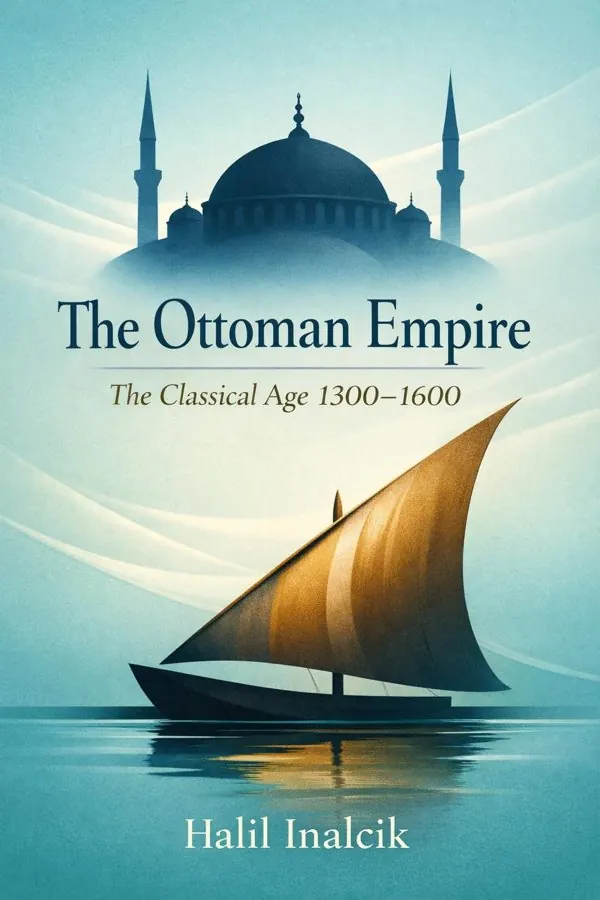
The Ottoman Empire: The Classical Age 1300–1600: Summary & Key Insights
 10 min5 chaptersAudio available
What Is The Ottoman Empire: The Classical Age 1300–1600 About?
The Ottoman Empire: The Classical Age 1300–1600 by Halil Inalcik is a world_history book spanning 5 pages. This book examines the Ottoman Empire from its foundation to the early seventeenth century. Halil Inalcik provides a detailed analysis of the empire’s political structure, social organization, and economic system during its classical age. It is widely regarded as a fundamental source in Ottoman historiography.
This FizzRead summary covers all 5 key chapters of The Ottoman Empire: The Classical Age 1300–1600 in approximately 10 minutes, distilling the most important ideas, arguments, and takeaways from Halil Inalcik's work. Also available as an audio summary and Key Quotes Podcast.
The Ottoman Empire: The Classical Age 1300–1600
This book examines the Ottoman Empire from its foundation to the early seventeenth century. Halil Inalcik provides a detailed analysis of the empire’s political structure, social organization, and economic system during its classical age. It is widely regarded as a fundamental source in Ottoman historiography.
Who Should Read The Ottoman Empire: The Classical Age 1300–1600?
This book is perfect for anyone interested in world_history and looking to gain actionable insights in a short read. Whether you're a student, professional, or lifelong learner, the key ideas from The Ottoman Empire: The Classical Age 1300–1600 by Halil Inalcik will help you think differently.
- ✓Readers who enjoy world_history and want practical takeaways
- ✓Professionals looking to apply new ideas to their work and life
- ✓Anyone who wants the core insights of The Ottoman Empire: The Classical Age 1300–1600 in just 10 minutes
Want the full summary?
Get instant access to this book summary and 100K+ more with Fizz Moment.
Get Free SummaryAvailable on App Store • Free to download
Key Chapters
The Ottoman Empire arose from the margins of Byzantium and the Seljuk world—a frontier principality led by Osman Bey around the turn of the fourteenth century. Its environment was fluid, neither fully Christian nor Muslim in political allegiance, a zone where warriors, migrants, and mystics mingled. I emphasize that the Ottoman beginnings cannot be understood as a simple military conquest; they were the product of frontier society, shaped by the ethos of the ghazi, the holy warrior who fought for faith but also sought opportunity.
Osman’s leadership combined charisma, pragmatic politics, and patronage of religious orders that legitimized expansion. His son Orhan consolidated the gains through organization—establishing coinage, taxation, and a rudimentary bureaucracy in Bursa after its conquest. The Ottomans absorbed elements from Byzantine and Seljuk traditions but gave them new form. The early system of land grants to warriors and officials foreshadowed the timar structure, and alliances with local Christian notables demonstrated a willingness to adapt. In tracing these beginnings, I show how flexibility, rather than rigid ideology, laid the foundation for empire.
By the time of Murad I and the conquest of Edirne, the frontier principality had evolved into a regional power. The Ottomans developed a permanent military structure and instituted the practice of devşirme, the recruitment of Christian youths into imperial service. Here we see the synthesis of frontier dynamism and bureaucratic rationality—a synthesis that would define Ottoman governance for generations. It was not destiny but deliberate statecraft that transformed this modest principality into a political organism capable of imperial rule.
The reign of Mehmed II, the Conqueror of Constantinople, marks the decisive moment of Ottoman centralization. In my analysis, Mehmed embodied the dual principle of Ottoman sovereignty: the ruler as both the source of law and the guarantor of order under divine legitimization. His conquest of 1453 was more than military triumph—it was institutional revolution. By establishing Istanbul as the imperial capital, he reorganized administration, codified law, and set the hierarchy of officials that would define the classical Ottoman polity.
I explain how the kanun, or sultanic law, complemented Islamic sharia. Mehmed’s codification did not abolish religious law but ordered it within a comprehensive system of governance. His law codes regulated land tenure, taxation, and the responsibilities of administrators. The sultan’s authority reached every level of the empire, yet the system depended on negotiation and consensus within the ruling elite. The Divan—the imperial council—acted as an instrument of deliberation, allowing viziers and secretaries to execute policy.
Mehmed’s vision was bureaucratic as well as imperial. He developed the training system for administrators through the palace schools and reorganized the service hierarchy that connected the palace, the army, and the provinces. This was the true birth of the Ottoman imperial state—a state that united personal rule and institutional order. In examining Mehmed II, I underscore the enduring principle of Ottoman governance: centralized control achieved not through coercion alone, but through law, discipline, and administrative intelligence.
+ 3 more chapters — available in the FizzRead app
All Chapters in The Ottoman Empire: The Classical Age 1300–1600
About the Author
Halil Inalcik (1916–2016) was a Turkish historian renowned for his research on the social, economic, and political history of the Ottoman Empire. He taught for many years at Ankara University and the University of Chicago and is considered one of the foremost authorities on Ottoman studies.
Get This Summary in Your Preferred Format
Read or listen to the The Ottoman Empire: The Classical Age 1300–1600 summary by Halil Inalcik anytime, anywhere. FizzRead offers multiple formats so you can learn on your terms — all free.
Available formats: App · Audio · PDF · EPUB — All included free with FizzRead
Download The Ottoman Empire: The Classical Age 1300–1600 PDF and EPUB Summary
Key Quotes from The Ottoman Empire: The Classical Age 1300–1600
“The Ottoman Empire arose from the margins of Byzantium and the Seljuk world—a frontier principality led by Osman Bey around the turn of the fourteenth century.”
“The reign of Mehmed II, the Conqueror of Constantinople, marks the decisive moment of Ottoman centralization.”
Frequently Asked Questions about The Ottoman Empire: The Classical Age 1300–1600
The Ottoman Empire: The Classical Age 1300–1600 by Halil Inalcik is a world_history book that explores key ideas across 5 chapters. This book examines the Ottoman Empire from its foundation to the early seventeenth century. Halil Inalcik provides a detailed analysis of the empire’s political structure, social organization, and economic system during its classical age. It is widely regarded as a fundamental source in Ottoman historiography.
You Might Also Like
The Age of Capital
Eric Hobsbawm
10 min
The Gulag Archipelago
Aleksandr Solzhenitsyn
10 min
Jerusalem: The Biography
Simon Sebag Montefiore
10 min
The Anglo-Saxons
James Campbell
10 min
The Boer War
Thomas Pakenham
10 min
The Industrial Revolutionaries: The Making of the Modern World 1776–1914
Gavin Weightman
10 minBrowse by Category
Ready to read The Ottoman Empire: The Classical Age 1300–1600?
Get the full summary and 100K+ more books with Fizz Moment.