
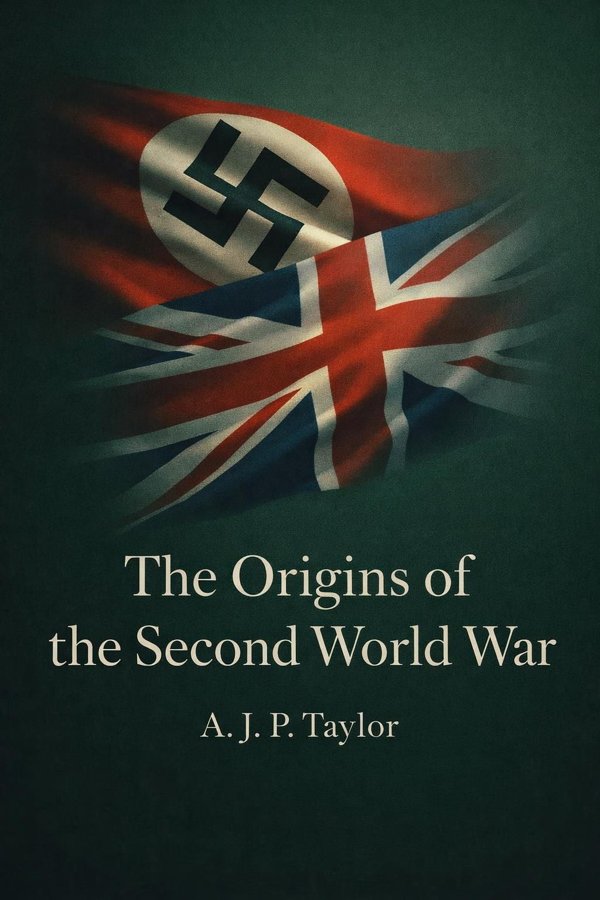
The Origins of the Second World War: Summary & Key Insights
 10 min10 chaptersAudio available
What Is The Origins of the Second World War About?
The Origins of the Second World War by A. J. P. Taylor is a world_history book spanning 10 pages. A.J.P. Taylor’s influential work reinterprets the causes of the Second World War, arguing that the conflict was not the result of a deliberate plan by Hitler but rather a series of miscalculations and diplomatic failures by European powers. The book challenges conventional narratives and provoked intense debate among historians for its revisionist stance.
This FizzRead summary covers all 10 key chapters of The Origins of the Second World War in approximately 10 minutes, distilling the most important ideas, arguments, and takeaways from A. J. P. Taylor's work. Also available as an audio summary and Key Quotes Podcast.
The Origins of the Second World War
A.J.P. Taylor’s influential work reinterprets the causes of the Second World War, arguing that the conflict was not the result of a deliberate plan by Hitler but rather a series of miscalculations and diplomatic failures by European powers. The book challenges conventional narratives and provoked intense debate among historians for its revisionist stance.
Who Should Read The Origins of the Second World War?
This book is perfect for anyone interested in world_history and looking to gain actionable insights in a short read. Whether you're a student, professional, or lifelong learner, the key ideas from The Origins of the Second World War by A. J. P. Taylor will help you think differently.
- ✓Readers who enjoy world_history and want practical takeaways
- ✓Professionals looking to apply new ideas to their work and life
- ✓Anyone who wants the core insights of The Origins of the Second World War in just 10 minutes
Want the full summary?
Get instant access to this book summary and 100K+ more with Fizz Moment.
Get Free SummaryAvailable on App Store • Free to download
Key Chapters
After 1919, Europe found itself under a peace that was neither stable nor just. The Treaty of Versailles, hailed initially as the instrument of lasting settlement, was in fact a blueprint for enduring disorder. The victors — above all France, Britain, and the United States — imposed terms designed not to reconcile Germany but to constrain her permanently. Reparation payments, territorial losses, and military restrictions created resentment that was both political and psychological. It was a humiliation carried into every level of German life.
I found when examining the documents from Versailles that the treaty was less about crafting peace than preserving supremacy. France sought security through punishment; Britain hoped for balance but lacked commitment; the Americans, though idealistic under Wilson, soon withdrew into isolation. Germany had to sign what it could not honor, and Europe inherited what it could not manage. The new borders imposed across Central and Eastern Europe disrupted economies and national identities. Everyone emerged dissatisfied, and thus everyone became prepared for revision.
I do not argue, as some do, that the war was inevitable from Versailles — but Versailles made inevitable the struggle for adjustment. Every state after 1919 engaged in diplomacy with that adjustment in mind. Traditional power politics survived intact: security continued to depend on balance, not cooperation. The failure of Europe’s leaders was not that they made cruel peace; it was that they believed stability could spring from punishment. In such an atmosphere, Hitler’s later demands seemed less radical, more like logical extensions of perpetual revisions that began immediately after the treaty was signed.
During the 1920s and early 1930s, Europe oscillated between hope and helplessness. The League of Nations, created to ensure collective security, was fatally flawed from birth. It represented the moral aspiration of peace, yet lacked the real instruments of enforcement. Britain and France were its supposed leaders, but neither was ready to sacrifice national interest for international duty. The result was gesture without authority.
I have always regarded the League’s history as a sequence of noble declarations followed by impotent responses. When Japan invaded Manchuria, when Italy attacked Abyssinia, when Germany withdrew — the League protested, passed resolutions, but did nothing effective. Collective security collapsed into collective hesitation. Nations continued to act in isolation, measuring risk against domestic constraint.
The interwar years also demonstrated Europe’s psychology of fear. Both Britain and France dreaded war more than injustice. Their policies were constrained by memory of 1914–18 — by the immense loss and by the conviction that another war would end civilization. This fear did not make them pacifist but paralyzed them into appeasement. It shaped every decision that followed. Diplomacy became defensive; negotiation replaced initiative. The structure of international relations reflected not progress but paralysis.
+ 8 more chapters — available in the FizzRead app
All Chapters in The Origins of the Second World War
About the Author
Alan John Percivale Taylor (1906–1990) was a British historian known for his accessible and provocative works on European and diplomatic history. A prolific writer and broadcaster, Taylor was one of the most prominent historians of the mid-20th century, noted for his sharp wit and revisionist interpretations of major historical events.
Get This Summary in Your Preferred Format
Read or listen to the The Origins of the Second World War summary by A. J. P. Taylor anytime, anywhere. FizzRead offers multiple formats so you can learn on your terms — all free.
Available formats: App · Audio · PDF · EPUB — All included free with FizzRead
Download The Origins of the Second World War PDF and EPUB Summary
Key Quotes from The Origins of the Second World War
“After 1919, Europe found itself under a peace that was neither stable nor just.”
“During the 1920s and early 1930s, Europe oscillated between hope and helplessness.”
Frequently Asked Questions about The Origins of the Second World War
The Origins of the Second World War by A. J. P. Taylor is a world_history book that explores key ideas across 10 chapters. A.J.P. Taylor’s influential work reinterprets the causes of the Second World War, arguing that the conflict was not the result of a deliberate plan by Hitler but rather a series of miscalculations and diplomatic failures by European powers. The book challenges conventional narratives and provoked intense debate among historians for its revisionist stance.
You Might Also Like
The Age of Capital
Eric Hobsbawm
10 min
The Gulag Archipelago
Aleksandr Solzhenitsyn
10 min
Jerusalem: The Biography
Simon Sebag Montefiore
10 min
The Anglo-Saxons
James Campbell
10 min
The Boer War
Thomas Pakenham
10 min
The Industrial Revolutionaries: The Making of the Modern World 1776–1914
Gavin Weightman
10 minBrowse by Category
Ready to read The Origins of the Second World War?
Get the full summary and 100K+ more books with Fizz Moment.