
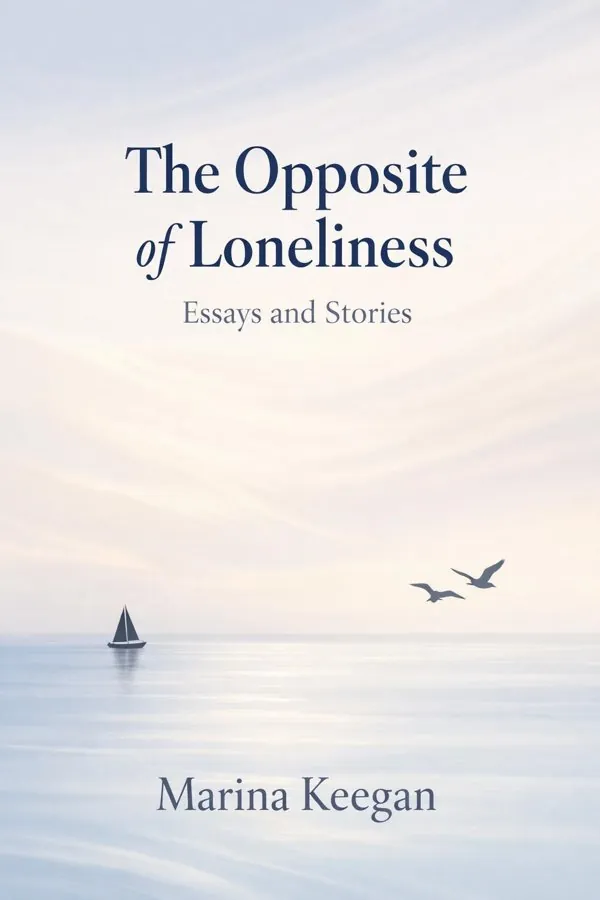
The Opposite of Loneliness: Essays and Stories: Summary & Key Insights
 10 min9 chaptersAudio available
Key Takeaways from The Opposite of Loneliness: Essays and Stories
One of the hardest truths about youth is that possibility can feel as heavy as limitation.
The awareness that life is fragile can either paralyze us or wake us up.
Sometimes fiction tells the truth more intimately than confession.
Loneliness is not always the absence of people; often, it is the absence of felt belonging.
Achievement without inner purpose can become a polished form of emptiness.
What Is The Opposite of Loneliness: Essays and Stories About?
The Opposite of Loneliness: Essays and Stories by Marina Keegan is a biographies book spanning 4 pages. The Opposite of Loneliness: Essays and Stories is a posthumous collection that gathers Marina Keegan’s essays, journalism, and fiction into a portrait of a remarkable young writer standing at the threshold of adult life. Written during her years at Yale and just after graduation, these pieces explore ambition, friendship, family, love, mortality, and the uneasy freedom that comes with realizing your life is finally your own. The collection matters not only because of the tragedy surrounding Keegan’s early death, but because her work articulates emotions that many people feel and struggle to name: the pressure to become someone extraordinary, the fear of wasting potential, and the deep need to belong to one another. Keegan writes with unusual clarity, emotional intelligence, and moral seriousness, moving easily between personal reflection and imagined lives. Her authority comes from that rare combination of literary talent and lived immediacy. She does not write as a distant expert, but as someone inside the confusion of youth, trying to make sense of it honestly. The result is a book that feels intimate, urgent, and enduring.
This FizzRead summary covers all 9 key chapters of The Opposite of Loneliness: Essays and Stories in approximately 10 minutes, distilling the most important ideas, arguments, and takeaways from Marina Keegan's work. Also available as an audio summary and Key Quotes Podcast.
The Opposite of Loneliness: Essays and Stories
The Opposite of Loneliness: Essays and Stories is a posthumous collection that gathers Marina Keegan’s essays, journalism, and fiction into a portrait of a remarkable young writer standing at the threshold of adult life. Written during her years at Yale and just after graduation, these pieces explore ambition, friendship, family, love, mortality, and the uneasy freedom that comes with realizing your life is finally your own. The collection matters not only because of the tragedy surrounding Keegan’s early death, but because her work articulates emotions that many people feel and struggle to name: the pressure to become someone extraordinary, the fear of wasting potential, and the deep need to belong to one another. Keegan writes with unusual clarity, emotional intelligence, and moral seriousness, moving easily between personal reflection and imagined lives. Her authority comes from that rare combination of literary talent and lived immediacy. She does not write as a distant expert, but as someone inside the confusion of youth, trying to make sense of it honestly. The result is a book that feels intimate, urgent, and enduring.
Who Should Read The Opposite of Loneliness: Essays and Stories?
This book is perfect for anyone interested in biographies and looking to gain actionable insights in a short read. Whether you're a student, professional, or lifelong learner, the key ideas from The Opposite of Loneliness: Essays and Stories by Marina Keegan will help you think differently.
- ✓Readers who enjoy biographies and want practical takeaways
- ✓Professionals looking to apply new ideas to their work and life
- ✓Anyone who wants the core insights of The Opposite of Loneliness: Essays and Stories in just 10 minutes
Want the full summary?
Get instant access to this book summary and 100K+ more with Fizz Moment.
Get Free SummaryAvailable on App Store • Free to download
Key Chapters
One of the hardest truths about youth is that possibility can feel as heavy as limitation. In The Opposite of Loneliness, Marina Keegan captures the emotional contradiction of early adulthood: young people are told they can become anything, yet that very openness creates anxiety, comparison, and self-doubt. Her essays describe a generation shaped by achievement, surrounded by opportunity, and still haunted by the suspicion that they may not be doing enough with their lives. This tension gives the collection much of its pulse.
Keegan is especially perceptive about how identity is formed in environments like elite universities, where ambition is constant and self-definition becomes a kind of competition. Her work suggests that uncertainty is not a sign of failure but an unavoidable stage of becoming. The polished public self often hides confusion, loneliness, and fear. In this sense, the book speaks to anyone who has felt pressure to seem certain before they actually are.
The practical value of this idea is significant. Many readers, especially students and young professionals, feel behind because their path is unclear. Keegan offers a gentler framework: uncertainty may be evidence that you are still growing, testing values, and discovering what matters to you. Rather than forcing a fixed identity too early, she models curiosity, emotional honesty, and openness to change.
A useful application is to notice where your ambitions are truly yours and where they are borrowed from the expectations of peers, institutions, or family. Ask not only, “What can I achieve?” but also, “What kind of life feels meaningful to me?” The actionable takeaway: treat uncertainty as part of self-creation, and give yourself permission to become before demanding that you already be fully defined.
The awareness that life is fragile can either paralyze us or wake us up. Keegan’s collection is permeated by a sense of impermanence, not in a gloomy or purely tragic way, but as a force that heightens attention, tenderness, and urgency. Her writing repeatedly returns to the unsettling fact that youth often feels invincible while knowing, at some level, that nothing is guaranteed. This tension gives her essays and stories their emotional charge.
Keegan explores mortality not as an abstract philosophical problem but as something that shapes how we love, work, and choose. The fragility of life makes small moments matter more: a conversation, a shared apartment, a family ritual, a friendship you assume will always be there. Her work suggests that authenticity begins when we stop imagining that we have unlimited time to postpone honesty, courage, or care.
In practical terms, this idea asks readers to reconsider what they defer. Many people postpone creative work until they feel established, postpone difficult conversations until the timing seems perfect, or postpone joy until some imagined future version of life. Keegan’s perspective argues against that delay. Living fully does not require dramatic reinvention; it often means becoming more present, more sincere, and more willing to act before certainty arrives.
For example, mortality awareness can encourage someone to reconnect with a friend, start a project they keep delaying, or stop performing a life that looks impressive but feels empty. It can also deepen gratitude for ordinary time. The actionable takeaway: let the fragility of life clarify your priorities—choose one neglected relationship, value, or creative impulse and honor it now rather than waiting for a later moment that may never come.
Loneliness is not always the absence of people; often, it is the absence of felt belonging. The central emotional insight of Keegan’s most famous essay—and of the collection as a whole—is that human life is sustained by connection. We are shaped by dorm rooms, friendships, families, collaborations, shared meals, late-night conversations, and the quiet certainty that our lives are intertwined. Keegan names a feeling many readers recognize but rarely define: the sense that community can soften the fear of uncertainty.
Her phrase “the opposite of loneliness” points to more than companionship. It suggests mutual recognition, a web of attachment in which people hold one another through transition. This is especially powerful at moments when life is changing rapidly—graduation, moving cities, career shifts, breakups, grief. In such moments, people often assume they must become radically self-sufficient. Keegan argues, implicitly and explicitly, that dependence and connection are not weaknesses but basic human conditions.
Applied practically, this idea encourages readers to build intentional communities rather than waiting passively for belonging to happen. That may mean nurturing friendships with more honesty, participating in shared projects, asking for help, or making room for rituals that reinforce connection. It also means resisting the cultural pressure to curate an image of total independence.
A simple example is replacing transactional contact with meaningful reach-outs: inviting a friend to a real conversation instead of exchanging only updates, or creating recurring gatherings that make relationships durable over time. Connection does not eliminate loneliness permanently, but it gives us structures of return. The actionable takeaway: choose one relationship or community you value and invest in it deliberately this week through time, honesty, and consistent presence.
Achievement without inner purpose can become a polished form of emptiness. Keegan writes from within a culture of high ambition, where intelligence and talent are abundant but often accompanied by exhaustion, insecurity, and quiet fear. Her work does not reject ambition; rather, it asks what ambition is for. Success, she suggests, becomes hollow when detached from values, relationships, and a deeper sense of contribution.
This is one of the collection’s most relevant themes for contemporary readers. Many people are trained to optimize: grades, internships, networks, titles, output, visibility. Yet few are taught how to examine whether their striving reflects genuine desire or social conditioning. Keegan’s essays imply that ambition should be interrogated, not merely celebrated. A meaningful life is not built only from accomplishment but from alignment between action and conviction.
The distinction matters in practice. Someone might pursue a prestigious career path because it promises approval, while privately feeling creatively starved or ethically uneasy. Another person may define success more broadly: work that matters, room for friendship, time for art, emotional presence, integrity in daily choices. Keegan’s writing encourages readers to notice these differences before life hardens around borrowed definitions of achievement.
A practical way to apply this is to evaluate major goals through three questions: Does this path energize me? Does it reflect my values? Will it leave room for the relationships and forms of aliveness I care about? Ambition is healthiest when it enlarges life instead of consuming it. The actionable takeaway: rewrite one current goal in value-based terms—not just what you want to achieve, but why it matters and what kind of person you want to remain while pursuing it.
A meaningful life is often built not through grand turning points but through small acts of attention. Throughout Keegan’s work, ordinary scenes—a conversation with family, a college ritual, a fleeting encounter, a moment of hesitation—carry emotional and ethical significance. She reminds readers that everyday life is not the background to meaning; it is where meaning actually happens.
This sensitivity to the ordinary is one reason the collection feels intimate and lasting. Keegan notices how much is embedded in routine moments: affection left unspoken, assumptions about time, the quiet labor of friendship, the hidden vulnerability inside casual interactions. By paying close attention, she reveals that our daily choices communicate values. How we respond to someone’s sadness, whether we show up, whether we listen, whether we let busyness excuse neglect—these are moral decisions, even when they appear minor.
For readers, this has practical implications. It shifts the focus from dramatic self-reinvention to daily presence. Instead of waiting to become a better person through one major breakthrough, we can practice care through small, repeatable actions: answering thoughtfully, noticing who is excluded, expressing gratitude, being on time, offering patience, following through. These behaviors create the texture of a life and the trust within relationships.
The idea also counters a culture that overvalues spectacle. Not every meaningful action will look impressive or publicly measurable. Often the most important things are private and quiet. The actionable takeaway: identify one ordinary habit that could better reflect your values—such as listening without distraction, checking in on someone consistently, or expressing appreciation more freely—and practice it daily for a week.
We often do not fully understand our emotions until language gives them shape. One of Keegan’s gifts as a writer is her ability to articulate diffuse feelings—restlessness, tenderness, anticipatory grief, communal affection, fear of wasted potential—in a way that makes readers feel seen. The collection demonstrates a central truth about art: it helps transform inchoate experience into recognizable meaning.
This matters because many forms of suffering are intensified by vagueness. When a person feels unsettled but cannot explain why, they may assume the problem is personal weakness or confusion. Writing, stories, and essays can interrupt that isolation by offering forms through which experience becomes legible. Keegan does this not by simplifying complexity but by honoring it. She gives language to contradictory emotions, allowing readers to see that mixed feelings are not defects but features of being human.
In practical life, this suggests that reading and writing are not luxuries but tools for self-knowledge. Journaling after a major transition, annotating passages that resonate, discussing a story with a friend, or even drafting letters never sent can help clarify what one values or fears. Art does not solve every problem, but it creates the conditions for more conscious living by helping us identify what is actually happening inside us.
For example, someone reading Keegan during a period of transition may realize that what they called laziness is really grief, or what they called ambition is partly fear. That recognition can change decisions. The actionable takeaway: keep a short “language journal” this week—write down one sentence from a book or one sentence of your own each day that captures something you have been feeling but struggling to express.
Major life transitions do not merely change our circumstances; they reveal our attachments, fears, and unfinished questions. Keegan writes powerfully from the brink of transition—graduation, departure, entry into adulthood—and shows how these threshold moments intensify self-awareness. When one chapter ends, the structures that once defined us loosen, and we are forced to ask what remains.
This is why the collection resonates beyond the college experience. Anyone moving through transition—starting a job, leaving a city, ending a relationship, becoming a parent, grieving a loss—can recognize the emotional instability Keegan describes. Transitions often expose hidden dependence on institutions, roles, routines, or communities. They also awaken possibility. What feels like disorientation may be the beginning of a more self-authored life.
Keegan’s writing suggests that transitions should not be treated only as logistical problems to manage. They are also interpretive moments. They invite reflection on what we are carrying forward and what we need to release. The anxiety of transition often comes from trying to preserve an old identity while stepping into a new context. Growth requires a willingness to let some certainty fall away.
A practical application is to mark transitions deliberately. Instead of rushing through them, create space for review: What did this period teach me? What relationships do I want to preserve? What values feel more real now than before? Rituals, letters, conversations, or personal reflection can make change more meaningful and less chaotic. The actionable takeaway: when entering or leaving a major life phase, take one hour to reflect on what you are intentionally carrying with you—and what you are ready to leave behind.
Hope is most meaningful when it survives contact with uncertainty. Keegan’s work is often described as hopeful, but its hope is not simplistic optimism. It emerges alongside anxiety, mortality, disappointment, and vulnerability. She does not deny that life is unstable or that people hurt one another. Instead, she insists—through tone, subject, and attention—that connection, purpose, and joy remain possible within that instability.
This distinction is important. Naive optimism assumes things will work out automatically. Keegan’s form of hope is more demanding. It requires choosing investment over cynicism, sincerity over irony, and participation over emotional withdrawal. In a world where detachment is often used as self-protection, her writing argues that hope is a kind of courage. To care deeply about work, people, ideals, or beauty is to risk disappointment, but refusing care is its own impoverishment.
Practically, this can shape how readers respond to uncertain futures. Instead of waiting for guarantees before committing to a vocation, relationship, or creative effort, they can act from hope-informed agency. That might mean applying for opportunities despite fear, loving people without certainty of permanence, or continuing to make art even when recognition is not assured. Hope becomes a way of moving, not a prediction of outcomes.
A concrete example is choosing contribution over resignation in difficult periods: joining a community effort, mentoring someone younger, or beginning a project because it matters, not because success is guaranteed. Keegan’s work affirms that meaning often comes from this kind of brave participation. The actionable takeaway: practice active hope by taking one concrete step toward a valued future this week, even if the outcome remains uncertain.
All Chapters in The Opposite of Loneliness: Essays and Stories
About the Author
Marina Keegan (1989–2012) was an American author, essayist, playwright, and journalist whose work gained wide recognition after her death shortly after graduating from Yale University. At Yale, she served as an editor of the Yale Daily News and wrote fiction, essays, and plays marked by emotional intelligence, wit, and unusual maturity. Her essay “The Opposite of Loneliness,” written around the time of graduation, became widely shared for its moving reflection on youth, friendship, and possibility. Keegan’s posthumous collection revealed a writer of exceptional promise, able to blend literary craft with a clear-eyed understanding of ambition, vulnerability, and human connection. Though her life was brief, her voice continues to resonate with readers facing transitions, uncertainty, and the search for meaning.
Get This Summary in Your Preferred Format
Read or listen to the The Opposite of Loneliness: Essays and Stories summary by Marina Keegan anytime, anywhere. FizzRead offers multiple formats so you can learn on your terms — all free.
Available formats: App · Audio · PDF · EPUB — All included free with FizzRead
Download The Opposite of Loneliness: Essays and Stories PDF and EPUB Summary
Key Quotes from The Opposite of Loneliness: Essays and Stories
“One of the hardest truths about youth is that possibility can feel as heavy as limitation.”
“The awareness that life is fragile can either paralyze us or wake us up.”
“Sometimes fiction tells the truth more intimately than confession.”
“Loneliness is not always the absence of people; often, it is the absence of felt belonging.”
“Achievement without inner purpose can become a polished form of emptiness.”
Frequently Asked Questions about The Opposite of Loneliness: Essays and Stories
The Opposite of Loneliness: Essays and Stories by Marina Keegan is a biographies book that explores key ideas across 9 chapters. The Opposite of Loneliness: Essays and Stories is a posthumous collection that gathers Marina Keegan’s essays, journalism, and fiction into a portrait of a remarkable young writer standing at the threshold of adult life. Written during her years at Yale and just after graduation, these pieces explore ambition, friendship, family, love, mortality, and the uneasy freedom that comes with realizing your life is finally your own. The collection matters not only because of the tragedy surrounding Keegan’s early death, but because her work articulates emotions that many people feel and struggle to name: the pressure to become someone extraordinary, the fear of wasting potential, and the deep need to belong to one another. Keegan writes with unusual clarity, emotional intelligence, and moral seriousness, moving easily between personal reflection and imagined lives. Her authority comes from that rare combination of literary talent and lived immediacy. She does not write as a distant expert, but as someone inside the confusion of youth, trying to make sense of it honestly. The result is a book that feels intimate, urgent, and enduring.
You Might Also Like

An American Marriage
Tayari Jones
10 min
Benjamin Franklin: An American Life
Walter Isaacson
10 min
I Know Why The Caged Bird Sings
Maya Angelou
10 min
Long Walk to Freedom
Nelson Mandela
10 min
Persepolis
Marjane Satrapi
10 min
Surely You're Joking, Mr. Feynman!
Richard P. Feynman
10 minBrowse by Category
Ready to read The Opposite of Loneliness: Essays and Stories?
Get the full summary and 100K+ more books with Fizz Moment.