
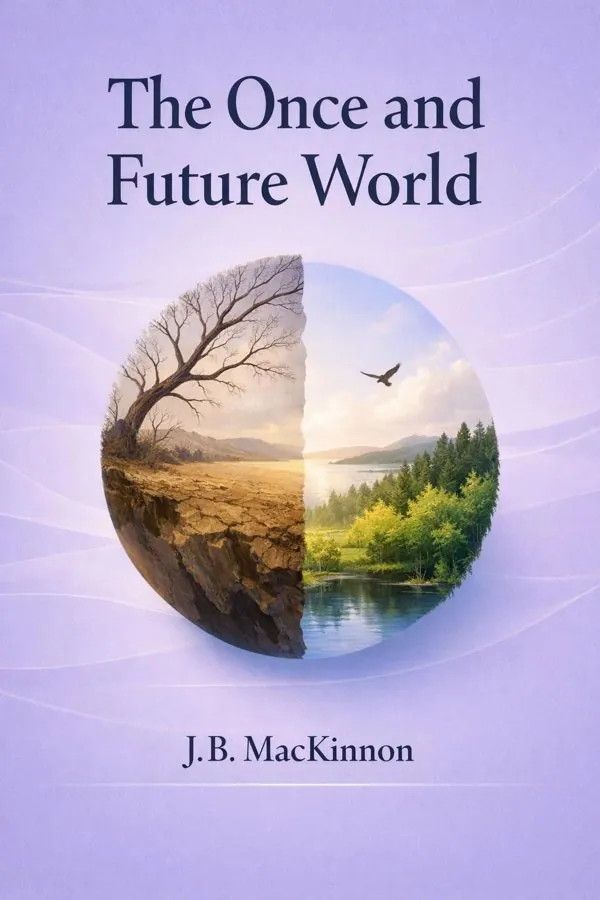
The Once and Future World: Nature As It Was, As It Is, As It Could Be: Summary & Key Insights
 10 min9 chaptersAudio available
Key Takeaways from The Once and Future World: Nature As It Was, As It Is, As It Could Be
The most powerful environmental idea in this book is also the simplest: we cannot understand loss unless we first understand former abundance.
How we treat nature depends less on facts alone than on the stories we believe about it.
Across continents and oceans, humans have reduced the scale, diversity, and density of wild beings.
One generation’s tragedy becomes the next generation’s normal.
Big environmental truths become clearest when seen in specific places.
What Is The Once and Future World: Nature As It Was, As It Is, As It Could Be About?
The Once and Future World: Nature As It Was, As It Is, As It Could Be by J.B. MacKinnon is a environment book spanning 9 pages. J.B. MacKinnon’s The Once and Future World asks a radical but deeply practical question: what if the natural world we now consider normal is only a shrunken remnant of what once existed? Blending environmental history, ecology, philosophy, and vivid reporting, MacKinnon shows how humans have gradually accepted ecological decline as ordinary. Forests seem healthy even when they hold only a fraction of their original life. Oceans appear productive even after immense depletion. Cities feel complete despite being built atop erased wetlands, grasslands, and migration routes. The book matters because it challenges one of modern society’s most limiting assumptions: that conservation is about protecting the little that remains. MacKinnon argues instead for recovering a larger vision of abundance, one that sees restoration not as fantasy but as a serious cultural and political project. He writes with the authority of a seasoned environmental journalist, drawing on scientific evidence, historical accounts, and contemporary restoration efforts from around the world. The result is both sobering and hopeful: a compelling invitation to rethink what nature was, what it has become, and what it still could be if human imagination expands as quickly as human power once did.
This FizzRead summary covers all 9 key chapters of The Once and Future World: Nature As It Was, As It Is, As It Could Be in approximately 10 minutes, distilling the most important ideas, arguments, and takeaways from J.B. MacKinnon's work. Also available as an audio summary and Key Quotes Podcast.
The Once and Future World: Nature As It Was, As It Is, As It Could Be
J.B. MacKinnon’s The Once and Future World asks a radical but deeply practical question: what if the natural world we now consider normal is only a shrunken remnant of what once existed? Blending environmental history, ecology, philosophy, and vivid reporting, MacKinnon shows how humans have gradually accepted ecological decline as ordinary. Forests seem healthy even when they hold only a fraction of their original life. Oceans appear productive even after immense depletion. Cities feel complete despite being built atop erased wetlands, grasslands, and migration routes. The book matters because it challenges one of modern society’s most limiting assumptions: that conservation is about protecting the little that remains. MacKinnon argues instead for recovering a larger vision of abundance, one that sees restoration not as fantasy but as a serious cultural and political project. He writes with the authority of a seasoned environmental journalist, drawing on scientific evidence, historical accounts, and contemporary restoration efforts from around the world. The result is both sobering and hopeful: a compelling invitation to rethink what nature was, what it has become, and what it still could be if human imagination expands as quickly as human power once did.
Who Should Read The Once and Future World: Nature As It Was, As It Is, As It Could Be?
This book is perfect for anyone interested in environment and looking to gain actionable insights in a short read. Whether you're a student, professional, or lifelong learner, the key ideas from The Once and Future World: Nature As It Was, As It Is, As It Could Be by J.B. MacKinnon will help you think differently.
- ✓Readers who enjoy environment and want practical takeaways
- ✓Professionals looking to apply new ideas to their work and life
- ✓Anyone who wants the core insights of The Once and Future World: Nature As It Was, As It Is, As It Could Be in just 10 minutes
Want the full summary?
Get instant access to this book summary and 100K+ more with Fizz Moment.
Get Free SummaryAvailable on App Store • Free to download
Key Chapters
The most powerful environmental idea in this book is also the simplest: we cannot understand loss unless we first understand former abundance. MacKinnon invites readers to look beyond the depleted landscapes of the present and imagine the world as it existed before industrial extraction, large-scale habitat conversion, and the mechanization of killing. Historical records describe rivers so full of fish they seemed to boil, skies darkened by immense flocks of birds, and coastlines crowded with marine mammals. These accounts are not romantic exaggerations; they are clues to ecological baselines that modern people have forgotten.
This historical perspective changes the emotional meaning of conservation. If we think nature has always been sparse, fragmented, and vulnerable, then our goals remain modest: save a few species, set aside a few parks, prevent complete collapse. But if we recognize that the planet once supported a far richer web of life, then conservation becomes a project of recovery rather than mere triage. The past becomes evidence that abundance is not imaginary.
MacKinnon is careful not to suggest a naive return to a prehuman Eden. Humans have long shaped ecosystems. The point is that recent centuries have compressed nature so dramatically that today’s standards are misleading. Looking backward can sharpen present-day judgment. It can inform fisheries management, urban planning, watershed restoration, and wildlife policy by asking not just what remains, but what once functioned.
A practical application is to seek historical ecology in local decisions. Before supporting a development plan, river project, or conservation initiative, ask: what lived here 100, 500, or 1,000 years ago, and what ecological roles were lost? Actionable takeaway: use the past as a benchmark for possibility, not just nostalgia.
How we treat nature depends less on facts alone than on the stories we believe about it. MacKinnon shows that every era frames the nonhuman world through cultural narratives. In some traditions, animals were relatives, messengers, or spiritual presences. In the modern industrial worldview, they often become units of production, scenic background, or problems to manage. These stories are not harmless metaphors; they shape laws, markets, and everyday behavior.
One of the book’s key insights is that environmental destruction often begins in language. A forest becomes “timber.” A wetland becomes “wasteland.” Predators become “vermin.” Once living systems are renamed as resources or obstacles, exploitation feels rational, even responsible. By contrast, when people see landscapes as communities of life with intrinsic worth, they become more willing to protect and restore them.
MacKinnon does not argue against science; rather, he asks for a broader cultural imagination. Science can measure biodiversity decline, but stories help societies care about what the numbers mean. Consider how children’s books, documentaries, school curricula, and local history shape ecological empathy. A city that teaches its residents they live on a former salmon river or bird migration corridor may make different choices about infrastructure and public space.
In practical terms, reframing matters at every level. Landowners can talk about “habitat” instead of “unused land.” Schools can integrate natural history into local education. Media can tell stories of recovery, not just collapse. Actionable takeaway: examine the language you use for the living world, and choose words that recognize relationship, not just utility.
Environmental decline is often discussed as a series of separate crises, but MacKinnon’s deeper claim is that they are all expressions of one long process: the great diminishment of life. Across continents and oceans, humans have reduced the scale, diversity, and density of wild beings. We have emptied seas, simplified forests, drained wetlands, fenced migrations, and replaced complex ecosystems with landscapes engineered for narrow human purposes.
What makes this diminishment so dangerous is that it unfolds gradually enough to feel normal. Extinction captures headlines, but abundance can disappear long before a species vanishes entirely. A river may still have salmon, but not enough to nourish forests, predators, and communities as it once did. A forest may still stand, yet lack old-growth structure, large herbivores, insects, and birds in the numbers needed for ecological resilience. Survival is not the same as fullness.
MacKinnon emphasizes that this reduction has consequences beyond aesthetics. Diminished ecosystems are less capable of storing carbon, cycling water, pollinating crops, buffering storms, and sustaining human mental health. Ecological simplification makes the world less stable and less generous. The losses are practical, moral, and civilizational all at once.
A useful way to apply this idea is to shift environmental goals from presence to function. Instead of asking only whether a species still exists, ask whether it exists in ecologically meaningful numbers. Instead of protecting isolated fragments, think about whole food webs and processes. Actionable takeaway: when evaluating environmental progress, measure abundance, connectivity, and function—not just whether collapse has been avoided.
One generation’s tragedy becomes the next generation’s normal. MacKinnon builds on the concept of shifting baseline syndrome: people assess environmental health against the conditions they grew up with rather than against longer ecological history. As a result, each generation inherits a diminished world but experiences it as ordinary. This is one of the book’s most unsettling insights, because it explains why societies tolerate losses that would have shocked their ancestors.
Ecological amnesia affects everyone from policymakers to everyday citizens. A child raised near a quiet stream may never know it once held massive fish runs. Urban residents may celebrate a few returning birds without realizing that millions once migrated overhead. Fisheries managers may treat already-depleted stocks as the baseline for “sustainable yield.” Memory shrinks, expectations shrink, and ambition shrinks with it.
The consequences are political as well as psychological. When the public lacks historical memory, restoration appears unrealistic and degradation appears inevitable. That makes it harder to justify bold recovery efforts. MacKinnon’s response is to rebuild ecological memory through archives, oral histories, Indigenous knowledge, old maps, and scientific reconstruction. Remembering is not sentimental; it is strategic.
There are practical ways to resist ecological forgetting. Communities can post historical species lists in parks, create museum exhibits about vanished local ecosystems, and integrate predevelopment ecology into planning documents. Families can learn the seasonal history of the places where they live. Actionable takeaway: recover your region’s ecological memory so your sense of what is “normal” becomes wider, richer, and more demanding.
Big environmental truths become clearest when seen in specific places. MacKinnon uses transformed landscapes as living case studies to show how humans have altered the Earth not only through destruction, but through redesign. Farmland, suburbs, dams, plantations, industrial fisheries, and managed parks all reveal a common pattern: we simplify ecosystems to increase short-term control, then live with the long-term consequences.
These landscapes are important because they complicate easy moral categories. Few places are purely wild or purely artificial. A city may contain remnant biodiversity. An agricultural valley may sit atop buried wetlands. A managed forest may still host species if handled differently. MacKinnon’s point is not to condemn every human-shaped place, but to ask what kind of ecological possibility remains within them. Once we recognize that transformation is layered, we can also imagine layered recovery.
Examples abound. Restoring floodplains can reduce flood damage while reviving fish habitat. Replacing lawn monocultures with native plantings can support pollinators in suburbs. Removing obsolete dams can reopen spawning routes and improve water quality. Even industrial waterfronts can be redesigned to include marsh edges, fish nurseries, and bird habitat.
The lesson is that restoration does not belong only in remote wilderness. The places most altered by humans are often the places where ecological gains can most directly improve human life. Actionable takeaway: look at your everyday landscape as a site of hidden ecological history and future repair, then support one local project that increases habitat, connectivity, or natural function.
Rewilding is often misunderstood as abandoning land or excluding people, but MacKinnon presents it as something more precise and more exciting: the restoration of ecological process. A rewilded landscape is one where natural relationships regain room to operate—predation, migration, disturbance, succession, flooding, grazing, and regeneration. It is less about recreating a museum version of the past than about reviving the dynamic forces that make ecosystems self-renewing.
This matters because many conservation efforts protect fragments without restoring the interactions that keep them alive. A park can preserve scenery while losing its ecological pulse. Rewilding asks bigger questions. Are keystone species present? Can animals move? Does the river flood? Is fire allowed to play its historical role where appropriate? Can food webs rebuild? These are the conditions under which abundance returns.
MacKinnon shows that rewilding can take many forms. In some places, it involves species reintroductions, such as wolves, beavers, or large herbivores. In others, it means removing barriers, reducing hunting pressure, reconnecting habitats, or simply stepping back from intensive management. Rewilding can happen in rural regions, river corridors, coastlines, and even urban networks of green space.
For individuals and communities, the principle is useful because it shifts focus from decoration to function. A restored streamside buffer, a connected pollinator corridor, or a re-flooded marsh does more than beautify; it reactivates life-supporting processes. Actionable takeaway: support restoration projects that rebuild ecological relationships, not just appearances.
At its heart, The Once and Future World is not only about ecology; it is about humility. MacKinnon challenges the assumption that humans stand outside or above the living world, entitled to reorganize it indefinitely for convenience. The ecological crisis is partly a crisis of self-understanding. When we imagine ourselves as masters of nature, we become blind to dependence, reciprocity, and limits.
The book suggests an ethical shift from domination to belonging. Belonging does not mean rejecting human needs, technology, or culture. It means recognizing that human flourishing depends on flourishing systems larger than ourselves. The disappearance of birds, fish, insects, and predators is not just a technical problem to solve; it reflects a failure to respect the community of life that makes our own existence possible.
This ethical view has practical consequences. It encourages restraint in consumption, greater care in land use, and a willingness to value nonhuman life beyond direct economic benefit. It also fosters a richer conception of citizenship: not only duties to other people, but duties to places, watersheds, and future generations. Such thinking can influence everything from dietary choices and gardening to voting, philanthropy, and urban development.
MacKinnon’s approach avoids both misanthropy and complacency. Humans are capable of immense damage, but also of repair, stewardship, and imagination. Ethical responsibility begins when we stop seeing restoration as optional charity toward nature and start seeing it as part of how to live well on Earth. Actionable takeaway: make one recurring life choice—how you buy, eat, travel, or vote—based on ecological belonging rather than convenience alone.
One of MacKinnon’s most original contributions is his insistence that environmentalism needs a better imagination. Much public discourse is framed around scarcity, sacrifice, and emergency. These frames are necessary to some extent, but they can also make ecological action feel joyless, defensive, and politically fragile. MacKinnon proposes a different horizon: abundance. Not endless human consumption, but abundant life—richer ecosystems, fuller skies, healthier seas, and more vibrant relationships between people and place.
This reframing matters because people are more likely to support restoration when they can picture what success looks like. A river alive with fish is more motivating than an abstract biodiversity target. A city full of birdsong, trees, and clean waterways offers a positive civic vision. Abundance can inspire culture, not just policy.
Importantly, MacKinnon does not equate abundance with pristine wilderness untouched by humans. He imagines a future where human settlements and economies are redesigned to allow more life, not less. This can include regenerative agriculture, wildlife-friendly infrastructure, marine reserves, urban greening, and large-scale habitat corridors. Abundance becomes a design principle.
For practical use, this idea encourages organizations and communities to communicate ecological goals in vivid, lived terms. Instead of saying “reduce degradation,” say “bring back wetlands that host fish, birds, and flood protection.” Instead of “protect habitat,” say “restore the seasonal pulse of life.” Actionable takeaway: whenever you think about environmental change, define a positive image of ecological abundance worth working toward.
Hope in this book is not abstract optimism; it is grounded in action. MacKinnon shows that while no society can rewind history, many forms of restoration are already underway. Rivers have recovered after dam removal. Predators have returned to reshape ecosystems. Urban waterways have been cleaned enough for fish and birds to come back. Forests, marshes, and grasslands can rebound when pressures are reduced and ecological processes are restored.
The practical lesson is that restoration works best when it is ambitious, place-based, and systemic. Small acts matter, but they become transformative when aligned with policy, science, local knowledge, and public support. Protected areas help, yet they are not enough on their own. We also need working lands managed for biodiversity, transportation networks designed for wildlife movement, fisheries governed by long-term abundance, and cities that make room for nonhuman life.
Individuals sometimes underestimate their role because environmental problems seem planetary. MacKinnon suggests thinking across scales. You can support local land trusts, vote for restoration funding, reduce demand for destructive products, participate in community science, replant native species, or advocate for daylighting streams and expanding urban habitat. Institutions can revise what success means—from maximizing extraction to maximizing ecological resilience.
The broader implication is that restoration is not a side project after economic life; it can reshape economics itself. Healthy ecosystems reduce risks, improve quality of life, and create meaningful work. Actionable takeaway: choose one sphere you influence—home, workplace, neighborhood, or politics—and commit to a restoration goal that increases living abundance over the next year.
All Chapters in The Once and Future World: Nature As It Was, As It Is, As It Could Be
About the Author
J.B. MacKinnon is a Canadian journalist and author whose work focuses on the environment, sustainability, culture, and the ways human societies shape the natural world. He is best known as the co-author of The 100-Mile Diet, a widely influential book that helped popularize conversations about local food and consumption. Over the course of his career, he has written for major publications and built a reputation for combining rigorous reporting with thoughtful, accessible storytelling. MacKinnon’s writing often examines large ecological questions through everyday life, making complex issues feel immediate and human. In The Once and Future World, he brings together history, science, and moral reflection to challenge readers’ assumptions about what nature used to be, what it has become, and what it might still become again.
Get This Summary in Your Preferred Format
Read or listen to the The Once and Future World: Nature As It Was, As It Is, As It Could Be summary by J.B. MacKinnon anytime, anywhere. FizzRead offers multiple formats so you can learn on your terms — all free.
Available formats: App · Audio · PDF · EPUB — All included free with FizzRead
Download The Once and Future World: Nature As It Was, As It Is, As It Could Be PDF and EPUB Summary
Key Quotes from The Once and Future World: Nature As It Was, As It Is, As It Could Be
“The most powerful environmental idea in this book is also the simplest: we cannot understand loss unless we first understand former abundance.”
“How we treat nature depends less on facts alone than on the stories we believe about it.”
“Environmental decline is often discussed as a series of separate crises, but MacKinnon’s deeper claim is that they are all expressions of one long process: the great diminishment of life.”
“One generation’s tragedy becomes the next generation’s normal.”
“Big environmental truths become clearest when seen in specific places.”
Frequently Asked Questions about The Once and Future World: Nature As It Was, As It Is, As It Could Be
The Once and Future World: Nature As It Was, As It Is, As It Could Be by J.B. MacKinnon is a environment book that explores key ideas across 9 chapters. J.B. MacKinnon’s The Once and Future World asks a radical but deeply practical question: what if the natural world we now consider normal is only a shrunken remnant of what once existed? Blending environmental history, ecology, philosophy, and vivid reporting, MacKinnon shows how humans have gradually accepted ecological decline as ordinary. Forests seem healthy even when they hold only a fraction of their original life. Oceans appear productive even after immense depletion. Cities feel complete despite being built atop erased wetlands, grasslands, and migration routes. The book matters because it challenges one of modern society’s most limiting assumptions: that conservation is about protecting the little that remains. MacKinnon argues instead for recovering a larger vision of abundance, one that sees restoration not as fantasy but as a serious cultural and political project. He writes with the authority of a seasoned environmental journalist, drawing on scientific evidence, historical accounts, and contemporary restoration efforts from around the world. The result is both sobering and hopeful: a compelling invitation to rethink what nature was, what it has become, and what it still could be if human imagination expands as quickly as human power once did.
You Might Also Like
A Life on Our Planet: My Witness Statement and a Vision for the Future
David Attenborough
10 min
A Sky Full Of Birds
Matt Merritt
10 min
Carbon Zero: Imagining Cities That Can Save the Planet
Alex Steffen
10 min
Eaarth: Making a Life on a Tough New Planet
Bill McKibben
10 min
The Social Contract and Environmental Governance
Various Editors
10 min
The Wild Places
Robert Macfarlane
10 minBrowse by Category
Ready to read The Once and Future World: Nature As It Was, As It Is, As It Could Be?
Get the full summary and 100K+ more books with Fizz Moment.