
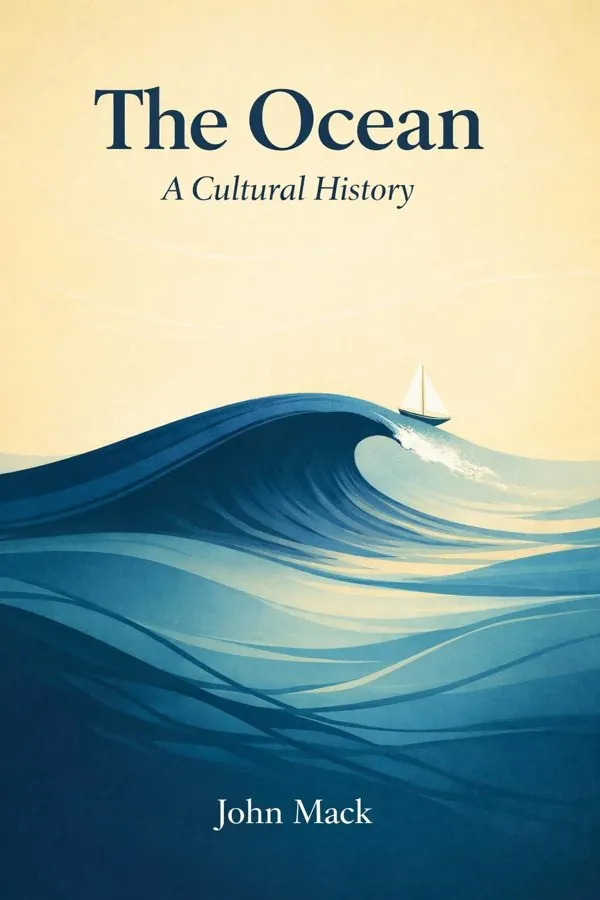
The Ocean: A Cultural History: Summary & Key Insights
by John Mack
 10 min9 chaptersAudio available
What Is The Ocean: A Cultural History About?
The Ocean: A Cultural History by John Mack is a civilization book spanning 9 pages. This book explores the ocean as a cultural and historical space, examining how human societies have perceived, represented, and interacted with the sea across time. It combines anthropology, history, and art to reveal the ocean’s role in shaping global connections, trade, exploration, and imagination.
This FizzRead summary covers all 9 key chapters of The Ocean: A Cultural History in approximately 10 minutes, distilling the most important ideas, arguments, and takeaways from John Mack's work. Also available as an audio summary and Key Quotes Podcast.
The Ocean: A Cultural History
This book explores the ocean as a cultural and historical space, examining how human societies have perceived, represented, and interacted with the sea across time. It combines anthropology, history, and art to reveal the ocean’s role in shaping global connections, trade, exploration, and imagination.
Who Should Read The Ocean: A Cultural History?
This book is perfect for anyone interested in civilization and looking to gain actionable insights in a short read. Whether you're a student, professional, or lifelong learner, the key ideas from The Ocean: A Cultural History by John Mack will help you think differently.
- ✓Readers who enjoy civilization and want practical takeaways
- ✓Professionals looking to apply new ideas to their work and life
- ✓Anyone who wants the core insights of The Ocean: A Cultural History in just 10 minutes
Want the full summary?
Get instant access to this book summary and 100K+ more with Fizz Moment.
Get Free SummaryAvailable on App Store • Free to download
Key Chapters
In humanity’s earliest stories, the sea was not geography but cosmology. Ancient Mediterranean civilizations imagined creation itself as emerging out of the waters of chaos. In Mesopotamian myth, the goddess Tiamat personified the primordial sea, a force embodying both life and destruction. The Hebrew Bible, too, speaks of oceans as unruly powers mastered by divine order. Across Polynesia, the Pacific was a living network of paths and ancestors, a space of origin rather than exile. For early societies, therefore, the sea’s ambiguity—its vastness, its rhythm, its unpredictability—was central to its sacred power.
These myths revealed a psychological truth: that the sea was the measure of humanity’s vulnerability and imagination. Classical Greece viewed the ocean both as a physical limit and a moral metaphor. Homer’s epics teach that to cross the sea was to cross into the unknown, a test of human endurance and divine favor. Even in medieval Europe, where the ocean remained largely unexplored, its imagined geography shaped worldviews. The edges of medieval maps were rimmed with sea monsters, serpents, and warnings—an artistic reflection of both fear and fascination.
Yet intertwined with these superstitions was the first recognition that the sea connected rather than divided. Fishermen and traders in the Mediterranean and the Indian Ocean created webs of exchange long before they were theorized as globalization. Maritime adaptation became a sign of both human ingenuity and cosmological humility: every voyage was an act of faith. The ancients did not yet speak of the ocean as a space to be conquered—but as one to be interpreted, navigated, and appeased.
With the Renaissance came a profound shift in the human imagination: the ocean was transformed from myth into measurable space. The expansion of cartography in the fifteenth and sixteenth centuries redefined how humanity related to the sea. Medieval maps, steeped in theology, yielded to charts guided by mathematics and observation. The Portuguese and Spanish navigators of the Age of Discovery ventured into what had once been taboo regions of the world. With their voyages, the ocean began to acquire a new identity—as a grid, a surface that could be mastered through reason and technology.
But mapping was never a neutral act. To name the oceans and chart their currents was also to claim them. Maps expressed ambition as much as curiosity. They turned the fluid and ungovernable into something manageable, transforming the unknown into possessions of knowledge and empire. At the same time, explorers like Columbus and Magellan carried within them residual fear and wonder. Their logbooks, alternately filled with navigational detail and spiritual reflection, reveal that the mystical dimension of the sea never quite disappeared.
In these centuries the ocean became the theater of human expansion. Every charted route redrew the boundaries of the known world. Yet exploration also exposed new anxieties about moral and physical limits. Storms, shipwrecks, and the loss of life at sea reminded mankind that mastery was always partial. What began as a dream of discovery evolved into a dialogue between power and humility—a tension that would define every subsequent encounter with the sea.
+ 7 more chapters — available in the FizzRead app
All Chapters in The Ocean: A Cultural History
About the Author
Get This Summary in Your Preferred Format
Read or listen to the The Ocean: A Cultural History summary by John Mack anytime, anywhere. FizzRead offers multiple formats so you can learn on your terms — all free.
Available formats: App · Audio · PDF · EPUB — All included free with FizzRead
Download The Ocean: A Cultural History PDF and EPUB Summary
Key Quotes from The Ocean: A Cultural History
“In humanity’s earliest stories, the sea was not geography but cosmology.”
“With the Renaissance came a profound shift in the human imagination: the ocean was transformed from myth into measurable space.”
Frequently Asked Questions about The Ocean: A Cultural History
The Ocean: A Cultural History by John Mack is a civilization book that explores key ideas across 9 chapters. This book explores the ocean as a cultural and historical space, examining how human societies have perceived, represented, and interacted with the sea across time. It combines anthropology, history, and art to reveal the ocean’s role in shaping global connections, trade, exploration, and imagination.
You Might Also Like
The Structure of Scientific Revolutions
Thomas S. Kuhn
10 min
Genius
Harold Bloom
10 min
A Cultural History of the Medieval Age
Various Editors
10 min
A History of God: The 4,000-Year Quest of Judaism, Christianity and Islam
Karen Armstrong
10 min
A History of the World in 10½ Chapters
Julian Barnes
10 min
A Short History of Progress
Ronald Wright
10 minBrowse by Category
Ready to read The Ocean: A Cultural History?
Get the full summary and 100K+ more books with Fizz Moment.