
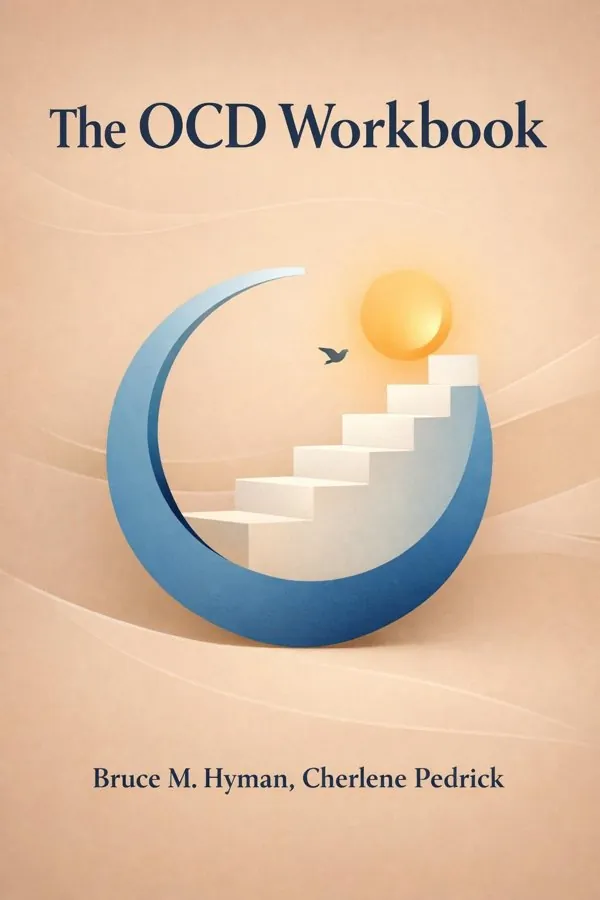
The OCD Workbook: Your Guide to Breaking Free from Obsessive-Compulsive Disorder: Summary & Key Insights
by Bruce M. Hyman, Cherlene Pedrick
 10 min6 chaptersAudio available
What Is The OCD Workbook: Your Guide to Breaking Free from Obsessive-Compulsive Disorder About?
The OCD Workbook: Your Guide to Breaking Free from Obsessive-Compulsive Disorder by Bruce M. Hyman, Cherlene Pedrick is a mental_health book spanning 6 pages. The OCD Workbook is a comprehensive self-help guide designed to help individuals understand and manage obsessive-compulsive disorder (OCD). It provides practical exercises based on cognitive-behavioral therapy (CBT) and exposure and response prevention (ERP) techniques, enabling readers to identify triggers, challenge intrusive thoughts, and reduce compulsive behaviors. The workbook offers step-by-step strategies for building resilience and regaining control over daily life.
This FizzRead summary covers all 6 key chapters of The OCD Workbook: Your Guide to Breaking Free from Obsessive-Compulsive Disorder in approximately 10 minutes, distilling the most important ideas, arguments, and takeaways from Bruce M. Hyman, Cherlene Pedrick's work. Also available as an audio summary and Key Quotes Podcast.
The OCD Workbook: Your Guide to Breaking Free from Obsessive-Compulsive Disorder
The OCD Workbook is a comprehensive self-help guide designed to help individuals understand and manage obsessive-compulsive disorder (OCD). It provides practical exercises based on cognitive-behavioral therapy (CBT) and exposure and response prevention (ERP) techniques, enabling readers to identify triggers, challenge intrusive thoughts, and reduce compulsive behaviors. The workbook offers step-by-step strategies for building resilience and regaining control over daily life.
Who Should Read The OCD Workbook: Your Guide to Breaking Free from Obsessive-Compulsive Disorder?
This book is perfect for anyone interested in mental_health and looking to gain actionable insights in a short read. Whether you're a student, professional, or lifelong learner, the key ideas from The OCD Workbook: Your Guide to Breaking Free from Obsessive-Compulsive Disorder by Bruce M. Hyman, Cherlene Pedrick will help you think differently.
- ✓Readers who enjoy mental_health and want practical takeaways
- ✓Professionals looking to apply new ideas to their work and life
- ✓Anyone who wants the core insights of The OCD Workbook: Your Guide to Breaking Free from Obsessive-Compulsive Disorder in just 10 minutes
Want the full summary?
Get instant access to this book summary and 100K+ more with Fizz Moment.
Get Free SummaryAvailable on App Store • Free to download
Key Chapters
Obsessive-compulsive disorder centers on two linked experiences: obsessions—unwanted, intrusive thoughts, images, or impulses that provoke distress—and compulsions—behaviors or mental acts meant to neutralize that distress. The relationship between the two forms a self-sustaining loop, because compulsions provide only temporary relief and ultimately strengthen the association between anxiety and ritual. In therapy, helping clients see this loop is crucial, as awareness becomes the first tool for change.
Imagine someone who worries they’ve left the stove on. The thought appears, followed by a spike of anxiety. The compulsion—checking—momentarily reduces the anxiety, but by yielding to that cycle, the brain learns that anxiety can only be reduced through checking. What we aim to teach is that anxiety, though uncomfortable, naturally diminishes on its own if we resist performing the compulsion. The illusion of control provided by rituals is replaced with genuine control through tolerance and acceptance.
In The OCD Workbook, we ask readers to map their own loops by recording specific obsessions and corresponding compulsions. Once the pattern is seen clearly, it shifts from feeling mysterious and all-powerful to something structured and manageable. This foundation sets the stage for all later work.
Cognitive-behavioral therapy (CBT) and its specialized technique, exposure and response prevention (ERP), are the gold standard for OCD treatment. CBT challenges distorted beliefs that inflate the meaning or danger of intrusive thoughts, while ERP provides a systematic way to face those fears without resorting to compulsive behaviors.
In this workbook, we emphasize that ERP isn’t about forcing yourself into panic; it’s about graded learning. You’ll begin by identifying triggers and creating a 'fear hierarchy'—a ranked list of situations that provoke anxiety. Then, you approach these situations gradually, while resisting the urge to perform rituals. This process retrains the brain to recognize that feared outcomes don’t occur, or that even when they do, they’re tolerable. The result is a genuine reduction in anxiety reactivity.
For example, a person with contamination fears might start by touching a slightly 'dirty' object without washing and, over time, progress to more triggering exposures. What matters is consistency and willingness to experience discomfort rather than escape it. Through repeated exposures, the anxious prediction shrinks, and confidence grows.
CBT complements this behavioral approach by helping you challenge catastrophic interpretations. You explore distorted thinking patterns like 'If I think something bad, it means I will make it happen' or 'Not neutralizing a thought means I’m irresponsible.' As you experiment with seeing thoughts as just mental events instead of warnings or commands, the power they once held begins to dissolve.
+ 4 more chapters — available in the FizzRead app
All Chapters in The OCD Workbook: Your Guide to Breaking Free from Obsessive-Compulsive Disorder
About the Authors
Bruce M. Hyman, PhD, LCSW, is the founder and director of the OCD Resource Center of South Florida and a leading expert in the treatment of obsessive-compulsive disorder. Cherlene Pedrick, RN, is a psychiatric nurse and co-author specializing in anxiety and OCD-related disorders.
Get This Summary in Your Preferred Format
Read or listen to the The OCD Workbook: Your Guide to Breaking Free from Obsessive-Compulsive Disorder summary by Bruce M. Hyman, Cherlene Pedrick anytime, anywhere. FizzRead offers multiple formats so you can learn on your terms — all free.
Available formats: App · Audio · PDF · EPUB — All included free with FizzRead
Download The OCD Workbook: Your Guide to Breaking Free from Obsessive-Compulsive Disorder PDF and EPUB Summary
Key Quotes from The OCD Workbook: Your Guide to Breaking Free from Obsessive-Compulsive Disorder
“The relationship between the two forms a self-sustaining loop, because compulsions provide only temporary relief and ultimately strengthen the association between anxiety and ritual.”
“Cognitive-behavioral therapy (CBT) and its specialized technique, exposure and response prevention (ERP), are the gold standard for OCD treatment.”
Frequently Asked Questions about The OCD Workbook: Your Guide to Breaking Free from Obsessive-Compulsive Disorder
The OCD Workbook: Your Guide to Breaking Free from Obsessive-Compulsive Disorder by Bruce M. Hyman, Cherlene Pedrick is a mental_health book that explores key ideas across 6 chapters. The OCD Workbook is a comprehensive self-help guide designed to help individuals understand and manage obsessive-compulsive disorder (OCD). It provides practical exercises based on cognitive-behavioral therapy (CBT) and exposure and response prevention (ERP) techniques, enabling readers to identify triggers, challenge intrusive thoughts, and reduce compulsive behaviors. The workbook offers step-by-step strategies for building resilience and regaining control over daily life.
You Might Also Like
Big Feelings: How to Be Okay When Things Are Not Okay
Liz Fosslien, Mollie West Duffy
10 min
Creative Arts Therapies Handbook: Art, Music and Dance Therapy Practices for Wellbeing
Susan I. Buchalter
10 min
Emotional First Aid: Healing Rejection, Guilt, Failure, and Other Everyday Hurts
Guy Winch
10 min
Lost Connections: Why You're Depressed and How to Find Hope
Johann Hari
10 min
No Time to Panic: How to Stop Worrying and Embrace Life
Matt Gutman
10 min
Overcoming Mobbing: A Recovery Guide for Workplace Aggression and Bullying
Maureen Duffy, Len Sperry
10 minBrowse by Category
Ready to read The OCD Workbook: Your Guide to Breaking Free from Obsessive-Compulsive Disorder?
Get the full summary and 100K+ more books with Fizz Moment.