
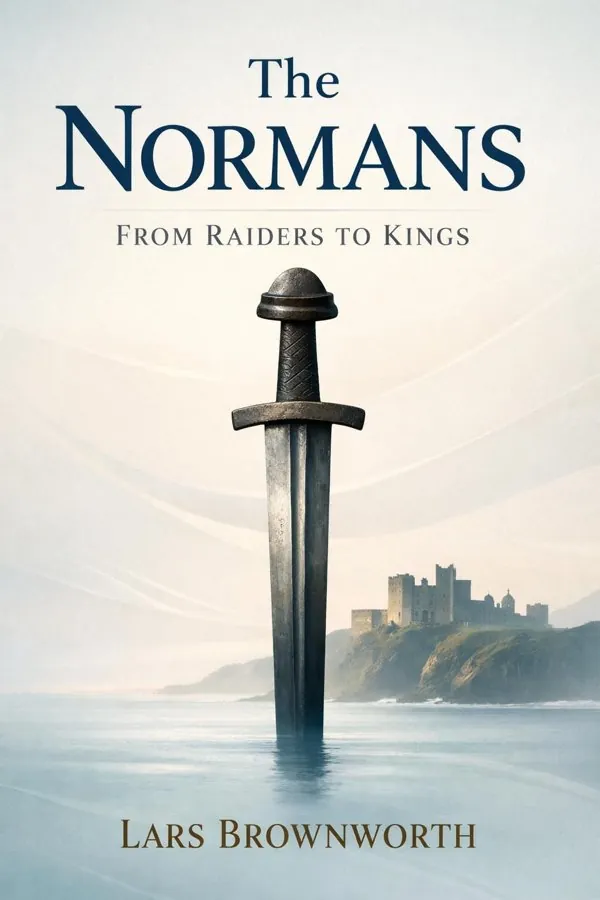
The Normans: From Raiders to Kings: Summary & Key Insights
 10 min9 chaptersAudio available
Key Takeaways from The Normans: From Raiders to Kings
A civilization can be born not only from conquest, but from compromise.
Military success rarely lasts without systems behind it.
The real test of power is not defeating enemies abroad, but controlling allies at home.
History often turns on the survival of one vulnerable person.
Conquest changes more than rulers; it rewires a society.
What Is The Normans: From Raiders to Kings About?
The Normans: From Raiders to Kings by Lars Brownworth is a world_history book spanning 5 pages. How does a people known first for fire and plunder become synonymous with castles, kingdoms, and statecraft? In The Normans: From Raiders to Kings, Lars Brownworth answers that question by following the astonishing journey of the Normans from Scandinavian raiders to some of the most influential rulers of medieval Europe. Beginning with Viking incursions along the coasts of France, Brownworth shows how these outsiders settled in Normandy, adopted local religion and language, and then launched themselves into history with an energy few rivals could match. From William the Conqueror’s triumph in England to the Hauteville family’s dazzling expansion in southern Italy and Sicily, the book reveals a people defined by discipline, ambition, and adaptability. What makes this story matter is not only its drama, but its lasting impact: the Normans reshaped politics, warfare, architecture, and cultural exchange across multiple regions. Brownworth, a respected popular historian known for making medieval history vivid and accessible, brings clarity, pace, and narrative force to a subject that can otherwise feel scattered across centuries and kingdoms.
This FizzRead summary covers all 9 key chapters of The Normans: From Raiders to Kings in approximately 10 minutes, distilling the most important ideas, arguments, and takeaways from Lars Brownworth's work. Also available as an audio summary and Key Quotes Podcast.
The Normans: From Raiders to Kings
How does a people known first for fire and plunder become synonymous with castles, kingdoms, and statecraft? In The Normans: From Raiders to Kings, Lars Brownworth answers that question by following the astonishing journey of the Normans from Scandinavian raiders to some of the most influential rulers of medieval Europe. Beginning with Viking incursions along the coasts of France, Brownworth shows how these outsiders settled in Normandy, adopted local religion and language, and then launched themselves into history with an energy few rivals could match. From William the Conqueror’s triumph in England to the Hauteville family’s dazzling expansion in southern Italy and Sicily, the book reveals a people defined by discipline, ambition, and adaptability. What makes this story matter is not only its drama, but its lasting impact: the Normans reshaped politics, warfare, architecture, and cultural exchange across multiple regions. Brownworth, a respected popular historian known for making medieval history vivid and accessible, brings clarity, pace, and narrative force to a subject that can otherwise feel scattered across centuries and kingdoms.
Who Should Read The Normans: From Raiders to Kings?
This book is perfect for anyone interested in world_history and looking to gain actionable insights in a short read. Whether you're a student, professional, or lifelong learner, the key ideas from The Normans: From Raiders to Kings by Lars Brownworth will help you think differently.
- ✓Readers who enjoy world_history and want practical takeaways
- ✓Professionals looking to apply new ideas to their work and life
- ✓Anyone who wants the core insights of The Normans: From Raiders to Kings in just 10 minutes
Want the full summary?
Get instant access to this book summary and 100K+ more with Fizz Moment.
Get Free SummaryAvailable on App Store • Free to download
Key Chapters
A civilization can be born not only from conquest, but from compromise. That is the essential starting point of the Norman story. The Normans began as Viking raiders from Scandinavia who terrorized the coasts and river systems of western Europe in the ninth and tenth centuries. Their fearsome mobility made them nearly impossible to stop. Yet the turning point came when the Frankish king Charles the Simple granted land around the lower Seine to the Viking leader Rollo. This was not merely a payoff to invaders; it was a political bargain. In exchange for territory, Rollo was expected to defend the region against further Viking attacks and become part of the Christian political order.
That settlement created Normandy, and with it a remarkable experiment in transformation. The former raiders did not remain culturally frozen. They adopted Christianity, began speaking a Romance language, intermarried with local elites, and learned the institutions of feudal Europe. What made them exceptional was the speed and completeness of this adaptation. They did not abandon their martial energy, but they redirected it into stable rule, military service, and territorial expansion.
The story offers a practical lens on leadership and organizational change. Groups can preserve their core strengths while changing their methods and identity. The Normans kept courage, aggression, and ambition, but paired them with administration, legitimacy, and social integration. Rather than treating adaptation as weakness, they turned it into an advantage.
The actionable takeaway: when entering a new environment, do not cling blindly to old habits. Keep your strengths, adopt useful local practices, and build legitimacy through integration rather than resistance.
Military success rarely lasts without systems behind it. After the first generation of settlement, Normandy hardened into one of the most disciplined and effective principalities in medieval Europe. Brownworth shows that Norman power was not simply the product of bold warriors; it rested on careful governance. The dukes of Normandy developed strong ducal authority, managed their nobles with unusual firmness, and created a political culture in which service and loyalty were rewarded but insubordination was dangerous. In an age when many rulers struggled to control fractious aristocrats, Normandy stood out for cohesion.
This mattered because a well-run duchy could produce more than raids. It could field organized armies, sustain campaigns, and transfer power with relative stability. Norman rulers invested in castles, ecclesiastical patronage, and legal order. They understood that authority required both fear and consent. Supporting monasteries and churches gave them moral legitimacy; enforcing ducal power gave them practical control. This blend of piety and discipline became a Norman trademark.
A useful example appears in how Normandy prepared men for opportunity beyond its borders. Because ducal government was comparatively efficient, ambitious younger sons and knights trained in a rigorous political and military environment. Normandy became a launchpad, exporting skilled fighters and leaders into England, southern Italy, and the eastern Mediterranean.
For modern readers, the lesson is striking: excellence scales when structure supports talent. Raw ability is not enough. A team, company, or state becomes formidable when it combines clear hierarchy, operational discipline, and a shared mission. The Normans succeeded because they institutionalized ambition.
The actionable takeaway: if you want lasting influence, build systems that channel talent into coordinated action rather than relying on charisma or improvisation alone.
The real test of power is not defeating enemies abroad, but controlling allies at home. One of Brownworth’s most important contributions is showing how the Norman state emerged from constant negotiation between dukes and nobles. Medieval politics was personal, local, and often unstable. Yet Norman rulers proved unusually capable of disciplining ambitious barons without destroying the warrior culture that made Normandy strong.
This balancing act required political intelligence. The dukes rewarded service with land and prestige, but they also expected obedience. Castles could secure frontiers, yet they could also become centers of rebellion if placed in the wrong hands. Church appointments mattered for the same reason: bishops and abbots were spiritual authorities, but also political actors. Norman rulers learned to use marriage alliances, patronage, military pressure, and legal ritual to keep the duchy functioning. In doing so, they created a model of statecraft that later helped them govern conquered territories.
A practical example is the Norman approach to hierarchy. Authority was distributed enough to mobilize local initiative, but centralized enough to prevent fragmentation. That combination proved especially powerful when Normans moved into more complex political landscapes like England and Sicily. They had already practiced the hard art of ruling armed elites.
The broader application is relevant to any institution filled with talented but self-interested people. High performers are valuable, but unmanaged ambition can tear a system apart. Effective leadership does not eliminate competition; it aligns incentives so that personal success supports collective goals.
The actionable takeaway: build institutions where autonomy exists within clear boundaries, and where rewards are tied to loyalty, competence, and shared outcomes.
History often turns on the survival of one vulnerable person. William the Conqueror, later king of England, began life as William the Bastard, the illegitimate son of Duke Robert of Normandy. His early years were marked by danger, rebellion, and assassination around him. Brownworth emphasizes that William’s greatness was not inevitable. He inherited a precarious position in a violent aristocratic society, and his first achievement was simply to survive long enough to rule.
What makes William remarkable is his combination of resilience, calculation, and legitimacy-building. He crushed internal revolts, forged alliances, and steadily imposed control over Normandy. When the English throne became contested after Edward the Confessor’s death in 1066, William did not act as a reckless adventurer. He framed his invasion as a lawful claim, gathered papal support, assembled a cross-Channel coalition, and planned a disciplined campaign. The Battle of Hastings was dramatic, but it was only the climax of a much broader political project.
William’s path shows how major victories are usually prepared long before the decisive moment. He invested in administration, military readiness, and narrative. He made people believe he had the right to act, and then ensured he had the capacity to act successfully.
This has obvious practical application. Whether launching a business, pursuing a leadership role, or managing a major transition, preparation matters more than spectacle. Success often belongs to those who combine a strong story with strong execution.
The actionable takeaway: before making your biggest move, secure legitimacy, prepare thoroughly, and strengthen your base so opportunity becomes conquest rather than gamble.
Conquest changes more than rulers; it rewires a society. Brownworth presents 1066 not merely as a famous battle, but as one of the most consequential turning points in English history. After defeating Harold Godwinson at Hastings, William still faced the far harder task of ruling a conquered kingdom. The Normans did this through an intense combination of force, administration, and restructuring. Rebellions were met with brutal reprisals, especially in the Harrying of the North, but violence alone did not secure England. The new regime replaced much of the Anglo-Saxon elite, redistributed land, built castles across the country, and bound England more closely to continental political culture.
The Domesday Book symbolizes the Norman genius for control. It was not simply a survey; it was a statement that the king intended to know, tax, and command his realm in unprecedented detail. Norman architecture, legal development, aristocratic networks, and language all left deep marks on English society. Even modern English bears the legacy of this fusion, with its layers of Germanic and French vocabulary.
What is especially important is that the Normans did not erase England’s past entirely. They grafted their own institutions onto existing administrative traditions, preserving what worked and replacing what served their purposes. This hybrid approach made their rule durable.
The broader lesson is that successful transformation often combines disruption with selective continuity. Radical change is more sustainable when it incorporates useful existing structures rather than discarding everything.
The actionable takeaway: when leading change, identify what must be replaced, what can be strengthened, and how to integrate old strengths into a new system.
Ambition travels where institutions make room for it. One of the most fascinating parts of the Norman story is that their achievements did not stop in France and England. In the fragmented world of southern Italy during the eleventh century, Norman adventurers found a region full of opportunity. Lombard princes, Byzantine officials, papal interests, and Muslim powers in Sicily competed for influence. Into this unstable environment came bands of Norman knights, initially as mercenaries. Brownworth shows how these men, especially members of the Hauteville family, turned hired service into territorial lordship.
Their rise was astonishing because it was not centrally planned from Normandy. It grew from the Norman habit of disciplined opportunism. Men like Robert Guiscard and his relatives excelled at reading fractured political landscapes. They fought for local rulers, switched alliances when needed, seized strategic strongholds, and slowly converted military contracts into independent power. Their success rested on courage, but also on patience and timing.
This southern expansion reveals a different side of Norman strength. They were not only conquerors with massive armies; they were also entrepreneurs of instability. In divided regions, they could rise quickly because they combined martial skill with pragmatic politics. They knew how to exploit conflict without being consumed by it.
The modern application is clear for anyone navigating complex environments. In competitive industries or institutions, outsiders can succeed when they identify spaces where established players are too divided, slow, or complacent to respond effectively.
The actionable takeaway: look for environments where fragmentation creates openings, then enter with discipline, adaptability, and a clear long-term strategy.
Some of the most successful rulers are those who know when not to impose uniformity. The Norman conquest of Sicily is one of the book’s most compelling examples of creative governance. Before the Normans arrived, Sicily had been shaped by Byzantine, Arab, and Latin Christian influences. It was ethnically and religiously diverse, strategically located, and economically valuable. When Roger I and later Roger II consolidated control, they did something extraordinary: rather than flattening this diversity, they used it.
Brownworth highlights the Norman kingdom of Sicily as a rare medieval state where Greek, Arab, and Latin traditions coexisted under strong central authority. Muslim administrators, Greek clerics, and Latin nobles all had roles to play. The court became a center of artistic, scientific, and architectural synthesis. Palaces, churches, mosaics, and administrative practices reflected a fusion that made Sicily one of the most sophisticated kingdoms in Europe.
This was not tolerance in a modern ideological sense. It was pragmatic, strategic, and political. The Normans recognized that local expertise was valuable and that legitimacy could be broadened by respecting existing traditions. Their rule was strong precisely because it was flexible.
For modern readers, Sicily offers a model of leadership in diverse settings. Strong institutions do not require cultural sameness. In fact, organizations often become more resilient when they integrate different skills, perspectives, and traditions rather than forcing everyone into one mold.
The actionable takeaway: in any diverse team or system, preserve unity of purpose while allowing multiple traditions and strengths to contribute to the whole.
Weapons matter, but organization matters more. The Norman military reputation was built not merely on ferocity, but on disciplined force. Brownworth shows that the Normans excelled because they combined cavalry shock, castle-building, and coordinated command in ways that made them formidable across very different regions. Their mounted knights became famous, but they were effective because they operated within a larger system of logistics, leadership, and fortification.
Castles were central to this system. The Normans used them aggressively, not just defensively. A castle could secure a conquest, intimidate a local population, protect supply lines, and serve as an administrative center. In England, the rapid spread of motte-and-bailey castles helped anchor Norman power. In southern Italy and Sicily, fortifications allowed small numbers of Normans to dominate larger and more diverse populations.
Their discipline also stands out. Norman leaders often fought in difficult coalitions, yet they retained cohesion under pressure. At Hastings, for instance, flexibility and command structure helped them recover from setbacks. In Italy, smaller Norman forces repeatedly outmaneuvered more established powers. This points to a recurring theme in the book: the Normans succeeded because they brought a repeatable method to new frontiers.
For today’s reader, the lesson extends beyond military history. Competitive advantage often comes from building durable infrastructure and reliable processes, not just from flashy performance. Preparation, positioning, and control of key assets matter enormously.
The actionable takeaway: do not rely only on moments of brilliance; create structures, tools, and routines that let you hold ground after the first success.
The greatest powers often disappear politically long before they vanish historically. The Normans eventually declined as a distinct ruling force, absorbed into larger dynastic and regional developments. In England, Norman identity blended into the broader Anglo-Norman and later English monarchy. In Sicily and southern Italy, the Norman kingdom passed to new dynasties. Yet Brownworth makes clear that decline in direct rule did not mean failure. The Normans had already transformed the regions they touched.
Their legacy can be traced in state formation, aristocratic culture, military practice, architecture, and language. England’s monarchy became more centralized and more tightly connected to continental Europe because of the Norman Conquest. Sicily’s brief golden age of cultural fusion left enduring artistic and administrative achievements. Across Europe, the Norman example demonstrated how a relatively small but cohesive people could project power far beyond their homeland.
Perhaps the deepest message of the book is that identity itself can be dynamic. The Normans were not important because they preserved a pure Viking past, nor because they simply became French, English, or Italian. They mattered because they were masters of reinvention. Their story challenges simplistic ideas of civilizations as fixed and isolated. Power often belongs to those who can absorb, adapt, and synthesize.
That insight remains useful today. Individuals, organizations, and societies are strongest when they can change without losing purpose. Reinvention is not betrayal; it can be the very engine of survival.
The actionable takeaway: measure success not only by how long you rule, but by the institutions, culture, and possibilities you leave behind.
All Chapters in The Normans: From Raiders to Kings
About the Author
Lars Brownworth is an American historian, author, and former history teacher known for bringing the medieval world to life for broad audiences. He first gained major recognition through his acclaimed podcast 12 Byzantine Rulers, one of the early breakout successes in popular history podcasting. Brownworth specializes in making complex historical periods accessible, especially the Middle Ages and the often-overlooked connections between East and West. His books include Lost to the West, The Sea Wolves, and The Normans: From Raiders to Kings. Across his work, he combines narrative drive with a talent for clear explanation, helping readers see how seemingly distant historical events shaped modern Europe. His writing is especially valued by readers who want serious history told with energy, clarity, and human drama.
Get This Summary in Your Preferred Format
Read or listen to the The Normans: From Raiders to Kings summary by Lars Brownworth anytime, anywhere. FizzRead offers multiple formats so you can learn on your terms — all free.
Available formats: App · Audio · PDF · EPUB — All included free with FizzRead
Download The Normans: From Raiders to Kings PDF and EPUB Summary
Key Quotes from The Normans: From Raiders to Kings
“A civilization can be born not only from conquest, but from compromise.”
“Military success rarely lasts without systems behind it.”
“The real test of power is not defeating enemies abroad, but controlling allies at home.”
“History often turns on the survival of one vulnerable person.”
“Conquest changes more than rulers; it rewires a society.”
Frequently Asked Questions about The Normans: From Raiders to Kings
The Normans: From Raiders to Kings by Lars Brownworth is a world_history book that explores key ideas across 9 chapters. How does a people known first for fire and plunder become synonymous with castles, kingdoms, and statecraft? In The Normans: From Raiders to Kings, Lars Brownworth answers that question by following the astonishing journey of the Normans from Scandinavian raiders to some of the most influential rulers of medieval Europe. Beginning with Viking incursions along the coasts of France, Brownworth shows how these outsiders settled in Normandy, adopted local religion and language, and then launched themselves into history with an energy few rivals could match. From William the Conqueror’s triumph in England to the Hauteville family’s dazzling expansion in southern Italy and Sicily, the book reveals a people defined by discipline, ambition, and adaptability. What makes this story matter is not only its drama, but its lasting impact: the Normans reshaped politics, warfare, architecture, and cultural exchange across multiple regions. Brownworth, a respected popular historian known for making medieval history vivid and accessible, brings clarity, pace, and narrative force to a subject that can otherwise feel scattered across centuries and kingdoms.
You Might Also Like
The Age of Capital
Eric Hobsbawm
10 min
The Gulag Archipelago
Aleksandr Solzhenitsyn
10 min
Jerusalem: The Biography
Simon Sebag Montefiore
10 min
The Anglo-Saxons
James Campbell
10 min
The Boer War
Thomas Pakenham
10 min
The Industrial Revolutionaries: The Making of the Modern World 1776–1914
Gavin Weightman
10 minBrowse by Category
Ready to read The Normans: From Raiders to Kings?
Get the full summary and 100K+ more books with Fizz Moment.