
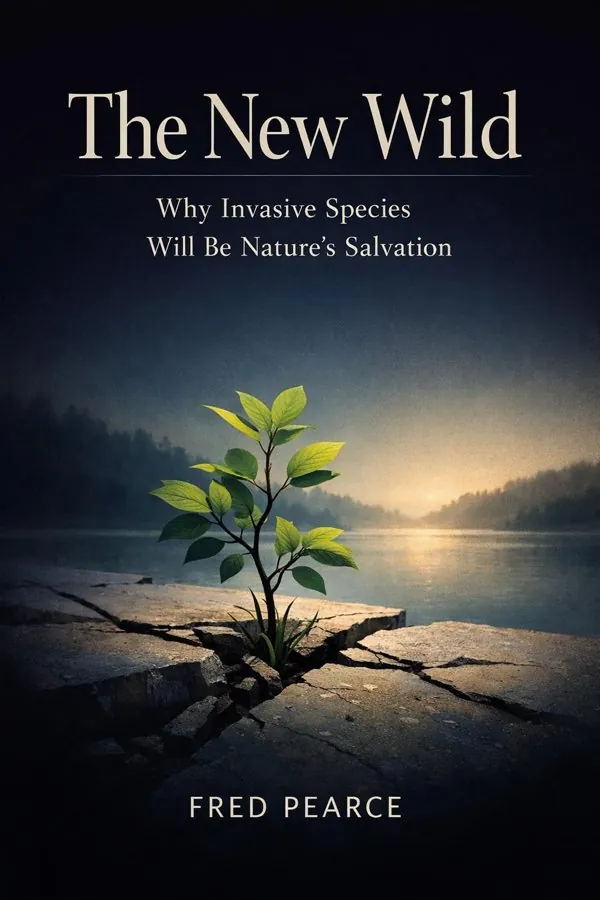
The New Wild: Why Invasive Species Will Be Nature’s Salvation: Summary & Key Insights
by Fred Pearce
 10 min8 chaptersAudio available
What Is The New Wild: Why Invasive Species Will Be Nature’s Salvation About?
The New Wild: Why Invasive Species Will Be Nature’s Salvation by Fred Pearce is a environment book spanning 8 pages. In this provocative work, environmental journalist Fred Pearce challenges conventional wisdom about invasive species. He argues that many so-called alien species are not ecological villains but rather vital participants in the planet’s recovery from human damage. Drawing on global case studies, Pearce explores how these species adapt, thrive, and sometimes restore balance to ecosystems disrupted by human activity.
This FizzRead summary covers all 8 key chapters of The New Wild: Why Invasive Species Will Be Nature’s Salvation in approximately 10 minutes, distilling the most important ideas, arguments, and takeaways from Fred Pearce's work. Also available as an audio summary and Key Quotes Podcast.
The New Wild: Why Invasive Species Will Be Nature’s Salvation
In this provocative work, environmental journalist Fred Pearce challenges conventional wisdom about invasive species. He argues that many so-called alien species are not ecological villains but rather vital participants in the planet’s recovery from human damage. Drawing on global case studies, Pearce explores how these species adapt, thrive, and sometimes restore balance to ecosystems disrupted by human activity.
Who Should Read The New Wild: Why Invasive Species Will Be Nature’s Salvation?
This book is perfect for anyone interested in environment and looking to gain actionable insights in a short read. Whether you're a student, professional, or lifelong learner, the key ideas from The New Wild: Why Invasive Species Will Be Nature’s Salvation by Fred Pearce will help you think differently.
- ✓Readers who enjoy environment and want practical takeaways
- ✓Professionals looking to apply new ideas to their work and life
- ✓Anyone who wants the core insights of The New Wild: Why Invasive Species Will Be Nature’s Salvation in just 10 minutes
Want the full summary?
Get instant access to this book summary and 100K+ more with Fizz Moment.
Get Free SummaryAvailable on App Store • Free to download
Key Chapters
Conservation biology is still a young science, born in the mid-twentieth century alongside a broader cultural movement to preserve the natural world. Its early pioneers were driven by a powerful vision: the idea that ecosystems, left undisturbed, would tend toward balance and stability. Within that framework, exotic species represented a kind of contamination—a threat to the delicate equilibrium of native communities. The language that arose reflected this moral dualism. Species weren’t just introduced; they were invaders, aliens, even enemies. The very vocabulary came from wartime rhetoric. In this conceptual universe, human intervention took on the form of policing: guarding the borders of nature against foreign intrusion.
This historical framing matters, because it shows that our fear of invasives is not purely ecological—it is cultural, even psychological. In Europe and North America especially, notions of purity and belonging have long shaped how we interpret identity, both human and biological. When we labeled gray squirrels or kudzu as villains, we were projecting a human anxiety onto the natural world. The rhetoric of ‘native good, non-native bad’ mapped too neatly onto older prejudices about belonging and displacement. Understanding that bias is the first step in seeing how distorted our conservation lens became.
What we failed to recognize is that nature itself doesn’t share our nostalgia for some lost, pre-industrial order. Ecosystems have always been open systems, constantly exchanging genes, flows, and forms across boundaries. Species have migrated for millennia via wind, water, and the movements of animals. The very notion of natural borders is a human fiction. The planet’s history is one of endless invasion—and endless renewal.
No system today exists untouched by humans. The age of pristine wilderness is gone—not because we destroyed everything, but because our presence has become a planetary force. Forests, grasslands, wetlands, and oceans now function under new conditions, shaped by altered temperatures, nitrogen cycles, and urban expansion. These human-induced shifts have destabilized older ecological communities, opening niches for new species to move in. Where we see disruption, nature sees opportunity.
I began to notice this pattern everywhere. In places where traditional conservationists saw chaos, I saw ecosystems reorganizing. Abandoned industrial zones in Europe, left for dead after decades of pollution, were greening under the influence of non-native plants that thrived in toxic soils. Mangroves expanded into new coastal zones as sea levels rose. Invasive fishes filled ecological roles vacated by species that had disappeared due to overfishing or climate change. The world, it seemed, wasn’t collapsing—it was changing form.
The key insight is that disturbance and adaptation are two sides of the same coin. Ecological change is not just a story of loss; it’s a narrative of transformation. The problem arises only when we cling to fixed benchmarks about what should be here and what shouldn’t. In the Anthropocene, the most resilient systems are those flexible enough to absorb newcomers and reorganize around them.
+ 6 more chapters — available in the FizzRead app
All Chapters in The New Wild: Why Invasive Species Will Be Nature’s Salvation
About the Author
Fred Pearce is a British science writer and environmental journalist. He has written extensively on climate change, water resources, and ecological issues for publications such as New Scientist, The Guardian, and Yale Environment 360. His books often explore the complex interactions between humans and the natural world.
Get This Summary in Your Preferred Format
Read or listen to the The New Wild: Why Invasive Species Will Be Nature’s Salvation summary by Fred Pearce anytime, anywhere. FizzRead offers multiple formats so you can learn on your terms — all free.
Available formats: App · Audio · PDF · EPUB — All included free with FizzRead
Download The New Wild: Why Invasive Species Will Be Nature’s Salvation PDF and EPUB Summary
Key Quotes from The New Wild: Why Invasive Species Will Be Nature’s Salvation
“Conservation biology is still a young science, born in the mid-twentieth century alongside a broader cultural movement to preserve the natural world.”
“No system today exists untouched by humans.”
Frequently Asked Questions about The New Wild: Why Invasive Species Will Be Nature’s Salvation
The New Wild: Why Invasive Species Will Be Nature’s Salvation by Fred Pearce is a environment book that explores key ideas across 8 chapters. In this provocative work, environmental journalist Fred Pearce challenges conventional wisdom about invasive species. He argues that many so-called alien species are not ecological villains but rather vital participants in the planet’s recovery from human damage. Drawing on global case studies, Pearce explores how these species adapt, thrive, and sometimes restore balance to ecosystems disrupted by human activity.
You Might Also Like
A Life on Our Planet: My Witness Statement and a Vision for the Future
David Attenborough
10 min
A Sky Full Of Birds
Matt Merritt
10 min
Carbon Zero: Imagining Cities That Can Save the Planet
Alex Steffen
10 min
Eaarth: Making a Life on a Tough New Planet
Bill McKibben
10 min
The Social Contract and Environmental Governance
Various Editors
10 min
The Wild Places
Robert Macfarlane
10 minBrowse by Category
Ready to read The New Wild: Why Invasive Species Will Be Nature’s Salvation?
Get the full summary and 100K+ more books with Fizz Moment.