
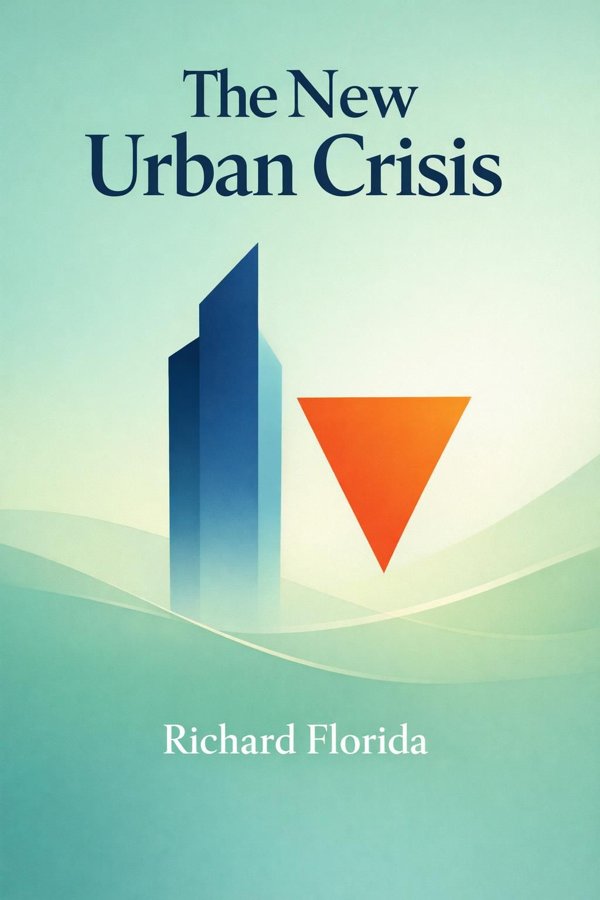
The New Urban Crisis: How Our Cities Are Increasing Inequality, Deepening Segregation, and Failing the Middle Class—and What We Can Do About It: Summary & Key Insights
 10 min4 chaptersAudio available
What Is The New Urban Crisis: How Our Cities Are Increasing Inequality, Deepening Segregation, and Failing the Middle Class—and What We Can Do About It About?
The New Urban Crisis: How Our Cities Are Increasing Inequality, Deepening Segregation, and Failing the Middle Class—and What We Can Do About It by Richard Florida is a sociology book spanning 4 pages. In The New Urban Crisis, urbanist Richard Florida explores how the very forces that drive urban growth and innovation have also created deep divides in wealth, opportunity, and living conditions. He argues that while cities have become the engines of the global economy, they are also sites of growing inequality and segregation. Florida examines the challenges facing modern cities—from housing affordability to gentrification—and proposes strategies for building more inclusive, sustainable, and prosperous urban environments.
This FizzRead summary covers all 4 key chapters of The New Urban Crisis: How Our Cities Are Increasing Inequality, Deepening Segregation, and Failing the Middle Class—and What We Can Do About It in approximately 10 minutes, distilling the most important ideas, arguments, and takeaways from Richard Florida's work. Also available as an audio summary and Key Quotes Podcast.
The New Urban Crisis: How Our Cities Are Increasing Inequality, Deepening Segregation, and Failing the Middle Class—and What We Can Do About It
In The New Urban Crisis, urbanist Richard Florida explores how the very forces that drive urban growth and innovation have also created deep divides in wealth, opportunity, and living conditions. He argues that while cities have become the engines of the global economy, they are also sites of growing inequality and segregation. Florida examines the challenges facing modern cities—from housing affordability to gentrification—and proposes strategies for building more inclusive, sustainable, and prosperous urban environments.
Who Should Read The New Urban Crisis: How Our Cities Are Increasing Inequality, Deepening Segregation, and Failing the Middle Class—and What We Can Do About It?
This book is perfect for anyone interested in sociology and looking to gain actionable insights in a short read. Whether you're a student, professional, or lifelong learner, the key ideas from The New Urban Crisis: How Our Cities Are Increasing Inequality, Deepening Segregation, and Failing the Middle Class—and What We Can Do About It by Richard Florida will help you think differently.
- ✓Readers who enjoy sociology and want practical takeaways
- ✓Professionals looking to apply new ideas to their work and life
- ✓Anyone who wants the core insights of The New Urban Crisis: How Our Cities Are Increasing Inequality, Deepening Segregation, and Failing the Middle Class—and What We Can Do About It in just 10 minutes
Want the full summary?
Get instant access to this book summary and 100K+ more with Fizz Moment.
Get Free SummaryAvailable on App Store • Free to download
Key Chapters
In the late 20th and early 21st centuries, the geography of innovation changed dramatically. Rather than being evenly distributed across regions, economic growth began to cluster in a few locations—what I call 'superstar cities.' These places, including New York, London, San Francisco, and Tokyo, became magnets for high-end industries, talented workers, and global capital. Their growth followed the logic of agglomeration: the more talent and enterprises concentrated in one place, the more creativity and productivity they generated. This dynamic propelled them into unprecedented prosperity, but it also created new divides.
Superstar cities became extraordinarily expensive. Their success drove demand for housing, services, and land, while supply failed to keep pace. As a result, only those at the top of the income ladder could afford to live in or near the urban core. Meanwhile, many middle- and lower-income workers were priced out, forced to commute long distances, or to settle in less desirable areas. The very geographic concentration that was fueling innovation was simultaneously deepening inequality.
Consider San Francisco’s transformation. Once a diverse, bohemian city, it evolved into the epicenter of tech wealth. Neighborhoods that nurtured artists and small businesses became dominated by startups and luxury apartments. The city’s creativity attracted global talent, but its affordability eroded, pushing out residents who had defined its cultural identity. Similar dynamics occurred in London’s financial districts and New York’s innovation corridors. The global economy now depends on these hubs—but it also depends on their workers, many of whom can no longer live nearby.
This pattern reveals a paradox: economic clustering increases collective productivity but reduces social mobility. The benefits of urban concentration accrue unevenly. Capital and talent amplify each other, creating self-reinforcing cycles of success. At the same time, cities lose their middle—becoming either playgrounds for the elite or zones of exclusion. This concentration of advantage is not unique to cities in affluent countries; emerging metropolises in China and India show comparable trends. The rise of superstar cities exemplifies how success breeds imbalance—and how the geography of innovation can harden into the geography of inequality.
The new urban crisis is not merely about economic disparity; it’s about spatial division—the way physical landscapes reflect and reproduce inequality. Urban geography now mirrors a hierarchy of privilege. At the center are affluent zones with creative offices, cafés, and cultural amenities; beyond them are working-class neighborhoods struggling with underinvestment, poor schools, and limited public transit. This separation is not accidental—it’s the product of market forces, zoning regulations, and social sorting.
What alarms me most is that cities once celebrated for diversity are becoming segregated by income and education. Highly educated professionals cluster in a few elite neighborhoods, while service workers and marginalized groups are relegated to the peripheries. This spatial divide undermines what Jane Jacobs called 'urban vitality'—the mix of people and purposes that gives cities their creative richness. When difference disappears from daily interaction, empathy erodes, and inequality becomes invisible.
Housing markets intensify this segregation. In many metropolitan areas, rising land values and restrictive building policies push affordable homes outward, disconnecting residents from economic opportunity. Transit systems then struggle to connect these outer regions to job centers, creating commutes that rob people of time and dignity. Education follows the same lines: neighborhoods with higher property values finance better schools, perpetuating advantage across generations.
Urban segregation also has cultural effects. When communities become homogenous, their political and social perspectives harden. Elite enclaves develop policies that favor their own interests, while poorer districts lose representation and voice. The result is not only inequality but polarization—a dangerous fragmentation of civic unity. The city, once a space of shared experience, becomes a map of isolation.
To understand inequality today, we must therefore look not just at income graphs but at city maps. They reveal exclusion that’s measured in miles and minutes. To solve the crisis, we have to make geography negotiable again—to reconnect people to places of opportunity, to invest in mixed-income neighborhoods, and to restore the urban mosaic that sustains creativity and community.
+ 2 more chapters — available in the FizzRead app
All Chapters in The New Urban Crisis: How Our Cities Are Increasing Inequality, Deepening Segregation, and Failing the Middle Class—and What We Can Do About It
About the Author
Richard Florida is an American urban studies theorist, professor, and author known for his work on the creative class and urban development. He is a professor at the University of Toronto’s Rotman School of Management and School of Cities, and a Distinguished Fellow at NYU’s Schack Institute of Real Estate. His research focuses on the intersection of place, creativity, and economic growth.
Get This Summary in Your Preferred Format
Read or listen to the The New Urban Crisis: How Our Cities Are Increasing Inequality, Deepening Segregation, and Failing the Middle Class—and What We Can Do About It summary by Richard Florida anytime, anywhere. FizzRead offers multiple formats so you can learn on your terms — all free.
Available formats: App · Audio · PDF · EPUB — All included free with FizzRead
Download The New Urban Crisis: How Our Cities Are Increasing Inequality, Deepening Segregation, and Failing the Middle Class—and What We Can Do About It PDF and EPUB Summary
Key Quotes from The New Urban Crisis: How Our Cities Are Increasing Inequality, Deepening Segregation, and Failing the Middle Class—and What We Can Do About It
“In the late 20th and early 21st centuries, the geography of innovation changed dramatically.”
“The new urban crisis is not merely about economic disparity; it’s about spatial division—the way physical landscapes reflect and reproduce inequality.”
Frequently Asked Questions about The New Urban Crisis: How Our Cities Are Increasing Inequality, Deepening Segregation, and Failing the Middle Class—and What We Can Do About It
The New Urban Crisis: How Our Cities Are Increasing Inequality, Deepening Segregation, and Failing the Middle Class—and What We Can Do About It by Richard Florida is a sociology book that explores key ideas across 4 chapters. In The New Urban Crisis, urbanist Richard Florida explores how the very forces that drive urban growth and innovation have also created deep divides in wealth, opportunity, and living conditions. He argues that while cities have become the engines of the global economy, they are also sites of growing inequality and segregation. Florida examines the challenges facing modern cities—from housing affordability to gentrification—and proposes strategies for building more inclusive, sustainable, and prosperous urban environments.
More by Richard Florida
You Might Also Like

Between the World and Me
Ta-Nehisi Coates
10 min
Half the Sky
Nicholas D. Kristof, Sheryl WuDunn
10 min
Men Explain Things To Me
Rebecca Solnit
10 min
Rational Ritual
Michael Suk-Young Chwe
10 min
The New Jim Crow
Michelle Alexander
10 min
Beyond Culture
Edward T. Hall
10 minBrowse by Category
Ready to read The New Urban Crisis: How Our Cities Are Increasing Inequality, Deepening Segregation, and Failing the Middle Class—and What We Can Do About It?
Get the full summary and 100K+ more books with Fizz Moment.