
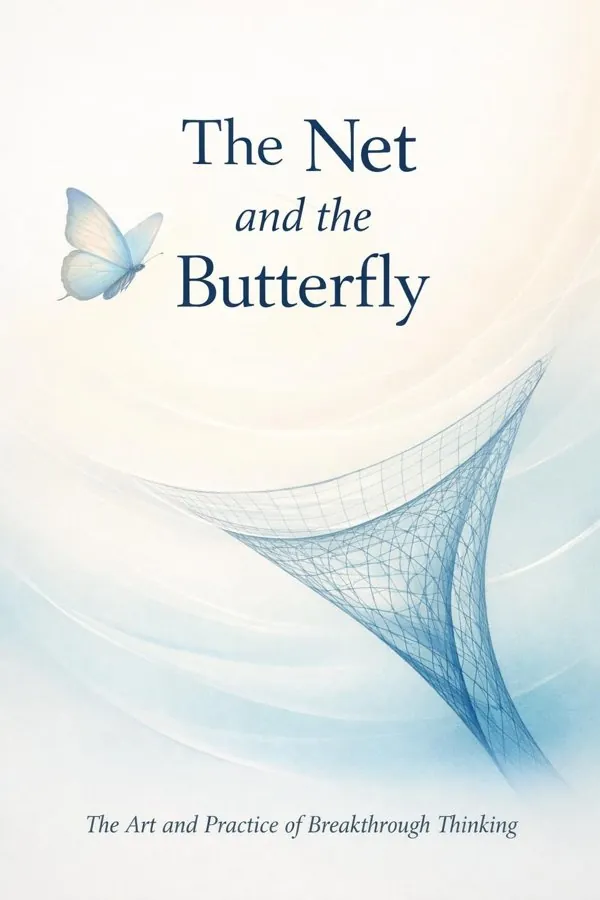
The Net and the Butterfly: The Art and Practice of Breakthrough Thinking: Summary & Key Insights
by Olivia Fox Cabane, Judah Pollack
 10 min10 chaptersAudio available
What Is The Net and the Butterfly: The Art and Practice of Breakthrough Thinking About?
The Net and the Butterfly: The Art and Practice of Breakthrough Thinking by Olivia Fox Cabane and Judah Pollack is a creativity book spanning 10 pages. This book explores how individuals and teams can cultivate breakthrough thinking by combining creativity, focus, and strategic insight. Drawing on neuroscience and psychology, the authors present practical methods to capture fleeting ideas—the 'butterflies'—and weave them into innovative solutions—the 'net.' It offers exercises and frameworks to enhance creative productivity and problem-solving in professional and personal contexts.
This FizzRead summary covers all 10 key chapters of The Net and the Butterfly: The Art and Practice of Breakthrough Thinking in approximately 10 minutes, distilling the most important ideas, arguments, and takeaways from Olivia Fox Cabane and Judah Pollack's work. Also available as an audio summary and Key Quotes Podcast.
The Net and the Butterfly: The Art and Practice of Breakthrough Thinking
This book explores how individuals and teams can cultivate breakthrough thinking by combining creativity, focus, and strategic insight. Drawing on neuroscience and psychology, the authors present practical methods to capture fleeting ideas—the 'butterflies'—and weave them into innovative solutions—the 'net.' It offers exercises and frameworks to enhance creative productivity and problem-solving in professional and personal contexts.
Who Should Read The Net and the Butterfly: The Art and Practice of Breakthrough Thinking?
This book is perfect for anyone interested in creativity and looking to gain actionable insights in a short read. Whether you're a student, professional, or lifelong learner, the key ideas from The Net and the Butterfly: The Art and Practice of Breakthrough Thinking by Olivia Fox Cabane and Judah Pollack will help you think differently.
- ✓Readers who enjoy creativity and want practical takeaways
- ✓Professionals looking to apply new ideas to their work and life
- ✓Anyone who wants the core insights of The Net and the Butterfly: The Art and Practice of Breakthrough Thinking in just 10 minutes
Want the full summary?
Get instant access to this book summary and 100K+ more with Fizz Moment.
Get Free SummaryAvailable on App Store • Free to download
Key Chapters
Every breakthrough begins inside your brain, in the subtle interplay of two networks that rarely speak the same language. The *default mode network* (DMN) is your inner wanderer, active when you daydream, imagine, or doze into reverie. It’s the source of surprising associations—a neurological playground where unrelated ideas collide and form something new. Opposite it stands the *executive control network* (ECN), the system of focus, discipline, and goal-oriented thought. It’s what edits, plans, and analyzes.
Most people live dominated by the executive mind: linear, efficient, and productivity-driven. The DMN is pushed aside as frivolous or lazy. Yet neuroscience shows that creative insight—what we often call an “aha moment”—arises precisely when the DMN is free to roam and then communicates back to the ECN. Breakthroughs occur at the boundary where dreaming meets doing.
To invite this dialogue, you must learn not to over-control your own mind. Let wandering have its moment. As research from creativity studies demonstrates, when people switch between focused attention and relaxed distraction, they uncover hidden connections. Einstein’s thought experiments, Tesla’s visualizations, or even day-to-day problem solving all hinge on this rhythmic toggle—rest, imagine, synthesize, then refine.
From my own coaching experience, when innovators recognize that the brain’s dynamics are not opposites but partners, pressure dissolves. They stop judging their procrastination and start using it. A walk, a shower, or idle quiet suddenly becomes fertile territory for discovery. The brain is sculpted for oscillation; the art is learning to honor that dance.
Breakthroughs bloom in certain conditions: openness, curiosity, relaxation, and trust in uncertainty. In our rush for results, these states are often neglected. Yet every genuine insight demands breathing space—the mental equivalent of a fertile field waiting for seeds.
The relaxed state isn’t mere leisure. Neurologically, relaxation reduces the dominance of the prefrontal cortex, freeing associative areas to generate new connections. You might recall times when ideas appeared after a vacation, or after you stopped obsessing over a problem. That’s no accident. In these moments, your brain’s creative subsystems finally synchronize, releasing the flash of insight that effort had been blocking.
Curiosity keeps the process alive. Instead of judging uncertainty as discomfort, treat it as the gateway to exploration. Curiosity is essentially dopamine for the mind—it energizes creativity. In workshops, we encourage questions that begin with “what if?” or “could we?” because the phrasing invites the DMN to search beyond boundaries.
Breakthrough thinkers also learn to befriend uncertainty. All innovations begin in the fog, when clarity hasn’t arrived. The trick is not to flee, but to dwell in mystery long enough for coherence to emerge. That demands emotional courage and the ability to relax into complexity. Organizations whose culture allows ambiguity tend to produce far more creative output than those attached to fixed rules. In essence, cultivating breakthroughs is less about trying harder and more about creating conditions where the butterfly feels safe enough to land.
+ 8 more chapters — available in the FizzRead app
All Chapters in The Net and the Butterfly: The Art and Practice of Breakthrough Thinking
About the Authors
Olivia Fox Cabane is an author and speaker known for her work on charisma and leadership development. Judah Pollack is a writer and consultant specializing in creativity and organizational innovation. Together, they combine expertise in psychology, neuroscience, and leadership to help readers unlock their creative potential.
Get This Summary in Your Preferred Format
Read or listen to the The Net and the Butterfly: The Art and Practice of Breakthrough Thinking summary by Olivia Fox Cabane and Judah Pollack anytime, anywhere. FizzRead offers multiple formats so you can learn on your terms — all free.
Available formats: App · Audio · PDF · EPUB — All included free with FizzRead
Download The Net and the Butterfly: The Art and Practice of Breakthrough Thinking PDF and EPUB Summary
Key Quotes from The Net and the Butterfly: The Art and Practice of Breakthrough Thinking
“Every breakthrough begins inside your brain, in the subtle interplay of two networks that rarely speak the same language.”
“Breakthroughs bloom in certain conditions: openness, curiosity, relaxation, and trust in uncertainty.”
Frequently Asked Questions about The Net and the Butterfly: The Art and Practice of Breakthrough Thinking
The Net and the Butterfly: The Art and Practice of Breakthrough Thinking by Olivia Fox Cabane and Judah Pollack is a creativity book that explores key ideas across 10 chapters. This book explores how individuals and teams can cultivate breakthrough thinking by combining creativity, focus, and strategic insight. Drawing on neuroscience and psychology, the authors present practical methods to capture fleeting ideas—the 'butterflies'—and weave them into innovative solutions—the 'net.' It offers exercises and frameworks to enhance creative productivity and problem-solving in professional and personal contexts.
You Might Also Like
Dimensions Of Creativity
Margaret A. Boden
10 min
How to Fly a Horse: The Secret History of Creation, Invention, and Discovery
Kevin Ashton
10 min
Imagine: How Creativity Works
Jonah Lehrer
10 min
The Accidental Creative: How to Be Brilliant at a Moment's Notice
Todd Henry
10 min
The Origins of Creativity
Edward O. Wilson
10 min
Wired to Create: Unraveling the Mysteries of the Creative Mind
Scott Barry Kaufman, Carolyn Gregoire
10 minBrowse by Category
Ready to read The Net and the Butterfly: The Art and Practice of Breakthrough Thinking?
Get the full summary and 100K+ more books with Fizz Moment.