
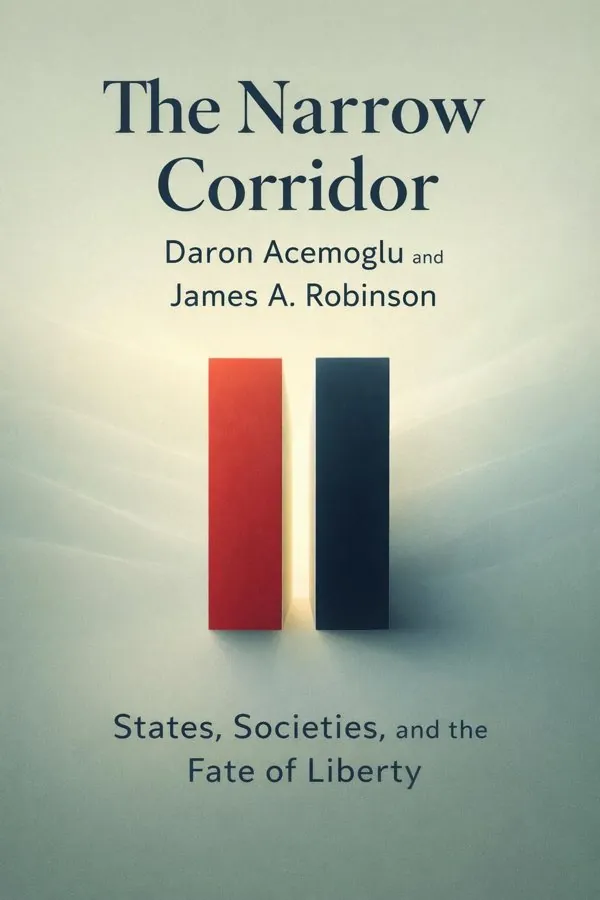
The Narrow Corridor: States, Societies, and the Fate of Liberty: Summary & Key Insights
by Daron Acemoglu, James A. Robinson
 10 min4 chaptersAudio available
What Is The Narrow Corridor: States, Societies, and the Fate of Liberty About?
The Narrow Corridor: States, Societies, and the Fate of Liberty by Daron Acemoglu and James A. Robinson is a politics book spanning 4 pages. In this influential work, economists Daron Acemoglu and political scientist James A. Robinson explore the delicate balance between state power and social strength that sustains liberty. They argue that freedom emerges only within a 'narrow corridor' where neither the state nor society dominates, tracing historical and contemporary examples to show how nations fall outside this corridor into despotism or anarchy.
This FizzRead summary covers all 4 key chapters of The Narrow Corridor: States, Societies, and the Fate of Liberty in approximately 10 minutes, distilling the most important ideas, arguments, and takeaways from Daron Acemoglu and James A. Robinson's work. Also available as an audio summary and Key Quotes Podcast.
The Narrow Corridor: States, Societies, and the Fate of Liberty
In this influential work, economists Daron Acemoglu and political scientist James A. Robinson explore the delicate balance between state power and social strength that sustains liberty. They argue that freedom emerges only within a 'narrow corridor' where neither the state nor society dominates, tracing historical and contemporary examples to show how nations fall outside this corridor into despotism or anarchy.
Who Should Read The Narrow Corridor: States, Societies, and the Fate of Liberty?
This book is perfect for anyone interested in politics and looking to gain actionable insights in a short read. Whether you're a student, professional, or lifelong learner, the key ideas from The Narrow Corridor: States, Societies, and the Fate of Liberty by Daron Acemoglu and James A. Robinson will help you think differently.
- ✓Readers who enjoy politics and want practical takeaways
- ✓Professionals looking to apply new ideas to their work and life
- ✓Anyone who wants the core insights of The Narrow Corridor: States, Societies, and the Fate of Liberty in just 10 minutes
Want the full summary?
Get instant access to this book summary and 100K+ more with Fizz Moment.
Get Free SummaryAvailable on App Store • Free to download
Key Chapters
Let us begin with the fundamental idea. Throughout human history, the relationship between the state and society has been deeply ambivalent. A strong state can protect citizens, enforce laws, build infrastructure, and create stability. Yet, the same strength can crush dissent and turn the ruler into a tyrant. Conversely, a weak state allows freedom of action, but also permits violence, exploitation, and chaos. The challenge has always been: Can we have a powerful state that does not oppress, and a society that is strong enough to constrain it but not destroy its capacity to govern?
In early human communities, there was no Leviathan—no centralized authority capable of imposing order. Social norms and custom ruled instead. People depended on kinship and trust to coordinate survival. In those stateless societies, equality was common, but liberty was not secure. Without an overarching power, disputes could spiral into feuds. There was no guarantee that individual rights would be respected; only social pressures maintained harmony, and these were limited to small groups.
The emergence of states was a monumental step. The Leviathan—a term borrowed from Hobbes—represented both salvation and danger. On the one hand, centralized power ended anarchic violence and allowed cooperation on a scale impossible for small tribes. On the other hand, it introduced new forms of domination. Kings claimed divine authority, bureaucracies extended control, taxation and armies bound populations under command. The freedom of individuals, if it ever existed, shrank in the shadow of concentrated power.
The history of liberty thus becomes the story of how societies learned to chain the Leviathan—to create institutions and norms that compel rulers to act for the common good rather than for their own power. But this chaining process is delicate. It requires that citizens themselves be mobilized, organized, and capable of collective action. A passive society cannot constrain authority; a fragmented one cannot resist oppression.
Imagine liberty as a dynamic equilibrium. On one side stands the state, with its capacity to protect and to control. On the other stands society, with its ability to demand accountability and participation. Between them lies the narrow corridor—a space where both forces are balanced. It is narrow precisely because any imbalance quickly pushes a nation toward extremes: too little state leads to the absent Leviathan, too much to the despotic one.
The narrow corridor provides a lens through which we can interpret history not as a linear march of progress, but as a perpetual contest between rulers and citizens. Liberty is not the natural outcome of prosperity or modernization. It is an institutional and cultural construct maintained by constant negotiation, conflict, and evolution.
Think of democracy today: we often assume freedom comes from elections or laws, but these are only surface forms. The real work of liberty occurs when citizens engage, when they demand transparency, when they resist power’s encroachment and refuse to become complacent. Every free society lives by the tension in this corridor, and every departure from it—toward either apathy or authoritarianism—signals danger.
This balance, this dance between state and society, is the foundation of all subsequent chapters. It explains why liberty emerged in some places and not others, why it survives only through vigilance, and why the corridor, though narrow, remains the only viable route to human freedom.
History offers a panorama of failed attempts to secure liberty. Every civilization has wrestled with the problem of how much power the state should hold. We can categorize their failures into two broad types: the absent Leviathan and the despotic Leviathan.
The absent Leviathan describes societies where state capacity is too weak to provide security, settle disputes, or enforce laws. In such places, freedom evaporates not because rulers oppress, but because danger and disorder dominate. Much of sub-Saharan Africa, historically, struggled with this problem. Without strong central institutions, local chiefs and warlords ruled, often engaging in endless conflict. Even though people were technically free from centralized control, they were trapped in cycles of violence and poverty.
The despotic Leviathan, on the other hand, is the opposite extreme. Here, power becomes so concentrated that society ceases to exist as an independent force. Imperial China exemplifies this model. For over two thousand years, the bureaucracy became an instrument of control, maintaining stability and efficiency but silencing dissent. The emperor stood above all, and the people were subjects, not citizens. China’s longevity as a centralized power is impressive, but beneath that stability lies the absence of liberty.
Between these two failures, the idea of the shackled Leviathan emerges—the condition where the state remains strong enough to govern but constrained enough to serve. Achieving this balance, however, is far from easy. It requires a society capable of persuasion, of organization, and of defending its autonomy against the ruler’s might.
Ancient civilizations illustrate this tension clearly. In Sumer, early cities developed governments to manage irrigation and defense. These states succeeded materially but created hierarchies that marginalized ordinary citizens. In contrast, certain ancient Greek city-states—especially Athens—managed to combine civic participation with state capacity. By organizing assemblies, fostering debate, and institutionalizing accountability, Athens entered the corridor where both power and freedom could coexist.
Rome later refined this balance, though its journey was turbulent. The Republic represented moments of social strength, where citizens resisted elite domination through councils and legal reforms. Yet as Rome expanded, military leaders acquired extraordinary influence, eventually collapsing the corridor under imperial authority. Despotism again replaced liberty.
These examples remind us that liberty’s environment is always precarious. Culture alone cannot sustain it. Athens succeeded not because its citizens were inherently democratic, but because their institutions encouraged participation and deliberation. China remained trapped under a despotic Leviathan not because of tradition alone, but because the bureaucratic machine left no space for autonomous social organization.
The narrow corridor thus reveals a pattern: freedom arises when both the Leviathan’s capacity and society’s activism grow together. It is a co-evolution, not a handout. Whenever one side stops growing—whether through complacency or suppression—the corridor disappears.
+ 2 more chapters — available in the FizzRead app
All Chapters in The Narrow Corridor: States, Societies, and the Fate of Liberty
About the Authors
Daron Acemoglu is an MIT economist known for his research on political economy and development. James A. Robinson is a University of Chicago political scientist specializing in comparative politics and economic history. Together, they previously co-authored the acclaimed book 'Why Nations Fail'.
Get This Summary in Your Preferred Format
Read or listen to the The Narrow Corridor: States, Societies, and the Fate of Liberty summary by Daron Acemoglu and James A. Robinson anytime, anywhere. FizzRead offers multiple formats so you can learn on your terms — all free.
Available formats: App · Audio · PDF · EPUB — All included free with FizzRead
Download The Narrow Corridor: States, Societies, and the Fate of Liberty PDF and EPUB Summary
Key Quotes from The Narrow Corridor: States, Societies, and the Fate of Liberty
“Throughout human history, the relationship between the state and society has been deeply ambivalent.”
“History offers a panorama of failed attempts to secure liberty.”
Frequently Asked Questions about The Narrow Corridor: States, Societies, and the Fate of Liberty
The Narrow Corridor: States, Societies, and the Fate of Liberty by Daron Acemoglu and James A. Robinson is a politics book that explores key ideas across 4 chapters. In this influential work, economists Daron Acemoglu and political scientist James A. Robinson explore the delicate balance between state power and social strength that sustains liberty. They argue that freedom emerges only within a 'narrow corridor' where neither the state nor society dominates, tracing historical and contemporary examples to show how nations fall outside this corridor into despotism or anarchy.
More by Daron Acemoglu and James A. Robinson
You Might Also Like
Antifa: The Anti-Fascist Handbook
Mark Bray
10 min
Attack from Within: How Disinformation Is Sabotaging America
Barbara McQuade
10 min
Coercion, Capital, and European States, AD 990–1992
Charles Tilly
10 min
Digital Democracy: Concepts, Methodologies, Tools, and Applications
Various Authors
10 min
Fascism
Stanley G. Payne
10 min
Fire And Fury: Inside The Trump White House
Michael Wolff
10 minBrowse by Category
Ready to read The Narrow Corridor: States, Societies, and the Fate of Liberty?
Get the full summary and 100K+ more books with Fizz Moment.