
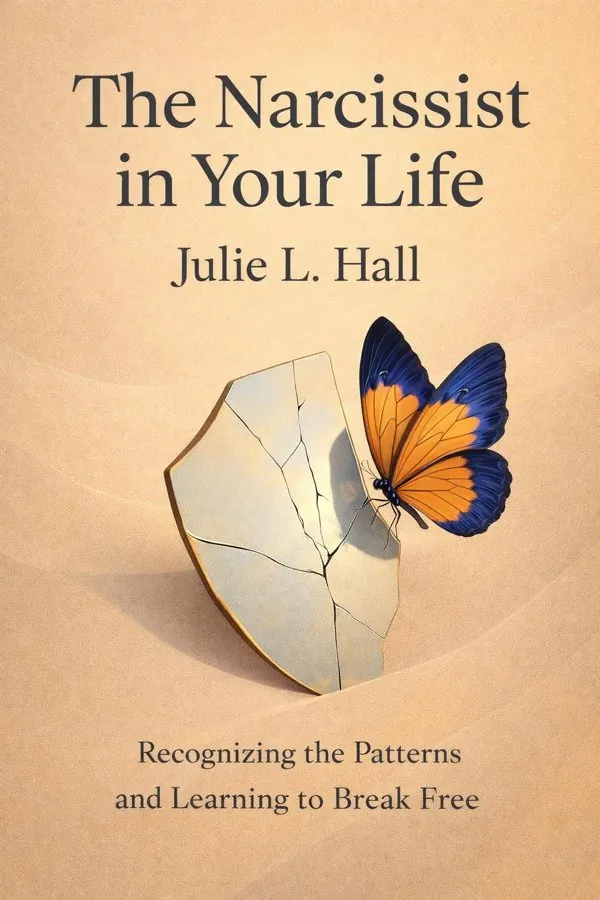
The Narcissist in Your Life: Recognizing the Patterns and Learning to Break Free: Summary & Key Insights
 10 min9 chaptersAudio available
Key Takeaways from The Narcissist in Your Life: Recognizing the Patterns and Learning to Break Free
One of the book’s most important insights is that narcissism is not an all-or-nothing label.
The family is often where narcissistic dynamics first become normalized.
Many survivors stay in narcissistic relationships not because the abuse is invisible, but because it is inconsistent.
The most powerful control tactic is often not aggression but confusion.
A painful truth runs through Hall’s work: insight alone rarely changes a narcissistic relationship.
What Is The Narcissist in Your Life: Recognizing the Patterns and Learning to Break Free About?
The Narcissist in Your Life: Recognizing the Patterns and Learning to Break Free by Julie L. Hall is a mental_health book spanning 5 pages. Some of the most damaging relationships do not begin with obvious cruelty. They begin with charm, confidence, intensity, and the feeling of being deeply seen. In The Narcissist in Your Life, Julie L. Hall explains how these seductive beginnings can evolve into confusion, self-doubt, and emotional captivity when a narcissistic person uses others to regulate their own fragile sense of self. The book is both an educational guide and a recovery map, helping readers recognize narcissistic traits, understand narcissistic personality disorder as a spectrum, and identify the family and relational patterns that keep abuse hidden. What makes Hall’s work especially powerful is its blend of psychological research, plain-language explanation, and lived experience. She writes not as a distant theorist but as someone who understands how hard it is to name manipulation when you are inside it. Her focus is not simply on diagnosing narcissists; it is on helping targets of narcissism reclaim clarity, boundaries, and autonomy. For readers who have felt trapped in impossible relationships, this book offers something essential: language for the chaos and a path toward freedom.
This FizzRead summary covers all 9 key chapters of The Narcissist in Your Life: Recognizing the Patterns and Learning to Break Free in approximately 10 minutes, distilling the most important ideas, arguments, and takeaways from Julie L. Hall's work. Also available as an audio summary and Key Quotes Podcast.
The Narcissist in Your Life: Recognizing the Patterns and Learning to Break Free
Some of the most damaging relationships do not begin with obvious cruelty. They begin with charm, confidence, intensity, and the feeling of being deeply seen. In The Narcissist in Your Life, Julie L. Hall explains how these seductive beginnings can evolve into confusion, self-doubt, and emotional captivity when a narcissistic person uses others to regulate their own fragile sense of self. The book is both an educational guide and a recovery map, helping readers recognize narcissistic traits, understand narcissistic personality disorder as a spectrum, and identify the family and relational patterns that keep abuse hidden.
What makes Hall’s work especially powerful is its blend of psychological research, plain-language explanation, and lived experience. She writes not as a distant theorist but as someone who understands how hard it is to name manipulation when you are inside it. Her focus is not simply on diagnosing narcissists; it is on helping targets of narcissism reclaim clarity, boundaries, and autonomy. For readers who have felt trapped in impossible relationships, this book offers something essential: language for the chaos and a path toward freedom.
Who Should Read The Narcissist in Your Life: Recognizing the Patterns and Learning to Break Free?
This book is perfect for anyone interested in mental_health and looking to gain actionable insights in a short read. Whether you're a student, professional, or lifelong learner, the key ideas from The Narcissist in Your Life: Recognizing the Patterns and Learning to Break Free by Julie L. Hall will help you think differently.
- ✓Readers who enjoy mental_health and want practical takeaways
- ✓Professionals looking to apply new ideas to their work and life
- ✓Anyone who wants the core insights of The Narcissist in Your Life: Recognizing the Patterns and Learning to Break Free in just 10 minutes
Want the full summary?
Get instant access to this book summary and 100K+ more with Fizz Moment.
Get Free SummaryAvailable on App Store • Free to download
Key Chapters
One of the book’s most important insights is that narcissism is not an all-or-nothing label. Many people show narcissistic traits at times: wanting praise, feeling defensive, or centering their own needs in stressful moments. But Hall emphasizes that narcissistic personality disorder sits at the extreme end of a broader spectrum, where grandiosity, entitlement, lack of empathy, and exploitation become enduring patterns rather than occasional lapses. This matters because many victims dismiss harmful behavior by saying, “They’re just insecure,” or “Everyone can be selfish sometimes.” The real question is not whether someone has flaws, but whether their relational style systematically harms others.
Hall helps readers distinguish ordinary self-involvement from entrenched narcissistic functioning. A healthy person can apologize, reflect, and change. A narcissistic person typically reacts to criticism with rage, blame, denial, or manipulation because their self-image is too brittle to tolerate accountability. They may appear charming and competent in public while becoming controlling, demeaning, or emotionally unavailable in private. Their reality depends on admiration and dominance, so they bend relationships around those needs.
This framework is especially useful in close relationships. A partner who occasionally acts defensively is very different from one who repeatedly gaslights, triangulates, and punishes you for having independent feelings. A parent who wants respect is different from one who requires total emotional loyalty and treats a child as an extension of themselves. By understanding narcissism as a spectrum, readers can stop arguing over labels and start evaluating patterns, impact, and persistence.
Actionable takeaway: Stop asking, “Are they officially a narcissist?” and start asking, “Do their repeated behaviors show entitlement, lack of empathy, and a refusal to take responsibility?”
The family is often where narcissistic dynamics first become normalized. Hall argues that in a narcissistic family system, image matters more than truth, hierarchy matters more than connection, and loyalty matters more than individuality. Children learn very early that love is conditional. Instead of being valued for who they are, they are assigned roles that serve the emotional needs of the dominant parent or family structure. One child may become the golden child who reflects parental greatness, while another becomes the scapegoat who absorbs blame and carries the family’s unspoken shame.
These roles are not harmless labels; they shape identity. A golden child may grow up believing worth comes from achievement, perfection, and compliance. A scapegoat may internalize defectiveness, becoming hypervigilant, self-blaming, or chronically driven to prove themselves. Other children may become caretakers, invisible peacekeepers, or emotional containers for the family’s tension. In all cases, authenticity is suppressed. The child learns not to ask, “What do I feel?” but “What will keep the system stable?”
Hall also shows how these early patterns echo into adulthood. People from narcissistic families often enter friendships, workplaces, or marriages that feel strangely familiar: one person dominates, another appeases, and conflict revolves around preserving appearances. They may struggle to trust their perceptions because reality was denied or rewritten throughout childhood. Even success can feel empty if it is still organized around earning approval.
Seeing the family system clearly can be painful, but it is liberating. It reframes lifelong shame as adaptation. What once looked like weakness may actually be the survival strategy of a child trying to stay emotionally safe in a manipulative environment.
Actionable takeaway: Identify the role you played in your family of origin and ask how that role still influences your relationships, self-worth, and conflict patterns today.
Many survivors stay in narcissistic relationships not because the abuse is invisible, but because it is inconsistent. Hall explains that narcissistic abuse often follows a repeating cycle: idealization, devaluation, and discard or withdrawal. In the beginning, the narcissist may overwhelm the target with attention, praise, sexual intensity, or promises of special connection. This creates hope and emotional investment. Over time, however, criticism, contempt, control, and unpredictability begin to replace warmth. The target then works harder to recover the original closeness, not realizing that the instability itself has become the trap.
Hall connects this pattern to trauma bonding, where intermittent reward strengthens attachment more powerfully than steady kindness would. The victim becomes preoccupied with regaining approval, decoding mood shifts, and avoiding triggers. Small moments of affection feel like proof that the relationship can still be saved. But these moments often serve to reset compliance rather than restore genuine mutuality. The narcissist’s alternating cruelty and charm keep the target emotionally hooked and neurologically dysregulated.
This dynamic explains why outsiders often misunderstand abusive bonds. They may say, “Why didn’t you just leave?” without understanding that the victim is operating inside a cycle of confusion, hope, fear, and dependency. A person can know they are being hurt and still feel unable to detach. Their body, not just their mind, has been conditioned to seek relief from the same source causing pain.
Breaking the trauma bond begins with pattern recognition. When survivors document incidents, emotional crashes, reconciliations, and repeated broken promises, they can start to see the structure beneath the chaos. What felt personal and unique is often painfully predictable.
Actionable takeaway: Keep a private reality log of hurtful incidents, apologies, and behavior changes so you can evaluate the pattern over time rather than the latest emotional high or low.
The most powerful control tactic is often not aggression but confusion. Hall shows how narcissistic individuals use manipulation to destabilize another person’s confidence in their own perceptions. Gaslighting is one of the clearest examples: events are denied, motives are twisted, and the victim is told they are too sensitive, irrational, jealous, or abusive. Over time, the target stops trusting memory, judgment, and intuition. Once this self-trust erodes, the manipulator gains enormous psychological leverage.
Hall outlines several common tactics beyond gaslighting. Projection allows the narcissist to accuse others of the very behaviors they display, such as selfishness, lying, or cruelty. Triangulation brings in third parties to create jealousy, competition, or social pressure. Love-bombing establishes fast attachment. Silent treatment punishes independence. Future-faking offers promises of change or commitment that never materialize. Word salad overwhelms the target with circular arguments until they are too exhausted to continue.
These tactics are effective because they exploit normal relationship instincts. Empathetic people want to understand, repair, and give the benefit of the doubt. Narcissistic manipulators weaponize those instincts. A partner may insist that your request for respect is actually control. A parent may frame your boundaries as cruelty. A boss may alternate flattery and humiliation to keep you off balance. The issue is not one difficult conversation but a recurring system of distortion.
Hall’s guidance is practical: recognize the tactic, disengage from circular debate, and return to observable facts. Boundaries are not persuasive speeches designed to make the narcissist finally understand. They are decisions about what you will and will not participate in.
Actionable takeaway: When a conversation leaves you confused and self-doubting, pause and write down only the verifiable facts; this helps separate manipulation from reality.
A painful truth runs through Hall’s work: insight alone rarely changes a narcissistic relationship. Many readers have spent years explaining their feelings more clearly, pleading for empathy, or searching for the perfect wording that will finally make the narcissist understand. But narcissistic dynamics are not usually caused by misunderstanding. They are driven by entitlement, defensiveness, and the need for control. That is why boundaries matter so much. Boundaries do not fix the narcissist; they protect the self.
Hall reframes boundaries as behavioral limits rather than emotional wishes. Saying, “I need you to respect me,” is a request. Saying, “If you insult me, I will end the conversation,” is a boundary. This distinction is crucial because targets of narcissism are often conditioned to over-explain, negotiate, and seek permission for basic self-protection. A boundary becomes effective when it is specific, enforceable, and linked to action within the survivor’s control.
Practical boundaries vary by situation. With a manipulative ex-partner, it may mean using written communication only and discussing children, logistics, and money rather than emotional history. With a narcissistic parent, it may mean limiting visits, refusing invasive questions, or ending calls when guilt or criticism begins. At work, it may mean documenting interactions, clarifying responsibilities in writing, and reducing unnecessary emotional disclosure.
Hall also acknowledges that boundary-setting often provokes backlash. The narcissist may escalate through rage, victimhood, charm, or smear campaigns. This does not mean the boundary is wrong; it often means it is working by disrupting access and control. Survivors need support, planning, and realistic expectations.
Actionable takeaway: Choose one recurring violation in your life and create a boundary statement that includes both the limit and the consequence you will carry out consistently.
Recovery from narcissistic abuse is not just about leaving a person or limiting contact. Hall makes clear that it also involves mourning the relationship you hoped for but never truly had. Survivors often cling to the idea that beneath the cruelty was a loving partner, parent, or friend waiting to emerge if only the right conditions were met. Letting go of that fantasy can feel like a second loss. Yet without that grief, people remain vulnerable to recycling the relationship in new forms.
Hall describes healing as a layered process. First comes stabilization: reducing exposure to manipulation, restoring sleep, calming the nervous system, and reestablishing practical safety. Then comes cognitive and emotional reorientation: naming abuse, challenging internalized blame, and rebuilding a coherent sense of reality. Finally comes identity recovery: rediscovering preferences, values, voice, and self-trust that were suppressed in survival mode. Many survivors realize they have spent years reacting rather than living.
A key part of this work is self-compassion. People emerging from narcissistic dynamics often judge themselves harshly for staying too long, missing red flags, or returning after promises of change. Hall urges readers to replace shame with context. Trauma responses such as appeasing, over-explaining, freezing, or dissociating were adaptive. They helped the person survive an environment where direct resistance felt dangerous or futile.
Healing also includes building healthier relationships. Survivors may need to relearn what mutuality feels like: disagreements without punishment, care without scorekeeping, love without possession. Recovery is not becoming invulnerable. It is becoming increasingly able to recognize safety, choose it, and trust yourself when something feels wrong.
Actionable takeaway: Write down three hopes you keep attaching to the narcissistic person, then ask whether these hopes are based on repeated reality or on the version of them you are grieving.
Not every reader can walk away immediately. Hall is realistic about the constraints people face with narcissistic relatives, co-parents, bosses, or financially entangled partners. In such cases, the goal may not be dramatic confrontation but strategic coexistence. This approach is not surrender. It is a form of harm reduction that prioritizes safety, clarity, and conservation of emotional energy.
Hall encourages readers to stop expecting reciprocity where there is little capacity for it. That does not mean approving abusive behavior; it means recognizing limits so you can make wiser choices. If a narcissistic parent predictably weaponizes vulnerability, you may decide to keep conversations superficial. If a co-parent thrives on conflict, you may use businesslike communication and avoid defending yourself against provocative accusations. If a workplace superior seeks narcissistic supply through public dominance, you may minimize reactive engagement and protect yourself through documentation and strategic alliances.
This stance often requires a mental shift from “How do I make them behave better?” to “How do I reduce their ability to destabilize me?” Techniques such as gray rocking, BIFF-style responses, agenda-based communication, and tightly controlled access can help. So can deciding in advance which topics are off-limits and which provocations will receive no response. The point is not emotional closeness but functional management.
Hall also warns that coexistence has limits. If the abuse is escalating, affecting children, damaging mental health, or crossing into physical danger, stronger interventions may be necessary. Safety planning, legal consultation, trauma-informed therapy, and support networks become essential. Strategic coexistence is useful when exit is delayed or partial, not when it perpetuates severe harm indefinitely.
Actionable takeaway: For one unavoidable relationship, define the minimum contact necessary, the safest communication channel, and the topics you will no longer discuss.
When narcissism shapes a household, children often absorb far more than adults realize. Hall emphasizes that children do not need to understand clinical terminology to be deeply affected by chronic invalidation, favoritism, fear, and emotional inconsistency. They learn through atmosphere. If one parent must constantly appease the other, if affection depends on performance, or if reality is regularly denied, children adapt by becoming anxious, perfectionistic, detached, or prematurely responsible.
One of Hall’s key contributions is showing how narcissistic parenting confuses a child’s developmental tasks. Instead of learning autonomy, they learn role compliance. Instead of practicing emotional expression, they learn impression management. A narcissistic parent may present the family as exceptional while privately humiliating, controlling, or neglecting the child’s emotional reality. The damage can be subtle but long-lasting: weak boundaries, chronic guilt, attraction to controlling people, or the feeling that love must be earned through self-erasure.
For non-narcissistic caregivers, the challenge is twofold: protecting children from direct harm and countering the distorted messages they are absorbing. Hall recommends age-appropriate validation, predictable routines, emotional literacy, and modeling healthy boundaries. A child who hears, “Your feelings make sense,” receives something the narcissistic system often withholds: reality confirmation. In high-conflict co-parenting situations, adults may need to focus less on exposing the narcissist and more on strengthening the child’s inner grounding.
Children do not need a perfect parent to recover from a narcissistic environment. They need at least one trustworthy relationship where truth, empathy, and consistency exist. That stable bond can become a psychological anchor against manipulation.
Actionable takeaway: If children are involved, regularly validate their emotions, avoid forcing loyalty tests, and create predictable spaces where they are allowed to be honest without punishment.
At the deepest level, Hall’s message is not merely about identifying narcissists. It is about restoring the capacity to trust oneself after prolonged distortion. Narcissistic relationships train people to override instincts, minimize pain, and prioritize someone else’s emotional weather over their own internal signals. Freedom begins when a person learns to believe their experience again.
This reconstruction of self-trust is both practical and psychological. Practically, it means noticing bodily cues: dread before a phone call, exhaustion after an interaction, tension when a boundary is crossed. Psychologically, it means taking those cues seriously rather than immediately rationalizing them away. Survivors often have highly developed perception but low confidence in that perception. Hall helps readers reconnect the two. If a pattern repeatedly leaves you smaller, confused, guilty, or afraid, that pattern deserves attention even if the other person has plausible excuses.
Self-trust also changes decision-making. Instead of waiting for perfect certainty, external validation, or a dramatic final incident, readers can act on accumulated evidence. They can choose distance before collapse, say no before burnout, and seek support before crisis. This is especially important for those raised in narcissistic families, where intuition was often punished and compliance rewarded.
Hall does not promise that recovery eliminates grief or ambiguity. Some narcissistic relationships are with parents, children, or long-term partners, and the losses are real. But she insists that clarity is kinder than confusion. To know what is happening, to stop fighting for a version of the relationship that does not exist, and to organize your life around truth rather than fantasy—this is the beginning of peace.
Actionable takeaway: After difficult interactions, ask yourself two questions: “What did I observe?” and “What did I feel?” Repeating this practice strengthens the bridge between perception and self-trust.
All Chapters in The Narcissist in Your Life: Recognizing the Patterns and Learning to Break Free
About the Author
Julie L. Hall is an American writer, educator, and advocate focused on narcissistic abuse recovery and dysfunctional family systems. She is best known for translating complex psychological concepts into clear, compassionate guidance for readers trying to understand manipulative relationships and their long-term effects. Hall founded The Narcissist Family Files, a resource dedicated to helping people recognize narcissistic patterns, make sense of childhood and adult relational trauma, and begin the process of healing. Her work is especially valued for bridging research and lived experience, offering both intellectual clarity and emotional validation. In The Narcissist in Your Life, Hall draws on this combined perspective to help readers identify abuse, establish boundaries, protect their mental health, and rebuild a stronger sense of self.
Get This Summary in Your Preferred Format
Read or listen to the The Narcissist in Your Life: Recognizing the Patterns and Learning to Break Free summary by Julie L. Hall anytime, anywhere. FizzRead offers multiple formats so you can learn on your terms — all free.
Available formats: App · Audio · PDF · EPUB — All included free with FizzRead
Download The Narcissist in Your Life: Recognizing the Patterns and Learning to Break Free PDF and EPUB Summary
Key Quotes from The Narcissist in Your Life: Recognizing the Patterns and Learning to Break Free
“One of the book’s most important insights is that narcissism is not an all-or-nothing label.”
“The family is often where narcissistic dynamics first become normalized.”
“Many survivors stay in narcissistic relationships not because the abuse is invisible, but because it is inconsistent.”
“The most powerful control tactic is often not aggression but confusion.”
“A painful truth runs through Hall’s work: insight alone rarely changes a narcissistic relationship.”
Frequently Asked Questions about The Narcissist in Your Life: Recognizing the Patterns and Learning to Break Free
The Narcissist in Your Life: Recognizing the Patterns and Learning to Break Free by Julie L. Hall is a mental_health book that explores key ideas across 9 chapters. Some of the most damaging relationships do not begin with obvious cruelty. They begin with charm, confidence, intensity, and the feeling of being deeply seen. In The Narcissist in Your Life, Julie L. Hall explains how these seductive beginnings can evolve into confusion, self-doubt, and emotional captivity when a narcissistic person uses others to regulate their own fragile sense of self. The book is both an educational guide and a recovery map, helping readers recognize narcissistic traits, understand narcissistic personality disorder as a spectrum, and identify the family and relational patterns that keep abuse hidden. What makes Hall’s work especially powerful is its blend of psychological research, plain-language explanation, and lived experience. She writes not as a distant theorist but as someone who understands how hard it is to name manipulation when you are inside it. Her focus is not simply on diagnosing narcissists; it is on helping targets of narcissism reclaim clarity, boundaries, and autonomy. For readers who have felt trapped in impossible relationships, this book offers something essential: language for the chaos and a path toward freedom.
You Might Also Like
Big Feelings: How to Be Okay When Things Are Not Okay
Liz Fosslien, Mollie West Duffy
10 min
Creative Arts Therapies Handbook: Art, Music and Dance Therapy Practices for Wellbeing
Susan I. Buchalter
10 min
Emotional First Aid: Healing Rejection, Guilt, Failure, and Other Everyday Hurts
Guy Winch
10 min
Lost Connections: Why You're Depressed and How to Find Hope
Johann Hari
10 min
No Time to Panic: How to Stop Worrying and Embrace Life
Matt Gutman
10 min
Overcoming Mobbing: A Recovery Guide for Workplace Aggression and Bullying
Maureen Duffy, Len Sperry
10 minBrowse by Category
Ready to read The Narcissist in Your Life: Recognizing the Patterns and Learning to Break Free?
Get the full summary and 100K+ more books with Fizz Moment.