
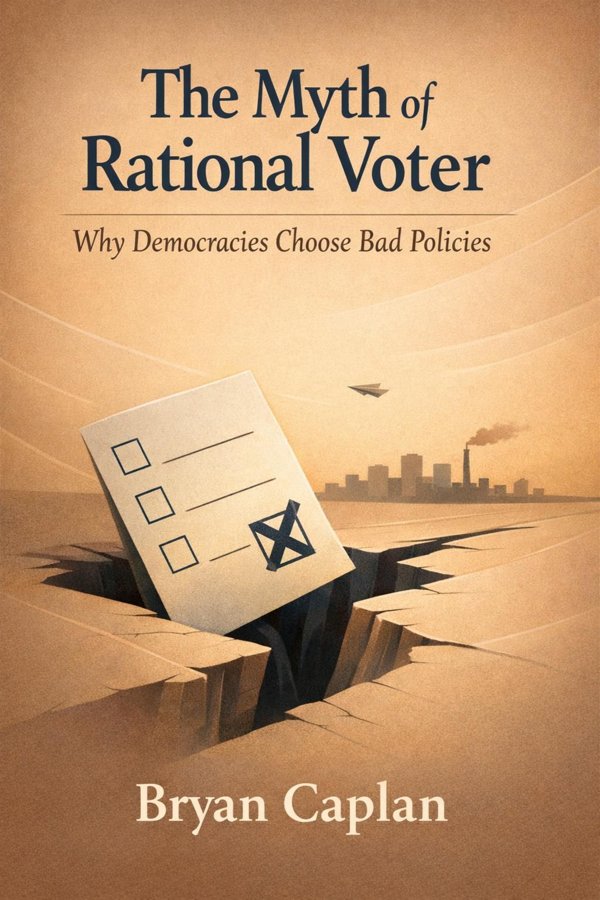
The Myth of the Rational Voter: Why Democracies Choose Bad Policies: Summary & Key Insights
by Bryan Caplan
 10 min11 chaptersAudio available
What Is The Myth of the Rational Voter: Why Democracies Choose Bad Policies About?
The Myth of the Rational Voter: Why Democracies Choose Bad Policies by Bryan Caplan is a economics book spanning 11 pages. In this influential work, economist Bryan Caplan challenges the conventional wisdom that voters are rational and well-informed participants in democratic decision-making. Drawing on insights from economics and psychology, Caplan argues that voters systematically hold biased beliefs about economics, leading democracies to adopt policies that are popular but economically harmful. He identifies four key biases—anti-market, anti-foreign, make-work, and pessimistic—that distort public opinion and policy outcomes. The book calls for a reevaluation of democratic processes and a greater reliance on expert knowledge in policymaking.
This FizzRead summary covers all 11 key chapters of The Myth of the Rational Voter: Why Democracies Choose Bad Policies in approximately 10 minutes, distilling the most important ideas, arguments, and takeaways from Bryan Caplan's work. Also available as an audio summary and Key Quotes Podcast.
The Myth of the Rational Voter: Why Democracies Choose Bad Policies
In this influential work, economist Bryan Caplan challenges the conventional wisdom that voters are rational and well-informed participants in democratic decision-making. Drawing on insights from economics and psychology, Caplan argues that voters systematically hold biased beliefs about economics, leading democracies to adopt policies that are popular but economically harmful. He identifies four key biases—anti-market, anti-foreign, make-work, and pessimistic—that distort public opinion and policy outcomes. The book calls for a reevaluation of democratic processes and a greater reliance on expert knowledge in policymaking.
Who Should Read The Myth of the Rational Voter: Why Democracies Choose Bad Policies?
This book is perfect for anyone interested in economics and looking to gain actionable insights in a short read. Whether you're a student, professional, or lifelong learner, the key ideas from The Myth of the Rational Voter: Why Democracies Choose Bad Policies by Bryan Caplan will help you think differently.
- ✓Readers who enjoy economics and want practical takeaways
- ✓Professionals looking to apply new ideas to their work and life
- ✓Anyone who wants the core insights of The Myth of the Rational Voter: Why Democracies Choose Bad Policies in just 10 minutes
Want the full summary?
Get instant access to this book summary and 100K+ more with Fizz Moment.
Get Free SummaryAvailable on App Store • Free to download
Key Chapters
The starting point for my argument is simple yet profound: people often hold irrational beliefs, and in politics, they can afford to. In market transactions, being wrong has consequences. If you believe homeopathy cures cancer and act on that belief, you may pay dearly. But in politics, the personal cost of being wrong is effectively zero. Your vote is one among millions; it won't change the outcome. That means political beliefs are a kind of luxury good—people consume them for comfort, identity, or moral satisfaction, not accuracy.
This leads to what I call *rational irrationality*: when the price of error is low, people act irrationally on purpose. They choose beliefs that make them feel virtuous, patriotic, or morally content, even if those beliefs are false. The democratic system amplifies these illusions because it treats each vote as equally valid regardless of reason or evidence. Democracy, in this sense, turns irrational beliefs into public policy.
The idea builds on research in behavioral economics and public choice theory. Economists like Anthony Downs and Gordon Tullock explained why rational ignorance—the idea that it’s not worth a voter’s time to be informed—is unavoidable. But I argue that ignorance alone isn’t enough to explain the persistence of bad policy. Voters don’t merely lack knowledge; they actively resist it. They cling to views that contradict economic reality, even when they are easily falsified. When a belief aligns with someone’s emotional or ideological identity, truth loses its incentive power.
This dynamic changes everything. It means that democracy’s problem is not corruption or apathy, but the human mind itself. Rational irrationality reveals why education campaigns and information drives often fail: they do not change the incentives. Unless being wrong becomes costly, voters will continue choosing myths over facts.
If my thesis were purely theoretical, it would amount to armchair cynicism. But data tell the same story with striking clarity. The heart of my evidence comes from the *Survey of Americans and Economists on the Economy* (SAEE), conducted by the *Washington Post* and *Kaiser Family Foundation*, which measured systematic differences between what economists believe and what ordinary citizens believe about economic issues.
Across dozens of questions—on trade, regulation, wages, and foreign investment—the pattern was unmistakable. The general public consistently favored pessimistic, protectionist, and interventionist positions that economists overwhelmingly rejected. For example, while most economists agreed that free trade raises living standards, the majority of voters believed it destroys jobs and harms the nation. Similarly, economists viewed automation and markets as sources of wealth and growth, while the public saw them as threats.
The remarkable part is not that people disagree with experts—that’s common in many domains. It’s that these disagreements are not random: they cluster around specific, predictable biases. And those biases align almost perfectly with emotional narratives—fear of foreigners, suspicion of profits, nostalgia for manual labor, and belief in national decline. When I analyze the data statistically, controlling for income, education, and self-interest, ideology and emotion explain far more variance than rational self-interest ever could.
To me, this is the death knell for the rational voter model. Citizens are not self-interested calculators optimizing their utility; they are human beings rationalizing comforting illusions. Democracy then aggregates those illusions, not truth.
+ 9 more chapters — available in the FizzRead app
All Chapters in The Myth of the Rational Voter: Why Democracies Choose Bad Policies
About the Author
Bryan Caplan is an American economist and professor of economics at George Mason University, known for his work in public choice theory, behavioral economics, and libertarian philosophy. He has written extensively on voter behavior, education, and immigration, and is a research fellow at the Mercatus Center.
Get This Summary in Your Preferred Format
Read or listen to the The Myth of the Rational Voter: Why Democracies Choose Bad Policies summary by Bryan Caplan anytime, anywhere. FizzRead offers multiple formats so you can learn on your terms — all free.
Available formats: App · Audio · PDF · EPUB — All included free with FizzRead
Download The Myth of the Rational Voter: Why Democracies Choose Bad Policies PDF and EPUB Summary
Key Quotes from The Myth of the Rational Voter: Why Democracies Choose Bad Policies
“The starting point for my argument is simple yet profound: people often hold irrational beliefs, and in politics, they can afford to.”
“If my thesis were purely theoretical, it would amount to armchair cynicism.”
Frequently Asked Questions about The Myth of the Rational Voter: Why Democracies Choose Bad Policies
The Myth of the Rational Voter: Why Democracies Choose Bad Policies by Bryan Caplan is a economics book that explores key ideas across 11 chapters. In this influential work, economist Bryan Caplan challenges the conventional wisdom that voters are rational and well-informed participants in democratic decision-making. Drawing on insights from economics and psychology, Caplan argues that voters systematically hold biased beliefs about economics, leading democracies to adopt policies that are popular but economically harmful. He identifies four key biases—anti-market, anti-foreign, make-work, and pessimistic—that distort public opinion and policy outcomes. The book calls for a reevaluation of democratic processes and a greater reliance on expert knowledge in policymaking.
More by Bryan Caplan
You Might Also Like
Business Adventures
John Brooks
10 min
Nudge
Richard H. Thaler, Cass R. Sunstein
10 min
The Hitchhiker"s Guide to the Galaxy
Douglas Adams
10 minThe Muqaddimah
Ibn Khaldun
10 minThe Outsiders
William N. Thorndike
10 min
A Little History of Economics
Niall Kishtainy
10 minBrowse by Category
Ready to read The Myth of the Rational Voter: Why Democracies Choose Bad Policies?
Get the full summary and 100K+ more books with Fizz Moment.