
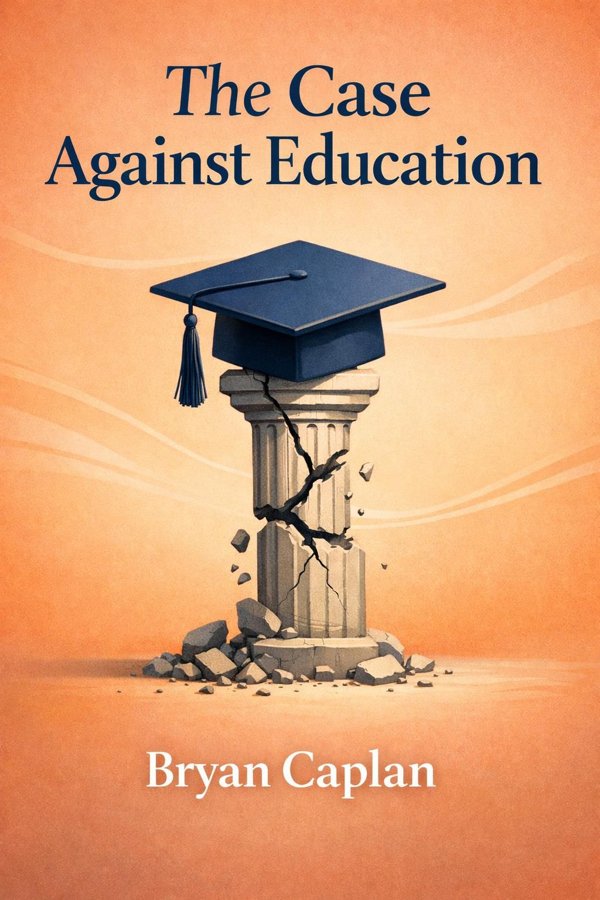
The Case Against Education: Why the Education System Is a Waste of Time and Money: Summary & Key Insights
by Bryan Caplan
 10 min10 chaptersAudio available
What Is The Case Against Education: Why the Education System Is a Waste of Time and Money About?
The Case Against Education: Why the Education System Is a Waste of Time and Money by Bryan Caplan is a economics book spanning 10 pages. In this provocative work, economist Bryan Caplan argues that much of modern education is wasteful signaling rather than genuine skill acquisition. He contends that schools primarily certify intelligence, conscientiousness, and conformity rather than imparting useful knowledge, and that society overinvests in formal education. Caplan proposes that reducing educational subsidies and focusing on practical training would yield better outcomes for individuals and the economy.
This FizzRead summary covers all 10 key chapters of The Case Against Education: Why the Education System Is a Waste of Time and Money in approximately 10 minutes, distilling the most important ideas, arguments, and takeaways from Bryan Caplan's work. Also available as an audio summary and Key Quotes Podcast.
The Case Against Education: Why the Education System Is a Waste of Time and Money
In this provocative work, economist Bryan Caplan argues that much of modern education is wasteful signaling rather than genuine skill acquisition. He contends that schools primarily certify intelligence, conscientiousness, and conformity rather than imparting useful knowledge, and that society overinvests in formal education. Caplan proposes that reducing educational subsidies and focusing on practical training would yield better outcomes for individuals and the economy.
Who Should Read The Case Against Education: Why the Education System Is a Waste of Time and Money?
This book is perfect for anyone interested in economics and looking to gain actionable insights in a short read. Whether you're a student, professional, or lifelong learner, the key ideas from The Case Against Education: Why the Education System Is a Waste of Time and Money by Bryan Caplan will help you think differently.
- ✓Readers who enjoy economics and want practical takeaways
- ✓Professionals looking to apply new ideas to their work and life
- ✓Anyone who wants the core insights of The Case Against Education: Why the Education System Is a Waste of Time and Money in just 10 minutes
Want the full summary?
Get instant access to this book summary and 100K+ more with Fizz Moment.
Get Free SummaryAvailable on App Store • Free to download
Key Chapters
The signaling model sits at the heart of my argument. Employers, faced with imperfect information, rely on educational credentials as reliable proxies for qualities they value: intelligence, conscientiousness, and conformity. A degree doesn’t necessarily make you smarter or more capable—it signals to others that you likely possess these traits. This insight, originally articulated in labor economics, helps explain why vast wage gaps persist between graduates and non-graduates even when the curriculum adds little direct job-relevant knowledge.
In practice, schooling operates like a tournament. Students signal their employability through persistence and performance in a largely artificial environment. Employers interpret academic success as evidence of valuable underlying characteristics, not as proof of learned skills. Think about the countless years spent memorizing facts later forgotten or mastering abstract theories never applied outside exams. These activities serve a social function—they allow employers to evaluate you indirectly—but they don’t enhance your productivity once hired.
What makes signaling powerful, yet tragic, is its self-reinforcing nature. Once degrees become the norm, those without them are stigmatized, even when equally competent. Students must continue playing the game simply to remain competitive, creating a credential arms race that wastes time and money while yielding little net increase in social welfare.
Traditional economists often defend the ‘human capital’ theory—that schooling boosts productivity by imparting valuable skills and knowledge. Under this view, education is like training: you learn mathematics to perform technical analysis, language to communicate effectively, history to gain perspective. I acknowledge parts of this story are true—basic literacy and numeracy undeniably raise competence—but empirical evidence suggests the human capital channel is vastly overestimated. Most subjects taught, especially in high school and college, have minimal relevance to real-world jobs.
Consider foreign languages, advanced mathematics, and literary theory. While intellectually enriching, they rarely improve occupational performance for the majority of graduates. When you ask adults how much they remember or use what they learned, you uncover a striking pattern of ‘forgetfulness and irrelevance.’ This gap between curriculum and application weakens the human capital argument. If schooling genuinely built job skills, the labor market would reward mastery of specific knowledge rather than completion of abstract degrees. Instead, employers prize credentials themselves, not the content behind them.
By critically comparing the signaling and human capital models, I argue that most educational investment does not yield proportional growth in national productivity. Schools teach compliance and perseverance more than competence, and social returns rarely justify the massive public subsidies they receive.
+ 8 more chapters — available in the FizzRead app
All Chapters in The Case Against Education: Why the Education System Is a Waste of Time and Money
About the Author
Bryan Caplan is a professor of economics at George Mason University and a research fellow at the Mercatus Center. He is known for his work on public choice theory, libertarian philosophy, and the economics of education. Caplan has authored several influential books, including 'The Myth of the Rational Voter' and 'Selfish Reasons to Have More Kids.'
Get This Summary in Your Preferred Format
Read or listen to the The Case Against Education: Why the Education System Is a Waste of Time and Money summary by Bryan Caplan anytime, anywhere. FizzRead offers multiple formats so you can learn on your terms — all free.
Available formats: App · Audio · PDF · EPUB — All included free with FizzRead
Download The Case Against Education: Why the Education System Is a Waste of Time and Money PDF and EPUB Summary
Key Quotes from The Case Against Education: Why the Education System Is a Waste of Time and Money
“The signaling model sits at the heart of my argument.”
“Traditional economists often defend the ‘human capital’ theory—that schooling boosts productivity by imparting valuable skills and knowledge.”
Frequently Asked Questions about The Case Against Education: Why the Education System Is a Waste of Time and Money
The Case Against Education: Why the Education System Is a Waste of Time and Money by Bryan Caplan is a economics book that explores key ideas across 10 chapters. In this provocative work, economist Bryan Caplan argues that much of modern education is wasteful signaling rather than genuine skill acquisition. He contends that schools primarily certify intelligence, conscientiousness, and conformity rather than imparting useful knowledge, and that society overinvests in formal education. Caplan proposes that reducing educational subsidies and focusing on practical training would yield better outcomes for individuals and the economy.
More by Bryan Caplan
You Might Also Like
Business Adventures
John Brooks
10 min
Nudge
Richard H. Thaler, Cass R. Sunstein
10 min
The Hitchhiker"s Guide to the Galaxy
Douglas Adams
10 minThe Muqaddimah
Ibn Khaldun
10 minThe Outsiders
William N. Thorndike
10 min
A Little History of Economics
Niall Kishtainy
10 minBrowse by Category
Ready to read The Case Against Education: Why the Education System Is a Waste of Time and Money?
Get the full summary and 100K+ more books with Fizz Moment.