
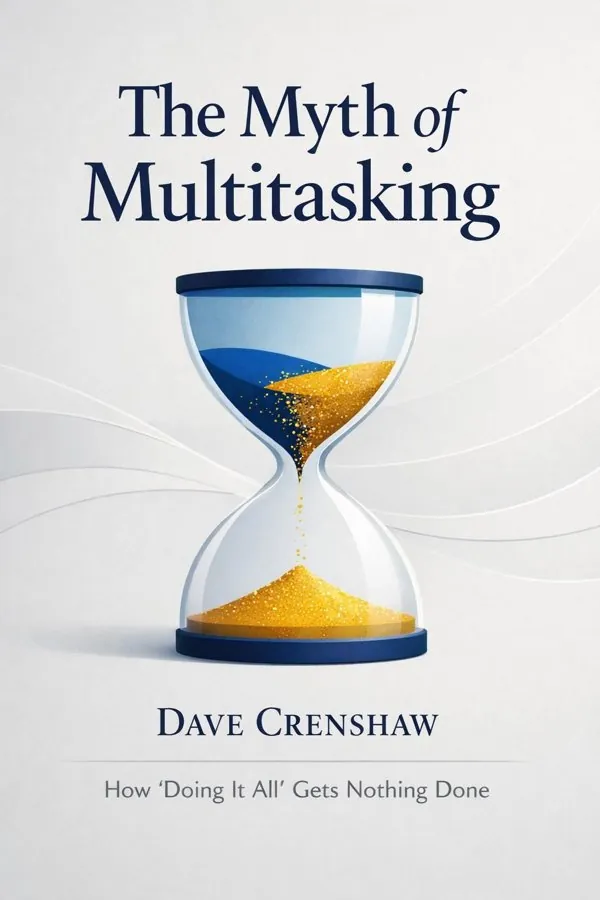
The Myth of Multitasking: How 'Doing It All' Gets Nothing Done: Summary & Key Insights
 10 min9 chaptersAudio available
Key Takeaways from The Myth of Multitasking: How 'Doing It All' Gets Nothing Done
One of the most dangerous productivity myths begins with a simple misunderstanding of language.
The brain does not slide smoothly between complex tasks; it pays a toll each time.
Most people underestimate the damage of divided attention because they only count visible minutes, not invisible consequences.
An interruption is not just a break in work; it is a lesson in how to work.
Deep focus is not just a productivity technique; it is a better way to work and live.
What Is The Myth of Multitasking: How 'Doing It All' Gets Nothing Done About?
The Myth of Multitasking: How 'Doing It All' Gets Nothing Done by Dave Crenshaw is a productivity book spanning 11 pages. In a culture that praises busyness, Dave Crenshaw delivers a sharp and necessary correction: multitasking is not a productivity skill, but a costly illusion. In The Myth of Multitasking, he argues that what most people call multitasking is really rapid task-switching, and every switch drains time, attention, energy, and quality. The result is not higher performance, but more mistakes, more stress, and less meaningful work completed. Crenshaw’s message matters because modern life constantly rewards responsiveness over effectiveness. Emails, messages, meetings, and digital notifications create the feeling of progress while quietly fragmenting focus. Drawing on research, workplace examples, and practical coaching insight, Crenshaw shows how these habits reduce clarity and weaken relationships both at work and at home. As a productivity expert, speaker, and business coach, Crenshaw writes with credibility and practicality. He does not merely criticize modern work habits; he offers a usable framework for change. This book is a concise guide for anyone who feels overloaded, distracted, or constantly busy without making real progress. Its core promise is simple but powerful: do fewer things at once, and you will accomplish more of what actually matters.
This FizzRead summary covers all 9 key chapters of The Myth of Multitasking: How 'Doing It All' Gets Nothing Done in approximately 10 minutes, distilling the most important ideas, arguments, and takeaways from Dave Crenshaw's work. Also available as an audio summary and Key Quotes Podcast.
The Myth of Multitasking: How 'Doing It All' Gets Nothing Done
In a culture that praises busyness, Dave Crenshaw delivers a sharp and necessary correction: multitasking is not a productivity skill, but a costly illusion. In The Myth of Multitasking, he argues that what most people call multitasking is really rapid task-switching, and every switch drains time, attention, energy, and quality. The result is not higher performance, but more mistakes, more stress, and less meaningful work completed.
Crenshaw’s message matters because modern life constantly rewards responsiveness over effectiveness. Emails, messages, meetings, and digital notifications create the feeling of progress while quietly fragmenting focus. Drawing on research, workplace examples, and practical coaching insight, Crenshaw shows how these habits reduce clarity and weaken relationships both at work and at home.
As a productivity expert, speaker, and business coach, Crenshaw writes with credibility and practicality. He does not merely criticize modern work habits; he offers a usable framework for change. This book is a concise guide for anyone who feels overloaded, distracted, or constantly busy without making real progress. Its core promise is simple but powerful: do fewer things at once, and you will accomplish more of what actually matters.
Who Should Read The Myth of Multitasking: How 'Doing It All' Gets Nothing Done?
This book is perfect for anyone interested in productivity and looking to gain actionable insights in a short read. Whether you're a student, professional, or lifelong learner, the key ideas from The Myth of Multitasking: How 'Doing It All' Gets Nothing Done by Dave Crenshaw will help you think differently.
- ✓Readers who enjoy productivity and want practical takeaways
- ✓Professionals looking to apply new ideas to their work and life
- ✓Anyone who wants the core insights of The Myth of Multitasking: How 'Doing It All' Gets Nothing Done in just 10 minutes
Want the full summary?
Get instant access to this book summary and 100K+ more with Fizz Moment.
Get Free SummaryAvailable on App Store • Free to download
Key Chapters
One of the most dangerous productivity myths begins with a simple misunderstanding of language. People often say they are multitasking when they mean they are handling several responsibilities during the day. But Crenshaw makes an essential distinction: doing many things over time is not the same as doing many things at the same time. True multitasking is rare and limited to activities that require little conscious thought, such as walking while listening to music. Most knowledge work, however, depends on concentration, judgment, memory, and decision-making. Those tasks cannot be done well simultaneously.
This distinction matters because the word “multitasking” sounds positive. It suggests speed, competence, and adaptability. In reality, what many people celebrate is often mental fragmentation. A manager answering emails during a meeting is not being efficient; that person is dividing attention and performing both tasks poorly. A parent checking messages while helping a child with homework may feel productive, but the divided focus diminishes presence and patience.
By redefining the problem correctly, Crenshaw helps readers stop praising a habit that is hurting them. When people understand that most multitasking is actually constant switching, they can begin to measure its real cost. Instead of admiring themselves for being busy, they can ask a better question: what deserves full attention right now?
Actionable takeaway: For one day, notice every time you say or think “I’m multitasking.” Replace it with a more accurate description, such as “I’m switching between tasks,” and observe how that changes your behavior.
The brain does not slide smoothly between complex tasks; it pays a toll each time. Crenshaw introduces the idea of “switchtasking” to describe what really happens when people jump from one mentally demanding activity to another. Each switch requires reorientation: remembering where you left off, recalling priorities, and rebuilding concentration. These tiny recovery periods may seem insignificant, but across a day they consume surprising amounts of time.
Imagine writing a proposal, then pausing to answer a text, then glancing at email, then returning to the proposal. You may tell yourself you only lost a minute here and there. But in practice, the interruption breaks thought patterns, weakens depth, and increases the odds of errors. Creative work becomes shallow. Analytical work becomes slower. Routine work becomes more frustrating.
Crenshaw’s insight is especially important for office environments, where interruptions are normalized. Open tabs, endless alerts, and expectations of instant responsiveness create the illusion that switching is a necessary professional skill. Yet the more often people switch, the less likely they are to complete meaningful work efficiently.
Switchtasking also has emotional consequences. It leaves people with a nagging feeling of incompletion because nothing gets finished cleanly. They remain mentally tethered to multiple unfinished loops at once.
Actionable takeaway: Choose one high-value task each day and protect a block of uninterrupted time for it. During that block, close unrelated tabs, silence notifications, and refuse to switch unless there is a true emergency.
An interruption is not just a break in work; it is a lesson in how to work. Crenshaw shows that frequent interruptions condition people to expect novelty, react impulsively, and tolerate fragmented attention. Over time, the problem becomes internal as well as external. Even when the environment is quiet, the mind starts generating its own distractions because it has grown accustomed to constant switching.
Some interruptions come from others: phone calls, coworkers stopping by, urgent-looking messages. Others are self-inflicted: checking inboxes too often, picking up the phone during difficult work, or opening social media for a quick mental break. The common feature is that they pull attention away before a task reaches completion. The more often this happens, the harder it becomes to sustain focus.
Crenshaw encourages readers to stop treating every interruption as equally important. Not every message is urgent. Not every request deserves immediate attention. In many workplaces, instant response has become a cultural habit rather than a genuine necessity. That habit makes everyone busier and less effective.
Reducing interruptions often requires both boundaries and systems. For example, setting office hours, batching email responses, using “do not disturb” modes, or communicating clear availability can dramatically improve concentration without harming service or teamwork.
Actionable takeaway: Identify your top three interruption sources this week. For each one, create a rule, such as checking email only three times daily or muting nonessential notifications during focus sessions.
Deep focus is not just a productivity technique; it is a better way to work and live. Crenshaw emphasizes that single-tasking allows people to enter a state of flow, where attention becomes fully absorbed in one meaningful activity. In that state, work feels clearer, faster, and more satisfying. Instead of constantly restarting, the mind builds momentum.
Flow matters because many valuable tasks require cognitive depth. Writing, planning, analysis, design, strategic thinking, and problem-solving all improve when the brain has enough uninterrupted time to move past surface-level engagement. The same is true in personal life. Listening to a spouse, playing with a child, or having a thoughtful conversation becomes richer when attention is undivided.
Crenshaw’s argument is not that people should become rigid or unreachable. Rather, he argues that attention should be directed intentionally. There is a profound difference between deciding when to shift focus and being dragged into distraction by every incoming stimulus.
Single-tasking also reduces stress because it narrows the mental field. Instead of carrying five unfinished concerns at once, you deal with one thing fully. That creates a sense of completion and competence. Over time, people who protect focus often discover that they produce better results in less time and feel less overwhelmed doing it.
Actionable takeaway: Schedule one daily focus block of at least 30 to 60 minutes for your most important work, and treat it as an appointment that cannot be casually broken.
Good intentions rarely survive a chaotic environment. Crenshaw stresses that focus is not achieved by willpower alone; it is supported by systems. If your calendar is cluttered, your workspace is noisy, and your digital tools constantly interrupt you, even strong motivation will struggle. Productive people do not merely try harder to focus. They design conditions that reduce the need for constant decisions.
These systems can be simple. Group similar tasks together so your brain stays in one mode longer. Reserve specific times for meetings, email, calls, and administrative work. Keep a visible task list that tells you what deserves attention now and what can wait. Organize your workspace so materials for the current task are easy to access and unrelated clutter is out of sight.
Crenshaw also highlights the importance of transition rituals. Before beginning a task, define the goal. Before ending it, leave yourself a note about the next step. These small practices reduce the friction of resuming work later and protect momentum.
At home, similar systems help. A basket for incoming mail, a routine for family planning, or designated times for household administration can prevent constant low-level switching. The point is not perfection but repeatability. Systems reduce mental drag by making focus the default rather than the exception.
Actionable takeaway: Choose one area of your life, such as email, meetings, or household tasks, and create a simple repeatable system that minimizes switching and tells you exactly when and how to handle that category.
Many interruptions are social, which means they can often be reduced through better expectations. Crenshaw notes that people frequently create their own distraction culture by failing to communicate boundaries, priorities, and response times. When coworkers, clients, or family members do not know how and when you work best, they assume constant availability. That assumption becomes a self-reinforcing pattern.
Clear communication can prevent this. A manager might tell a team, “I review email at 11 a.m. and 4 p.m., but call me immediately for emergencies.” A freelancer might explain project timelines and response windows upfront. A parent working from home might establish visible signals for when they can and cannot be interrupted. These approaches do not reduce service; they improve clarity.
Crenshaw’s point is that responsiveness should be intentional, not reflexive. In fact, structured communication often increases trust because people know what to expect. Instead of wondering why you did not answer instantly, they understand your system and can plan accordingly.
This idea also applies inwardly. Communicating priorities to yourself matters. If you start each day without identifying your most important tasks, you leave your attention vulnerable to the loudest request rather than the most important responsibility.
Actionable takeaway: Write a short message, script, or policy that explains your availability and response times to key people in your life. Use it consistently for one week and notice whether interruptions become more manageable.
Digital tools promise efficiency, but without discipline they become engines of distraction. Crenshaw argues that technology is not the enemy in itself; the real issue is unstructured use. Smartphones, email, messaging apps, and browser tabs make it easy to switch tasks in seconds, which means they also make it easy to lose focus dozens of times an hour.
The problem is psychological as much as practical. Every notification carries the possibility of novelty, urgency, or social reward. That makes devices hard to ignore, especially when work feels difficult. A quick glance turns into a chain of small diversions. Even if each one lasts only moments, the cumulative effect can devastate concentration.
Crenshaw encourages readers to treat technology as a tool to be managed rather than a master to be obeyed. This may mean disabling nonessential notifications, separating communication channels by purpose, keeping the phone out of sight during deep work, or using website blockers during high-focus periods. It can also mean questioning cultural assumptions, such as the idea that good employees must be instantly reachable at all times.
Used wisely, technology can support single-tasking. Calendars can protect focus blocks. Task managers can store reminders so the brain does not have to. Automation can reduce repetitive administrative work. The key is intentional design rather than passive consumption.
Actionable takeaway: Perform a digital audit today. Turn off every notification that is not truly urgent, remove one distracting app from your home screen, and create a distraction-free work mode for your most important tasks.
The benefits of focused attention extend far beyond efficiency. Crenshaw shows that when people stop switchtasking, they not only complete more meaningful work, but also become more present, reliable, and calm. Productivity improves because tasks are finished with fewer errors and less rework. Relationships improve because people feel heard instead of half-attended to.
In professional settings, single-tasking enhances credibility. A leader who gives full attention in meetings makes better decisions and builds trust. An employee who protects time for high-value work produces stronger outcomes. A service professional who listens carefully to a client catches nuances others miss. These advantages accumulate into better performance and reputation.
In personal life, the change can be even more profound. Many people physically share space with loved ones while mentally remaining elsewhere. Crenshaw reminds readers that partial attention is often experienced by others as indifference. Being fully present for a conversation, meal, or family routine can strengthen connection in ways that no productivity system alone can achieve.
The deeper lesson is that attention is one of the most valuable resources we possess. Where it goes, quality follows. When we scatter it, our work and relationships become thinner. When we concentrate it, results become better and life often feels more meaningful.
Actionable takeaway: Choose one recurring situation this week, such as meetings, meals, or one-on-one conversations, and commit to full presence with no phone, email, or side activity. Notice how the quality of the experience changes.
All Chapters in The Myth of Multitasking: How 'Doing It All' Gets Nothing Done
About the Author
Dave Crenshaw is an American author, speaker, and business coach best known for his expertise in productivity, time management, and leadership. He has helped organizations and individuals improve performance by reducing overload, clarifying priorities, and creating better work habits. Crenshaw’s advice is widely respected because it combines practical business experience with clear, accessible teaching. His ideas and commentary have appeared in major media outlets including Time, Forbes, and the BBC. Through his books, workshops, and consulting, he has become especially known for challenging modern workplace assumptions that reward busyness over effectiveness. In The Myth of Multitasking, Crenshaw distills one of his most influential messages: people do better work, make better decisions, and live with less stress when they give full attention to one important thing at a time.
Get This Summary in Your Preferred Format
Read or listen to the The Myth of Multitasking: How 'Doing It All' Gets Nothing Done summary by Dave Crenshaw anytime, anywhere. FizzRead offers multiple formats so you can learn on your terms — all free.
Available formats: App · Audio · PDF · EPUB — All included free with FizzRead
Download The Myth of Multitasking: How 'Doing It All' Gets Nothing Done PDF and EPUB Summary
Key Quotes from The Myth of Multitasking: How 'Doing It All' Gets Nothing Done
“One of the most dangerous productivity myths begins with a simple misunderstanding of language.”
“The brain does not slide smoothly between complex tasks; it pays a toll each time.”
“Most people underestimate the damage of divided attention because they only count visible minutes, not invisible consequences.”
“An interruption is not just a break in work; it is a lesson in how to work.”
“Deep focus is not just a productivity technique; it is a better way to work and live.”
Frequently Asked Questions about The Myth of Multitasking: How 'Doing It All' Gets Nothing Done
The Myth of Multitasking: How 'Doing It All' Gets Nothing Done by Dave Crenshaw is a productivity book that explores key ideas across 9 chapters. In a culture that praises busyness, Dave Crenshaw delivers a sharp and necessary correction: multitasking is not a productivity skill, but a costly illusion. In The Myth of Multitasking, he argues that what most people call multitasking is really rapid task-switching, and every switch drains time, attention, energy, and quality. The result is not higher performance, but more mistakes, more stress, and less meaningful work completed. Crenshaw’s message matters because modern life constantly rewards responsiveness over effectiveness. Emails, messages, meetings, and digital notifications create the feeling of progress while quietly fragmenting focus. Drawing on research, workplace examples, and practical coaching insight, Crenshaw shows how these habits reduce clarity and weaken relationships both at work and at home. As a productivity expert, speaker, and business coach, Crenshaw writes with credibility and practicality. He does not merely criticize modern work habits; he offers a usable framework for change. This book is a concise guide for anyone who feels overloaded, distracted, or constantly busy without making real progress. Its core promise is simple but powerful: do fewer things at once, and you will accomplish more of what actually matters.
You Might Also Like


Browse by Category
Ready to read The Myth of Multitasking: How 'Doing It All' Gets Nothing Done?
Get the full summary and 100K+ more books with Fizz Moment.