
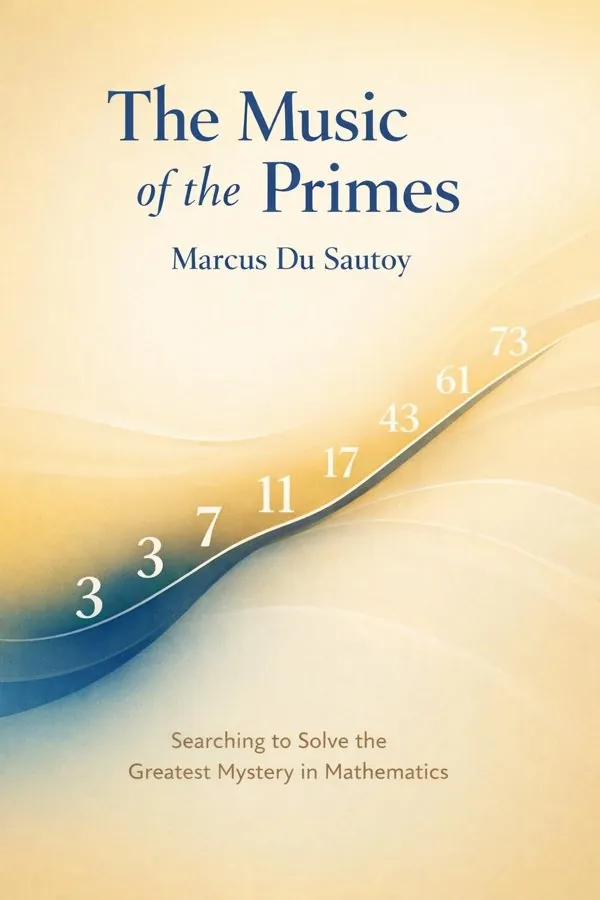
The Music of the Primes: Searching to Solve the Greatest Mystery in Mathematics: Summary & Key Insights
 10 min4 chaptersAudio available
What Is The Music of the Primes: Searching to Solve the Greatest Mystery in Mathematics About?
The Music of the Primes: Searching to Solve the Greatest Mystery in Mathematics by Marcus Du Sautoy is a popular_sci book spanning 4 pages. In this engaging and accessible work, Marcus du Sautoy explores the history and mystery of prime numbers, focusing on the Riemann Hypothesis and the mathematicians who have pursued its solution. Blending biography, history, and mathematics, the book illuminates one of the most profound unsolved problems in number theory and its far-reaching implications for science and technology.
This FizzRead summary covers all 4 key chapters of The Music of the Primes: Searching to Solve the Greatest Mystery in Mathematics in approximately 10 minutes, distilling the most important ideas, arguments, and takeaways from Marcus Du Sautoy's work. Also available as an audio summary and Key Quotes Podcast.
The Music of the Primes: Searching to Solve the Greatest Mystery in Mathematics
In this engaging and accessible work, Marcus du Sautoy explores the history and mystery of prime numbers, focusing on the Riemann Hypothesis and the mathematicians who have pursued its solution. Blending biography, history, and mathematics, the book illuminates one of the most profound unsolved problems in number theory and its far-reaching implications for science and technology.
Who Should Read The Music of the Primes: Searching to Solve the Greatest Mystery in Mathematics?
This book is perfect for anyone interested in popular_sci and looking to gain actionable insights in a short read. Whether you're a student, professional, or lifelong learner, the key ideas from The Music of the Primes: Searching to Solve the Greatest Mystery in Mathematics by Marcus Du Sautoy will help you think differently.
- ✓Readers who enjoy popular_sci and want practical takeaways
- ✓Professionals looking to apply new ideas to their work and life
- ✓Anyone who wants the core insights of The Music of the Primes: Searching to Solve the Greatest Mystery in Mathematics in just 10 minutes
Want the full summary?
Get instant access to this book summary and 100K+ more with Fizz Moment.
Get Free SummaryAvailable on App Store • Free to download
Key Chapters
Every mathematician sooner or later meets the primes — those numbers that can be divided only by themselves and one. They lie scattered along the number line like rare gems amid common stones. To the casual observer, their occurrence may appear utterly random; yet deep within their seeming disorder lies a tantalizing suggestion of hidden order, a secret rhythm.
From the beginning of mathematics, primes have stood as fundamental yet elusive entities. Euclid, over two thousand years ago, proved that there are infinitely many primes, a result so simple yet so profound that it remains one of the pillars of mathematical thought. His argument was clear and irrefutable: suppose there were a finite list of primes; multiply them together and add one — that new number could not be divided by any of the existing primes. Thus, at least one new prime must exist. Infinity, therefore, was guaranteed.
This early revelation launched the centuries-long search for understanding their distribution. Euler, whose brilliance reshaped eighteenth-century mathematics, found the first connections between prime numbers and infinite series. His discovery that the sum of their reciprocals diverged hinted at their pervasive presence throughout the numerical universe. This was the moment primes began to sing softly in the background of mathematics — their melody faint, but unmistakable.
To study primes is to wrestle with randomness itself. At small scales, they come unpredictably — 2, 3, 5, 7, 11 — yet at larger scales, patterns emerge like harmonies in music. The gaps between them widen, the rhythm slows, but never ceases. The primes are both chaos and structure, the signature of something infinitely complex yet perfectly precise.
The nineteenth century brought mathematics to a new level of abstraction, and with it came Bernhard Riemann, perhaps the most enigmatic figure in our story. Before him, Carl Friedrich Gauss had already intuited that the primes were not scattered completely at random. Gauss kept private notes suggesting that the number of primes less than a given number n was roughly n divided by its logarithm, an insight that captured the slowing rhythm of primes as numbers grew larger. This prediction was eventually formalized as the Prime Number Theorem.
Riemann took Gauss’s empirical observation and infused it with profound theoretical depth. His zeta function—a mysterious expression linking all primes to the infinite continuum of complex numbers—was unlike anything mathematics had seen before. By looking at the zeros of this function, Riemann believed one could understand the precise distribution of the primes. His single short paper in 1859 contained ideas so rich that they have dominated number theory ever since.
The Riemann Hypothesis, stating that all the nontrivial zeros of the zeta function lie along a straight line in the complex plane, has become mathematics’ ultimate test of truth. It is a statement about harmony: the belief that the erratic sequence of primes obeys a hidden, perfect order, much like the overtone series in music obeys the laws of resonance.
To investigate primes now became a quest through the abstract realms of analysis. Mathematicians such as Hardy and Littlewood carried forward Riemann’s legacy, forging methods of vast ingenuity to approximate, bound, and analyze primes. Hardy once remarked that mathematics, at its finest, possesses a cold and austere beauty; yet in the primes, that beauty meets something almost mystical — the suggestion that chaos and order are but two faces of the same coin.
+ 2 more chapters — available in the FizzRead app
All Chapters in The Music of the Primes: Searching to Solve the Greatest Mystery in Mathematics
About the Author
Marcus du Sautoy is a British mathematician and professor at the University of Oxford, where he holds the Simonyi Professorship for the Public Understanding of Science. He is known for his research in group theory and for popularizing mathematics through books, television, and public lectures.
Get This Summary in Your Preferred Format
Read or listen to the The Music of the Primes: Searching to Solve the Greatest Mystery in Mathematics summary by Marcus Du Sautoy anytime, anywhere. FizzRead offers multiple formats so you can learn on your terms — all free.
Available formats: App · Audio · PDF · EPUB — All included free with FizzRead
Download The Music of the Primes: Searching to Solve the Greatest Mystery in Mathematics PDF and EPUB Summary
Key Quotes from The Music of the Primes: Searching to Solve the Greatest Mystery in Mathematics
“Every mathematician sooner or later meets the primes — those numbers that can be divided only by themselves and one.”
“The nineteenth century brought mathematics to a new level of abstraction, and with it came Bernhard Riemann, perhaps the most enigmatic figure in our story.”
Frequently Asked Questions about The Music of the Primes: Searching to Solve the Greatest Mystery in Mathematics
The Music of the Primes: Searching to Solve the Greatest Mystery in Mathematics by Marcus Du Sautoy is a popular_sci book that explores key ideas across 4 chapters. In this engaging and accessible work, Marcus du Sautoy explores the history and mystery of prime numbers, focusing on the Riemann Hypothesis and the mathematicians who have pursued its solution. Blending biography, history, and mathematics, the book illuminates one of the most profound unsolved problems in number theory and its far-reaching implications for science and technology.
More by Marcus Du Sautoy
You Might Also Like

Structures: Or Why Things Don"t Fall Down
J.E. Gordon
10 min
The Road to Wigan Pier
George Orwell
10 min
Bonk: The Curious Coupling of Science and Sex
Mary Roach
10 min
First Bite: How We Learn to Eat
Bee Wilson
10 min
In Pursuit Of The Unknown: 17 Equations That Changed The World
Ian Stewart
10 min
Napoleon's Buttons: 17 Molecules That Changed History
Penny Le Couteur and Jay Burreson
10 minBrowse by Category
Ready to read The Music of the Primes: Searching to Solve the Greatest Mystery in Mathematics?
Get the full summary and 100K+ more books with Fizz Moment.