
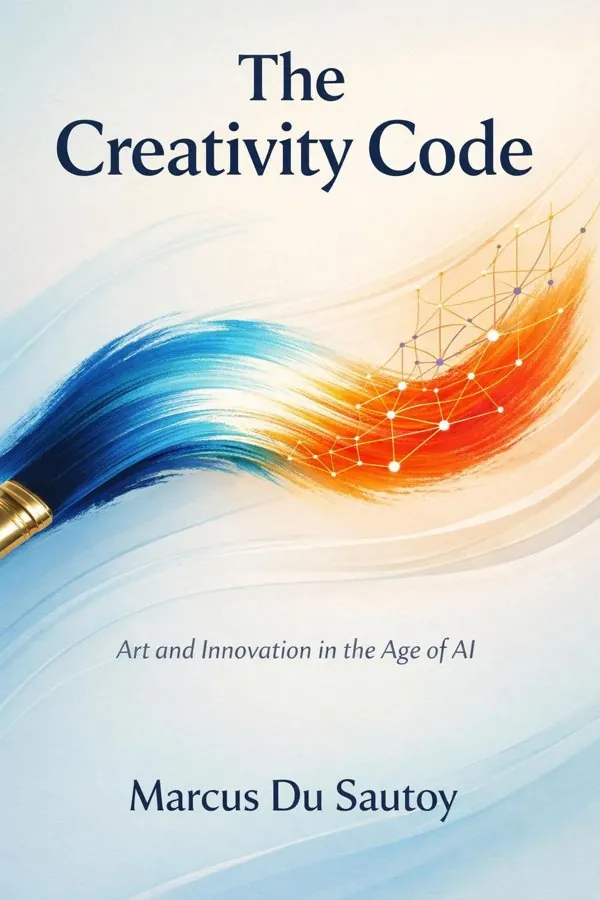
The Creativity Code: Art and Innovation in the Age of AI: Summary & Key Insights
 10 min10 chaptersAudio available
What Is The Creativity Code: Art and Innovation in the Age of AI About?
The Creativity Code: Art and Innovation in the Age of AI by Marcus Du Sautoy is a ai_ml book spanning 10 pages. In this book, mathematician Marcus du Sautoy explores the intersection of creativity and artificial intelligence, examining whether machines can truly create art, music, and literature. He delves into the algorithms behind AI-generated works and reflects on what creativity means in a world increasingly shaped by technology.
This FizzRead summary covers all 10 key chapters of The Creativity Code: Art and Innovation in the Age of AI in approximately 10 minutes, distilling the most important ideas, arguments, and takeaways from Marcus Du Sautoy's work. Also available as an audio summary and Key Quotes Podcast.
The Creativity Code: Art and Innovation in the Age of AI
In this book, mathematician Marcus du Sautoy explores the intersection of creativity and artificial intelligence, examining whether machines can truly create art, music, and literature. He delves into the algorithms behind AI-generated works and reflects on what creativity means in a world increasingly shaped by technology.
Who Should Read The Creativity Code: Art and Innovation in the Age of AI?
This book is perfect for anyone interested in ai_ml and looking to gain actionable insights in a short read. Whether you're a student, professional, or lifelong learner, the key ideas from The Creativity Code: Art and Innovation in the Age of AI by Marcus Du Sautoy will help you think differently.
- ✓Readers who enjoy ai_ml and want practical takeaways
- ✓Professionals looking to apply new ideas to their work and life
- ✓Anyone who wants the core insights of The Creativity Code: Art and Innovation in the Age of AI in just 10 minutes
Want the full summary?
Get instant access to this book summary and 100K+ more with Fizz Moment.
Get Free SummaryAvailable on App Store • Free to download
Key Chapters
To understand whether machines can be creative, we must first pin down what creativity actually entails. Philosophers, psychologists, and artists have long argued over this word, trying to capture the elusive mixture of imagination, intuition, and intellect that allows something truly new to emerge. I propose a definition grounded in three pillars: originality, value, and surprise.
Originality implies that the outcome isn’t merely a repetition of what came before—it breaks boundaries, finds an unexpected path through familiar territory. Value means that this creation must have significance; it must connect to our emotions, our curiosity, our sense of aesthetics or truth. Surprise marks the flash of discovery—the delight in encountering something we didn’t anticipate, yet instantly recognize as meaningful.
When we examine creativity through these lenses, we realize it’s not exclusive to human consciousness. Algorithms are already producing outputs that are original in form, valued by critics and audiences, and surprisingly innovative in technique. But does that mean the algorithm itself is creative? I argue that creativity may not reside in the mind alone—it might instead be a property of systems capable of combining information in novel and effective ways. When a machine composes a piece that moves a human listener, perhaps creativity arises from the interplay between algorithm and audience, not one or the other alone.
The key is how we design algorithms to go beyond imitation. Most early creative programs simply mimic existing styles. But creativity emerges when algorithms learn the essence of those styles—the deeper structures—and then recombine or mutate them into new forms. This process requires choice, risk, and the pursuit of the unknown, qualities we traditionally associate with living creators.
As I explore throughout the book, defining creativity thus leads to redefining ourselves. The mirror that machines hold up to our creative processes forces us to ask: what part of creation lies in emotion, what part in computation, and what part in the mysterious human urge to surprise even ourselves?
Mathematics may seem an unlikely domain for creativity, yet for me, it was here that I first learned what it means to make something new. Each proof is a journey, a narrative woven with logical threads and moments of inspiration. When a mathematician discovers an elegant solution, it feels like composing a symphony—precision and imagination fused.
I share examples of how machines are entering this realm. Programs now conjecture new relationships among prime numbers, search vast spaces of geometric configurations, and even generate proofs. They explore patterns as we do—sometimes through brute force, but increasingly through abstraction. One case I explore is the use of AI to discover new mathematical conjectures by analyzing massive datasets, a process that reveals patterns no human might notice unaided.
This challenges our notion of mathematical creativity. If an algorithm recognizes a hidden symmetry that leads to new theory, is that creativity? I suggest that creativity in mathematics emerges from pattern-recognition combined with the courage to step into unknown territory. Machines are developing the first of these skills rapidly. The second—risk and intuition—remains, for now, uniquely human. Yet working in tandem, human and machine mathematicians might achieve discoveries neither could make alone.
My perspective here is optimistic. Mathematics, far from being an outdated symbol of human reasoning, becomes the bridge between human and artificial creativity. It shows how both minds and machines can explore infinite possibility through patterns, proving that creativity is not limited by biology but by curiosity.
+ 8 more chapters — available in the FizzRead app
All Chapters in The Creativity Code: Art and Innovation in the Age of AI
About the Author
Marcus du Sautoy is a British mathematician and professor at the University of Oxford, known for his work in number theory and for popularizing mathematics through books and television. He has written several acclaimed works on mathematics and science communication.
Get This Summary in Your Preferred Format
Read or listen to the The Creativity Code: Art and Innovation in the Age of AI summary by Marcus Du Sautoy anytime, anywhere. FizzRead offers multiple formats so you can learn on your terms — all free.
Available formats: App · Audio · PDF · EPUB — All included free with FizzRead
Download The Creativity Code: Art and Innovation in the Age of AI PDF and EPUB Summary
Key Quotes from The Creativity Code: Art and Innovation in the Age of AI
“To understand whether machines can be creative, we must first pin down what creativity actually entails.”
“Mathematics may seem an unlikely domain for creativity, yet for me, it was here that I first learned what it means to make something new.”
Frequently Asked Questions about The Creativity Code: Art and Innovation in the Age of AI
The Creativity Code: Art and Innovation in the Age of AI by Marcus Du Sautoy is a ai_ml book that explores key ideas across 10 chapters. In this book, mathematician Marcus du Sautoy explores the intersection of creativity and artificial intelligence, examining whether machines can truly create art, music, and literature. He delves into the algorithms behind AI-generated works and reflects on what creativity means in a world increasingly shaped by technology.
More by Marcus Du Sautoy
You Might Also Like
Life 3.0
Max Tegmark
10 min
Superintelligence
Nick Bostrom
10 min
TensorFlow in Action
Thushan Ganegedara
10 min
AI Made Simple: A Beginner’s Guide to Generative AI, ChatGPT, and the Future of Work
Rajeev Kapur
10 min
AI Snake Oil
Arvind Narayanan, Sayash Kapoor
10 min
AI Superpowers: China, Silicon Valley, and the New World Order
Kai-Fu Lee
10 minBrowse by Category
Ready to read The Creativity Code: Art and Innovation in the Age of AI?
Get the full summary and 100K+ more books with Fizz Moment.