
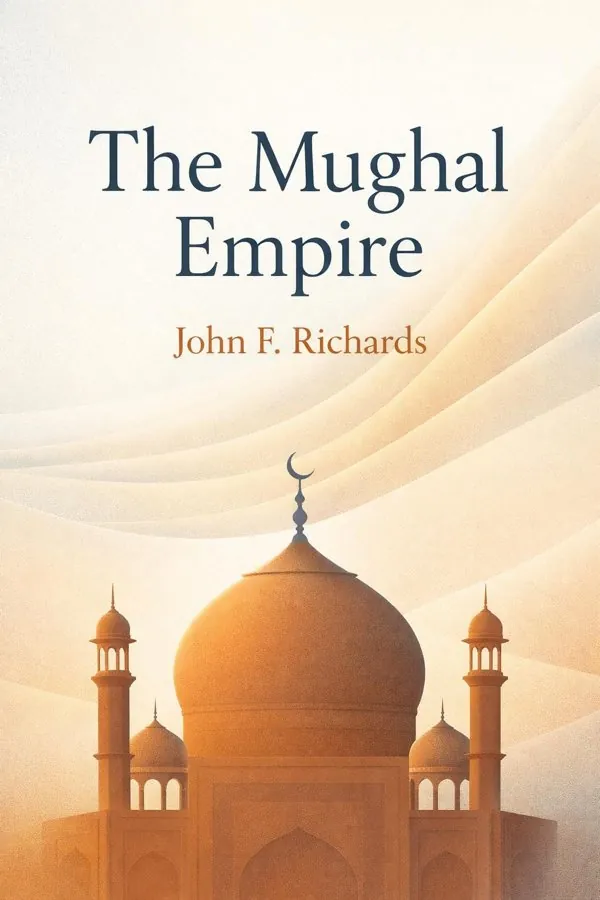
The Mughal Empire: Summary & Key Insights
 10 min10 chaptersAudio available
Key Takeaways from The Mughal Empire
Empires often begin not with stability, but with improvisation under pressure.
The survival of a dynasty can depend as much on recovery from failure as on victory in triumph.
Great rulers are remembered for conquest, but the most consequential ones solve the problem of governing difference.
An empire’s real strength is measured less by the splendor of its court than by its ability to turn land, labor, and loyalty into predictable power.
Religious policy becomes politically decisive when rulers govern societies too diverse to be mastered by exclusion alone.
What Is The Mughal Empire About?
The Mughal Empire by John F. Richards is a world_history book spanning 6 pages. John F. Richards’s The Mughal Empire is one of the most respected single-volume histories of early modern South Asia. Covering the rise of Mughal power from Babur’s victory in 1526 to the empire’s fragmentation in the eighteenth century, the book explains how a dynasty of Central Asian origin built one of the most sophisticated imperial systems in the world. Richards does far more than recount battles and royal successions. He shows how conquest, administration, land revenue, military organization, religion, trade, and court culture worked together to sustain imperial rule over a vast and diverse population. What makes this book especially valuable is its balance: it treats emperors as important, but never isolates them from the institutions, regional elites, peasantry, merchants, and cultural networks that made the empire function. Richards, a leading historian of South Asia, writes with deep command of Persian sources, modern scholarship, and comparative imperial history. The result is a clear, authoritative account of why the Mughal Empire became so powerful, why it mattered to the wider early modern world, and why its legacy still shapes South Asian politics, culture, and memory.
This FizzRead summary covers all 10 key chapters of The Mughal Empire in approximately 10 minutes, distilling the most important ideas, arguments, and takeaways from John F. Richards's work. Also available as an audio summary and Key Quotes Podcast.
The Mughal Empire
John F. Richards’s The Mughal Empire is one of the most respected single-volume histories of early modern South Asia. Covering the rise of Mughal power from Babur’s victory in 1526 to the empire’s fragmentation in the eighteenth century, the book explains how a dynasty of Central Asian origin built one of the most sophisticated imperial systems in the world. Richards does far more than recount battles and royal successions. He shows how conquest, administration, land revenue, military organization, religion, trade, and court culture worked together to sustain imperial rule over a vast and diverse population. What makes this book especially valuable is its balance: it treats emperors as important, but never isolates them from the institutions, regional elites, peasantry, merchants, and cultural networks that made the empire function. Richards, a leading historian of South Asia, writes with deep command of Persian sources, modern scholarship, and comparative imperial history. The result is a clear, authoritative account of why the Mughal Empire became so powerful, why it mattered to the wider early modern world, and why its legacy still shapes South Asian politics, culture, and memory.
Who Should Read The Mughal Empire?
This book is perfect for anyone interested in world_history and looking to gain actionable insights in a short read. Whether you're a student, professional, or lifelong learner, the key ideas from The Mughal Empire by John F. Richards will help you think differently.
- ✓Readers who enjoy world_history and want practical takeaways
- ✓Professionals looking to apply new ideas to their work and life
- ✓Anyone who wants the core insights of The Mughal Empire in just 10 minutes
Want the full summary?
Get instant access to this book summary and 100K+ more with Fizz Moment.
Get Free SummaryAvailable on App Store • Free to download
Key Chapters
Empires often begin not with stability, but with improvisation under pressure. Richards opens the Mughal story with Zahir-ud-Din Muhammad Babur, a Timurid prince displaced from his Central Asian homeland and forced to seek new opportunities in northern India. His victory over Ibrahim Lodi at the First Battle of Panipat in 1526 is usually remembered as a military turning point, but Richards makes clear that it was also a political experiment. Babur was not merely raiding for plunder. He aimed to found a durable regime rooted in sovereignty, dynastic legitimacy, and control over productive territory.
Babur brought with him more than ambition. He introduced a style of kingship shaped by Turco-Mongol and Timurid traditions, along with military techniques such as field artillery and coordinated cavalry warfare. Yet conquest alone did not create an empire. Babur’s early rule remained fragile, challenged by Afghan chiefs, Rajput powers, and the enormous complexity of India’s existing political landscape. His achievement lay in establishing a new claim to rule and setting a precedent for Mughal permanence.
Richards shows that imperial foundations are rarely complete in the founder’s lifetime. Babur created the opening, but not the finished structure. That distinction matters. In studying institutions today, whether governments, companies, or movements, we often overcredit founders and underappreciate the long work of consolidation that follows.
A practical way to apply this insight is to ask, when assessing any new system: what has actually been built, and what still depends on charisma, momentum, or luck? Babur’s career teaches that vision matters, but durability requires institutions. Actionable takeaway: distinguish between a dramatic beginning and a stable foundation whenever you evaluate leadership or long-term success.
The survival of a dynasty can depend as much on recovery from failure as on victory in triumph. After Babur’s death, his son Humayun inherited a realm that looked impressive on paper but remained insecure in practice. Richards treats Humayun not as a minor interlude between stronger rulers, but as proof that early Mughal power could easily have collapsed. Defeated by the Afghan leader Sher Shah Suri, Humayun lost control of north India and spent years in exile, including time at the Safavid court in Iran.
This period of displacement was politically humiliating, yet historically transformative. Humayun’s exile exposed the Mughals to Persian courtly practices, artistic traditions, and administrative influences that would later become central to Mughal imperial culture. His eventual restoration in 1555 was brief, but it preserved the dynasty long enough for Akbar to inherit and expand it. Richards’s treatment makes a broader point: continuity in history is often precarious, and what later appears inevitable was in fact contingent.
Humayun’s reign also shows the importance of external alliances and adaptive learning. Rather than disappearing after defeat, the Mughals absorbed influences, rebuilt networks, and returned with a stronger political vocabulary. In modern terms, this resembles organizations that use crisis as a period of redesign rather than dissolution.
Readers can apply this lesson by rethinking setbacks as moments when institutional identity is tested and refined. Failure may strip away illusion, reveal structural weaknesses, and create opportunities for reinvention. Actionable takeaway: when facing disruption, focus not only on immediate recovery but on what new alliances, skills, and systems can make a future comeback more durable than the original model.
Great rulers are remembered for conquest, but the most consequential ones solve the problem of governing difference. Richards presents Jalal-ud-Din Muhammad Akbar as the true architect of the Mughal Empire because he transformed a vulnerable dynasty into an expansive and integrated imperial order. Akbar’s genius did not lie simply in winning battles, though he was an effective conqueror. It lay in designing institutions capable of linking military elites, regional powers, and local society to the center.
Akbar expanded Mughal rule across northern and central India, but he avoided ruling solely through fear or narrow ethnic solidarity. He incorporated Rajput rulers into the imperial system, expanded the nobility beyond its Central Asian core, reorganized provinces, and developed administrative frameworks that tied service, rank, and reward to imperial loyalty. His court became a political machine for managing diversity. Richards emphasizes the mansabdari system, through which nobles were assigned ranks and military responsibilities, as one of Akbar’s most important innovations for structuring elite service.
Akbar also understood symbolism. Ceremonies, architecture, imperial chronicles, and court ritual all projected a vision of sovereignty that was universal rather than sectarian. He made the empire imaginable as a coherent whole. In any large organization, that step is crucial: people do not cooperate at scale unless institutions distribute incentives clearly and narratives legitimize authority.
A practical application is to examine how inclusion and structure reinforce each other. Diverse coalitions last when participation is meaningful, rewards are transparent, and power is translated into systems rather than personal favor alone. Actionable takeaway: if you want a complex organization to endure, build institutions that convert diversity from a threat into a source of stability.
An empire’s real strength is measured less by the splendor of its court than by its ability to turn land, labor, and loyalty into predictable power. Richards shows that Mughal durability depended on a sophisticated administrative core, especially the connection between the mansabdari ranking system and the land-revenue structure. The empire rewarded nobles not primarily with hereditary fiefs but with jagirs, assignments of revenue from designated territories. In theory, this prevented autonomous regional dynasties from becoming too entrenched while ensuring that military service remained tied to the imperial center.
The state also worked to measure and classify agrarian production. Building on reforms associated especially with Akbar and his finance minister Todar Mal, Mughal administrators sought to estimate crop yields, fix assessment schedules, and regularize collection. This did not create a modern bureaucracy in the contemporary sense, but it did produce an impressive fiscal machine for the early modern world. Revenue from agriculture financed armies, court expenditure, patronage, and expansion.
Richards is careful, however, not to romanticize this system. It depended on negotiation with local intermediaries, pressure on peasants, and constant information gathering. Its effectiveness varied from region to region. Still, the Mughals demonstrated a core principle of state formation: military power without revenue discipline is short-lived.
This insight applies widely. Any institution with ambitious goals must build mechanisms for resource extraction, accountability, and data collection. Vision unsupported by administration remains theater. When evaluating governments, firms, or nonprofits, ask how they fund themselves, track performance, and align incentives. Actionable takeaway: study the operating system beneath visible success, because durable power always rests on a reliable method of converting resources into coordinated action.
Religious policy becomes politically decisive when rulers govern societies too diverse to be mastered by exclusion alone. Richards treats Mughal religious life with nuance, especially under Akbar, whose reign is often reduced to slogans about tolerance. The reality was deeper and more strategic. Akbar recognized that an empire ruling Muslims, Hindus, Jains, and others could not rely on a narrow claim to Islamic legitimacy if it sought broad and lasting obedience. He cultivated a style of kingship that elevated the emperor above sectarian conflict and made room for debate, accommodation, and symbolic inclusion.
This is visible in his court discussions with scholars of different traditions, his reduction of discriminatory taxes such as the jizya for a time, and his willingness to elevate non-Muslim elites into positions of significance. Richards does not portray this as modern secularism. Rather, it was an imperial response to pluralism. Akbar used religious openness as a means of stabilizing rule, broadening loyalty, and redefining sovereignty.
At the same time, Richards makes clear that Mughal religious policy always remained contested. Orthodox scholars, court factions, and later rulers interpreted imperial duty differently. The Mughal court was not a place of harmony without tension; it was an arena where ideas about authority, law, and community were constantly negotiated.
For modern readers, this chapter offers a practical lesson in governing diversity. Lasting legitimacy often depends on creating forums in which different groups can see themselves reflected in the system without erasing real differences. Inclusion is not passivity; it is active political design. Actionable takeaway: when leading across differences, build shared legitimacy by respecting plurality while anchoring authority in institutions broad enough to command trust from more than one community.
Political power lasts longer when it becomes beautiful, memorable, and emotionally persuasive. Richards highlights the Mughal court not simply as a site of luxury, but as a cultural engine that translated authority into visible form. Architecture, miniature painting, literature, garden design, ceremonies, and manuscript production all helped create what might be called the imperial imagination. The state was not sustained by armies and taxes alone; it was also sustained by a world of symbols that made Mughal sovereignty feel refined, universal, and cosmopolitan.
Under emperors such as Akbar, Jahangir, and Shah Jahan, the court became a center of extraordinary artistic patronage. Persianate traditions mixed with Indian forms to produce a distinctly Mughal aesthetic. Imperial workshops recorded events, illustrated texts, and shaped official memory. Monuments such as Fatehpur Sikri, the Red Fort, and the Taj Mahal were not merely artistic achievements. They projected order, legitimacy, and dynastic grandeur.
Richards’s broader point is that culture is never just decoration in imperial history. It helps bind elites, impress subjects, attract talent, and define what a regime claims to represent. Modern institutions do something similar through branding, architecture, design language, public ceremony, and storytelling. These may seem superficial, but they often shape belonging and legitimacy more deeply than policy documents do.
A useful application is to ask what visual and symbolic world an institution creates around itself. Does it communicate confidence, inclusion, memory, and purpose? Or does it rely only on technical function? Actionable takeaway: treat culture and symbolism as strategic assets, because the stories institutions tell about themselves can determine whether people merely obey them or genuinely believe in them.
A thriving empire is not only a political structure; it is an economic ecosystem. Richards places major emphasis on the Mughal economy, especially its agrarian base and commercial vitality. The empire drew enormous wealth from cultivation, and its expansion often went hand in hand with the extension of agriculture into new areas. Forests were cleared, irrigation improved in some regions, and peasant communities were increasingly drawn into revenue-paying structures. Population growth and rural commercialization fed the fiscal power of the state.
But Mughal India was not simply a land empire living off peasants. Richards shows that it was deeply connected to long-distance trade. Textiles, indigo, saltpeter, and other goods linked Mughal regions to markets across Asia, the Middle East, and Europe. Merchants, bankers, transporters, and urban artisans all played crucial roles in sustaining the wider imperial economy. Cities such as Agra, Lahore, and Surat emerged as major nodes in commercial networks.
This economic complexity matters because it challenges any simplistic picture of premodern empires as static or isolated. The Mughal Empire participated in an interconnected early modern world, and its prosperity depended on both local production and global exchange. State power and private commerce were mutually entangled, even if their interests did not always align.
The practical lesson is that strong systems usually depend on multiple layers of value creation. Agriculture, trade, finance, and infrastructure reinforce one another. If one layer weakens, the whole system becomes more vulnerable. Actionable takeaway: when analyzing any large economy or organization, look beyond headline wealth and identify the underlying networks of production, exchange, and mobility that make scale possible.
Peak power can conceal future strain. Richards presents the reigns of Jahangir and Shah Jahan as the era in which Mughal authority reached its most polished and expansive form. The empire enjoyed immense wealth, a mature administrative order, and a court culture of extraordinary sophistication. International observers often saw Mughal India as one of the great powers of the early modern world. Yet Richards encourages readers to look beneath the surface of magnificence and ask what costs accompanied imperial success.
Jahangir sustained much of Akbar’s system while bringing his own style of rulership, especially in matters of court culture and the visual arts. Shah Jahan, meanwhile, is often remembered for monumental architecture, but his reign also represented heightened ceremonial kingship and intensified extraction to support military campaigns and royal grandeur. The empire appeared supremely confident, but that confidence depended on balancing elite competition, fiscal demands, and continual territorial management.
One of Richards’s strengths is showing that a golden age is rarely free of contradiction. Administrative sophistication can coexist with rising pressure on local society. Cultural brilliance can coexist with expensive display. Strong states often generate the very burdens that later make them harder to sustain.
This pattern applies well beyond Mughal history. In business, politics, or institutions, moments of maximum success are often the right time to ask hard questions about sustainability. Are revenues keeping pace with commitments? Are symbols of greatness masking overextension? Actionable takeaway: do not judge a system only at its most impressive moment; examine whether the conditions supporting peak performance are resilient enough to last.
An empire can be strongest at the very moment it begins to overreach. Richards treats Aurangzeb Alamgir with balance, neither reducing him to a villain nor accepting older narratives that make him solely responsible for Mughal decline. Under Aurangzeb, the empire reached its greatest territorial extent, especially through prolonged campaigns in the Deccan. Yet these military efforts imposed severe fiscal and administrative strain. Expansion brought more land, but not necessarily more governable order.
Aurangzeb’s reign also sharpened debates about religion and kingship. His personal piety, reimposition of the jizya, temple destructions in some political contexts, and preference for a more visibly Islamic style of rule have often been interpreted as a decisive break with Akbar’s inclusiveness. Richards suggests a more careful reading: religious policy mattered, but so did war, elite factionalism, regional resistance, and the structural burdens of managing a giant empire. The Marathas, in particular, exposed the difficulty of imposing centralized rule over mobile and resilient regional forces.
The key lesson is that decline seldom has a single cause. Ideology, military exhaustion, financial pressure, and administrative fragmentation interacted over time. Aurangzeb did not simply destroy a healthy system; he governed one whose very scale created new contradictions.
For modern readers, this is a warning about overextension and rigid governance. Expanding reach without adapting institutions can produce hidden weakness. Leaders must ask not only whether they can grow, but whether they can absorb complexity without undermining cohesion. Actionable takeaway: treat scale as a challenge to be managed, not a prize that automatically produces strength.
The end of an empire is rarely the end of its influence. Richards argues that the Mughal Empire’s eighteenth-century decline should not be understood as simple collapse into chaos. Central authority weakened after Aurangzeb, succession struggles multiplied, and regional powers such as the Marathas, Hyderabad, Awadh, and Bengal gained autonomy. Yet many of these successor states continued to use Mughal administrative practices, titles, fiscal structures, and political language. Even in fragmentation, the imperial template endured.
This is one of the book’s most important contributions. Richards shows that empires leave behind more than ruins or nostalgia. They transmit habits of governance, elite culture, territorial imagination, and economic organization. The Mughal state shaped patterns of landholding, provincial administration, military service, urban life, and artistic production long after its central power declined. It also remained symbolically potent. Later rulers, including the British, had to define themselves in relation to Mughal precedents, whether by claiming succession, reform, or superiority.
The Mughal legacy is still visible today in South Asian architecture, language, cuisine, memory, and politics. Debates over tolerance, kingship, identity, and state power often revisit Mughal examples, sometimes simplistically, but always meaningfully. Richards helps readers see why.
The practical lesson is to think historically about institutions after their formal peak. Influence often survives in systems, assumptions, and inherited categories. When a dominant order fades, its deepest legacy may be what successors continue to borrow. Actionable takeaway: evaluate historical change not only by who wins next, but by which structures, ideas, and practices remain powerful even after the original regime has weakened.
All Chapters in The Mughal Empire
About the Author
John F. Richards (1938–2007) was an influential American historian best known for his work on South Asian and global early modern history. He taught for many years at Duke University, where he built a distinguished reputation as a scholar of the Mughal Empire, agrarian systems, and the relationship between states, economies, and environments. Richards combined deep expertise in South Asian sources with a broad comparative perspective, allowing him to place Mughal India within larger patterns of world history. In addition to The Mughal Empire, he wrote important studies on land revenue, frontier expansion, and environmental change, including influential work on the early modern world economy. His scholarship is admired for its clarity, rigor, and ability to connect political narrative with social and economic structures.
Get This Summary in Your Preferred Format
Read or listen to the The Mughal Empire summary by John F. Richards anytime, anywhere. FizzRead offers multiple formats so you can learn on your terms — all free.
Available formats: App · Audio · PDF · EPUB — All included free with FizzRead
Download The Mughal Empire PDF and EPUB Summary
Key Quotes from The Mughal Empire
“Empires often begin not with stability, but with improvisation under pressure.”
“The survival of a dynasty can depend as much on recovery from failure as on victory in triumph.”
“Great rulers are remembered for conquest, but the most consequential ones solve the problem of governing difference.”
“An empire’s real strength is measured less by the splendor of its court than by its ability to turn land, labor, and loyalty into predictable power.”
“Religious policy becomes politically decisive when rulers govern societies too diverse to be mastered by exclusion alone.”
Frequently Asked Questions about The Mughal Empire
The Mughal Empire by John F. Richards is a world_history book that explores key ideas across 10 chapters. John F. Richards’s The Mughal Empire is one of the most respected single-volume histories of early modern South Asia. Covering the rise of Mughal power from Babur’s victory in 1526 to the empire’s fragmentation in the eighteenth century, the book explains how a dynasty of Central Asian origin built one of the most sophisticated imperial systems in the world. Richards does far more than recount battles and royal successions. He shows how conquest, administration, land revenue, military organization, religion, trade, and court culture worked together to sustain imperial rule over a vast and diverse population. What makes this book especially valuable is its balance: it treats emperors as important, but never isolates them from the institutions, regional elites, peasantry, merchants, and cultural networks that made the empire function. Richards, a leading historian of South Asia, writes with deep command of Persian sources, modern scholarship, and comparative imperial history. The result is a clear, authoritative account of why the Mughal Empire became so powerful, why it mattered to the wider early modern world, and why its legacy still shapes South Asian politics, culture, and memory.
You Might Also Like
The Age of Capital
Eric Hobsbawm
10 min
The Gulag Archipelago
Aleksandr Solzhenitsyn
10 min
Jerusalem: The Biography
Simon Sebag Montefiore
10 min
The Anglo-Saxons
James Campbell
10 min
The Boer War
Thomas Pakenham
10 min
The Industrial Revolutionaries: The Making of the Modern World 1776–1914
Gavin Weightman
10 minBrowse by Category
Ready to read The Mughal Empire?
Get the full summary and 100K+ more books with Fizz Moment.