
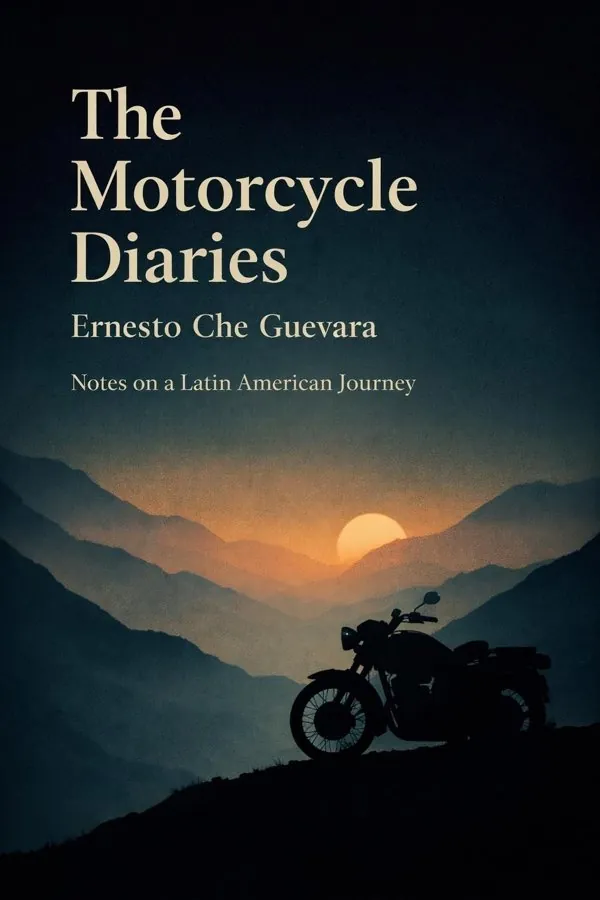
The Motorcycle Diaries: Notes on a Latin American Journey: Summary & Key Insights
 10 min9 chaptersAudio available
Key Takeaways from The Motorcycle Diaries: Notes on a Latin American Journey
A journey often changes us long before we reach our destination.
The most important education is often the one that contradicts what we thought we already knew.
Borders divide states, but experience often reveals deeper forms of human continuity.
Some landscapes are beautiful; others are accusatory.
To understand a people, you must look at both their present suffering and their historical inheritance.
What Is The Motorcycle Diaries: Notes on a Latin American Journey About?
The Motorcycle Diaries: Notes on a Latin American Journey by Ernesto Che Guevara is a biographies book spanning 8 pages. The Motorcycle Diaries: Notes on a Latin American Journey is far more than a travel memoir. It is the record of a young Ernesto Guevara, years before the world knew him as Che, setting out across South America in 1952 with his friend Alberto Granado on a battered motorcycle called La Poderosa. What begins as an adventurous road trip gradually turns into a moral and political awakening. Along the way, Guevara encounters miners, laborers, Indigenous communities, the sick, and the poor, and he starts to see Latin America not as a collection of separate nations but as a shared landscape marked by beauty, hardship, and deep inequality. The book matters because it captures the formation of a worldview in motion. Readers witness how direct experience can transform abstract ideals into urgent convictions. Guevara writes with humor, youthful bravado, and growing seriousness, making the diary vivid as both literature and history. His authority comes not from hindsight alone, but from observation: he was a medical student, a restless traveler, and an attentive witness to social realities often ignored by the privileged. The result is a deeply human account of travel, empathy, and political becoming.
This FizzRead summary covers all 9 key chapters of The Motorcycle Diaries: Notes on a Latin American Journey in approximately 10 minutes, distilling the most important ideas, arguments, and takeaways from Ernesto Che Guevara's work. Also available as an audio summary and Key Quotes Podcast.
The Motorcycle Diaries: Notes on a Latin American Journey
The Motorcycle Diaries: Notes on a Latin American Journey is far more than a travel memoir. It is the record of a young Ernesto Guevara, years before the world knew him as Che, setting out across South America in 1952 with his friend Alberto Granado on a battered motorcycle called La Poderosa. What begins as an adventurous road trip gradually turns into a moral and political awakening. Along the way, Guevara encounters miners, laborers, Indigenous communities, the sick, and the poor, and he starts to see Latin America not as a collection of separate nations but as a shared landscape marked by beauty, hardship, and deep inequality.
The book matters because it captures the formation of a worldview in motion. Readers witness how direct experience can transform abstract ideals into urgent convictions. Guevara writes with humor, youthful bravado, and growing seriousness, making the diary vivid as both literature and history. His authority comes not from hindsight alone, but from observation: he was a medical student, a restless traveler, and an attentive witness to social realities often ignored by the privileged. The result is a deeply human account of travel, empathy, and political becoming.
Who Should Read The Motorcycle Diaries: Notes on a Latin American Journey?
This book is perfect for anyone interested in biographies and looking to gain actionable insights in a short read. Whether you're a student, professional, or lifelong learner, the key ideas from The Motorcycle Diaries: Notes on a Latin American Journey by Ernesto Che Guevara will help you think differently.
- ✓Readers who enjoy biographies and want practical takeaways
- ✓Professionals looking to apply new ideas to their work and life
- ✓Anyone who wants the core insights of The Motorcycle Diaries: Notes on a Latin American Journey in just 10 minutes
Want the full summary?
Get instant access to this book summary and 100K+ more with Fizz Moment.
Get Free SummaryAvailable on App Store • Free to download
Key Chapters
A journey often changes us long before we reach our destination. In The Motorcycle Diaries, Ernesto Guevara and Alberto Granado leave Buenos Aires as young men looking for adventure, novelty, and perhaps a little self-invention. Their departure is full of humor, bravado, and romantic energy. They are not yet revolutionaries, prophets, or symbols. They are two friends with limited money, a shaky motorcycle, and an oversized appetite for the unknown. That is exactly what makes the opening of the book so powerful: it shows that life-altering convictions often begin in ordinary restlessness.
La Poderosa, their motorcycle, becomes more than transportation. It symbolizes youthful confidence, improvisation, and the illusion of control. As long as the machine moves, the trip feels like a grand escapade. But even at the beginning, the instability of the bike hints that this voyage will not go according to plan. That instability matters. It forces Guevara out of the comfort of being a tourist and into the vulnerability of depending on strangers, reading difficult realities up close, and adapting to hardship.
This early stage of the journey also introduces one of the book’s deepest themes: motion creates perspective. By leaving the familiar world of university, family expectations, and urban routine, Guevara puts himself in position to see Latin America from the road rather than from theory. The lesson applies beyond this memoir. Major shifts in worldview rarely happen when we stay inside well-managed routines. They happen when our assumptions are exposed to people and places that do not fit them.
A practical way to apply this idea is to treat travel, career changes, or new environments not only as experiences but as opportunities for moral learning. Instead of asking, “What will I see?” ask, “What will this force me to reconsider?” Actionable takeaway: step outside one familiar setting this month and pay attention not just to what is different, but to what your old perspective failed to notice.
Borders divide states, but experience often reveals deeper forms of human continuity. When Guevara and Granado cross into Chile, the trip expands from an Argentine adventure into a continental encounter. The change is not merely geographic. The crossing pushes Guevara to compare cultures, institutions, landscapes, and living conditions across national lines. He begins to recognize that the hardships he has seen are not isolated national failures, but recurring patterns across Latin America.
Chile offers new scenes, new people, and fresh evidence of how ordinary lives are shaped by social systems. Along the way, the travelers rely on hospitality, chance, and resilience. Their status shifts constantly: sometimes they are welcomed guests, sometimes nuisances, sometimes medical helpers, sometimes hungry drifters. This instability teaches humility. It also exposes the informal networks of kindness that sustain people on the margins. Guevara sees how strangers share food, shelter, and conversation even when they possess very little themselves. Such moments become moral evidence against the idea that poverty equals a lack of worth or culture.
At the same time, Chile sharpens his awareness of exclusion. The contrast between beauty and hardship becomes increasingly difficult to ignore. Mountain passes and dramatic landscapes are never just scenic backdrops; they frame lives marked by labor and vulnerability. This is one of the book’s signature strengths: it refuses to separate geography from society. The land is magnificent, but it is inhabited by people whose struggles demand attention.
For modern readers, this section offers a useful insight into cross-border empathy. It is easy to think in national categories and assume that one country’s problems are unique. But migration, labor exploitation, access to healthcare, and social abandonment often cross those boundaries. A broader perspective can lead to better policy thinking and deeper personal understanding.
Actionable takeaway: the next time you study a social issue, compare how it appears across regions or countries; patterns become clearer when you stop treating borders as explanations.
Some landscapes are beautiful; others are accusatory. In the Atacama Desert and at the Chuquicamata copper mine, Guevara encounters one of the clearest moral confrontations in the book: the collision between vast natural wealth and the harsh lives of those who labor around it. The mine is not just an industrial site. It becomes a symbol of extraction, hierarchy, and systemic inequality. Here, economic power is visible in space itself: the earth yields riches, yet many of the workers remain precarious, exhausted, and disposable.
This episode is especially important because it deepens Guevara’s political perception. He is no longer simply noting hardship in isolated communities; he is seeing a structure in which labor, profit, and suffering are connected. The desert amplifies that realization. Its severity strips away romantic illusions. Human beings endure brutal conditions so that valuable resources can move outward to benefit others more than themselves. The contrast between abundance and deprivation leaves a lasting impression on him.
The encounter with workers, especially those living under insecurity and ideological repression, pushes Guevara toward a stronger sense of solidarity. He begins to identify not just with individuals but with classes of people whose conditions are systematically produced. Whether or not a reader agrees with his later politics, this chapter reveals the emotional and observational roots of his convictions.
The lesson still matters in a modern economy shaped by global supply chains. The devices, metals, food, and clothing many people use daily often come from systems in which labor remains invisible to consumers. To read this chapter well is to ask where comfort comes from and whose bodies bear its cost.
A practical application is ethical curiosity. Learn how one product you use regularly is sourced, who extracts or assembles it, and under what conditions. Such knowledge can influence purchasing, advocacy, and civic awareness.
Actionable takeaway: trace one convenience in your life back to the labor behind it, and let that knowledge shape at least one more responsible decision.
To understand a people, you must look at both their present suffering and their historical inheritance. In Peru, Guevara’s journey takes on a richer civilizational dimension. He encounters not only contemporary inequality but also the enduring presence of Indigenous cultures, ancient histories, and unresolved colonial legacies. Peru becomes a place where grandeur and dispossession exist side by side. Ruins and sacred landscapes testify to extraordinary past achievements, while living communities often endure neglect, marginalization, and exclusion.
This contrast deepens Guevara’s understanding of Latin America. He begins to see that injustice is not simply a matter of current policy or individual misfortune. It is layered over centuries of conquest, racial hierarchy, and economic domination. The people he meets are not abstract representatives of “poverty”; they are heirs to civilizations whose dignity has been repeatedly denied by modern power structures. This realization broadens his political imagination. Social justice, in this view, is not only about redistribution. It is also about recognition, belonging, and historical repair.
Peru also reinforces one of the memoir’s central shifts: the move from seeing separate countries to seeing a shared continental condition. Guevara notices recurring patterns of exclusion among Indigenous and rural populations across national boundaries. The details vary, but the wound is familiar.
Readers today can apply this insight by resisting shallow explanations of inequality. Present-day disparities are often rooted in long histories of land dispossession, discrimination, and institutional neglect. Whether discussing education, healthcare, or rural development, meaningful analysis requires historical depth.
One practical habit is to ask of any social problem: when did this begin, and who benefited from its continuation? That question often reveals more than a narrow focus on current symptoms.
Actionable takeaway: when examining injustice, include history in your analysis; many present crises make sense only when viewed as inherited patterns rather than isolated failures.
How a society treats its most vulnerable people reveals its true moral structure. At the San Pablo leper colony in Peru, Guevara experiences one of the most famous and transformative episodes in The Motorcycle Diaries. As a medical student, he is drawn to disease, treatment, and patient care. But what affects him most is not just the medical condition of the residents; it is the social separation imposed on them. The colony dramatizes how illness can become a pretext for exclusion, fear, and dehumanization.
Guevara’s response is significant because it combines professional instinct with ethical rebellion. He does not want merely to observe patients from a distance. He seeks contact, conversation, and shared humanity. In one of the book’s most memorable gestures, his willingness to cross physical and symbolic boundaries suggests a rejection of the social rules that isolate the sick from the healthy, the poor from the respected, and the stigmatized from the fully human.
This chapter matters because it shows that compassion is most meaningful when it challenges hierarchy. Many people are willing to pity the vulnerable, but fewer are willing to erase the distance that protects their own comfort. Guevara begins to understand that medicine without solidarity can remain paternalistic. Healing is not only a technical act; it is also a moral encounter rooted in equality.
This insight has wide modern relevance. Stigma still surrounds illness, disability, mental health, homelessness, addiction, and migration. Institutions may provide services while still preserving emotional or social distance. Real dignity requires more than assistance. It requires recognition.
A practical application is to examine where you maintain unnecessary distance from people you categorize as different, unwell, risky, or socially marginal. Volunteering, listening, and engaging directly can reshape those assumptions.
Actionable takeaway: choose one way to replace abstract compassion with real contact, because dignity becomes visible only when distance is reduced.
Sometimes the biggest discovery in travel is not a place but a political imagination. As the journey unfolds, Guevara increasingly stops seeing Latin America as a patchwork of separate republics and starts seeing it as a connected human landscape. This is one of the memoir’s most consequential developments. His growing sense of continental unity is not based on diplomatic theory but on repeated encounters with similar patterns of poverty, labor exploitation, racial marginalization, and medical neglect across multiple countries.
This emerging consciousness is deeply emotional as well as intellectual. Guevara begins to feel that the suffering he witnesses demands more than sympathy and more than professional service. It demands alignment. The memoir captures the early stages of a transformation from observer to participant, from traveler to someone seeking a larger cause. He starts to imagine that real justice cannot be achieved through isolated charity or national reform alone, because the systems producing inequality are broader and interconnected.
Whether readers admire or reject the revolutionary path he later chose, this moment of continental awakening is historically important. It reveals how identity can expand through experience. Guevara does not stop being Argentine, but he starts imagining himself as responsible to a wider collective. That widening of moral concern is one of the book’s most lasting contributions.
For contemporary readers, the lesson is that solidarity often requires scaling up our sense of belonging. Many urgent problems today, including climate change, migration, public health, and labor conditions, cannot be understood within narrow local frames alone. At the same time, solidarity must remain grounded in real people rather than slogans.
A useful practice is to connect a local issue you care about to its regional or global dimensions. Ask who else faces similar conditions and what shared action might look like.
Actionable takeaway: expand one concern beyond your immediate community and look for the larger human pattern it belongs to.
The final stages of a journey often reveal what the beginning concealed. As Guevara moves through Colombia and into Venezuela, the physical adventure is nearing its end, but the internal reckoning grows sharper. Fatigue, uncertainty, financial strain, and the accumulated weight of what he has witnessed all reshape the meaning of the trip. Travel is no longer just movement through space. It has become an examination of character, conviction, and purpose.
These later chapters show how difficult it is to carry insight back into ordinary life. A transformative experience does not automatically tell a person what to do next. Guevara is still young, still searching, still not fully formed. Yet the road has stripped away many illusions. He has seen enough to know that he cannot return unchanged to the comfortable boundaries of his earlier identity. The question is no longer whether he has been affected, but how he will live in response to that effect.
This is a crucial part of the memoir because it makes the book more than a collection of episodes. It gives the narrative arc. A meaningful journey should alter decision-making, not just memory. By the end, Guevara’s observations have begun to harden into commitments. The emotional residue of the trip becomes a foundation for future action.
Many readers can relate to this pattern in smaller ways. A difficult job, volunteer experience, encounter with injustice, or period abroad may reveal truths that make old ambitions feel inadequate. The challenge is translating awareness into sustained practice rather than temporary inspiration.
A practical method is to write down what an experience has changed in you and identify one decision that should follow from it: a new project, a shift in work, a form of service, or a political engagement.
Actionable takeaway: after any meaningful experience, ask not only what you learned, but what obligation that learning creates.
Seeing suffering creates a choice: move on unchanged, or let the encounter rearrange your sense of duty. Across The Motorcycle Diaries, the deepest transformation is not that Guevara becomes more knowledgeable, but that he becomes less able to remain neutral. The book is ultimately about the ethics of witnessing. Adventure opens the door, but observation gives way to identification, and identification begins to demand action.
What makes this process compelling is its gradualness. There is no single conversion scene that magically explains everything. Instead, one meeting after another accumulates force: workers in hard conditions, marginalized Indigenous communities, patients at the leper colony, poor families surviving with dignity, and the recurring spectacle of inequality amid abundance. The result is a widening refusal to accept injustice as natural. Guevara’s diary shows how repeated contact with the vulnerable can erode the psychological protections that keep privilege comfortable.
This idea has practical relevance far beyond politics. In medicine, education, journalism, law, business, and public service, people often witness harm without knowing how much responsibility they bear. The memoir suggests that proximity should deepen accountability. If you are close enough to see a pattern clearly, you are close enough to ask what role you can play in changing it.
At the same time, the book invites caution. Moral awakening is powerful, but it can also lead to sweeping conclusions. Readers should appreciate both the sincerity of Guevara’s awakening and the need to think carefully about how conviction becomes action. The value of the memoir lies not in prescribing one ideology, but in showing that indifference becomes harder to defend once suffering has a face.
Actionable takeaway: identify one injustice you have personally witnessed and convert your awareness into one consistent form of response, however modest, rather than letting concern remain purely emotional.
All Chapters in The Motorcycle Diaries: Notes on a Latin American Journey
About the Author
Ernesto “Che” Guevara (1928–1967) was an Argentine-born physician, writer, and revolutionary whose life became inseparable from the political upheavals of twentieth-century Latin America. Born in Rosario, Argentina, he studied medicine before traveling widely across the continent, experiences that profoundly shaped his views on poverty, inequality, and political struggle. He later joined Fidel Castro’s revolutionary movement, played a major role in the Cuban Revolution, and held several leadership positions in post-revolutionary Cuba. Guevara also wrote diaries, essays, and speeches that reveal both his intellectual development and his political convictions. He remains one of the most debated figures in modern history: to some, a symbol of resistance and social justice; to others, a deeply controversial revolutionary. The Motorcycle Diaries preserves his formative years before fame and myth overtook the man.
Get This Summary in Your Preferred Format
Read or listen to the The Motorcycle Diaries: Notes on a Latin American Journey summary by Ernesto Che Guevara anytime, anywhere. FizzRead offers multiple formats so you can learn on your terms — all free.
Available formats: App · Audio · PDF · EPUB — All included free with FizzRead
Download The Motorcycle Diaries: Notes on a Latin American Journey PDF and EPUB Summary
Key Quotes from The Motorcycle Diaries: Notes on a Latin American Journey
“A journey often changes us long before we reach our destination.”
“The most important education is often the one that contradicts what we thought we already knew.”
“Borders divide states, but experience often reveals deeper forms of human continuity.”
“Some landscapes are beautiful; others are accusatory.”
“To understand a people, you must look at both their present suffering and their historical inheritance.”
Frequently Asked Questions about The Motorcycle Diaries: Notes on a Latin American Journey
The Motorcycle Diaries: Notes on a Latin American Journey by Ernesto Che Guevara is a biographies book that explores key ideas across 9 chapters. The Motorcycle Diaries: Notes on a Latin American Journey is far more than a travel memoir. It is the record of a young Ernesto Guevara, years before the world knew him as Che, setting out across South America in 1952 with his friend Alberto Granado on a battered motorcycle called La Poderosa. What begins as an adventurous road trip gradually turns into a moral and political awakening. Along the way, Guevara encounters miners, laborers, Indigenous communities, the sick, and the poor, and he starts to see Latin America not as a collection of separate nations but as a shared landscape marked by beauty, hardship, and deep inequality. The book matters because it captures the formation of a worldview in motion. Readers witness how direct experience can transform abstract ideals into urgent convictions. Guevara writes with humor, youthful bravado, and growing seriousness, making the diary vivid as both literature and history. His authority comes not from hindsight alone, but from observation: he was a medical student, a restless traveler, and an attentive witness to social realities often ignored by the privileged. The result is a deeply human account of travel, empathy, and political becoming.
You Might Also Like

An American Marriage
Tayari Jones
10 min
Benjamin Franklin: An American Life
Walter Isaacson
10 min
I Know Why The Caged Bird Sings
Maya Angelou
10 min
Long Walk to Freedom
Nelson Mandela
10 min
Persepolis
Marjane Satrapi
10 min
Surely You're Joking, Mr. Feynman!
Richard P. Feynman
10 minBrowse by Category
Ready to read The Motorcycle Diaries: Notes on a Latin American Journey?
Get the full summary and 100K+ more books with Fizz Moment.