
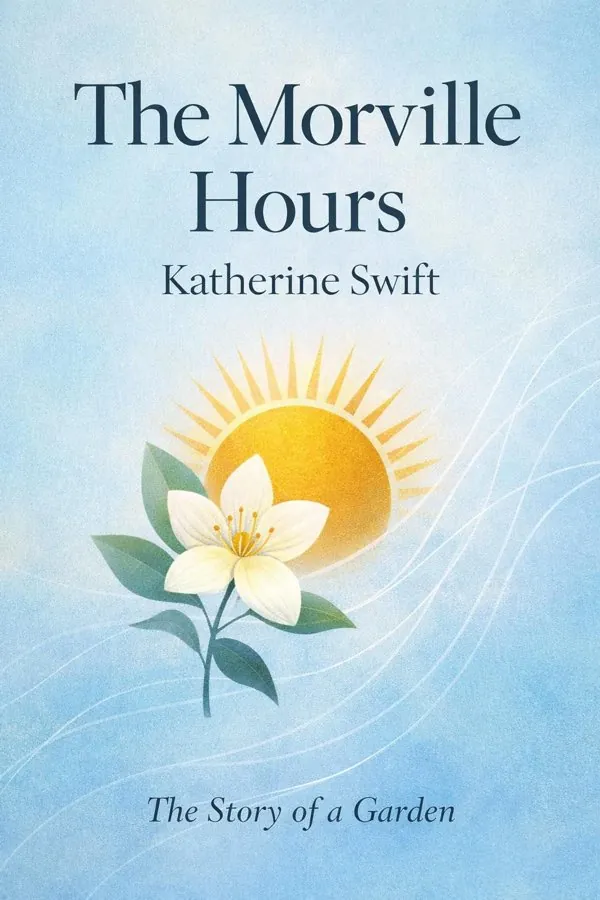
The Morville Hours: The Story of a Garden: Summary & Key Insights
 10 min9 chaptersAudio available
Key Takeaways from The Morville Hours: The Story of a Garden
Every meaningful creation begins before there is any proof it can succeed.
To praise something fully, you must first notice how much of it existed before you arrived.
A beautiful idea remains fragile until it is translated into repeated physical work.
What flourishes in a garden does so not in spite of loss, but often because of it.
We do not simply make places; over time, places make us.
What Is The Morville Hours: The Story of a Garden About?
The Morville Hours: The Story of a Garden by Katherine Swift is a biographies book spanning 8 pages. The Morville Hours: The Story of a Garden is far more than a gardening memoir. It is a meditation on time, place, beauty, and the quiet labor through which a landscape becomes meaningful. In this richly atmospheric book, Katherine Swift recounts her years creating a garden at the Dower House in Morville, Shropshire, shaping her narrative around the medieval Book of Hours, the cycle of prayers that once ordered the day. Each chapter corresponds to a canonical hour and reveals a different dimension of the garden’s making: vision, work, history, decay, memory, and completion. What makes the book so powerful is that Swift never treats gardening as mere design. For her, a garden is a conversation with the past, with the land itself, and with one’s own inner life. Her background as a scholar and her deep knowledge of English garden history give the book unusual depth, while her prose lends it lyrical grace. The result is a reflective, intelligent, and emotionally resonant work for readers interested in gardens, biography, history, and the spiritual meanings hidden in everyday acts of care.
This FizzRead summary covers all 9 key chapters of The Morville Hours: The Story of a Garden in approximately 10 minutes, distilling the most important ideas, arguments, and takeaways from Katherine Swift's work. Also available as an audio summary and Key Quotes Podcast.
The Morville Hours: The Story of a Garden
The Morville Hours: The Story of a Garden is far more than a gardening memoir. It is a meditation on time, place, beauty, and the quiet labor through which a landscape becomes meaningful. In this richly atmospheric book, Katherine Swift recounts her years creating a garden at the Dower House in Morville, Shropshire, shaping her narrative around the medieval Book of Hours, the cycle of prayers that once ordered the day. Each chapter corresponds to a canonical hour and reveals a different dimension of the garden’s making: vision, work, history, decay, memory, and completion. What makes the book so powerful is that Swift never treats gardening as mere design. For her, a garden is a conversation with the past, with the land itself, and with one’s own inner life. Her background as a scholar and her deep knowledge of English garden history give the book unusual depth, while her prose lends it lyrical grace. The result is a reflective, intelligent, and emotionally resonant work for readers interested in gardens, biography, history, and the spiritual meanings hidden in everyday acts of care.
Who Should Read The Morville Hours: The Story of a Garden?
This book is perfect for anyone interested in biographies and looking to gain actionable insights in a short read. Whether you're a student, professional, or lifelong learner, the key ideas from The Morville Hours: The Story of a Garden by Katherine Swift will help you think differently.
- ✓Readers who enjoy biographies and want practical takeaways
- ✓Professionals looking to apply new ideas to their work and life
- ✓Anyone who wants the core insights of The Morville Hours: The Story of a Garden in just 10 minutes
Want the full summary?
Get instant access to this book summary and 100K+ more with Fizz Moment.
Get Free SummaryAvailable on App Store • Free to download
Key Chapters
Every meaningful creation begins before there is any proof it can succeed. In Matins, the hour before full daylight, Katherine Swift captures the uncertain beginning of her life at the Dower House. When she first encountered Morville, the site was not a finished vision waiting to be restored but an overgrown, neglected place layered with traces of former order. What mattered most at this stage was not certainty but attentiveness. Swift had to imagine what the garden could become while accepting that the land itself would resist, surprise, and redirect her plans.
This opening section makes clear that gardening is an act of interpretation as much as construction. A site contains climate, soil, aspect, history, and memory. The gardener does not impose a dream onto empty ground; she reads what is already there and begins from that conversation. Swift’s earliest work at Morville involved observation, clearing, and the patient forming of first principles. She had to decide what kind of place this garden should be and what emotional and historical language it would speak.
The idea applies far beyond gardening. Starting a new project, career, home, or creative life often feels similar: the available materials are imperfect, the future is hidden, and confidence must coexist with doubt. The lesson is that beginnings are rarely neat. They require vision, but also humility toward reality.
A practical application is to begin any major undertaking with a period of close observation. Instead of rushing to fix everything, study the conditions, identify the inherited structure, and ask what is already possible. Keep notes, sketch ideas, and allow the project to disclose itself gradually.
Actionable takeaway: when starting something important, spend time seeing before doing, and let your first decisions grow from what the place, project, or moment is truly asking of you.
A beautiful idea remains fragile until it is translated into repeated physical work. Prime, the hour associated with the beginning of the day’s labor, focuses on the disciplined effort required to turn Morville from a possibility into a coherent garden. Swift emphasizes that gardens are not made by inspiration alone. They depend on digging, clearing, pruning, staking, ordering spaces, choosing plants, correcting mistakes, and returning again and again to tasks that are never entirely finished.
This chapter deepens the book’s realism. The romance of gardening often centers on flowers and finished vistas, but Swift insists on the value of craft and endurance. Form does not emerge by accident. Hedges must be clipped, borders shaped, transitions between spaces considered. The work is both intellectual and bodily. A gardener must understand design, but also weather, labor capacity, and the limits imposed by time and resources.
One of the most practical lessons here is that meaningful order comes from rhythm. You cannot do everything at once, but you can establish patterns of maintenance and development. In a garden, that might mean seasonal pruning schedules, phased planting, or prioritizing structure before ornament. In life, it may mean setting up habits that slowly support a larger vision: writing every morning, reviewing finances monthly, or tending relationships consistently rather than dramatically.
Swift also shows that labor is not opposed to beauty. It is the hidden condition of beauty. The serenity of a well-made garden rests on countless acts of attention. This makes the garden a metaphor for any worthwhile human endeavor.
Actionable takeaway: turn aspiration into structure by identifying the recurring tasks your vision requires, then commit to a steady rhythm of work instead of waiting for ideal conditions.
What flourishes in a garden does so not in spite of loss, but often because of it. In Terce, Swift explores one of the central paradoxes of all living landscapes: growth is inseparable from decay. Plants thrive, fail, reseed, collapse, and return. Seasons bring promise and damage in equal measure. The gardener quickly learns that control is partial and that every appearance of permanence is temporary.
This is not a pessimistic view. For Swift, decay is part of the garden’s intelligence. Compost enriches soil. Deadheading encourages further flowering. Diseased wood must be cut away so healthier growth can emerge. Even the disappearance of certain plants teaches the gardener about the truth of the site. Failure becomes information. The garden develops not through the elimination of change but through responsive adaptation to it.
This idea has broad emotional power. Many people approach projects, relationships, and even self-development as if progress should be linear. Swift’s experience at Morville suggests otherwise. Real development includes setbacks, revisions, endings, and necessary relinquishments. Something must often be removed for something else to mature. This applies to design decisions, too. A crowded border may need thinning; an overambitious plan may need simplifying.
Practically, this means building feedback into how we care for living systems. Gardeners can monitor what thrives naturally, keep records of seasonal failures, and use pruning or division as tools of renewal rather than signs of defeat. More broadly, anyone managing a household, team, or personal creative practice can periodically ask: what is no longer serving growth?
Actionable takeaway: treat setbacks and endings as part of the life cycle of improvement, and regularly clear away what is exhausted so new energy has room to emerge.
We do not simply make places; over time, places make us. In Sext, the midday hour, Swift reflects on how the passage of time alters not only Morville but also her own consciousness. The garden is no longer a project external to the self. Through years of work, observation, and seasonal repetition, it becomes a medium through which memory accumulates. Plants mark episodes of life, weather recalls emotional states, and each return to a familiar path is also a return to former versions of the self.
This is one of the book’s most profound contributions. Swift shows that a garden is a lived chronology. It records time materially. Trees thicken, borders settle, gaps appear, and combinations once impossible become natural. The gardener, meanwhile, changes in perception. What first seemed urgent later appears trivial; what once looked empty later reveals depth. Time produces both maturity and tenderness.
The practical lesson is to stop expecting immediate completion from work that is inherently developmental. A young garden can look sparse or unresolved, but time is one of its main ingredients. The same is true of expertise, homes, families, and creative practice. Rushing can flatten what only duration can enrich.
Swift’s reflections also invite a more mindful relationship with memory. Keeping journals, photographs, planting notes, or seasonal records can help reveal the subtle dialogue between outer and inner change. Such habits are not sentimental extras. They deepen understanding of how life unfolds.
Actionable takeaway: allow long-term projects to mature over years rather than months, and create simple records so you can notice how time is shaping both the work and the person doing it.
A garden is never only present tense. In None, Swift turns more explicitly toward the historical density of Morville and the ways a cultivated place can preserve continuity across generations. The Dower House garden exists within English cultural traditions, estate histories, architectural forms, and older relationships between domestic life and the land. By tending it, Swift is not merely arranging plants; she is inhabiting and extending a lineage.
This sense of continuity gives the book unusual depth. Swift is acutely aware that a garden may outlast individual intentions while still bearing their imprint. A wall survives one owner, a yew another, a planted axis another. The present gardener becomes a custodian rather than an absolute author. This is a corrective to modern habits of possessiveness. We often speak as though places belong entirely to us, but Swift suggests a more responsible perspective: we receive places temporarily and leave them altered for those who come later.
There are practical implications in design and stewardship. Choosing durable structures, respecting regional character, conserving mature trees, and understanding local horticultural traditions all reflect a long view. Even in a small urban garden, continuity can matter. You might preserve an old rose from a previous resident, save seeds from year to year, or document plantings for future occupants.
This idea also has moral significance. To act as a custodian rather than a consumer changes decision-making. It encourages restraint, patience, and care for future users rather than only present preference.
Actionable takeaway: approach any place you manage as a temporary trust, and make at least one decision with the next generation of caretakers, residents, or visitors in mind.
The loveliest things in a garden are often the ones that do not last. In Vespers, the evening hour, Swift dwells on beauty as something inseparable from fragility. Light shifts, petals fall, seedheads replace blooms, and the season bends toward decline. Rather than resisting this, Swift learns to see transience as the source of the garden’s emotional intensity. A flower matters because it opens briefly. An evening border glows because dusk is passing.
This insight pushes against the desire to freeze beauty at its peak. Many people imagine the ideal garden as one that remains perfect, but Swift’s vision is more truthful and more moving. Gardens are beautiful because they are in time. Their changing states create rhythm, anticipation, and poignancy. A month of scarcity may sharpen delight in the first rose. The fading of summer may reveal subtler autumn structure.
In practical terms, this encourages a more seasonal approach to appreciation and design. Instead of expecting continuous spectacle, gardeners can plan for sequences of interest: spring bulbs, summer abundance, autumn color, winter bark and form. They can also cultivate attentiveness by walking the garden at different times of day and year, noticing fleeting effects rather than only permanent features.
More broadly, Swift’s point applies to life itself. Relationships, health, youth, and moments of happiness are all finite. Their impermanence is not a reason to withdraw from them but a reason to value them more deeply.
Actionable takeaway: practice noticing fleeting beauty without trying to possess it, and design your days or spaces to honor changing seasons rather than demanding constant perfection.
The end of a day, like the end of a life’s major work, rarely arrives as flawless completion. In Compline, Swift reaches toward rest, acceptance, and a quieter understanding of what it means to finish. Morville is never complete in the rigid sense. A garden remains alive, and therefore open to weather, accident, maturity, and decline. Yet there comes a point at which the gardener can recognize wholeness without demanding finality.
This is an important distinction. Perfection seeks control and closure; peace accepts enoughness. Swift’s closing perspective suggests that fulfillment arises not from eliminating every imperfection but from entering a harmonious relationship with incompleteness. The garden has become itself. It carries beauty, memory, labor, and time. That is sufficient.
This lesson is especially useful for ambitious readers who struggle to stop refining, correcting, or expanding. In creative work, domestic life, and personal goals, there is often a temptation to postpone satisfaction until everything aligns. Swift offers a wiser model: mature effort includes the capacity to conclude a phase, inhabit what has been made, and release the fantasy of total control.
A practical way to apply this is through reflective closure. At the end of a season or project, identify what has been achieved, what remains open, and what can be accepted as part of the work’s living nature. This prevents endless dissatisfaction and creates room for gratitude.
Actionable takeaway: define completion as a state of meaningful coherence rather than flawless finish, and regularly pause to acknowledge what is already whole enough to be appreciated.
Some forms of attention change the soul as much as they change the world. One of the deepest themes running through The Morville Hours is that gardening can function as a spiritual discipline. Swift’s use of the medieval Book of Hours is not decorative structure; it reveals her conviction that daily care, repeated observation, and seasonal return can become a mode of contemplation. The garden is a place where time slows, perception sharpens, and ordinary acts acquire inward significance.
This spirituality is not abstract or doctrinal. It is grounded in physical reality: kneeling in soil, noticing first light, waiting for a tree to mature, accepting weather, and working within natural limits. Such activities teach patience, reverence, and humility. They also counter the speed and distraction of modern life. The garden becomes a school of attention, where one learns to be present rather than merely productive.
Readers do not need to be gardeners to apply this insight. Any recurring practice that combines care, rhythm, and observation can have similar power: walking, cooking, journaling, tending a balcony, or caring for a small patch of community land. The key is repetition joined to meaning. Instead of treating routine as emptiness, Swift invites us to see it as a container for depth.
Practically, this may mean creating small rituals of seasonal awareness: a weekly walk in the same place, a morning visit to plants before checking devices, or a habit of marking changes in weather and growth. These acts cultivate steadiness and gratitude.
Actionable takeaway: choose one recurring act of care and perform it with full attention for several weeks, treating it not as a chore but as a practice of presence.
All Chapters in The Morville Hours: The Story of a Garden
About the Author
Katherine Swift is a British gardener, writer, and former academic whose work is distinguished by its combination of literary grace, historical awareness, and deep horticultural knowledge. Before dedicating herself fully to gardening and writing, she worked in scholarly and library settings, including the Bodleian Library and Trinity College Dublin. She later became known for the garden she created at the Dower House in Morville, Shropshire, a project that inspired The Morville Hours. Swift writes about gardens not merely as designed spaces but as living records of memory, time, and cultural inheritance. Her work appeals to readers interested in landscape, nature, history, and the contemplative dimensions of everyday life. She is widely admired for bringing intelligence, subtlety, and spiritual depth to garden writing.
Get This Summary in Your Preferred Format
Read or listen to the The Morville Hours: The Story of a Garden summary by Katherine Swift anytime, anywhere. FizzRead offers multiple formats so you can learn on your terms — all free.
Available formats: App · Audio · PDF · EPUB — All included free with FizzRead
Download The Morville Hours: The Story of a Garden PDF and EPUB Summary
Key Quotes from The Morville Hours: The Story of a Garden
“Every meaningful creation begins before there is any proof it can succeed.”
“To praise something fully, you must first notice how much of it existed before you arrived.”
“A beautiful idea remains fragile until it is translated into repeated physical work.”
“What flourishes in a garden does so not in spite of loss, but often because of it.”
“We do not simply make places; over time, places make us.”
Frequently Asked Questions about The Morville Hours: The Story of a Garden
The Morville Hours: The Story of a Garden by Katherine Swift is a biographies book that explores key ideas across 9 chapters. The Morville Hours: The Story of a Garden is far more than a gardening memoir. It is a meditation on time, place, beauty, and the quiet labor through which a landscape becomes meaningful. In this richly atmospheric book, Katherine Swift recounts her years creating a garden at the Dower House in Morville, Shropshire, shaping her narrative around the medieval Book of Hours, the cycle of prayers that once ordered the day. Each chapter corresponds to a canonical hour and reveals a different dimension of the garden’s making: vision, work, history, decay, memory, and completion. What makes the book so powerful is that Swift never treats gardening as mere design. For her, a garden is a conversation with the past, with the land itself, and with one’s own inner life. Her background as a scholar and her deep knowledge of English garden history give the book unusual depth, while her prose lends it lyrical grace. The result is a reflective, intelligent, and emotionally resonant work for readers interested in gardens, biography, history, and the spiritual meanings hidden in everyday acts of care.
You Might Also Like

An American Marriage
Tayari Jones
10 min
Benjamin Franklin: An American Life
Walter Isaacson
10 min
I Know Why The Caged Bird Sings
Maya Angelou
10 min
Long Walk to Freedom
Nelson Mandela
10 min
Persepolis
Marjane Satrapi
10 min
Surely You're Joking, Mr. Feynman!
Richard P. Feynman
10 minBrowse by Category
Ready to read The Morville Hours: The Story of a Garden?
Get the full summary and 100K+ more books with Fizz Moment.