
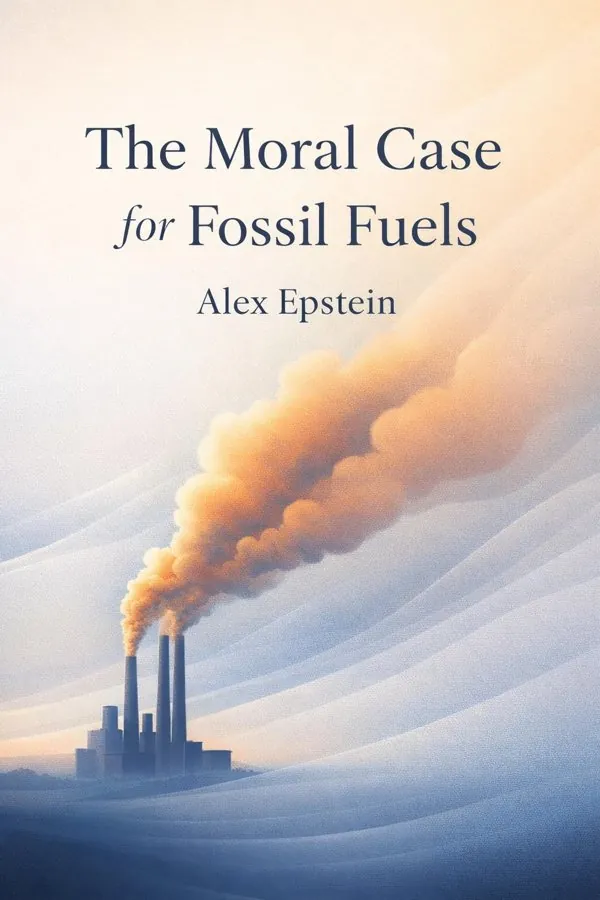
The Moral Case for Fossil Fuels: Summary & Key Insights
by Alex Epstein
 10 min9 chaptersAudio available
What Is The Moral Case for Fossil Fuels About?
The Moral Case for Fossil Fuels by Alex Epstein is a environment book spanning 9 pages. In this provocative and well-researched work, Alex Epstein argues that the use of fossil fuels has been overwhelmingly beneficial to human flourishing. He challenges the conventional narrative that portrays fossil fuels as an existential threat, presenting data and reasoning to show how they have improved life expectancy, health, and prosperity worldwide. Epstein calls for a rational, human-centered approach to energy policy that recognizes the moral value of energy abundance.
This FizzRead summary covers all 9 key chapters of The Moral Case for Fossil Fuels in approximately 10 minutes, distilling the most important ideas, arguments, and takeaways from Alex Epstein's work. Also available as an audio summary and Key Quotes Podcast.
The Moral Case for Fossil Fuels
In this provocative and well-researched work, Alex Epstein argues that the use of fossil fuels has been overwhelmingly beneficial to human flourishing. He challenges the conventional narrative that portrays fossil fuels as an existential threat, presenting data and reasoning to show how they have improved life expectancy, health, and prosperity worldwide. Epstein calls for a rational, human-centered approach to energy policy that recognizes the moral value of energy abundance.
Who Should Read The Moral Case for Fossil Fuels?
This book is perfect for anyone interested in environment and looking to gain actionable insights in a short read. Whether you're a student, professional, or lifelong learner, the key ideas from The Moral Case for Fossil Fuels by Alex Epstein will help you think differently.
- ✓Readers who enjoy environment and want practical takeaways
- ✓Professionals looking to apply new ideas to their work and life
- ✓Anyone who wants the core insights of The Moral Case for Fossil Fuels in just 10 minutes
Want the full summary?
Get instant access to this book summary and 100K+ more with Fizz Moment.
Get Free SummaryAvailable on App Store • Free to download
Key Chapters
If the world’s conversation about energy seems distorted, it is because we are often using the wrong moral measuring stick. Most people have been trained to think that the highest moral value is minimizing our impact on nature. This 'non-impact' standard looks noble at first glance—it suggests humility before the environment—but its logical consequence is an impossible and self-destructive demand. Humans survive precisely by altering nature: we dig, build, plant, and innovate. To condemn impact per se is to condemn life itself.
That is why I introduce the standard of human flourishing as an alternative moral framework. By human flourishing, I mean every individual's ability to live long, healthy, and happy lives, in an environment that sustains creativity and growth. This does not mean ignoring nature’s boundaries; rather, it recognizes that our relationship with nature should be viewed as one of improvement, not abstinence. We use reason and technology to make nature safer and more conducive to our needs.
When evaluating fossil fuels, therefore, the relevant question is not 'Do they impact the planet?'—of course they do—but 'Do they enable or endanger human flourishing?' Once you apply that standard, the moral picture looks radically different. The same resources that critics accuse of causing harm have made possible unprecedented safety, abundance, and progress for billions. The moral yardstick shifts the debate from emotion and guilt toward reason and gratitude.
Seeing things this way also clarifies many misunderstandings in environmental policy. A human-centered standard does not excuse irresponsibility or pollution; rather, it demands that we weigh trade-offs honestly. Every energy source has benefits and costs—but not all have the same capacity to support flourishing. To pursue energy policies guided by human well-being is to apply morality in the service of life, creativity, and freedom, not stagnation or fear.
Energy is life’s master resource—the capacity that enables every other form of productivity. I often ask readers to imagine a world without modern energy: without heat, light, transportation, irrigation, or refrigeration. Instantly, we realize that virtually every necessity and comfort we take for granted depends on the ability to convert raw materials into usable power.
Fossil fuels—coal, oil, and natural gas—provide that power at scale with remarkable reliability and affordability. They underpin food production, making possible fertilizers and mechanized agriculture that feed billions. They power hospitals and sanitation systems that prevent disease. They transport goods and people across continents, enabling economic integration and cultural exchange. Whenever we talk about progress—from clean water to computers—we are talking, implicitly, about energy.
In this book, I show how cheap, reliable energy liberates human potential. It transforms scarcity into abundance. A single machine, run on fossil energy, can perform the labor of hundreds of humans. That multiplier effect is the hidden engine behind global prosperity. When critics say we should 'move beyond fossil fuels,' they often ignore what that would mean for billions who still lack dependable electricity. Energy poverty kills—and fossil fuels are the first affordable cure.
Energy also determines our ability to cope with environmental challenges. With sufficient energy, we build strong structures, purify air and water, and create advanced materials to replace what nature cannot provide. In short, energy turns danger into opportunity. Human adaptability grows when energy use increases, not when it decreases. This insight is crucial: it reveals that expanding, not restricting, energy access is the truly moral path forward.
+ 7 more chapters — available in the FizzRead app
All Chapters in The Moral Case for Fossil Fuels
About the Author
Alex Epstein is an American author, philosopher, and energy expert. He is the founder of the Center for Industrial Progress and a leading advocate for the moral defense of fossil fuels. Epstein holds a degree in philosophy from Duke University and is known for his work on energy ethics and environmental policy.
Get This Summary in Your Preferred Format
Read or listen to the The Moral Case for Fossil Fuels summary by Alex Epstein anytime, anywhere. FizzRead offers multiple formats so you can learn on your terms — all free.
Available formats: App · Audio · PDF · EPUB — All included free with FizzRead
Download The Moral Case for Fossil Fuels PDF and EPUB Summary
Key Quotes from The Moral Case for Fossil Fuels
“If the world’s conversation about energy seems distorted, it is because we are often using the wrong moral measuring stick.”
“Energy is life’s master resource—the capacity that enables every other form of productivity.”
Frequently Asked Questions about The Moral Case for Fossil Fuels
The Moral Case for Fossil Fuels by Alex Epstein is a environment book that explores key ideas across 9 chapters. In this provocative and well-researched work, Alex Epstein argues that the use of fossil fuels has been overwhelmingly beneficial to human flourishing. He challenges the conventional narrative that portrays fossil fuels as an existential threat, presenting data and reasoning to show how they have improved life expectancy, health, and prosperity worldwide. Epstein calls for a rational, human-centered approach to energy policy that recognizes the moral value of energy abundance.
You Might Also Like

A Life on Our Planet: My Witness Statement and a Vision for the Future
David Attenborough
10 min
A Sky Full Of Birds
Matt Merritt
10 min
Carbon Zero: Imagining Cities That Can Save the Planet
Alex Steffen
10 min
Eaarth: Making a Life on a Tough New Planet
Bill McKibben
10 min
The Social Contract and Environmental Governance
Various Editors
10 min
The Wild Places
Robert Macfarlane
10 minBrowse by Category
Ready to read The Moral Case for Fossil Fuels?
Get the full summary and 100K+ more books with Fizz Moment.