
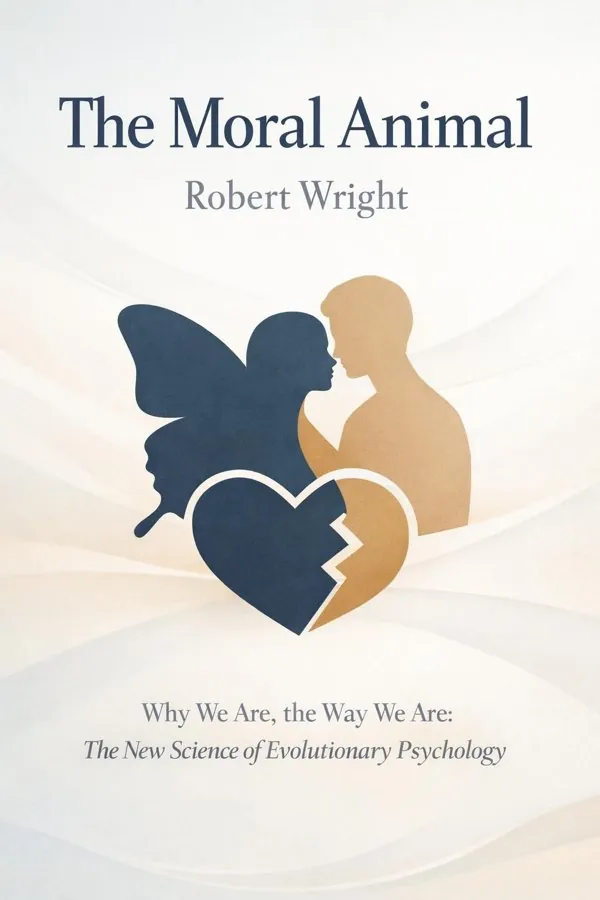
The Moral Animal: Why We Are, the Way We Are: The New Science of Evolutionary Psychology: Summary & Key Insights
 10 min5 chaptersAudio available
What Is The Moral Animal: Why We Are, the Way We Are: The New Science of Evolutionary Psychology About?
The Moral Animal: Why We Are, the Way We Are: The New Science of Evolutionary Psychology by Robert Wright is a popular_sci book spanning 5 pages. The Moral Animal explores how evolutionary theory can explain human behavior, morality, and social relationships. Robert Wright uses insights from Darwinian psychology to examine why people act the way they do, discussing topics such as love, jealousy, altruism, and ethics through the lens of natural selection.
This FizzRead summary covers all 5 key chapters of The Moral Animal: Why We Are, the Way We Are: The New Science of Evolutionary Psychology in approximately 10 minutes, distilling the most important ideas, arguments, and takeaways from Robert Wright's work. Also available as an audio summary and Key Quotes Podcast.
The Moral Animal: Why We Are, the Way We Are: The New Science of Evolutionary Psychology
The Moral Animal explores how evolutionary theory can explain human behavior, morality, and social relationships. Robert Wright uses insights from Darwinian psychology to examine why people act the way they do, discussing topics such as love, jealousy, altruism, and ethics through the lens of natural selection.
Who Should Read The Moral Animal: Why We Are, the Way We Are: The New Science of Evolutionary Psychology?
This book is perfect for anyone interested in popular_sci and looking to gain actionable insights in a short read. Whether you're a student, professional, or lifelong learner, the key ideas from The Moral Animal: Why We Are, the Way We Are: The New Science of Evolutionary Psychology by Robert Wright will help you think differently.
- ✓Readers who enjoy popular_sci and want practical takeaways
- ✓Professionals looking to apply new ideas to their work and life
- ✓Anyone who wants the core insights of The Moral Animal: Why We Are, the Way We Are: The New Science of Evolutionary Psychology in just 10 minutes
Want the full summary?
Get instant access to this book summary and 100K+ more with Fizz Moment.
Get Free SummaryAvailable on App Store • Free to download
Key Chapters
To understand human behavior through Darwin’s lens is to reimagine psychology itself. Natural selection operates ruthlessly on variation: traits that help an organism survive and reproduce tend to persist. Traditionally, we have applied this to physical features—long necks in giraffes or sharp claws in predators—but the same logic applies to mental traits. Our psychological mechanisms, from jealousy to compassion, evolved because they influenced reproductive success.
In this view, there is no single, unified human nature, but rather a collection of specialized modules—strategies honed through ancestral challenges. Fear of snakes, parental love, preference for gossip, ambition for status—each reflects an adaptive response to problems our forebears faced in their evolutionary past. Just as the eye evolved to perceive light, the mind evolved to perceive social reality.
Darwin himself never fully elaborated the psychological implications of his theory, though his private writings revealed curiosity and unease. His correspondence shows that he suspected natural selection influenced moral sense and social instincts. Indeed, *The Descent of Man* begins to sketch how sympathy, loyalty, and conscience could evolve. Yet even Darwin hesitated to press the logic to its limit, for the implications were radical: the sacred human mind was the product of blind selection.
What I attempt to do is complete that leap. I bring together biology, anthropology, and sociology to reveal that our modern behaviors are living fossils of ancient selection pressures. Our courtships, honors, and laws carry the traces of our evolutionary DNA. The question then becomes not whether morality can coexist with Darwinism, but how Darwinism can deepen our understanding of morality.
If evolution is the story of reproduction, then much of human behavior can be read through the lens of mating strategy. Darwin identified sexual selection as a force distinct from survival selection: traits evolving not because they aid survival, but because they attract mates. Peacock feathers, the lion’s mane, even human displays of art or humor, can be seen as signals of genetic fitness.
Men and women face different reproductive calculations. A male’s potential offspring number is limited mainly by access to females, whereas a female’s is constrained by gestation and childcare. This asymmetry shapes divergent strategies: males may favor mating opportunities; females, resource reliability. The modern dating world—its complexities, rivalries, heartbreaks—reflects ancient reproductive math playing out in new contexts.
Yet sexual selection isn’t just about physical attraction. It involves emotional investment, reputation, and status. Human pair bonding likely evolved to ensure paternal care, but biology still pushes subtle incentives toward both fidelity and strategic infidelity. The very emotion of jealousy, painful as it is, serves a function: guarding investments of love and lineage. Even the varying tolerance societies display toward monogamy or polygamy mirrors ecological pressures on parental investment.
By recognizing these evolutionary roots, we don’t excuse infidelity or rivalry; we contextualize them. The moral animal wrestles with instincts forged by evolution but refined by culture. Understanding this tension allows us to navigate relationships with empathy rather than illusion.
+ 3 more chapters — available in the FizzRead app
All Chapters in The Moral Animal: Why We Are, the Way We Are: The New Science of Evolutionary Psychology
About the Author
Robert Wright is an American author and journalist known for his works on science, religion, and philosophy. He has written for major publications such as The Atlantic and The New York Times, and his books often explore the intersection of evolutionary theory and human behavior.
Get This Summary in Your Preferred Format
Read or listen to the The Moral Animal: Why We Are, the Way We Are: The New Science of Evolutionary Psychology summary by Robert Wright anytime, anywhere. FizzRead offers multiple formats so you can learn on your terms — all free.
Available formats: App · Audio · PDF · EPUB — All included free with FizzRead
Download The Moral Animal: Why We Are, the Way We Are: The New Science of Evolutionary Psychology PDF and EPUB Summary
Key Quotes from The Moral Animal: Why We Are, the Way We Are: The New Science of Evolutionary Psychology
“To understand human behavior through Darwin’s lens is to reimagine psychology itself.”
“If evolution is the story of reproduction, then much of human behavior can be read through the lens of mating strategy.”
Frequently Asked Questions about The Moral Animal: Why We Are, the Way We Are: The New Science of Evolutionary Psychology
The Moral Animal: Why We Are, the Way We Are: The New Science of Evolutionary Psychology by Robert Wright is a popular_sci book that explores key ideas across 5 chapters. The Moral Animal explores how evolutionary theory can explain human behavior, morality, and social relationships. Robert Wright uses insights from Darwinian psychology to examine why people act the way they do, discussing topics such as love, jealousy, altruism, and ethics through the lens of natural selection.
More by Robert Wright

You Might Also Like

Structures: Or Why Things Don"t Fall Down
J.E. Gordon
10 min
The Road to Wigan Pier
George Orwell
10 min
Bonk: The Curious Coupling of Science and Sex
Mary Roach
10 min
First Bite: How We Learn to Eat
Bee Wilson
10 min
In Pursuit Of The Unknown: 17 Equations That Changed The World
Ian Stewart
10 min
Napoleon's Buttons: 17 Molecules That Changed History
Penny Le Couteur and Jay Burreson
10 minBrowse by Category
Ready to read The Moral Animal: Why We Are, the Way We Are: The New Science of Evolutionary Psychology?
Get the full summary and 100K+ more books with Fizz Moment.