
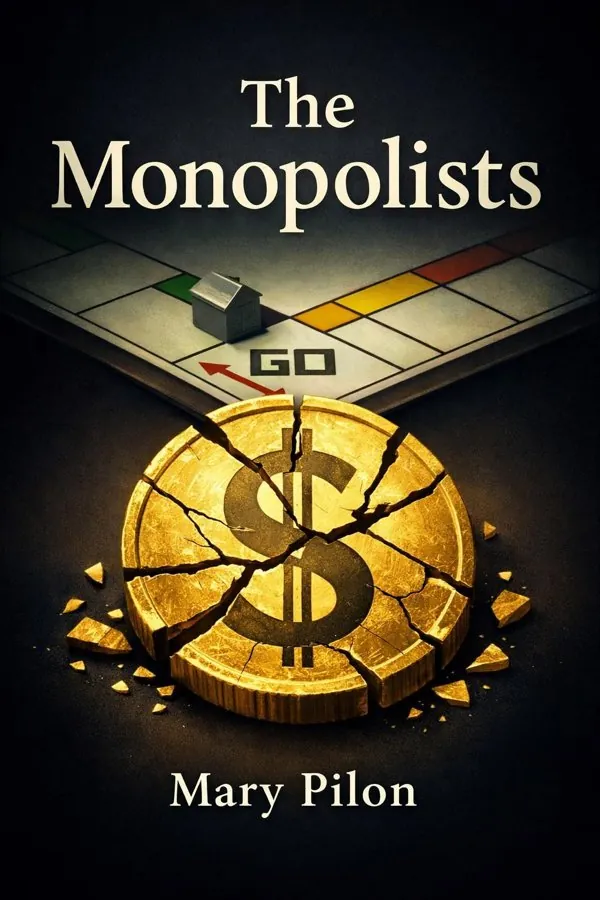
The Monopolists: Obsession, Fury, and the Scandal Behind the World's Favorite Board Game: Summary & Key Insights
by Mary Pilon
 10 min5 chaptersAudio available
What Is The Monopolists: Obsession, Fury, and the Scandal Behind the World's Favorite Board Game About?
The Monopolists: Obsession, Fury, and the Scandal Behind the World's Favorite Board Game by Mary Pilon is a world_history book spanning 5 pages. The Monopolists tells the true story behind the creation of the board game Monopoly, revealing how a game originally designed to critique capitalism was transformed into a celebration of it. Mary Pilon uncovers the hidden history of Elizabeth Magie, the woman who invented the original 'Landlord’s Game,' and traces how Charles Darrow and Parker Brothers commercialized it into the global phenomenon we know today. The book explores themes of intellectual property, gender, and the evolution of American business culture.
This FizzRead summary covers all 5 key chapters of The Monopolists: Obsession, Fury, and the Scandal Behind the World's Favorite Board Game in approximately 10 minutes, distilling the most important ideas, arguments, and takeaways from Mary Pilon's work. Also available as an audio summary and Key Quotes Podcast.
The Monopolists: Obsession, Fury, and the Scandal Behind the World's Favorite Board Game
The Monopolists tells the true story behind the creation of the board game Monopoly, revealing how a game originally designed to critique capitalism was transformed into a celebration of it. Mary Pilon uncovers the hidden history of Elizabeth Magie, the woman who invented the original 'Landlord’s Game,' and traces how Charles Darrow and Parker Brothers commercialized it into the global phenomenon we know today. The book explores themes of intellectual property, gender, and the evolution of American business culture.
Who Should Read The Monopolists: Obsession, Fury, and the Scandal Behind the World's Favorite Board Game?
This book is perfect for anyone interested in world_history and looking to gain actionable insights in a short read. Whether you're a student, professional, or lifelong learner, the key ideas from The Monopolists: Obsession, Fury, and the Scandal Behind the World's Favorite Board Game by Mary Pilon will help you think differently.
- ✓Readers who enjoy world_history and want practical takeaways
- ✓Professionals looking to apply new ideas to their work and life
- ✓Anyone who wants the core insights of The Monopolists: Obsession, Fury, and the Scandal Behind the World's Favorite Board Game in just 10 minutes
Want the full summary?
Get instant access to this book summary and 100K+ more with Fizz Moment.
Get Free SummaryAvailable on App Store • Free to download
Key Chapters
In the first decade of the twentieth century, Lizzie Magie was living in a world freshly electrified by reformist ideas. Henry George’s *Progress and Poverty*, published in 1879, had ignited debate about inequality in industrial society. George proposed a radical solution: a single tax on land ownership that would redistribute economic benefits more fairly. Magie absorbed these ideas with zeal and sought a way to translate them beyond pamphlets and lectures. Her medium was play.
The Landlord’s Game was both ingenious and prophetic. On the surface, it resembled a simple race around a board — players purchased properties, developed them, and collected rent. Yet its deeper mechanics carried a moral sting. As one player amassed holdings, the rest faced dwindling options, their resources drained until bankruptcy loomed. Magie envisioned the game as a form of experiential education: the lesson of monopoly economics rendered tangible through dice and deeds.
To design such a game was a bold act for a woman in a male-dominated intellectual sphere. But Magie was no passive idealist. She patented her invention in 1904, one of the earliest board-game patents filed by a woman. In her writings and interviews, she explained that her game was intended to demonstrate how private monopolies could impoverish society — how wealth, when locked in land rents, suffocated opportunity for everyone else. Magie’s intent was not to make money but to make a point.
This fusion of play and politics was revolutionary. At a time when board games were largely diversions for children or genteel social gatherings, Magie turned the format into an instrument for economic education. Her creation anticipated modern serious games by decades. She believed people could learn through competition and empathy — not lectures. When players groaned at the unfairness of losing property, she wanted them to feel what real renters felt under monopolistic rule.
Magie’s invention thus stood at the crossroads of two American trends: the rise of popular game culture and the ferment of social activism. Yet her vision’s radicalness also ensured that its full message would later be muted. Within her modest patent papers lay seeds destined to grow into one of capitalism’s loudest icons — though hardly as she had imagined.
After receiving her patent, Magie distributed The Landlord’s Game quietly among like-minded reformers. Progressive educators recognized its value as a tool for teaching economics. In various communities — especially among Quakers, who valued cooperation and fairness — the game gained respect as a moral illustration. In their circles, it was common for teachers and families to make their own boards, adapting property names to local geography. This grassroots method of play embodied the game’s message: economic systems are not fixed; people can design them differently.
Such circles used The Landlord’s Game to test both competitive and cooperative modes. Magie actually built two rule sets — one monopolist, one anti-monopolist — allowing players to see how different tax structures affected outcomes. That design choice reflected her conviction that fairness must be modeled, not preached. The contrast between the two versions dramatized systemic inequality with uncanny realism, decades before modern economics formalized game theory.
Throughout the 1910s and 1920s, versions of Magie’s creation spread by word of mouth. College students, professors, and reformist households passed hand-drawn boards to each other. No one involved sought profit; they wanted discourse. Yet with every copy, the original message blurred. Some modified the rules for entertainment, others omitted Magie’s name. By the time the game reached the mid-Atlantic region, its political intent was nearly invisible.
Still, within these communities, Magie’s idea lived as a quiet protest against greed. It transformed living rooms into miniature economies where players could witness the fate of social structures in motion. It was never about winning; it was about learning. That difference would later define the cultural tragedy at the heart of Monopoly’s rise.
+ 3 more chapters — available in the FizzRead app
All Chapters in The Monopolists: Obsession, Fury, and the Scandal Behind the World's Favorite Board Game
About the Author
Mary Pilon is an American journalist and author whose work has appeared in The New York Times, The Wall Street Journal, and The New Yorker. She writes about sports, business, and culture, often focusing on the intersection of money and social issues.
Get This Summary in Your Preferred Format
Read or listen to the The Monopolists: Obsession, Fury, and the Scandal Behind the World's Favorite Board Game summary by Mary Pilon anytime, anywhere. FizzRead offers multiple formats so you can learn on your terms — all free.
Available formats: App · Audio · PDF · EPUB — All included free with FizzRead
Download The Monopolists: Obsession, Fury, and the Scandal Behind the World's Favorite Board Game PDF and EPUB Summary
Key Quotes from The Monopolists: Obsession, Fury, and the Scandal Behind the World's Favorite Board Game
“In the first decade of the twentieth century, Lizzie Magie was living in a world freshly electrified by reformist ideas.”
“After receiving her patent, Magie distributed The Landlord’s Game quietly among like-minded reformers.”
Frequently Asked Questions about The Monopolists: Obsession, Fury, and the Scandal Behind the World's Favorite Board Game
The Monopolists: Obsession, Fury, and the Scandal Behind the World's Favorite Board Game by Mary Pilon is a world_history book that explores key ideas across 5 chapters. The Monopolists tells the true story behind the creation of the board game Monopoly, revealing how a game originally designed to critique capitalism was transformed into a celebration of it. Mary Pilon uncovers the hidden history of Elizabeth Magie, the woman who invented the original 'Landlord’s Game,' and traces how Charles Darrow and Parker Brothers commercialized it into the global phenomenon we know today. The book explores themes of intellectual property, gender, and the evolution of American business culture.
You Might Also Like
The Age of Capital
Eric Hobsbawm
10 min
The Gulag Archipelago
Aleksandr Solzhenitsyn
10 min
Jerusalem: The Biography
Simon Sebag Montefiore
10 min
The Anglo-Saxons
James Campbell
10 min
The Boer War
Thomas Pakenham
10 min
The Industrial Revolutionaries: The Making of the Modern World 1776–1914
Gavin Weightman
10 minBrowse by Category
Ready to read The Monopolists: Obsession, Fury, and the Scandal Behind the World's Favorite Board Game?
Get the full summary and 100K+ more books with Fizz Moment.