
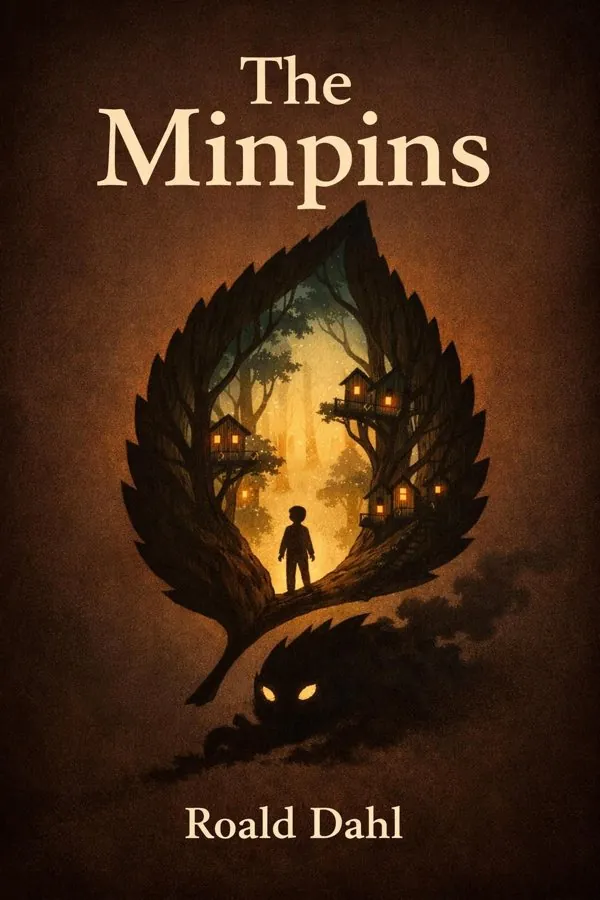
The Minpins: Summary & Key Insights
by Roald Dahl
 10 min9 chaptersAudio available
Key Takeaways from The Minpins
Children often meet the world first through other people’s fears.
Bravery rarely begins as heroism; more often, it begins as a question.
Wonder often appears in places we are too frightened or too busy to notice.
Even the most resourceful community can become trapped by fear when danger feels constant.
Many of Roald Dahl’s best stories insist on the same satisfying truth: intelligence can outmatch brute force.
What Is The Minpins About?
The Minpins by Roald Dahl is a classics book spanning 4 pages. The Minpins is one of Roald Dahl’s most enchanting short fantasies, a story that turns a child’s forbidden curiosity into a thrilling adventure filled with danger, wonder, and quiet wisdom. At its center is Little Billy, a boy warned never to enter the nearby Forest of Sin, a place his mother describes in terrifying detail. But when Billy steps beyond the border of safety, he discovers that the world is far stranger and more magical than fear allows. Hidden in the treetops are the Minpins, a community of tiny people living in constant terror of a monstrous predator called the Gruncher. Billy’s courage and quick thinking help transform their fate. What makes the book matter is not only its imaginative plot, but its understanding of childhood itself. Dahl explores how fear can protect us, but also confine us; how rules can be necessary, yet incomplete; and how bravery often begins with curiosity. A master of children’s literature, Dahl brings his trademark blend of menace, humor, and inventiveness to a smaller-scale tale that still feels emotionally large. The Minpins is a classic reminder that imagination can reveal possibilities adults often forget to see.
This FizzRead summary covers all 9 key chapters of The Minpins in approximately 10 minutes, distilling the most important ideas, arguments, and takeaways from Roald Dahl's work. Also available as an audio summary and Key Quotes Podcast.
The Minpins
The Minpins is one of Roald Dahl’s most enchanting short fantasies, a story that turns a child’s forbidden curiosity into a thrilling adventure filled with danger, wonder, and quiet wisdom. At its center is Little Billy, a boy warned never to enter the nearby Forest of Sin, a place his mother describes in terrifying detail. But when Billy steps beyond the border of safety, he discovers that the world is far stranger and more magical than fear allows. Hidden in the treetops are the Minpins, a community of tiny people living in constant terror of a monstrous predator called the Gruncher. Billy’s courage and quick thinking help transform their fate.
What makes the book matter is not only its imaginative plot, but its understanding of childhood itself. Dahl explores how fear can protect us, but also confine us; how rules can be necessary, yet incomplete; and how bravery often begins with curiosity. A master of children’s literature, Dahl brings his trademark blend of menace, humor, and inventiveness to a smaller-scale tale that still feels emotionally large. The Minpins is a classic reminder that imagination can reveal possibilities adults often forget to see.
Who Should Read The Minpins?
This book is perfect for anyone interested in classics and looking to gain actionable insights in a short read. Whether you're a student, professional, or lifelong learner, the key ideas from The Minpins by Roald Dahl will help you think differently.
- ✓Readers who enjoy classics and want practical takeaways
- ✓Professionals looking to apply new ideas to their work and life
- ✓Anyone who wants the core insights of The Minpins in just 10 minutes
Want the full summary?
Get instant access to this book summary and 100K+ more with Fizz Moment.
Get Free SummaryAvailable on App Store • Free to download
Key Chapters
Children often meet the world first through other people’s fears. Little Billy grows up in a home shaped by rules, warnings, and loving caution. His mother does not want to harm him; she wants to keep him safe. But her picture of the Forest of Sin is so vivid and dreadful that it turns the unknown into something almost mythical. The forest becomes more than a place. It becomes a symbol of everything forbidden, uncertain, and possibly dangerous.
Roald Dahl captures an important truth here: fear can be both useful and limiting. Adults pass down warnings for good reasons, yet children also need room to discover reality for themselves. Billy’s longing to enter the forest is not mere disobedience. It is the natural pull of curiosity, the same impulse that drives learning, creativity, and independence. If he only accepted inherited fear, he would never encounter the hidden wonders waiting beyond the edge of the familiar.
This idea applies well beyond childhood. Many people organize their lives around “forests” they have been taught to avoid: unfamiliar careers, difficult conversations, artistic ambitions, or new communities. Sometimes those fears are justified. Sometimes they are exaggerated stories that prevent growth. The challenge is not to ignore risk, but to examine it honestly.
Billy’s first step into the forest marks the beginning of self-discovery. He learns that reality is more complicated than warnings suggest. Danger exists, yes, but so do beauty, surprise, and opportunity.
Actionable takeaway: Think of one “Forest of Sin” in your own life—a place, project, or decision you avoid because of secondhand fear—and take one small, sensible step toward understanding it directly.
Bravery rarely begins as heroism; more often, it begins as a question. In The Minpins, Billy does not enter the forest because he sees himself as bold or extraordinary. He goes because he wants to know. That distinction matters. Dahl suggests that curiosity is not the opposite of caution, but the force that helps a person move beyond passive fear. Curiosity asks, “Is what I’ve been told the whole story?”
This is a powerful lesson for young readers. Courage is often portrayed as a dramatic act, but in life it usually starts in quieter ways: reading about something unfamiliar, meeting someone outside your usual circle, trying a difficult skill, or speaking up when you feel uncertain. Billy’s adventure begins not with certainty, but with wonder. He does not know what he will find, and that makes his step into the unknown more meaningful.
Dahl also shows that curiosity can change what a person notices. Someone entering the forest only in panic would see threat everywhere. Billy, however, remains open enough to observe details, respond creatively, and eventually discover the Minpins’ hidden world. Curiosity sharpens attention. It turns the world from a wall into a landscape.
In practical terms, this idea can help children and adults alike approach intimidating situations. A new school, new city, or difficult responsibility becomes less overwhelming when framed as something to explore rather than something to survive. Questions create space where fear tries to close it.
Actionable takeaway: The next time you feel intimidated by something unknown, replace one anxious statement like “I can’t handle this” with one curious question like “What can I learn from this?”
Wonder often appears in places we are too frightened or too busy to notice. When Billy flees upward into the trees, he discovers the Minpins, a tiny hidden people living in carefully built homes among the branches. This revelation changes the emotional texture of the story. The forest is no longer just a site of danger. It is also a place of delicate intelligence, community, and beauty.
The Minpins represent an important imaginative idea in Dahl’s work: entire worlds may exist just beyond ordinary perception. Children understand this instinctively. A tree, a cupboard, or a patch of woods can contain secret kingdoms if one knows how to look. But the concept also carries a moral meaning. The world contains lives, perspectives, and vulnerabilities that remain invisible until we pay close attention. Billy’s discovery teaches him to see beyond appearances.
The Minpins are tiny, but they are not insignificant. Their size makes them vulnerable, yet they possess organization, ingenuity, and social bonds. Dahl invites readers to respect beings who might otherwise be overlooked. That has practical value in everyday life. Often the people with the least power, the quietest voices, or the smallest presence in a room are carrying real burdens and deserving real care.
Billy’s encounter with the Minpins also shows how adventure becomes meaningful when it leads to relationship. He does not simply marvel at them from afar. He listens, learns, and becomes involved in their problem.
Actionable takeaway: Practice noticing what you usually overlook—a quiet classmate, a hidden detail in nature, or an ignored perspective—and ask what larger world may exist behind what first seems small.
Even the most resourceful community can become trapped by fear when danger feels constant. The Minpins have created a remarkable society in the trees, but their lives are overshadowed by the Gruncher, a terrifying beast below. They have adapted, survived, and organized themselves as best they can, yet they remain constrained by a threat they cannot defeat alone. Billy, an outsider, becomes the person able to imagine a different outcome.
This idea gives the story emotional depth. The Minpins are not weak because they need help. They are simply limited by circumstance. Dahl shows that collaboration between the vulnerable and the unexpected newcomer can produce change neither could achieve alone. Billy offers scale, mobility, and fresh thinking. The Minpins offer knowledge, perspective, and a cause worth fighting for.
In life, this pattern appears frequently. A family under stress may need help from a teacher, neighbor, or friend. A workplace team stuck in old habits may benefit from an outside perspective. A community facing a long-standing problem may need someone new enough to ask questions others have stopped asking. Sometimes insiders know the situation deeply but cannot see beyond it; outsiders can see possibilities but need insiders’ trust and guidance.
The friendship between Billy and the Minpins also models empathy. He does not dismiss their fear just because he is larger than they are. Instead, he treats their danger as real. That is one reason he earns a place in their world.
Actionable takeaway: When you encounter a group or person struggling with a problem, ask not “Why haven’t they fixed this?” but “What strength or perspective could I contribute that they may not have access to?”
Many of Roald Dahl’s best stories insist on the same satisfying truth: intelligence can outmatch brute force. The Gruncher is not merely a scary animal; it is the embodiment of overwhelming fear, a predator so powerful that the Minpins have built their lives around avoiding it. Billy cannot simply overpower such a creature. Instead, he uses observation, timing, and nerve to create a solution.
This matters because it reframes heroism. The most useful kind of courage is not reckless aggression, but inventive problem-solving under pressure. Billy wins not because he is strongest, but because he thinks. Dahl thereby gives children a deeply encouraging message: being small, young, or physically outmatched does not make you helpless. Cleverness is a real form of power.
The practical lesson is broad. When people face large problems, they often imagine only two options: surrender or direct confrontation. But many challenges yield to strategy. A student overwhelmed by a big assignment can break it into smaller tasks. Someone dealing with conflict can choose the right moment and tone instead of arguing impulsively. A family trying to manage expenses can redesign habits rather than relying on wishful thinking.
Billy’s success also depends on staying present in danger. Panic narrows perception, while calm attention reveals openings. He acts decisively because he has learned enough about the situation to make a smart move.
Actionable takeaway: The next time a problem feels bigger than you are, pause before reacting and ask, “What would a clever solution look like if force or panic were not options?”
One of the most subtle achievements of The Minpins is how it distinguishes real danger from exaggerated dread. The forest does contain threat. Billy’s mother is not entirely wrong to warn him. Yet her warnings flatten the world into a single message: stay away. That simplification keeps Billy from danger, but it also keeps him from truth. The forest is not only terrible; it is also alive, layered, and full of wonder.
Dahl suggests that fear often works by reducing complexity. When we are afraid, we stop seeing shades, exceptions, and hidden possibilities. Everything becomes monster or safety, forbidden or allowed. But maturity requires a fuller vision. Billy learns that one place can hold both risk and beauty. That is a more useful understanding than blind obedience or reckless denial.
This insight has practical relevance in everyday decision-making. People may avoid friendships because of one betrayal, avoid opportunities because of one failure, or avoid whole groups because of stereotypes passed down by others. In each case, fear replaces encounter with assumption. That does not mean all fear is false. It means fear should be tested against reality rather than accepted as total truth.
For children, this lesson can be especially liberating. They begin to understand that adults, though well-intentioned, do not always describe the world completely. For adults, it is a reminder to examine how many convictions are inherited emotional habits rather than carefully observed facts.
Actionable takeaway: When you notice yourself making an all-or-nothing judgment about a person, place, or challenge, deliberately list three details that make the picture more nuanced.
At first glance, The Minpins may seem like a simple celebration of rule-breaking. A boy ignores his mother, enters the forbidden woods, and finds excitement. But Dahl’s deeper point is not that rules are foolish; it is that genuine adventure matures a person. Billy does not return from the forest merely thrilled. He returns changed by responsibility. He has seen hidden lives, faced danger, and acted on behalf of others.
This is an important distinction. Rebellion seeks only freedom from limits. Adventure, in its best form, leads to greater awareness, competence, and moral seriousness. Billy’s journey is worthwhile because it moves beyond self-indulgence. Once he meets the Minpins, the story becomes less about satisfying his curiosity and more about what he will do with what he has learned.
That pattern mirrors healthy growth in real life. A child given more independence must also learn judgment. A teenager exploring new freedoms must learn consequences. An adult leaving a stable routine for a new path must become more disciplined, not less. Exploration without responsibility turns destructive; exploration with responsibility becomes transformative.
Dahl allows readers to enjoy the thrill of crossing boundaries while also showing that the true test of character comes after the discovery. What matters is not simply seeing a bigger world, but responding to it well.
Actionable takeaway: When you seek a new experience—whether travel, a project, or a personal challenge—ask not only “What will I get from this?” but also “What responsibility comes with what I’m about to learn?”
A child who can imagine hidden worlds is not escaping reality; often, that child is learning how to inhabit reality more fully. The Minpins is built on this principle. The story’s tiny tree-dwellers, looming beast, and enchanted forest are fantastical, yet the feelings beneath them are deeply recognizable: fear of the unknown, longing for freedom, compassion for the vulnerable, and delight in discovery.
Dahl’s genius lies in using fantasy not to avoid truth but to sharpen it. By shrinking an entire community into the branches of trees, he makes readers feel tenderness and protectiveness. By inventing the Gruncher, he gives shape to the overwhelming threats that children often sense before they can explain them. Imagination turns abstract emotions into vivid encounters.
This matters in practical life because imagination supports resilience. Children process anxieties through stories, games, and invented worlds. Adults do something similar when they use metaphor, art, or narrative to understand experience. A challenge described one way may feel unbearable; reframed through imagination, it becomes something navigable. Stories help us rehearse courage before life demands it.
The Minpins also reminds readers that beauty often depends on imaginative attention. A tree is not just a tree once you have considered who might be living in it. The ordinary becomes charged with mystery.
Actionable takeaway: Use imagination intentionally this week—through reading, storytelling, drawing, or reflective writing—to give shape to a fear or hope that feels hard to express directly.
The true value of an adventure is revealed in what a person carries back from it. After Billy’s encounter with the Minpins and the defeat of the Gruncher, the story moves toward return. This matters because a journey is not complete when the danger ends. It becomes meaningful when its lessons are integrated into ordinary life. Billy has crossed into a hidden world, but he cannot remain only a visitor to wonder. He must now live as someone who knows more than he did before.
Dahl often understands that childhood growth is cyclical rather than linear. A child ventures outward, experiences something transformative, and then returns to familiar surroundings with a changed mind. Home may look the same, but the child does not. Billy’s relationship to safety, authority, and imagination has deepened. He has seen that the world includes invisible struggles and unexpected marvels. That knowledge creates a lasting connection between him and the Minpins, and between him and the larger mystery of life.
This idea applies to everyday experiences of growth. After travel, grief, success, failure, or learning, the challenge is not merely to remember what happened, but to let it alter how we live. Reflection turns episodes into wisdom. Without reflection, adventure becomes anecdote.
The ending of The Minpins carries warmth because it suggests that wonder need not disappear when the story closes. A meaningful encounter can continue as an inner companionship, shaping how we see familiar places.
Actionable takeaway: After any meaningful experience, take ten minutes to ask yourself what has changed in how you see the world—and identify one habit or attitude you want to carry back into daily life.
All Chapters in The Minpins
About the Author
Roald Dahl (1916–1990) was a British novelist, short story writer, poet, and screenwriter whose work transformed children’s literature. Born in Wales to Norwegian parents, he first gained attention for his adult short fiction before becoming one of the world’s most beloved authors for young readers. His books, including Charlie and the Chocolate Factory, Matilda, The BFG, James and the Giant Peach, and The Witches, are celebrated for their wild imagination, dark humor, unforgettable villains, and deep sympathy for children. Dahl’s storytelling often combines danger with delight, creating worlds where cleverness and courage triumph over cruelty. His work continues to be read across generations, and his influence on modern children’s fiction remains enormous.
Get This Summary in Your Preferred Format
Read or listen to the The Minpins summary by Roald Dahl anytime, anywhere. FizzRead offers multiple formats so you can learn on your terms — all free.
Available formats: App · Audio · PDF · EPUB — All included free with FizzRead
Download The Minpins PDF and EPUB Summary
Key Quotes from The Minpins
“Children often meet the world first through other people’s fears.”
“Bravery rarely begins as heroism; more often, it begins as a question.”
“Wonder often appears in places we are too frightened or too busy to notice.”
“Even the most resourceful community can become trapped by fear when danger feels constant.”
“Many of Roald Dahl’s best stories insist on the same satisfying truth: intelligence can outmatch brute force.”
Frequently Asked Questions about The Minpins
The Minpins by Roald Dahl is a classics book that explores key ideas across 9 chapters. The Minpins is one of Roald Dahl’s most enchanting short fantasies, a story that turns a child’s forbidden curiosity into a thrilling adventure filled with danger, wonder, and quiet wisdom. At its center is Little Billy, a boy warned never to enter the nearby Forest of Sin, a place his mother describes in terrifying detail. But when Billy steps beyond the border of safety, he discovers that the world is far stranger and more magical than fear allows. Hidden in the treetops are the Minpins, a community of tiny people living in constant terror of a monstrous predator called the Gruncher. Billy’s courage and quick thinking help transform their fate. What makes the book matter is not only its imaginative plot, but its understanding of childhood itself. Dahl explores how fear can protect us, but also confine us; how rules can be necessary, yet incomplete; and how bravery often begins with curiosity. A master of children’s literature, Dahl brings his trademark blend of menace, humor, and inventiveness to a smaller-scale tale that still feels emotionally large. The Minpins is a classic reminder that imagination can reveal possibilities adults often forget to see.
More by Roald Dahl

You Might Also Like




Browse by Category
Ready to read The Minpins?
Get the full summary and 100K+ more books with Fizz Moment.