
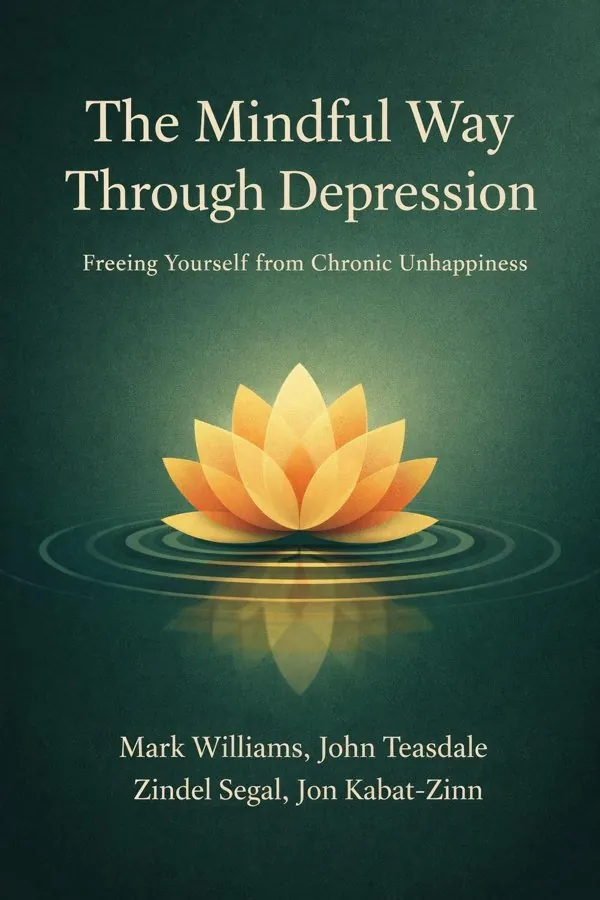
The Mindful Way Through Depression: Freeing Yourself from Chronic Unhappiness: Summary & Key Insights
by Mark Williams, John Teasdale, Zindel Segal, Jon Kabat-Zinn
 10 min12 chaptersAudio available
What Is The Mindful Way Through Depression: Freeing Yourself from Chronic Unhappiness About?
The Mindful Way Through Depression: Freeing Yourself from Chronic Unhappiness by Mark Williams, John Teasdale, Zindel Segal, Jon Kabat-Zinn is a mental_health book spanning 12 pages. This book introduces readers to mindfulness-based cognitive therapy (MBCT), a scientifically validated approach for preventing relapse in depression. It combines insights from cognitive psychology and mindfulness meditation to help individuals recognize and disengage from negative thought patterns. Through practical exercises and guided meditations, the authors show how awareness and acceptance can lead to emotional balance and resilience.
This FizzRead summary covers all 12 key chapters of The Mindful Way Through Depression: Freeing Yourself from Chronic Unhappiness in approximately 10 minutes, distilling the most important ideas, arguments, and takeaways from Mark Williams, John Teasdale, Zindel Segal, Jon Kabat-Zinn's work. Also available as an audio summary and Key Quotes Podcast.
The Mindful Way Through Depression: Freeing Yourself from Chronic Unhappiness
This book introduces readers to mindfulness-based cognitive therapy (MBCT), a scientifically validated approach for preventing relapse in depression. It combines insights from cognitive psychology and mindfulness meditation to help individuals recognize and disengage from negative thought patterns. Through practical exercises and guided meditations, the authors show how awareness and acceptance can lead to emotional balance and resilience.
Who Should Read The Mindful Way Through Depression: Freeing Yourself from Chronic Unhappiness?
This book is perfect for anyone interested in mental_health and looking to gain actionable insights in a short read. Whether you're a student, professional, or lifelong learner, the key ideas from The Mindful Way Through Depression: Freeing Yourself from Chronic Unhappiness by Mark Williams, John Teasdale, Zindel Segal, Jon Kabat-Zinn will help you think differently.
- ✓Readers who enjoy mental_health and want practical takeaways
- ✓Professionals looking to apply new ideas to their work and life
- ✓Anyone who wants the core insights of The Mindful Way Through Depression: Freeing Yourself from Chronic Unhappiness in just 10 minutes
Want the full summary?
Get instant access to this book summary and 100K+ more with Fizz Moment.
Get Free SummaryAvailable on App Store • Free to download
Key Chapters
From our professional experience and years of research, we’ve seen that depression isn’t just a passing mood; it’s a self-reinforcing system built from habitual patterns of mind. At its core, it involves a mode of thinking that repeatedly circles around what's wrong—rumination—and a mode of feeling that amplifies reactivity. The more we try to reason our way out of sadness, the deeper the cycle becomes.
When people become trapped in these loops, they often believe that constant mental effort will lead them back to balance. It doesn’t. The analytical mind, though invaluable for solving external problems, is poorly equipped to untangle emotional pain. Depression thrives precisely because this analytic orientation operates blindly on the inner landscape, continually seeking to fix feelings that can’t be fixed by logic.
Recognizing this mechanism is the first step toward freedom. Our thoughts are not enemies, but they can imprison us when we mistake them for reality. The patterns of self-criticism—“why can’t I be happier?” “what’s wrong with me?”—are attempts by the mind to regain control. Yet every such thought, however well-intentioned, keeps the body and brain locked in the same stress response.
The science behind depression tells us that neural pathways in the brain learn through repetition. When negative thinking or avoidance recurs, the brain becomes increasingly efficient at producing the same emotional states. Over time, chronic unhappiness is less about circumstance and more about conditioning.
Our work invites you to look at this process with awareness. Instead of treating sadness as an enemy to be vanquished, you can regard it as a teacher. Depression signals a misalignment between experience and awareness—it shows how much of life is lived automatically, without noticing. The key is to bring consciousness back into the picture, not to banish sadness but to dissolve its unconscious power.
Imagine a moment when a small disappointment occurs—a friend forgets to call, a plan falls through. The feeling of hurt or frustration arises naturally. But the mind, conditioned by years of habit, immediately leaps into explanation and blame: 'I’m always overlooked,' 'Nothing ever goes right.' Thoughts pile up, feelings intensify, and before long, a single event becomes a descent into deep gloom.
That’s the cycle of unhappiness. It begins with trigger, followed by thought, then by emotional amplification—the classic loop of rumination. Each step reinforces the next, until you’re no longer responding to the present but to a repetitive internal narrative. The brain’s default mode network sustains this cycle, constantly recalling the past and projecting the future instead of resting in now.
Jon Kabat-Zinn often describes this as ‘living on automatic pilot.’ We react rather than respond; we think about life rather than inhabit it. The result is disconnection—from ourselves, from others, from the moment we’re in. Depression is not purely emotional; it’s experiential, a dulling of presence.
In mindfulness practice, we learn to recognize this loop as it forms, catching the moment between stimulus and response. By observing sensations and thoughts without immediately following them, we interrupt the chain reaction that sustains unhappiness. The aim isn’t to stop negative thoughts but to see them clearly enough that they lose their authority.
Once you notice a thought arising—'I’m failing,' 'I’ll never get better'—you can label it quietly as 'thinking.' By doing so, you shift identification away from the content of the thought and into awareness itself. This small act of observation begins to weaken the cycle. Awareness is the solvent that dissolves rumination.
+ 10 more chapters — available in the FizzRead app
All Chapters in The Mindful Way Through Depression: Freeing Yourself from Chronic Unhappiness
About the Authors
Mark Williams is a professor of clinical psychology at the University of Oxford and a leading researcher in mindfulness-based cognitive therapy. John Teasdale and Zindel Segal are clinical psychologists who co-developed MBCT. Jon Kabat-Zinn is the founder of Mindfulness-Based Stress Reduction (MBSR) and a pioneer in bringing mindfulness into mainstream medicine and psychology.
Get This Summary in Your Preferred Format
Read or listen to the The Mindful Way Through Depression: Freeing Yourself from Chronic Unhappiness summary by Mark Williams, John Teasdale, Zindel Segal, Jon Kabat-Zinn anytime, anywhere. FizzRead offers multiple formats so you can learn on your terms — all free.
Available formats: App · Audio · PDF · EPUB — All included free with FizzRead
Download The Mindful Way Through Depression: Freeing Yourself from Chronic Unhappiness PDF and EPUB Summary
Key Quotes from The Mindful Way Through Depression: Freeing Yourself from Chronic Unhappiness
“From our professional experience and years of research, we’ve seen that depression isn’t just a passing mood; it’s a self-reinforcing system built from habitual patterns of mind.”
“Imagine a moment when a small disappointment occurs—a friend forgets to call, a plan falls through.”
Frequently Asked Questions about The Mindful Way Through Depression: Freeing Yourself from Chronic Unhappiness
The Mindful Way Through Depression: Freeing Yourself from Chronic Unhappiness by Mark Williams, John Teasdale, Zindel Segal, Jon Kabat-Zinn is a mental_health book that explores key ideas across 12 chapters. This book introduces readers to mindfulness-based cognitive therapy (MBCT), a scientifically validated approach for preventing relapse in depression. It combines insights from cognitive psychology and mindfulness meditation to help individuals recognize and disengage from negative thought patterns. Through practical exercises and guided meditations, the authors show how awareness and acceptance can lead to emotional balance and resilience.
You Might Also Like

Big Feelings: How to Be Okay When Things Are Not Okay
Liz Fosslien, Mollie West Duffy
10 min
Creative Arts Therapies Handbook: Art, Music and Dance Therapy Practices for Wellbeing
Susan I. Buchalter
10 min
Emotional First Aid: Healing Rejection, Guilt, Failure, and Other Everyday Hurts
Guy Winch
10 min
Lost Connections: Why You're Depressed and How to Find Hope
Johann Hari
10 min
No Time to Panic: How to Stop Worrying and Embrace Life
Matt Gutman
10 min
Overcoming Mobbing: A Recovery Guide for Workplace Aggression and Bullying
Maureen Duffy, Len Sperry
10 minBrowse by Category
Ready to read The Mindful Way Through Depression: Freeing Yourself from Chronic Unhappiness?
Get the full summary and 100K+ more books with Fizz Moment.