
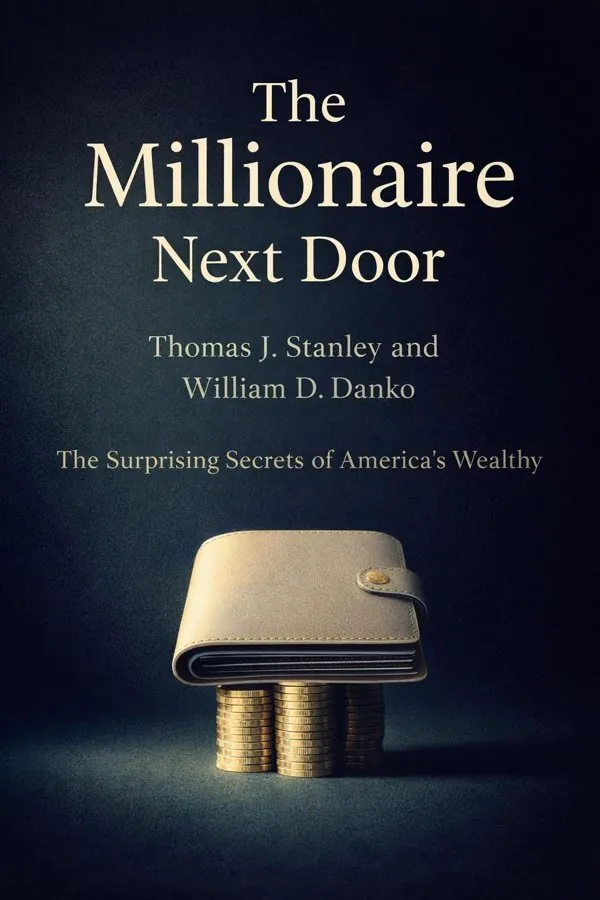
The Millionaire Next Door: Summary & Key Insights
 10 min10 chaptersAudio available
Key Takeaways from The Millionaire Next Door
One of the book’s most revealing insights is that many millionaires do not fit the cultural stereotype of wealth.
A high paycheck can create the illusion of wealth, but income alone does not make anyone financially secure.
Frugality is often misunderstood as penny-pinching or joyless self-denial.
Another striking theme in Stanley’s research is that wealthy households plan.
The book makes an important point that is easy to overlook: wealth building is not just about money management, but also about managing time, attention, and effort.
What Is The Millionaire Next Door About?
The Millionaire Next Door by Thomas Stanley is a finance book published in 1996 spanning 11 pages. What if most millionaires did not look rich at all? That is the surprising premise at the heart of The Millionaire Next Door, Thomas J. Stanley and William D. Danko’s landmark study of how wealth is actually built in America. Drawing on years of research, surveys, and interviews with affluent households, the authors challenge the popular image of wealth as visible luxury. Instead, they show that many truly wealthy people live in ordinary neighborhoods, drive practical cars, avoid status spending, and quietly build financial independence over decades. The book matters because it reframes wealth as a behavioral outcome rather than an income level or a lifestyle performance. It argues that financial success is usually the result of discipline, planning, self-control, and consistent investing—not luck, glamour, or a spectacular salary. Stanley’s authority comes from rigorous empirical research into the spending patterns, occupations, family habits, and values of high-net-worth individuals. His central insight is both simple and powerful: people become wealthy not by appearing affluent, but by prioritizing asset accumulation over consumption. For readers seeking a realistic path to financial independence, this book remains one of the most influential and practical guides ever written.
This FizzRead summary covers all 10 key chapters of The Millionaire Next Door in approximately 10 minutes, distilling the most important ideas, arguments, and takeaways from Thomas Stanley's work. Also available as an audio summary and Key Quotes Podcast.
The Millionaire Next Door
What if most millionaires did not look rich at all? That is the surprising premise at the heart of The Millionaire Next Door, Thomas J. Stanley and William D. Danko’s landmark study of how wealth is actually built in America. Drawing on years of research, surveys, and interviews with affluent households, the authors challenge the popular image of wealth as visible luxury. Instead, they show that many truly wealthy people live in ordinary neighborhoods, drive practical cars, avoid status spending, and quietly build financial independence over decades.
The book matters because it reframes wealth as a behavioral outcome rather than an income level or a lifestyle performance. It argues that financial success is usually the result of discipline, planning, self-control, and consistent investing—not luck, glamour, or a spectacular salary. Stanley’s authority comes from rigorous empirical research into the spending patterns, occupations, family habits, and values of high-net-worth individuals. His central insight is both simple and powerful: people become wealthy not by appearing affluent, but by prioritizing asset accumulation over consumption. For readers seeking a realistic path to financial independence, this book remains one of the most influential and practical guides ever written.
Who Should Read The Millionaire Next Door?
This book is perfect for anyone interested in finance and looking to gain actionable insights in a short read. Whether you're a student, professional, or lifelong learner, the key ideas from The Millionaire Next Door by Thomas Stanley will help you think differently.
- ✓Readers who enjoy finance and want practical takeaways
- ✓Professionals looking to apply new ideas to their work and life
- ✓Anyone who wants the core insights of The Millionaire Next Door in just 10 minutes
Want the full summary?
Get instant access to this book summary and 100K+ more with Fizz Moment.
Get Free SummaryAvailable on App Store • Free to download
Key Chapters
One of the book’s most revealing insights is that many millionaires do not fit the cultural stereotype of wealth. We are trained to associate money with visible luxury: premium cars, large homes, expensive watches, and constant consumption. Stanley’s research overturns that assumption. The typical millionaire is far more likely to live modestly, buy used or practical vehicles, shop carefully, and avoid drawing attention to their financial status.
This matters because appearances can be profoundly misleading. Many high-income households spend so aggressively that they build little actual net worth. Meanwhile, some families with more moderate incomes accumulate impressive wealth by saving consistently and resisting lifestyle inflation. The wealthy next door often choose neighborhoods below what they could technically afford, maintain strict household budgets, and focus their spending on value rather than prestige.
Think about two professionals earning the same salary. One upgrades homes frequently, leases luxury cars, and feels pressure to maintain a polished image. The other lives below their means, invests the difference, and avoids status competition. After twenty years, the second person may have far greater net worth despite living less conspicuously.
The lesson is practical and liberating: stop using outward signs to measure financial success, including your own. A quieter lifestyle can be a stronger foundation for lasting wealth than one designed to impress. Actionable takeaway: audit your spending for image-driven purchases and redirect that money into long-term assets.
A high paycheck can create the illusion of wealth, but income alone does not make anyone financially secure. Stanley distinguishes between people who earn well and people who keep, grow, and preserve what they earn. This gap is the difference between being a prodigious accumulator of wealth and an under accumulator of wealth.
The core equation is simple: wealth is what you retain, not what flows through your hands. Many physicians, executives, attorneys, and business owners earn impressive incomes but spend nearly all of it. They live in expensive zip codes, send signals of success, and carry large recurring obligations. Their lifestyle consumes the very resources that could have become investments. By contrast, people with moderate incomes often accumulate substantial net worth because they convert earnings into ownership: stocks, businesses, retirement accounts, and debt-free homes.
This reframing is especially useful for modern readers who may assume that a future raise will solve their financial stress. In reality, more income often brings more spending unless there is a deliberate system in place. Without discipline, higher earnings can simply fund a more expensive version of the same financial insecurity.
A useful exercise is to compare your annual income with your net worth trajectory. Are your assets growing meaningfully each year, or are you mainly financing consumption? Actionable takeaway: track your net worth every quarter and judge financial progress by asset growth, not salary growth.
Frugality is often misunderstood as penny-pinching or joyless self-denial. In The Millionaire Next Door, it appears as something much more powerful: a strategic habit that creates freedom. The affluent households Stanley studied were not cheap in a fearful sense; they were intentional. They spent carefully so they could own more of their future.
This distinction matters. Frugal people are not simply spending less for the sake of spending less. They are making trade-offs in favor of autonomy, security, and opportunity. They may negotiate major purchases, avoid paying full price unnecessarily, keep cars longer, limit luxury spending, and resist social pressure to upgrade constantly. These choices do not usually feel dramatic in the moment, but over years they create investable capital, reduce dependence on employment income, and cushion households against shocks.
For example, skipping a prestige car payment and investing that amount monthly can produce a six-figure difference over time. Living in a reasonably priced home rather than stretching for a dream address can lower taxes, debt, maintenance, and stress while increasing savings capacity. Frugality compounds because it preserves both money and decision-making flexibility.
Importantly, the book shows that frugality is common among the wealthy not because they cannot afford more, but because they understand what conspicuous spending costs in lost compounding. Actionable takeaway: choose three recurring expenses to permanently reduce and automate the savings into investment accounts.
Another striking theme in Stanley’s research is that wealthy households plan. They do not leave financial outcomes to vague hopes or occasional bursts of discipline. They budget, track, forecast, and allocate. This planning habit may seem ordinary, but it is one of the clearest dividing lines between people who steadily build wealth and people who drift financially.
Budgeting in this context is not about restricting every pleasure. It is about giving each dollar a job before it disappears. Wealth accumulators know their annual cash flow, estimate taxes, monitor household expenses, and set explicit saving and investment targets. They think in long time horizons. Instead of asking, “Can I afford this this month?” they ask, “What does this do to my balance sheet over ten years?”
Long-term vision also changes behavior in subtle ways. A family with a written financial plan is more likely to delay purchases, maintain emergency reserves, fund retirement consistently, and evaluate career decisions through the lens of financial independence. They are less reactive because they have a framework for priorities.
A practical example is the difference between automatic investing and discretionary investing. People who wait to invest whatever is “left over” usually find little remains. People who automate contributions treat wealth-building as a fixed obligation rather than an optional extra.
Planning does not guarantee perfect outcomes, but it dramatically increases the odds of progress. Actionable takeaway: create a one-page annual wealth plan with savings targets, investment contributions, debt goals, and a monthly spending cap.
The book makes an important point that is easy to overlook: wealth building is not just about money management, but also about managing time, attention, and effort. Financially successful people tend to direct their energy toward activities that increase their economic productivity and reduce waste. They are purposeful not only with dollars, but with hours.
This has several dimensions. First, they often avoid time-consuming status games that drain money and focus. Second, they devote effort to areas with long-term payoff: building businesses, improving professional competence, evaluating investments, planning taxes, and learning how money works. Third, they develop systems that reduce financial friction, such as organized records, disciplined bill payment, and efficient decision-making.
Consider someone who spends countless hours browsing luxury products, comparing prestige purchases, or maintaining an expensive lifestyle. Contrast that with someone who invests that same energy into increasing savings rates, researching low-cost investment vehicles, or building a side business. Over time, the second approach compounds in both financial and psychological ways.
Stanley also suggests that many wealthy households are careful about who handles money decisions and how. They reduce chaos. They know that disorganization can lead to missed opportunities, tax inefficiency, avoidable fees, and emotional spending.
In modern terms, financial success often depends on attention control. The world constantly invites consumption; wealth requires selective focus. Actionable takeaway: spend one hour each week on a scheduled “money review” to manage accounts, track progress, and make one high-value financial decision.
A powerful and sometimes uncomfortable idea in the book is that family upbringing strongly influences future wealth. Many millionaires were raised in households that emphasized discipline, responsibility, delayed gratification, and economic self-reliance. Just as importantly, the authors warn that excessive financial support from parents can undermine a child’s ability to become independent and wealth-building.
This does not mean parents should be harsh or ungenerous. It means that money given without expectations can weaken initiative, distort spending habits, and encourage dependence. Adult children who receive frequent subsidies may come to expect rescue rather than practice restraint. They may choose lifestyles beyond their own sustainable means because someone else fills the gap.
By contrast, households that teach budgeting, work ethic, and accountability tend to produce adults who understand trade-offs. Children who learn to save, earn, compare prices, and wait for purchases develop a stronger foundation than children who are shielded from all financial reality. Even affluent parents can foster healthy habits by linking privileges to responsibility and by modeling modest behavior themselves.
The broader point is that wealth is cultural as much as financial. Values are transmitted through everyday behavior: how a family talks about debt, spending, work, and entitlement. A home that rewards prudence often creates future accumulators of wealth.
For readers raising children, the question is not just how much to provide, but what patterns you are teaching. Actionable takeaway: establish family rules that teach earning, saving, and delayed gratification instead of automatic financial rescue.
Many people assume wealth is mainly determined by elite credentials or glamorous professions. Stanley’s findings are more nuanced. While education and income certainly matter, occupation alone does not guarantee financial success. Some of the wealthiest individuals in the study came from unglamorous but profitable fields, especially those with stable demand, low status competition, and opportunities for ownership.
The key is not choosing the most prestigious path, but finding work that supports high savings, disciplined living, and long-term capital accumulation. Professionals in high-status occupations often face pressure to spend heavily in order to look successful. Those in more ordinary businesses may feel less need to display status and therefore retain more of what they earn. A contractor, distributor, small manufacturer, or service business owner may build more wealth than a high-earning executive whose lifestyle expands with every bonus.
Education can help, but the book pushes readers to think beyond degrees as automatic wealth tickets. Behavioral factors still dominate: living below your means, avoiding debt, investing consistently, and making prudent career decisions. A solid income combined with low consumption can outperform a spectacular income paired with chronic overspending.
This idea is encouraging because it broadens the path to financial independence. You do not need a celebrity career or elite social image. You need a durable way to create value and the discipline to retain the rewards. Actionable takeaway: evaluate your career not just by salary and status, but by its ability to support saving, ownership, and a sustainable lifestyle.
Financial independence is rarely an individual project alone. Stanley highlights how marriage and partnership can significantly influence wealth outcomes. When two people share values around spending, saving, budgeting, and long-term planning, they can accelerate wealth creation. When they clash on money, even strong incomes can be neutralized by conflict, inconsistency, and excess consumption.
The most successful households in the book often display financial alignment. They agree on priorities, avoid performative spending, and make major decisions with a long view. Their households operate with coordination rather than hidden habits or competing expectations. This alignment reduces waste and increases trust. It also allows for strategic choices, such as one partner supporting a business launch, both partners prioritizing retirement contributions, or the family jointly resisting lifestyle inflation.
By contrast, a mismatch in values can be expensive. If one partner views money as a tool for security and the other sees it mainly as a tool for visible enjoyment, the household may swing between discipline and overspending. Debt, secrecy, and resentment can follow.
For couples, wealth-building is therefore partly about communication. Conversations about housing, children, cars, giving, education, and retirement are not side topics; they are central to the financial future of the family. Compatibility around money habits may matter as much as income itself.
A practical household system can include shared goals, regular check-ins, and agreed limits for discretionary spending. Actionable takeaway: schedule a monthly money meeting with your partner to review goals, expenses, and one upcoming financial decision together.
A major pattern in The Millionaire Next Door is the high presence of self-employed individuals and business owners among the affluent. Entrepreneurship is not presented as glamorous or easy, but as a powerful route to wealth because it offers ownership, control, and potentially scalable income. Many millionaires build fortunes not through extraordinary salaries, but through businesses in ordinary industries.
This is a critical correction to the myth that wealth requires celebrity entrepreneurship or venture-backed innovation. The book points to businesses that solve practical, recurring problems: distribution, maintenance, repair, contracting, niche manufacturing, and specialized services. These fields may not attract admiration, but they often produce stable profits and opportunities to accumulate equity.
Ownership changes the wealth equation. Employees primarily trade time for compensation. Owners can build systems, customer relationships, and enterprise value that persist beyond a single paycheck. Of course, entrepreneurship carries risk, uncertainty, and long hours. But for many disciplined individuals, it also creates the possibility of both income and appreciating assets.
The book also suggests that entrepreneurs who become wealthy tend to combine ambition with restraint. They often reinvest in their businesses, control personal spending, and avoid confusing revenue with personal wealth. Their modest lifestyles help their businesses survive lean periods and expand during good ones.
Not everyone needs to start a company, but the principle of ownership is powerful. Actionable takeaway: look for ways to build equity—through a business, side venture, or investments—rather than relying solely on earned income.
Perhaps the book’s deepest message is psychological: wealth is not best understood as luxury, but as independence. The truly rich are often those who have enough assets to make choices without fear. They can change careers, survive setbacks, retire with dignity, help family responsibly, and avoid being trapped by monthly obligations. This kind of wealth is quieter than status, but far more powerful.
Stanley contrasts this with the illusion of affluence. A person can appear successful while being financially fragile. Expensive possessions may signal consumption capacity, not actual security. If maintaining an image requires continuous high earnings, then that lifestyle rests on a fragile foundation. Real wealth is measured by accumulated assets, low dependence on external validation, and the ability to live on one’s own terms.
This redefinition has important emotional consequences. It frees readers from social comparison. Instead of asking how to look wealthier, the better question becomes: how can I become more independent next year than I am today? That shift encourages habits that compound—saving, investing, reducing debt, avoiding unnecessary upgrades, and making career choices that increase autonomy.
The book ultimately argues that millionaires think differently. They value freedom over display, substance over symbolism, and long-term security over immediate applause. That mindset is available to almost anyone willing to live intentionally.
Actionable takeaway: define your personal number for financial independence and build a plan around reaching it, rather than around maintaining an impressive lifestyle.
All Chapters in The Millionaire Next Door
About the Author
Thomas J. Stanley was an American author, researcher, and expert on wealth accumulation who became widely known for changing how people think about financial success. Trained in business and marketing, he spent years studying affluent households, focusing not on how rich people appeared, but on how they actually earned, saved, invested, and lived. His best-known work, The Millionaire Next Door, co-authored with William D. Danko, drew on extensive surveys and interviews to show that many millionaires are surprisingly frugal and financially disciplined. Stanley’s research emphasized behavioral patterns such as living below one’s means, budgeting carefully, and avoiding status consumption. Through his books, speaking, and consulting, he became one of the most influential voices in practical personal finance, especially on the link between everyday habits and long-term wealth.
Get This Summary in Your Preferred Format
Read or listen to the The Millionaire Next Door summary by Thomas Stanley anytime, anywhere. FizzRead offers multiple formats so you can learn on your terms — all free.
Available formats: App · Audio · PDF · EPUB — All included free with FizzRead
Download The Millionaire Next Door PDF and EPUB Summary
Key Quotes from The Millionaire Next Door
“One of the book’s most revealing insights is that many millionaires do not fit the cultural stereotype of wealth.”
“A high paycheck can create the illusion of wealth, but income alone does not make anyone financially secure.”
“Frugality is often misunderstood as penny-pinching or joyless self-denial.”
“Another striking theme in Stanley’s research is that wealthy households plan.”
“The book makes an important point that is easy to overlook: wealth building is not just about money management, but also about managing time, attention, and effort.”
Frequently Asked Questions about The Millionaire Next Door
The Millionaire Next Door by Thomas Stanley is a finance book that explores key ideas across 10 chapters. What if most millionaires did not look rich at all? That is the surprising premise at the heart of The Millionaire Next Door, Thomas J. Stanley and William D. Danko’s landmark study of how wealth is actually built in America. Drawing on years of research, surveys, and interviews with affluent households, the authors challenge the popular image of wealth as visible luxury. Instead, they show that many truly wealthy people live in ordinary neighborhoods, drive practical cars, avoid status spending, and quietly build financial independence over decades. The book matters because it reframes wealth as a behavioral outcome rather than an income level or a lifestyle performance. It argues that financial success is usually the result of discipline, planning, self-control, and consistent investing—not luck, glamour, or a spectacular salary. Stanley’s authority comes from rigorous empirical research into the spending patterns, occupations, family habits, and values of high-net-worth individuals. His central insight is both simple and powerful: people become wealthy not by appearing affluent, but by prioritizing asset accumulation over consumption. For readers seeking a realistic path to financial independence, this book remains one of the most influential and practical guides ever written.
Compare The Millionaire Next Door

You Might Also Like


Featured In
Browse by Category
Ready to read The Millionaire Next Door?
Get the full summary and 100K+ more books with Fizz Moment.