
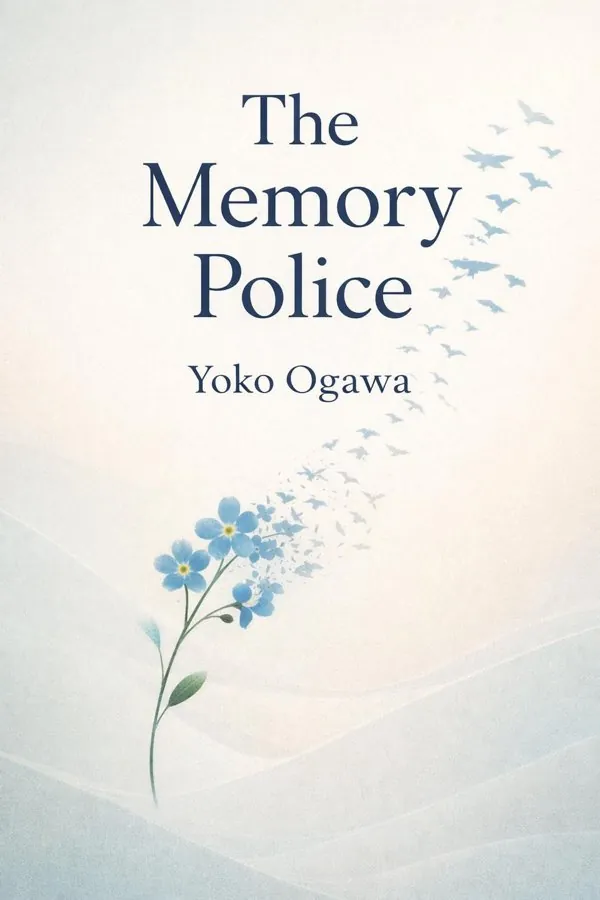
The Memory Police: Summary & Key Insights
by Yoko Ogawa
 10 min8 chaptersAudio available
Key Takeaways from The Memory Police
Loss is most frightening when it arrives politely.
Memory often survives first in private devotion before it survives in public history.
When memory collapses, art becomes one of the last shelters for meaning.
To remember what others forget is both a gift and a burden.
A society can survive isolated losses more easily than cumulative emptiness.
What Is The Memory Police About?
The Memory Police by Yoko Ogawa is a bestsellers book spanning 5 pages. What disappears first in Yoko Ogawa’s The Memory Police is not only objects, but certainty. Set on an unnamed island governed by a mysterious force that erases things from both daily life and collective memory, the novel follows a young writer as disappearances accelerate from flowers and birds to photographs, calendars, and even language itself. Most islanders forget what has been lost as soon as the order comes, but a few retain their memories—and that makes them dangerous. When the writer learns that her editor, R, is one of those rare people, she hides him in her home and begins a quiet act of resistance through care, secrecy, and storytelling. The novel is suspenseful, but its deeper power lies in its emotional precision: it asks what remains of identity when memory is stripped away piece by piece. Ogawa, one of Japan’s most celebrated contemporary authors, is renowned for transforming unsettling premises into intimate, elegant fiction. In The Memory Police, she creates a haunting meditation on authoritarian control, grief, art, and the fragile human need to remember.
This FizzRead summary covers all 8 key chapters of The Memory Police in approximately 10 minutes, distilling the most important ideas, arguments, and takeaways from Yoko Ogawa's work. Also available as an audio summary and Key Quotes Podcast.
The Memory Police
What disappears first in Yoko Ogawa’s The Memory Police is not only objects, but certainty. Set on an unnamed island governed by a mysterious force that erases things from both daily life and collective memory, the novel follows a young writer as disappearances accelerate from flowers and birds to photographs, calendars, and even language itself. Most islanders forget what has been lost as soon as the order comes, but a few retain their memories—and that makes them dangerous. When the writer learns that her editor, R, is one of those rare people, she hides him in her home and begins a quiet act of resistance through care, secrecy, and storytelling. The novel is suspenseful, but its deeper power lies in its emotional precision: it asks what remains of identity when memory is stripped away piece by piece. Ogawa, one of Japan’s most celebrated contemporary authors, is renowned for transforming unsettling premises into intimate, elegant fiction. In The Memory Police, she creates a haunting meditation on authoritarian control, grief, art, and the fragile human need to remember.
Who Should Read The Memory Police?
This book is perfect for anyone interested in bestsellers and looking to gain actionable insights in a short read. Whether you're a student, professional, or lifelong learner, the key ideas from The Memory Police by Yoko Ogawa will help you think differently.
- ✓Readers who enjoy bestsellers and want practical takeaways
- ✓Professionals looking to apply new ideas to their work and life
- ✓Anyone who wants the core insights of The Memory Police in just 10 minutes
Want the full summary?
Get instant access to this book summary and 100K+ more with Fizz Moment.
Get Free SummaryAvailable on App Store • Free to download
Key Chapters
Loss is most frightening when it arrives politely. On Ogawa’s unnamed island, disappearances do not begin with explosions or open war. They arrive as strangely ordinary events: one morning, roses are no longer meaningful; another day, birds vanish from memory; later, photographs become unbearable remnants of a world that must be surrendered. The islanders respond with ritual efficiency. They gather the newly forbidden objects, destroy them, and continue living as if nothing essential has changed. That calm acceptance is the novel’s first great shock.
Ogawa uses this pattern to show how authoritarian control often depends less on dramatic force than on repetition, habit, and social compliance. The Memory Police, who enforce each disappearance, are certainly frightening, but the system works because most people adapt. They internalize loss before they can question it. Everyday life becomes a sequence of adjustments, and each adjustment makes the next one easier.
This idea extends beyond the novel’s setting. In real life, people also normalize gradual erosion—of privacy, language, traditions, institutions, even attention. What vanishes is often not noticed all at once. A neighborhood changes, a custom dies, a word falls out of use, and only later do we realize that a structure of meaning has quietly collapsed.
Ogawa invites us to notice these small erasures before they harden into the new normal. Pay attention to what your culture treats as disposable: books, archives, family stories, local rituals, even emotional vocabulary. Ask what daily habits preserve memory instead of dissolving it. Actionable takeaway: choose one ordinary thing you value—a photograph album, a family recipe, a childhood song—and actively preserve and revisit it this week.
Memory often survives first in private devotion before it survives in public history. The narrator’s parents embody two different ways of honoring a vanishing world. Her mother, a sculptor, creates objects that hold shape against impermanence; her father studies birds, attending carefully to fragile lives that may soon be gone. Their work is not loud resistance, yet it carries a quiet refusal to let reality pass unmarked.
The narrator’s memories of them become morally important because they teach her that attention is a form of care. Her mother does not merely make art; she preserves traces. Hidden drawers, preserved objects, and a reverence for what others are ready to discard suggest that remembrance is both emotional and practical. Her father’s study of birds likewise reminds us that observation can be an ethical act. To name, record, and cherish something is to resist its total erasure.
These parental influences shape the narrator’s later choices. She may appear passive compared with the machinery of the state, but the values she inherits—tenderness, patience, detail, and loyalty to vanished things—prepare her for hidden resistance. Ogawa suggests that moral courage is often rooted not in ideology but in intimate upbringing.
Readers can apply this idea by thinking about what forms of remembrance they inherited. Did someone in your family keep letters, tell stories, label photographs, save tools, or teach songs? These habits are not trivial; they are frameworks for identity. In a fast-moving culture, continuity is often maintained through personal rituals rather than public institutions. Actionable takeaway: document one memory passed down by a parent, grandparent, or mentor, and preserve it in writing, audio, or a physical archive.
When memory collapses, art becomes one of the last shelters for meaning. The narrator is a novelist, and her profession is not incidental: writing in The Memory Police represents an effort to hold form together in a world that is being emptied from within. As disappearances increase, language itself grows unstable. How can someone write when the objects, sensations, and associations that nourish imagination keep being erased? Ogawa turns this into one of the novel’s deepest tensions.
The narrator’s writing process reveals that creativity is not just expression; it is preservation. Even when she can no longer fully remember what has vanished, the act of composing fiction allows her to approach what remains emotionally true. Embedded within the novel is the story she is writing, a haunting tale of confinement and voice, which mirrors the main plot and reinforces the idea that art can capture truths that official reality denies.
This matters beyond literature. People often think creativity requires abundance—time, freedom, resources, perfect recall. Ogawa shows the opposite: creative work can become most urgent when conditions are narrowing. Journaling through grief, making art after loss, or writing during social instability can help people maintain continuity when external structures fail.
The novel also warns that when language shrinks, thought shrinks with it. If words disappear, so do nuanced feelings, histories, and possibilities. That makes reading, writing, and careful speech subtly political acts.
Actionable takeaway: start a small daily writing practice—even five minutes of notes, memories, or observations—to strengthen your relationship with language before distraction, fear, or routine can erode it.
A society can survive isolated losses more easily than cumulative emptiness. Early in The Memory Police, each disappearance is disturbing yet manageable. People adapt, routines continue, and the island maintains a superficial order. But as the vanishings accelerate, the strain becomes visible. Practical life deteriorates. Emotional life flattens. The range of human experience narrows until existence itself feels skeletal.
Ogawa’s brilliance lies in showing collapse not as a single catastrophic event but as a slow subtraction. Remove photographs, and people lose access to personal history. Remove calendars, and time becomes harder to organize. Remove boats, and mobility shrinks. Each disappearance alters both logistics and imagination. The islanders are not only deprived of things; they are deprived of the mental structures those things support.
This gradual unraveling reflects many forms of real-world decline. Institutions weaken one policy at a time. Relationships decay through small neglects. Creative lives shrink when curiosity, rest, conversation, and concentration are chipped away. People often notice collapse only when the cumulative effect becomes undeniable.
The novel therefore teaches a systemic lesson: what seems minor in isolation may be devastating in sequence. We should ask not only whether one loss is survivable, but what kind of person or society repeated losses are creating.
A practical application is to audit your own life for cumulative erosion. Have you gradually lost time for reading, friendships, reflection, exercise, or unstructured thought? None of these losses may feel dramatic alone, but together they can hollow out your sense of self. Actionable takeaway: identify one area of gradual diminishment in your life and restore a single supporting habit before further losses become your new baseline.
Things are never just things. One reason the disappearances in The Memory Police feel so devastating is that each vanished object carries more than function. A ribbon is not merely fabric; it may hold childhood, ceremony, affection, vanity, or grief. A photograph is not merely paper; it is proof that a moment once existed. By targeting objects, the island’s system of erasure attacks identity through material culture.
Ogawa understands that human memory is often externalized. We remember through keepsakes, furniture, clothing, letters, sounds, and places. Remove these anchors, and internal memory weakens as well. The novel therefore challenges modern habits of disposability. In a culture that often treats objects as replaceable, Ogawa reminds us that possessions can be emotionally and historically dense.
This does not mean clinging to everything. Rather, it means recognizing that some objects deserve conscious stewardship because they connect us to relationships, values, and former selves. A worn cookbook, a ticket stub, a grandfather’s pen, or an old voicemail may preserve dimensions of meaning no abstract summary can replicate.
The book also suggests that when societies destroy objects—books, monuments, artworks, archives, tools—they are not simply clearing space. They are editing memory. That insight applies to personal life too. If we outsource all memory to fleeting digital streams, we risk weakening our tactile relationship with the past.
Actionable takeaway: choose three meaningful objects you own and write down why each matters. This simple practice clarifies what you want to preserve and what kind of life story your possessions are helping you carry.
Not all resistance looks dramatic; sometimes it looks like making soup, lowering your voice, and refusing to abandon another person. The emotional force of The Memory Police comes from its understated acts of loyalty. The narrator, R, and the old man who helps them do not overthrow the regime. They hide, share meals, exchange memories, and protect one another’s dignity. In a world organized around disappearance, these gestures become radical.
Ogawa’s vision is especially powerful because it rejects the fantasy that only grand, public acts matter. The novel honors maintenance: keeping someone safe, preserving a room, continuing a conversation, writing a page, remembering a detail. Such actions may seem small, yet they hold open a human world when systems are trying to close it.
This has broad relevance. During periods of fear or social fragmentation, people often feel powerless because they cannot solve everything. The Memory Police offers a more sustainable model of moral action. You may not control the whole structure, but you can still protect a person, preserve a truth, or create a pocket of trust.
Tenderness here is not sentimental. It is disciplined attention to another’s vulnerability. By linking care with resistance, Ogawa broadens our understanding of courage. Strength is not only defiance; it is also consistency, gentleness, and the refusal to let another person be erased.
Actionable takeaway: practice one concrete act of sustaining care this week—check on someone isolated, preserve a shared memory, or create a small environment where honesty and safety are possible.
All Chapters in The Memory Police
About the Author
Yoko Ogawa is an acclaimed Japanese author widely admired for her subtle, unsettling, and emotionally precise fiction. Born in Okayama in 1962, she began publishing in the late 1980s and quickly earned recognition for her distinctive voice, which often explores memory, loss, isolation, and the hidden tensions beneath ordinary life. Her work moves gracefully between literary realism and the uncanny, combining restraint with deep psychological force. Ogawa has received numerous literary honors, including the Akutagawa Prize, and has gained a large international readership through works such as The Housekeeper and the Professor, Revenge, and The Memory Police. Her fiction is known for its elegance, its quiet intensity, and its ability to transform intimate settings into profound meditations on human vulnerability and endurance.
Get This Summary in Your Preferred Format
Read or listen to the The Memory Police summary by Yoko Ogawa anytime, anywhere. FizzRead offers multiple formats so you can learn on your terms — all free.
Available formats: App · Audio · PDF · EPUB — All included free with FizzRead
Download The Memory Police PDF and EPUB Summary
Key Quotes from The Memory Police
“Loss is most frightening when it arrives politely.”
“Memory often survives first in private devotion before it survives in public history.”
“When memory collapses, art becomes one of the last shelters for meaning.”
“To remember what others forget is both a gift and a burden.”
“A society can survive isolated losses more easily than cumulative emptiness.”
Frequently Asked Questions about The Memory Police
The Memory Police by Yoko Ogawa is a bestsellers book that explores key ideas across 8 chapters. What disappears first in Yoko Ogawa’s The Memory Police is not only objects, but certainty. Set on an unnamed island governed by a mysterious force that erases things from both daily life and collective memory, the novel follows a young writer as disappearances accelerate from flowers and birds to photographs, calendars, and even language itself. Most islanders forget what has been lost as soon as the order comes, but a few retain their memories—and that makes them dangerous. When the writer learns that her editor, R, is one of those rare people, she hides him in her home and begins a quiet act of resistance through care, secrecy, and storytelling. The novel is suspenseful, but its deeper power lies in its emotional precision: it asks what remains of identity when memory is stripped away piece by piece. Ogawa, one of Japan’s most celebrated contemporary authors, is renowned for transforming unsettling premises into intimate, elegant fiction. In The Memory Police, she creates a haunting meditation on authoritarian control, grief, art, and the fragile human need to remember.
More by Yoko Ogawa

You Might Also Like
The Godfather
Mario Puzo
10 min
The Handmaid's Tale
Margaret Atwood
10 min
The Hunger Games
Suzanne Collins
10 min
The Nightingale
Kristin Hannah
10 min
The Seven Husbands of Evelyn Hugo
Taylor Jenkins Reid
10 min
Backwater Justice
Fern Michaels
10 minBrowse by Category
Ready to read The Memory Police?
Get the full summary and 100K+ more books with Fizz Moment.