
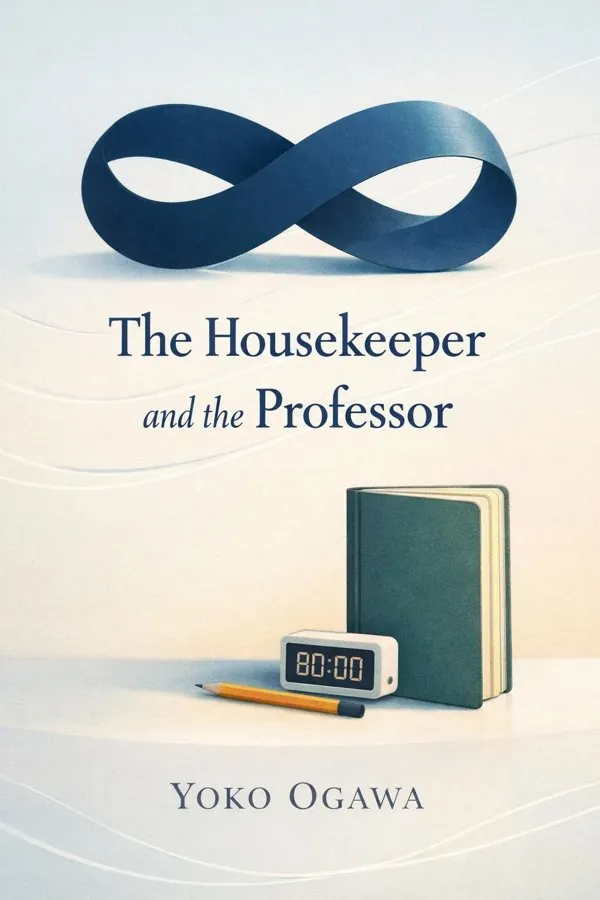
The Housekeeper and the Professor: Summary & Key Insights
by Yoko Ogawa
 10 min9 chaptersAudio available
Key Takeaways from The Housekeeper and the Professor
Some of the most meaningful relationships begin not with recognition, but with patience.
Sometimes people connect most deeply through a shared way of seeing the world.
Wonder often arrives when we learn to see the familiar through a new lens.
When memory cannot create continuity, ritual steps in.
Children often enter difficult situations with a kind of honesty adults have forgotten.
What Is The Housekeeper and the Professor About?
The Housekeeper and the Professor by Yoko Ogawa is a classics book spanning 4 pages. What if a person could remember the beauty of mathematics forever, but could not remember your face for more than eighty minutes? That haunting premise lies at the heart of The Housekeeper and the Professor, Yoko Ogawa’s quiet masterpiece about memory, dignity, and the fragile ways human beings learn to care for one another. The novel follows a practical housekeeper assigned to an aging mathematician whose brain injury leaves him unable to form new long-term memories. Yet within that unusual limitation, an extraordinary relationship unfolds between the Professor, the housekeeper, and her young son, whom he nicknames Root. This is not simply a story about numbers. It is a meditation on how rituals, attention, and kindness can create continuity even when memory fails. Ogawa transforms mathematics into a language of intimacy, wonder, and order, showing how abstract ideas can illuminate everyday life. Widely admired for her precise, elegant prose and emotional subtlety, Ogawa brings rare authority to stories of psychological depth. The result is a novel that feels gentle on the surface yet leaves a lasting impression: love does not always depend on permanence, and meaning can emerge even in lives shaped by loss.
This FizzRead summary covers all 9 key chapters of The Housekeeper and the Professor in approximately 10 minutes, distilling the most important ideas, arguments, and takeaways from Yoko Ogawa's work. Also available as an audio summary and Key Quotes Podcast.
The Housekeeper and the Professor
What if a person could remember the beauty of mathematics forever, but could not remember your face for more than eighty minutes? That haunting premise lies at the heart of The Housekeeper and the Professor, Yoko Ogawa’s quiet masterpiece about memory, dignity, and the fragile ways human beings learn to care for one another. The novel follows a practical housekeeper assigned to an aging mathematician whose brain injury leaves him unable to form new long-term memories. Yet within that unusual limitation, an extraordinary relationship unfolds between the Professor, the housekeeper, and her young son, whom he nicknames Root.
This is not simply a story about numbers. It is a meditation on how rituals, attention, and kindness can create continuity even when memory fails. Ogawa transforms mathematics into a language of intimacy, wonder, and order, showing how abstract ideas can illuminate everyday life. Widely admired for her precise, elegant prose and emotional subtlety, Ogawa brings rare authority to stories of psychological depth. The result is a novel that feels gentle on the surface yet leaves a lasting impression: love does not always depend on permanence, and meaning can emerge even in lives shaped by loss.
Who Should Read The Housekeeper and the Professor?
This book is perfect for anyone interested in classics and looking to gain actionable insights in a short read. Whether you're a student, professional, or lifelong learner, the key ideas from The Housekeeper and the Professor by Yoko Ogawa will help you think differently.
- ✓Readers who enjoy classics and want practical takeaways
- ✓Professionals looking to apply new ideas to their work and life
- ✓Anyone who wants the core insights of The Housekeeper and the Professor in just 10 minutes
Want the full summary?
Get instant access to this book summary and 100K+ more with Fizz Moment.
Get Free SummaryAvailable on App Store • Free to download
Key Chapters
Some of the most meaningful relationships begin not with recognition, but with patience. When the Housekeeper first enters the isolated cottage where the Professor lives, she expects an ordinary assignment. Instead, she discovers a man whose memory resets every eighty minutes due to a traumatic brain injury. To function at all, he pins notes to his suit: reminders about his condition, his routines, and the people around him. What could have become a tragic or merely eccentric setup quickly turns into something more profound. The Housekeeper realizes that caring for him will require more than efficient labor. It will require emotional discipline, gentleness, and a willingness to reintroduce herself again and again.
This opening establishes the novel’s central tension: how do you build trust with someone who cannot carry your presence forward in time? Ogawa answers by shifting attention away from conventional progress and toward the quality of each moment. Every greeting matters. Every exchange begins fresh. Instead of treating the Professor as broken, the Housekeeper learns to meet him where he is. That act of adjustment becomes a form of respect.
In practical terms, the story reminds us that many human relationships depend on accepting another person’s limitations rather than demanding that they behave according to our expectations. Whether in caregiving, parenting, friendship, or work, people often need consistency more than brilliance. We may not face an eighty-minute memory span, but we all encounter others through the filters of stress, age, illness, distraction, or grief.
The actionable takeaway is simple: when someone cannot meet you in the usual way, do not begin with frustration. Begin with curiosity, consistency, and respect for the reality they are living in.
Sometimes people connect most deeply through a shared way of seeing the world. For the Professor, mathematics is not a technical subject separated from life; it is the very language through which life becomes meaningful. He greets people by asking for their shoe size or birthday, then turns those numbers into elegant patterns or mathematical observations. What might seem strange at first gradually becomes tender. Numbers allow him to notice others with precision. They become his way of saying, I am paying attention to you.
Ogawa uses these scenes to show that abstraction can be deeply human. The Professor’s delight in prime numbers, perfect numbers, and elegant proofs is not cold or detached. It is full of warmth. When he explains a concept, he is not trying to impress anyone. He is inviting the Housekeeper and Root into a world where hidden order exists beneath ordinary surfaces. A jacket’s size, a calendar date, a baseball statistic, or the arrangement of household objects can suddenly reveal beauty.
This idea has broad application. Every person has a preferred language of connection: some speak through stories, some through food, some through humor, some through systems and ideas. Misunderstanding often happens when we assume only one style of communication counts as affection. The Professor teaches that enthusiasm itself can be generous. To share what you love with sincerity is to offer someone a bridge.
Readers can apply this insight by noticing what others naturally care about and meeting them there. Instead of forcing conversation into familiar scripts, ask what sparks someone’s attention. Listen for patterns. Encourage people to explain what fascinates them.
The actionable takeaway: treat another person’s passion not as a quirk to tolerate, but as a doorway into genuine connection.
Wonder often arrives when we learn to see the familiar through a new lens. One of the novel’s deepest pleasures is the way the Professor transforms domestic life into a field of discovery. Carrots, calendars, birthday dates, shoelaces, and baseball records become occasions for mathematical reflection. He finds meaning not by escaping ordinary life, but by examining it more closely. The Housekeeper, who begins as a practical outsider to mathematics, slowly learns that numbers are not merely tools for calculation. They can also be sources of elegance, surprise, and emotional resonance.
Ogawa’s larger point is that intellectual life need not be separate from daily routine. The novel resists the common assumption that serious thought belongs only in classrooms, offices, or institutions. In the Professor’s cottage, ideas emerge in kitchens and hallways, during meals and conversations, in the middle of caring work. This fusion of thought and daily life gives the book its distinctive gentleness. The highest form of knowledge here is not domination or expertise, but attentiveness.
For modern readers, this insight is especially refreshing. We often divide life into useful and useless, productive and reflective, practical and beautiful. The Professor collapses those categories. He suggests that seeing patterns clearly can deepen gratitude. A simple household detail can become more vivid when understood in terms of form, ratio, symmetry, or sequence.
In practice, this means cultivating small habits of noticing. You do not need advanced mathematics to experience this way of looking. Observe repetition in music, proportion in architecture, rhythms in schedules, or probability in sports. Let curiosity interrupt routine.
The actionable takeaway: choose one ordinary object or activity each day and ask what hidden pattern, structure, or beauty it contains. Attention is the first step toward wonder.
Children often enter difficult situations with a kind of honesty adults have forgotten. The Housekeeper’s young son, nicknamed Root because of the shape of his flat head, becomes essential to the novel’s emotional center. At first, bringing a child into the Professor’s carefully controlled world seems risky. But Root’s presence opens a new dimension of tenderness. The Professor, who is awkward with ordinary social expectations yet deeply responsive to innocence and sincerity, forms a powerful bond with him.
Root changes the household in several ways. He gives the Professor someone to protect, teach, and admire. He gives the Housekeeper reassurance that this unusual relationship is not merely functional but genuinely nourishing. And he gives readers a way to see the Professor not only as a damaged genius, but as a person capable of paternal affection. Their conversations about mathematics and baseball are especially moving because they show how knowledge can become a gift across generations.
The novel suggests that children do not require adults to be perfect. They respond to steadiness, attention, and authenticity. Root accepts the Professor’s memory condition more naturally than many adults might. Instead of obsessing over what is missing, he participates in what is present. That flexibility becomes a quiet lesson in emotional maturity.
In practical life, Root’s role reminds us that intergenerational relationships are often richer than we expect. Children benefit from contact with older adults, and older adults benefit from the energy and directness of children. Such bonds can soften loneliness, expand empathy, and preserve knowledge in living form.
The actionable takeaway: make space for meaningful connection across generations. A conversation, shared hobby, or mentorship can create unexpected healing for everyone involved.
A person is more than what they can remember. One of the novel’s most humane achievements is its refusal to reduce the Professor to his impairment. His memory loss shapes every interaction, but it does not erase his intelligence, courtesy, moral sensitivity, or capacity for joy. Ogawa presents him neither as a saint nor as an object of pity. Instead, she insists on his full humanity. This is why the Housekeeper’s care matters so much: she learns to support him without stripping away his dignity.
The distinction is crucial. In many stories about illness or cognitive decline, the healthy character becomes the center while the impaired person fades into passivity. Here, the Professor remains vividly himself. His love of mathematics, his concern for Root, and his desire to behave honorably all continue despite his limitations. The novel asks readers to reconsider how society measures personhood. Memory, productivity, and independence matter, but they are not the sole markers of value.
This insight applies far beyond the book. In real life, people living with disability, aging, trauma, or illness are often defined by what they cannot do. The novel urges a more generous ethic: notice what remains, not only what has been lost. Respect routines, ask for preferences, preserve agency where possible, and avoid treating vulnerability as incompetence.
For caregivers in particular, this is a powerful lesson. Helpful care does not mean controlling everything. It means supporting another person’s life in a way that protects their identity and choices.
The actionable takeaway: whenever you assist someone vulnerable, ask not only “What do they need?” but also “How can I help without diminishing who they are?” That question changes the quality of care.
Not all forms of meaning come from grand philosophy; sometimes they come from a box score. Baseball occupies a surprisingly important place in The Housekeeper and the Professor. For the Professor, the sport is not merely entertainment. It is another world where numbers reveal drama, probability, loyalty, and beauty. Statistics make performance legible, yet the game still leaves room for suspense and emotion. This balance mirrors the novel itself: orderly on the surface, deeply feeling underneath.
The shared love of baseball helps the characters communicate across gaps that ordinary conversation cannot always cross. Root, especially, meets the Professor through enthusiasm for players, games, and records. Statistics become a common grammar, much like mathematics. But baseball also adds something else: collective feeling. Unlike pure abstraction, a sport involves hope, disappointment, memory, and allegiance. It ties private lives to a wider world.
Ogawa uses baseball to show that numbers do not strip life of mystery. They can heighten it. A batting average or earned run average is not the whole story, but it sharpens our awareness of what is happening. In our own lives, shared interests often work in the same way. A hobby, team, game, or tradition can offer structure for intimacy, especially when direct emotional expression feels difficult.
This matters because many relationships grow indirectly. People do not always bond by confessing their deepest feelings right away. Often they bond while discussing something outside themselves, and trust emerges there.
The actionable takeaway: if a conversation feels strained or limited, build connection through a shared interest. A common topic can carry affection more easily than forced emotional intensity.
One of the novel’s most quietly devastating ideas is that love does not always get to accumulate in the usual way. Because the Professor cannot retain new memories, the Housekeeper and Root cannot possess a stable place in his mind. Every day contains a kind of loss. Their relationship must continually begin again. Yet this does not make the bond unreal. In some ways, it makes it purer. Care is expressed not through guaranteed permanence, but through repeated choice.
This challenges a common assumption that meaningful relationships depend on continuity, recognition, and narrative growth. Ogawa suggests something more subtle: even when memory fails, acts of kindness still matter. A shared meal still nourishes. A lesson still delights. A gesture of protection still comforts. Meaning does not disappear simply because it cannot be stored indefinitely.
There is practical wisdom here for anyone facing impermanence. Children grow up. Loved ones change. Illness alters relationships. Distance intervenes. Careers end. Many parts of life cannot be held in the way we want. The novel does not deny the sorrow of this. But it offers an alternative to possession: presence. To love well is sometimes to give yourself fully to a moment you know cannot last.
This perspective can change how we approach daily life. Instead of asking whether an experience will endure, we might ask whether it is real, generous, and alive now. That shift makes room for gratitude without denial.
The actionable takeaway: practice valuing moments for their depth rather than their permanence. What matters is not only what lasts, but what is lovingly given while it exists.
Every beautiful pattern eventually encounters an ending, but endings do not erase what came before. In the later movement of the novel, the fragile world built by the Housekeeper, the Professor, and Root faces the unavoidable pressures of time, health, and institutional reality. Loss enters more clearly. The household cannot remain untouched by change. Yet Ogawa resists melodrama. Instead, she shows that continuity may survive even when a particular arrangement of life comes to an end.
This final idea deepens the novel’s emotional intelligence. The bond between the characters is not validated by a perfect outcome. It matters because it transformed how they lived while it lasted. The Housekeeper has learned to see beauty in precision, Root has received affection and guidance, and the Professor has inhabited a world made warmer by their presence. These changes endure in those who carry them forward, even if memory itself cannot.
The image of an equation ending is especially fitting. A proof concludes; a game finishes; a life stage passes. Yet the truth disclosed by that pattern remains. In the same way, relationships may end in form but continue in influence. We become, in part, the shape of what we have loved.
For readers, this offers a mature understanding of grief. The goal is not to defeat loss, but to recognize that tenderness can outlast circumstance. We honor endings best when we continue the values they taught us.
The actionable takeaway: when something precious ends, identify one practice, principle, or memory from it that you can carry into the future. Continuity often survives through what we choose to keep living.
All Chapters in The Housekeeper and the Professor
About the Author
Yoko Ogawa is an acclaimed Japanese writer celebrated for her elegant prose, emotional precision, and distinctive psychological insight. Born in Okayama, Japan, in 1962, she studied at Waseda University before emerging as one of the most important voices in contemporary Japanese literature. Her work often explores memory, solitude, obsession, and the strange beauty hidden inside ordinary life. Ogawa has received numerous literary honors, including the Akutagawa Prize and the Yomiuri Prize for Literature, and many of her books have found a wide international audience in translation. She is especially admired for her ability to combine restraint with emotional intensity, creating fiction that feels both delicate and unsettling. The Housekeeper and the Professor remains one of her most beloved novels, introducing many readers to her humane and quietly luminous style.
Get This Summary in Your Preferred Format
Read or listen to the The Housekeeper and the Professor summary by Yoko Ogawa anytime, anywhere. FizzRead offers multiple formats so you can learn on your terms — all free.
Available formats: App · Audio · PDF · EPUB — All included free with FizzRead
Download The Housekeeper and the Professor PDF and EPUB Summary
Key Quotes from The Housekeeper and the Professor
“Some of the most meaningful relationships begin not with recognition, but with patience.”
“Sometimes people connect most deeply through a shared way of seeing the world.”
“Wonder often arrives when we learn to see the familiar through a new lens.”
“When memory cannot create continuity, ritual steps in.”
“Children often enter difficult situations with a kind of honesty adults have forgotten.”
Frequently Asked Questions about The Housekeeper and the Professor
The Housekeeper and the Professor by Yoko Ogawa is a classics book that explores key ideas across 9 chapters. What if a person could remember the beauty of mathematics forever, but could not remember your face for more than eighty minutes? That haunting premise lies at the heart of The Housekeeper and the Professor, Yoko Ogawa’s quiet masterpiece about memory, dignity, and the fragile ways human beings learn to care for one another. The novel follows a practical housekeeper assigned to an aging mathematician whose brain injury leaves him unable to form new long-term memories. Yet within that unusual limitation, an extraordinary relationship unfolds between the Professor, the housekeeper, and her young son, whom he nicknames Root. This is not simply a story about numbers. It is a meditation on how rituals, attention, and kindness can create continuity even when memory fails. Ogawa transforms mathematics into a language of intimacy, wonder, and order, showing how abstract ideas can illuminate everyday life. Widely admired for her precise, elegant prose and emotional subtlety, Ogawa brings rare authority to stories of psychological depth. The result is a novel that feels gentle on the surface yet leaves a lasting impression: love does not always depend on permanence, and meaning can emerge even in lives shaped by loss.
More by Yoko Ogawa


You Might Also Like






Browse by Category
Ready to read The Housekeeper and the Professor?
Get the full summary and 100K+ more books with Fizz Moment.