
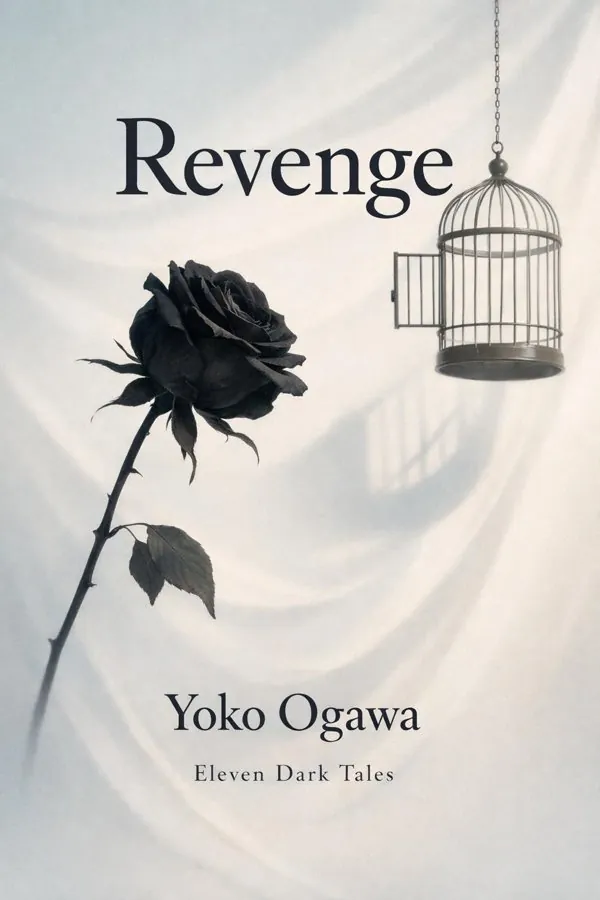
Revenge: Eleven Dark Tales: Summary & Key Insights
by Yoko Ogawa
 10 min10 chaptersAudio available
Key Takeaways from Revenge: Eleven Dark Tales
The most unsettling experiences often begin in places that should feel safe.
When affection loses its balance, it can become something far darker than heartbreak.
A culture’s deepest anxieties often surface through the body, and Ogawa understands this with uncanny precision.
We like to think of objects as passive, but in Ogawa’s fiction they absorb emotion, preserve history, and silently direct human behavior.
Loneliness does not always make people withdraw; sometimes it drives them toward forms of closeness that are invasive, inappropriate, or psychologically risky.
What Is Revenge: Eleven Dark Tales About?
Revenge: Eleven Dark Tales by Yoko Ogawa is a bestsellers book spanning 11 pages. Revenge: Eleven Dark Tales is a brilliantly disquieting collection of interconnected stories by Japanese author Yoko Ogawa, translated into English by Stephen Snyder. At first glance, each tale seems small and self-contained: a visit to a bakery, a failed love affair, a strange apartment, a fan letter, a delivery gone wrong. But as the book unfolds, tiny details begin to recur, characters drift in and out of one another’s lives, and ordinary experiences acquire an eerie, almost fatal weight. What emerges is not a traditional plot-driven novel, but a web of grief, desire, decay, memory, and emotional damage. What makes the collection matter is Ogawa’s ability to transform quiet scenes into psychological disturbances. She rarely relies on overt horror. Instead, she lets loneliness deepen into obsession, lets beauty sit beside rot, and lets chance encounters reveal hidden violence. The result is subtle, elegant, and unforgettable. Ogawa is one of contemporary Japan’s most celebrated literary voices, known for her precise, restrained style and her fascination with the darker corners of human feeling. In Revenge, she shows how easily private sorrow can spread, linking strangers through wounds they barely understand themselves.
This FizzRead summary covers all 10 key chapters of Revenge: Eleven Dark Tales in approximately 10 minutes, distilling the most important ideas, arguments, and takeaways from Yoko Ogawa's work. Also available as an audio summary and Key Quotes Podcast.
Revenge: Eleven Dark Tales
Revenge: Eleven Dark Tales is a brilliantly disquieting collection of interconnected stories by Japanese author Yoko Ogawa, translated into English by Stephen Snyder. At first glance, each tale seems small and self-contained: a visit to a bakery, a failed love affair, a strange apartment, a fan letter, a delivery gone wrong. But as the book unfolds, tiny details begin to recur, characters drift in and out of one another’s lives, and ordinary experiences acquire an eerie, almost fatal weight. What emerges is not a traditional plot-driven novel, but a web of grief, desire, decay, memory, and emotional damage.
What makes the collection matter is Ogawa’s ability to transform quiet scenes into psychological disturbances. She rarely relies on overt horror. Instead, she lets loneliness deepen into obsession, lets beauty sit beside rot, and lets chance encounters reveal hidden violence. The result is subtle, elegant, and unforgettable. Ogawa is one of contemporary Japan’s most celebrated literary voices, known for her precise, restrained style and her fascination with the darker corners of human feeling. In Revenge, she shows how easily private sorrow can spread, linking strangers through wounds they barely understand themselves.
Who Should Read Revenge: Eleven Dark Tales?
This book is perfect for anyone interested in bestsellers and looking to gain actionable insights in a short read. Whether you're a student, professional, or lifelong learner, the key ideas from Revenge: Eleven Dark Tales by Yoko Ogawa will help you think differently.
- ✓Readers who enjoy bestsellers and want practical takeaways
- ✓Professionals looking to apply new ideas to their work and life
- ✓Anyone who wants the core insights of Revenge: Eleven Dark Tales in just 10 minutes
Want the full summary?
Get instant access to this book summary and 100K+ more with Fizz Moment.
Get Free SummaryAvailable on App Store • Free to download
Key Chapters
The most unsettling experiences often begin in places that should feel safe. Revenge opens in a bakery, a setting associated with comfort, sweetness, and routine. Yet when the narrator arrives searching for a strawberry shortcake, the scene becomes charged with sorrow. The baker recounts the story of his wife’s death, and the ordinary rhythm of commerce gives way to grief that seems to have seeped into the walls, the pastries, and the air itself. Ogawa’s point is immediate and powerful: suffering does not announce itself dramatically. It waits inside familiar spaces and reveals itself through casual conversation, small gestures, and objects that suddenly carry unbearable emotional weight.
This opening matters because it establishes the collection’s governing logic. In Ogawa’s world, stories are not neatly separated; pain travels. A bakery customer can become a witness to mourning. A simple dessert can become an emblem of loss. The emotional pulse of one person’s tragedy moves outward, touching strangers who did not expect to become involved. That is how the whole collection works. Every encounter contains the potential to expose hidden damage.
In real life, this idea can change how we read human behavior. The barista who seems distracted, the neighbor who talks too much, or the colleague who fixates on minor details may be carrying a private grief invisible from the outside. Ogawa asks us to look more carefully at the emotional residues inside ordinary routines.
Actionable takeaway: pay attention to the emotional atmosphere of everyday interactions. Behind a small request, a repeated habit, or a strange remark, there may be a deeper story shaping someone’s behavior.
When affection loses its balance, it can become something far darker than heartbreak. In the second tale, a woman learns after her lover’s death that he had led a hidden double life. What begins as mourning turns into an encounter with betrayal, disgust, and emotional disorientation. Instead of receiving closure, she is forced to confront the possibility that intimacy never guaranteed truth. The body of the dead lover, the revelations about his secrets, and the woman’s fixation on what she did not know all push grief into a grotesque form.
Ogawa is not merely describing infidelity; she is examining what happens when love becomes entangled with possession and fantasy. The woman’s suffering is intensified not only by what was done to her, but by the collapse of the story she told herself about the relationship. In this collection, people do not simply lose others. They lose the meanings that made their lives coherent. That collapse can invite obsession, because the mind keeps circling the wound, hoping to recover certainty from decay.
This idea applies far beyond romantic relationships. We often become attached not just to people, but to narratives: who we think they are, what we think a bond means, what role we believe we play in someone’s life. When reality contradicts that narrative, the resulting shock can distort judgment.
Actionable takeaway: after betrayal or loss, separate facts from the story you constructed around them. Naming what actually happened can prevent grief from hardening into a self-destructive obsession with what can no longer be repaired.
We like to think of objects as passive, but in Ogawa’s fiction they absorb emotion, preserve history, and silently direct human behavior. In the story centered on a museum curator, fragile artifacts become more than things to catalog. They are vessels of attachment, reverence, and possible destruction. The curator’s relationship to delicate objects reflects the broader emotional structure of the collection: people try to preserve what time is already eroding, and in that effort they often reveal their deepest vulnerabilities.
Why does this matter? Because objects let Ogawa dramatize the tension between control and loss. A carefully kept specimen, a treasured item, or a piece of art promises permanence. Yet all objects are breakable, and their fragility mirrors the instability of memory itself. The desire to protect them can become a form of devotion, but also a form of fixation. In Revenge, people often transfer feeling onto things because things seem safer than relationships. Objects do not argue, abandon, or betray. Yet they cannot truly return love either, and so the attachment remains haunted.
This pattern is easy to recognize outside literature. People preserve clothing from a dead relative, keep letters from an ended relationship, or refuse to discard broken possessions because those objects hold identity and memory. There is tenderness in that impulse, but also risk when memory becomes a shrine no new life can enter.
Actionable takeaway: choose consciously which objects you keep as meaningful anchors and which ones keep you trapped in old pain. Preservation is valuable, but healing requires knowing when remembrance has become emotional imprisonment.
Loneliness does not always make people withdraw; sometimes it drives them toward forms of closeness that are invasive, inappropriate, or psychologically risky. In the stories involving letters between a writer and a fan, Ogawa explores how admiration can slip into intrusion and how the wish to be seen can become a hunger with no clear boundary. Correspondence appears civilized and controlled, yet the emotional undercurrents are unstable. Writing allows intimacy at a distance, but distance can also encourage projection, fantasy, and dependency.
This is one of the collection’s sharpest insights: people often seek connection not with another real person, but with a figure they have partly invented. The fan imagines access, recognition, perhaps even destiny. The writer becomes both intimate and unreachable, a perfect surface for longing. Ogawa treats this dynamic without melodrama. She simply shows how loneliness rearranges ethics. What might otherwise seem inappropriate begins to feel justified when the need to connect becomes desperate enough.
The same mechanism appears in many modern settings: parasocial relationships with celebrities, emotional oversharing with strangers online, or idealized attachments formed through text rather than sustained reality. We create meaning quickly when we are starved for contact, and the imagination often fills gaps with dangerous confidence.
Actionable takeaway: when a connection is built mostly on fantasy, correspondence, or projection, ask what is actually mutual and what exists only in your mind. Healthy intimacy grows through reciprocity, not through one-sided emotional invention.
The apartment stories in Revenge show that private spaces do not automatically offer safety. Rooms, hallways, walls, and neighboring units become containers for residue left by previous tenants, hidden tragedies, and unresolved emotional disturbances. Instead of refuge, the home becomes a place where the self is exposed. In Ogawa’s hands, architecture acquires psychological force. A room can seem to remember. An apartment can feel inhabited by absence. Domestic life, supposedly orderly and familiar, becomes unstable from within.
This idea deepens the collection’s central mood. Horror does not descend from some external monster; it emerges from environments that should support ordinary life. That is why Ogawa’s stories linger. She destabilizes the places readers trust most. If grief can live in a bakery and dread can settle into an apartment, then no sphere of daily life is untouched by the possibility of emotional contamination.
There is also a broader psychological truth here. Our living spaces often mirror internal states. Clutter can reflect avoidance. Excessive neatness can reflect anxiety. Certain rooms preserve memories we have not integrated. Even after moving, people can feel marked by old spaces where illness, breakup, neglect, or mourning occurred. Ogawa turns that common experience into art by making the setting itself seem complicit.
Actionable takeaway: treat your environment as part of your emotional life. If a space continually reinforces dread, grief, or numbness, change something tangible in it, whether through rearrangement, repair, ritual, or leaving. Emotional clarity often needs physical support.
Care and surveillance are closer than we like to admit. In the tale involving a mother, her lost son, and the act of watching, Ogawa probes the unstable boundary between protection and fixation. To care for someone is to monitor them, remember details, anticipate harm, and fear disappearance. But this attentiveness can become consuming, especially when loss has already occurred or seems imminent. The watcher begins to live in relation to another person’s vulnerability, and over time that role can distort both love and identity.
Ogawa is especially perceptive about parental grief and anxiety. A child’s absence creates a void that the mind tries to fill with vigilance, memory, and repetition. The mother figure does not merely remember; she inhabits a state of suspended alarm. The emotional atmosphere is one of relentless alertness, as if attention itself could reverse loss. Yet watching cannot restore what is gone. It can only preserve the ache.
This dynamic appears in many forms of modern life: parents tracking children constantly, partners confusing concern with control, or caregivers losing themselves in hypervigilance. The intention may be loving, but the psychological cost is real. Ogawa does not condemn care. She reveals how grief can alter it, making observation feel like an ethical necessity even when it becomes corrosive.
Actionable takeaway: if your care for someone relies on constant monitoring, ask whether you are helping them live or trying to manage your own fear. Healthy care includes trust, limits, and the acceptance that love cannot eliminate all risk.
One of the most impressive achievements of Revenge is the way unrelated lives gradually reveal hidden connections. A letter, a delivery, a remembered name, a dead body, an object, a passing encounter: all become threads in a web that links strangers who never fully grasp their place within it. Ogawa suggests that human lives are far more entangled than they appear, and that suffering in particular travels along these unnoticed pathways. What seems like a private event often belongs to a wider pattern.
This interconnected design gives the collection its cumulative force. Each story gains additional meaning from the ones around it. A detail that felt incidental returns with new weight. A minor figure becomes central elsewhere. The result is not a puzzle for clever decoding so much as a moral atmosphere: no one exists in isolation. Our actions, betrayals, losses, and silences move outward, shaping people we may never meet.
In everyday terms, this is a useful corrective to the illusion of separateness. A careless act in one context can become trauma in another. A gesture of kindness can ripple farther than expected. Institutions, families, neighborhoods, and online communities all work through chains of unseen consequence. Ogawa’s fiction makes those chains emotionally vivid.
Actionable takeaway: live as if your private choices have public echoes. Small actions, especially those involving carelessness or compassion, often matter beyond the immediate moment. The invisible thread may be real even when you cannot see where it leads.
The title Revenge invites expectations of punishment, justice, or dramatic retaliation, but Ogawa’s treatment is subtler and more disturbing. In these stories, revenge is rarely a clear act carried out by a single injured person against a guilty target. Instead, it behaves like a mood, a contagion, or a cycle. Harm reproduces itself through memory, obsession, neglect, and the inability to release pain. Even when characters do not explicitly seek vengeance, they may still perpetuate it by passing suffering onward.
The story of the dying man and the larger arc of the collection illustrate this beautifully. Death does not end emotional consequences. If anything, it intensifies them by denying resolution. The dead leave questions, the living create fantasies, and those fantasies shape future actions. What counts as revenge, then, is not always deliberate cruelty. Sometimes it is the way unresolved hurt compels repetition. A betrayal alters a mourner, the mourner disturbs another life, and the chain continues.
This understanding is practical as well as literary. Many conflicts in families, workplaces, and relationships are sustained less by one major injury than by accumulated retaliations: coldness answering coldness, humiliation answered by withdrawal, neglect answered by manipulation. People call this self-protection, but often it is revenge by diffusion.
Actionable takeaway: break cycles of retaliation by naming the injury instead of reenacting it. The moment you stop converting pain into indirect harm, you interrupt the chain Ogawa shows with such chilling clarity.
Perhaps the collection’s deepest achievement is its insistence that elegance and dread are not opposites. Ogawa writes with restraint, precision, and lyric calm, even when describing decay, mutilation, betrayal, or death. The effect is not ornamental. It reveals a profound truth about experience: the most disturbing realities often arrive clothed in beauty, courtesy, tenderness, or aesthetic order. A cake can accompany mourning. A garden can conceal unease. A letter can carry emotional poison. A delicate sentence can describe something grotesque.
This coexistence is what makes Revenge so memorable. Ogawa never lets readers retreat into comforting categories. The lovely is not safe, and the disturbing is not separate from the everyday. Her stories invite us to reconsider how often we use beauty to reassure ourselves that a situation is wholesome, meaningful, or under control. In fact, beauty can deepen horror by making it intimate and unforgettable.
There is a wider life lesson here. People often present polished surfaces while carrying severe private pain. Institutions can look refined while harboring cruelty. Relationships can feel gentle while becoming destructive. Aesthetic grace does not guarantee moral safety. Ogawa’s genius lies in making this insight felt, not merely stated.
Actionable takeaway: do not let refinement, charm, or beauty prevent you from noticing what feels wrong. Train yourself to hold two truths at once: something can be appealing on the surface and deeply harmful underneath.
All Chapters in Revenge: Eleven Dark Tales
About the Author
Yoko Ogawa is a major contemporary Japanese writer celebrated for her elegant prose, psychological depth, and uncanny ability to uncover the disturbing within ordinary life. Born in 1962 in Okayama, Japan, she studied at Waseda University before establishing herself as a distinctive literary voice. Her fiction frequently explores memory, loss, isolation, bodily fragility, and quiet forms of obsession. Ogawa has received numerous literary honors, including the Akutagawa Prize and the Yomiuri Prize, and her work has been translated widely for international audiences. She is best known outside Japan for novels such as The Housekeeper and the Professor, The Memory Police, and Hotel Iris. In Revenge: Eleven Dark Tales, she demonstrates the qualities that define her work at its best: restraint, precision, emotional intensity, and a haunting sense that ordinary reality is always on the verge of turning strange.
Get This Summary in Your Preferred Format
Read or listen to the Revenge: Eleven Dark Tales summary by Yoko Ogawa anytime, anywhere. FizzRead offers multiple formats so you can learn on your terms — all free.
Available formats: App · Audio · PDF · EPUB — All included free with FizzRead
Download Revenge: Eleven Dark Tales PDF and EPUB Summary
Key Quotes from Revenge: Eleven Dark Tales
“The most unsettling experiences often begin in places that should feel safe.”
“When affection loses its balance, it can become something far darker than heartbreak.”
“A culture’s deepest anxieties often surface through the body, and Ogawa understands this with uncanny precision.”
“We like to think of objects as passive, but in Ogawa’s fiction they absorb emotion, preserve history, and silently direct human behavior.”
“Loneliness does not always make people withdraw; sometimes it drives them toward forms of closeness that are invasive, inappropriate, or psychologically risky.”
Frequently Asked Questions about Revenge: Eleven Dark Tales
Revenge: Eleven Dark Tales by Yoko Ogawa is a bestsellers book that explores key ideas across 10 chapters. Revenge: Eleven Dark Tales is a brilliantly disquieting collection of interconnected stories by Japanese author Yoko Ogawa, translated into English by Stephen Snyder. At first glance, each tale seems small and self-contained: a visit to a bakery, a failed love affair, a strange apartment, a fan letter, a delivery gone wrong. But as the book unfolds, tiny details begin to recur, characters drift in and out of one another’s lives, and ordinary experiences acquire an eerie, almost fatal weight. What emerges is not a traditional plot-driven novel, but a web of grief, desire, decay, memory, and emotional damage. What makes the collection matter is Ogawa’s ability to transform quiet scenes into psychological disturbances. She rarely relies on overt horror. Instead, she lets loneliness deepen into obsession, lets beauty sit beside rot, and lets chance encounters reveal hidden violence. The result is subtle, elegant, and unforgettable. Ogawa is one of contemporary Japan’s most celebrated literary voices, known for her precise, restrained style and her fascination with the darker corners of human feeling. In Revenge, she shows how easily private sorrow can spread, linking strangers through wounds they barely understand themselves.
More by Yoko Ogawa
You Might Also Like
The Godfather
Mario Puzo
10 min
The Handmaid's Tale
Margaret Atwood
10 min
The Hunger Games
Suzanne Collins
10 min
The Nightingale
Kristin Hannah
10 min
The Seven Husbands of Evelyn Hugo
Taylor Jenkins Reid
10 min
Backwater Justice
Fern Michaels
10 minBrowse by Category
Ready to read Revenge: Eleven Dark Tales?
Get the full summary and 100K+ more books with Fizz Moment.