
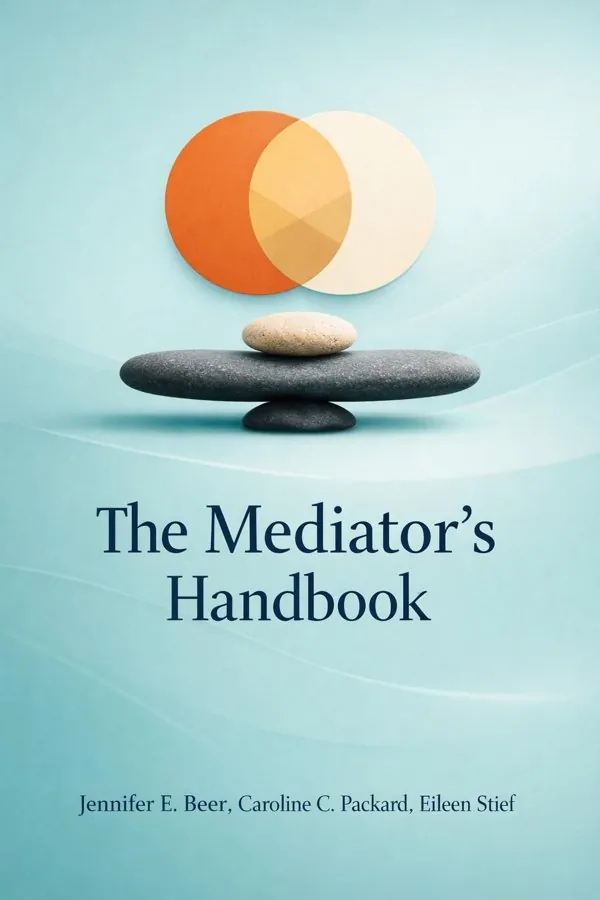
The Mediator's Handbook: Summary & Key Insights
by Jennifer E. Beer, Caroline C. Packard, Eileen Stief
 10 min9 chaptersAudio available
Key Takeaways from The Mediator's Handbook
Most conflicts do not persist because solutions are impossible; they persist because communication has broken down so badly that people can no longer search for solutions together.
Conflict often feels chaotic from the inside, but one of the book’s most useful lessons is that escalation follows recognizable patterns.
Many people imagine mediation begins when everyone sits in the same room.
When emotions run high, structure is not a constraint; it is a form of protection.
People in conflict often listen to reply, defend, or attack.
What Is The Mediator's Handbook About?
The Mediator's Handbook by Jennifer E. Beer, Caroline C. Packard, Eileen Stief is a communication book spanning 11 pages. Conflict rarely begins with hatred; more often, it begins with unmet needs, clashing assumptions, and conversations that go wrong. The Mediator's Handbook by Jennifer E. Beer, Caroline C. Packard, and Eileen Stief is a practical guide to what happens next: how people can move from accusation and stalemate toward clarity, mutual understanding, and workable agreement. Written by experienced practitioners in mediation, law, training, and cross-cultural conflict resolution, the book combines principle with method. It explains not only what mediators do, but how they think, listen, structure difficult conversations, and help people generate solutions they can actually live with. What makes this handbook especially valuable is its grounded, usable approach. It treats mediation as both a disciplined process and a human art, one that depends on neutrality, trust-building, ethical judgment, and communication skill. Whether the conflict involves families, workplaces, organizations, neighborhoods, or communities, the book shows how mediation can transform destructive patterns into constructive dialogue. For mediators, managers, facilitators, coaches, and anyone who regularly navigates tension, this is an enduring manual for handling conflict with wisdom and integrity.
This FizzRead summary covers all 9 key chapters of The Mediator's Handbook in approximately 10 minutes, distilling the most important ideas, arguments, and takeaways from Jennifer E. Beer, Caroline C. Packard, Eileen Stief's work. Also available as an audio summary and Key Quotes Podcast.
The Mediator's Handbook
Conflict rarely begins with hatred; more often, it begins with unmet needs, clashing assumptions, and conversations that go wrong. The Mediator's Handbook by Jennifer E. Beer, Caroline C. Packard, and Eileen Stief is a practical guide to what happens next: how people can move from accusation and stalemate toward clarity, mutual understanding, and workable agreement. Written by experienced practitioners in mediation, law, training, and cross-cultural conflict resolution, the book combines principle with method. It explains not only what mediators do, but how they think, listen, structure difficult conversations, and help people generate solutions they can actually live with. What makes this handbook especially valuable is its grounded, usable approach. It treats mediation as both a disciplined process and a human art, one that depends on neutrality, trust-building, ethical judgment, and communication skill. Whether the conflict involves families, workplaces, organizations, neighborhoods, or communities, the book shows how mediation can transform destructive patterns into constructive dialogue. For mediators, managers, facilitators, coaches, and anyone who regularly navigates tension, this is an enduring manual for handling conflict with wisdom and integrity.
Who Should Read The Mediator's Handbook?
This book is perfect for anyone interested in communication and looking to gain actionable insights in a short read. Whether you're a student, professional, or lifelong learner, the key ideas from The Mediator's Handbook by Jennifer E. Beer, Caroline C. Packard, Eileen Stief will help you think differently.
- ✓Readers who enjoy communication and want practical takeaways
- ✓Professionals looking to apply new ideas to their work and life
- ✓Anyone who wants the core insights of The Mediator's Handbook in just 10 minutes
Want the full summary?
Get instant access to this book summary and 100K+ more with Fizz Moment.
Get Free SummaryAvailable on App Store • Free to download
Key Chapters
Most conflicts do not persist because solutions are impossible; they persist because communication has broken down so badly that people can no longer search for solutions together. That is the core insight behind mediation. The book presents mediation as a structured conversation designed to help people in conflict reach voluntary agreement. The mediator does not judge, impose outcomes, or take sides. Instead, the mediator builds a process in which each party can speak, be heard, clarify concerns, and explore possible resolution.
This role is more demanding than it sounds. A good mediator must balance empathy with neutrality, patience with forward motion, and openness with structure. The mediator must also protect the integrity of the process. That includes setting ground rules, ensuring each person has a fair chance to participate, and keeping the discussion focused on productive problem-solving rather than blame. In a workplace dispute, for example, a mediator may help two colleagues move from personal accusations toward practical concerns about workload, communication, and decision-making authority. In a community conflict, the mediator may create enough safety for opposing groups to express fears without escalating hostility.
The book emphasizes that mediation works because people are more likely to honor agreements they helped create. Ownership matters. Durable outcomes emerge when parties feel respected, not overruled. Mediation does not eliminate disagreement, but it can transform how disagreement is handled.
Actionable takeaway: If you are stepping into a conflict, begin by asking not “Who is right?” but “What process will help both sides speak honestly and search for a voluntary solution?”
Conflict often feels chaotic from the inside, but one of the book’s most useful lessons is that escalation follows recognizable patterns. A difference in needs, values, or expectations becomes a dispute when parties start interpreting each other’s actions through fear, suspicion, or resentment. Misunderstandings harden into assumptions. Language becomes sharper. People recruit allies, simplify the story into heroes and villains, and focus more on defending themselves than understanding what happened.
By mapping these dynamics, the authors help mediators intervene more intelligently. Escalation is fueled by identity, emotion, and perception as much as by facts. Two neighbors arguing about noise may appear to be fighting over volume, but beneath the surface lie issues of respect, boundaries, and dignity. A conflict between departments may seem to concern resources, while the real force behind it is mistrust built over years of poor coordination. When mediators recognize these layers, they can avoid treating symptoms as root causes.
The book also reminds readers that conflict is not inherently destructive. It can surface hidden problems, expose unfair systems, and force long-avoided conversations. The danger lies not in disagreement itself but in unmanaged escalation. Practical tools include identifying triggers, distinguishing positions from deeper concerns, and noticing when emotions are driving interpretation. Naming the pattern can reduce its power.
Actionable takeaway: The next time a conflict intensifies, pause and ask what is escalating it beyond the surface issue: fear, identity, assumptions, old grievances, or lack of trust. That diagnosis will shape a better response.
Many people imagine mediation begins when everyone sits in the same room. In practice, some of the most important work happens before the joint conversation ever starts. The handbook stresses preparation as a decisive stage: understanding the nature of the dispute, clarifying who needs to be involved, assessing safety and readiness, and designing a process that fits the conflict rather than forcing the conflict into a generic format.
Preparation includes logistical details, but it goes much deeper. Mediators may conduct pre-mediation conversations to hear each party’s perspective, explain the process, identify sensitive issues, and build enough trust for participation. They must also consider whether mediation is appropriate at all. If there is severe power imbalance, ongoing violence, bad-faith participation, or a need for formal adjudication, mediation may require safeguards or may not be the right avenue. Ethical preparation means not treating mediation as a one-size-fits-all cure.
The authors also highlight the value of clarifying expectations. Parties need to know what mediation can and cannot do. It does not guarantee agreement. It does not erase emotions. It does create a structured opportunity for dialogue, problem-solving, and decision-making. In a business dispute, preparation may involve gathering documents, clarifying decision authority, and identifying nonnegotiables. In family or community conflicts, it may involve choosing a neutral location and discussing confidentiality concerns in advance.
Actionable takeaway: Before convening any difficult conversation, invest time in process design. Ask who must be present, what conditions are needed for fairness and safety, and what expectations must be clarified beforehand.
When emotions run high, structure is not a constraint; it is a form of protection. The book lays out mediation as a sequence with purpose: opening the session, setting ground rules, hearing each side’s story, identifying issues, exploring interests, generating options, negotiating terms, and closing with either agreement or clear next steps. This sequence matters because it prevents difficult conversations from collapsing into interruption, argument, or avoidance.
The opening phase establishes tone. The mediator explains neutrality, confidentiality, and the voluntary nature of participation. Ground rules such as no interruptions, respectful language, and direct communication create a workable container. Then comes the crucial narrative stage, where each party tells their story. This is not mere venting. It helps surface perceptions, priorities, and emotional realities that need acknowledgment before problem-solving can begin.
As the conversation progresses, the mediator helps shift the parties from backward-looking accusation to forward-looking negotiation. Issues are named, organized, and clarified. Shared concerns become visible. Options are explored without immediate commitment. If agreement emerges, it is translated into specific, realistic terms. If no agreement is reached, a good process can still produce value by clarifying misunderstandings, reducing hostility, or identifying next steps.
For example, in an organizational dispute, a mediator might guide two leaders from conflicting interpretations of past meetings toward a shared plan for communication protocols and decision rights. Without structure, they might simply relive the argument.
Actionable takeaway: In any tense conversation, think in stages. People usually need acknowledgment before analysis, clarity before bargaining, and structure before resolution.
People in conflict often listen to reply, defend, or attack. Mediators listen to understand, organize, and reveal what is really being said beneath the surface. The handbook treats communication not as a soft skill on the margins of mediation, but as the heart of the entire practice. Through attentive listening, reframing, summarizing, and thoughtful questioning, mediators lower defensiveness and create conditions in which understanding becomes possible.
One of the book’s most practical contributions is its emphasis on reframing. Parties often speak in language of blame: “She never respects deadlines” or “He is impossible to work with.” A mediator can reframe these statements into interests and concerns: “It sounds like reliability and clearer coordination matter a lot here.” This shift is subtle but powerful. It preserves meaning while reducing attack. Similarly, summarizing helps people feel heard and keeps the conversation anchored in substance rather than emotion alone.
Questions are equally important. Open-ended questions invite reflection: “What would a workable arrangement look like for you?” Clarifying questions uncover specifics. Reality-testing questions help evaluate options: “How would that agreement work next month when deadlines tighten?” In cross-cultural or emotionally charged settings, careful communication also means checking assumptions and avoiding language that intensifies shame or defensiveness.
These skills are useful far beyond formal mediation. Managers, teachers, partners, and community leaders can all use them to interrupt reactive patterns and create better dialogue.
Actionable takeaway: The next time someone speaks in accusation, do not mirror the attack. Reframe their words into needs, concerns, or goals, and respond to that deeper level.
A position is what someone says they want; an interest is why they want it. This distinction is one of the most important ideas in the handbook. Conflicts become stuck when parties argue over fixed demands without exploring the needs, fears, values, and practical concerns beneath them. Mediation creates movement by uncovering those underlying interests.
Consider a simple workplace example. One employee insists on working remotely full-time; a manager insists on office attendance. If the conversation stays at the level of positions, deadlock is likely. But if the mediator explores interests, new possibilities emerge. The employee may care about caregiving responsibilities and uninterrupted focus. The manager may care about team coordination, mentoring, and accountability. Once those interests are visible, hybrid schedules, core collaboration days, or clearer reporting systems become possible.
The book shows that interests can be material, emotional, procedural, or relational. People may want money, time, or access, but they may also want respect, acknowledgment, fairness, autonomy, or safety. Often the emotional or symbolic interest is the real obstacle. A party may reject a reasonable settlement because they feel humiliated or ignored. By helping parties identify and prioritize interests, mediators widen the field of resolution.
This approach does not mean every interest can be fully satisfied. It means solutions become more intelligent when the real drivers are on the table. The goal is not endless exploration but more informed negotiation.
Actionable takeaway: When a discussion gets stuck on demands, ask each side, “What makes that important to you?” The answer often reveals the path forward.
People in conflict usually arrive with a narrow menu: my solution, your solution, or no solution. The handbook argues that one of the mediator’s greatest gifts is helping parties generate options before evaluating them. This sounds simple, but it is psychologically difficult. When trust is low, people rush to defend preferred outcomes and dismiss alternatives too early. Creative problem-solving requires a temporary suspension of judgment.
The mediator supports this by separating brainstorming from decision-making. During option generation, the aim is quantity, not immediate agreement. Possibilities can include partial steps, trial arrangements, contingent agreements, shared standards, future review dates, or exchanges that satisfy different priorities. In a neighborhood dispute, for instance, options might include quiet-hour agreements, communication protocols, shared maintenance schedules, or third-party noise assessment. In a business partnership conflict, options may involve revised roles, phased buyouts, profit-sharing changes, or structured check-ins.
The book also connects option generation to negotiation strategy. Not every proposal is equally realistic, fair, or durable. Once possibilities are on the table, parties need help comparing them against interests, feasibility, and consequences. Here the mediator can reality-test assumptions, highlight common ground, and help parties combine ideas into stronger packages. This balance between creativity and practicality is essential.
The broader lesson is that conflict narrows imagination, while mediation restores it. Better options often exist, but they appear only after people feel heard enough to think more flexibly.
Actionable takeaway: In your next dispute, devote time to generating at least five possible solutions before debating any one of them. New options often emerge only after the obvious ones are exhausted.
Technique alone does not make a trustworthy mediator. The handbook makes clear that mediation rests on ethical foundations: impartiality, confidentiality, informed consent, respect for self-determination, and commitment to a fair process. Without these, mediation can become manipulative, coercive, or merely performative. The mediator’s integrity is not an abstract virtue; it directly affects whether parties feel safe enough to participate honestly.
Impartiality does not mean emotional distance or pretending all conduct is equally acceptable. It means not favoring one side and not steering outcomes according to personal preferences. Self-determination means the parties, not the mediator, own the decisions. A mediator may suggest process options, ask hard questions, and test practicality, but should not pressure parties into agreement for the sake of closure. The book also underscores confidentiality as a key support for candor, while noting that mediators must be clear about legal or ethical limits.
Ethical complexity increases in real-world settings. What if one party is far more articulate than the other? What if a proposed agreement seems unwise but voluntary? What if a mediator’s own values are triggered by the subject matter? The authors encourage reflection, transparency about role boundaries, and continuous attention to fairness. In some cases, caucusing, support persons, or outside expertise may be needed to balance participation.
This focus on integrity gives the book enduring relevance. Mediation is not simply a set of communication tricks; it is a disciplined practice of facilitating human dignity under pressure.
Actionable takeaway: If you facilitate conflict, define your ethical boundaries in advance. Know what neutrality, confidentiality, and voluntary agreement mean in practice before difficult situations test them.
No mediation method works unchanged in every setting. One of the strengths of The Mediator's Handbook is its attention to diversity, complexity, and the mediator’s ongoing growth. Conflicts unfold inside cultures, institutions, histories, and power structures. A mediator who ignores these realities may unintentionally reproduce the very harms the process is meant to address.
The book encourages mediators to adapt thoughtfully. Cross-cultural disputes may require greater sensitivity to communication norms, authority patterns, indirect expression, or the role of family and community. Organizational conflicts may be shaped by hierarchy, policy, or hidden incentives. Community disputes may involve historical mistrust, collective identity, or public pressure. In each case, the mediator must ask what process design, language, pacing, and support structures will make genuine participation possible.
Equally important is the mediator’s self-awareness. Reflection is presented as a professional necessity, not a luxury. Mediators bring their own biases, emotional triggers, assumptions, and habits into the room. Without reflection, these can distort listening, reframing, and judgment. The book implicitly treats growth as part of ethical practice: reviewing cases, seeking feedback, learning from mistakes, and deepening one’s understanding of power and difference.
Closing the mediation is also part of this adaptive mindset. A session ends well when agreements are clear, realistic, and understood, or when next steps are responsibly identified if no full agreement is reached. Closure should consolidate progress rather than assume resolution where none exists.
Actionable takeaway: After every difficult conversation, review not just what the parties did, but what you brought into the process. Improvement begins with honest reflection on your own role.
All Chapters in The Mediator's Handbook
About the Authors
Jennifer E. Beer, Caroline C. Packard, and Eileen Stief are respected figures in the field of mediation and conflict resolution. Jennifer E. Beer is a professional mediator, trainer, and anthropologist known for her work in cross-cultural communication and collaborative problem-solving. Caroline C. Packard is an attorney and mediator with extensive experience in organizational, workplace, and community disputes, bringing legal insight and practical facilitation skill to her work. Eileen Stief is widely recognized as a pioneer in mediation training and was a co-founder of the Center for Dispute Settlement in Washington, D.C., where she helped shape mediation practice and education. Together, the authors combine deep hands-on experience with a commitment to ethical, accessible, and effective conflict resolution, making The Mediator's Handbook a trusted resource for practitioners and learners alike.
Get This Summary in Your Preferred Format
Read or listen to the The Mediator's Handbook summary by Jennifer E. Beer, Caroline C. Packard, Eileen Stief anytime, anywhere. FizzRead offers multiple formats so you can learn on your terms — all free.
Available formats: App · Audio · PDF · EPUB — All included free with FizzRead
Download The Mediator's Handbook PDF and EPUB Summary
Key Quotes from The Mediator's Handbook
“Most conflicts do not persist because solutions are impossible; they persist because communication has broken down so badly that people can no longer search for solutions together.”
“Conflict often feels chaotic from the inside, but one of the book’s most useful lessons is that escalation follows recognizable patterns.”
“Many people imagine mediation begins when everyone sits in the same room.”
“When emotions run high, structure is not a constraint; it is a form of protection.”
“People in conflict often listen to reply, defend, or attack.”
Frequently Asked Questions about The Mediator's Handbook
The Mediator's Handbook by Jennifer E. Beer, Caroline C. Packard, Eileen Stief is a communication book that explores key ideas across 9 chapters. Conflict rarely begins with hatred; more often, it begins with unmet needs, clashing assumptions, and conversations that go wrong. The Mediator's Handbook by Jennifer E. Beer, Caroline C. Packard, and Eileen Stief is a practical guide to what happens next: how people can move from accusation and stalemate toward clarity, mutual understanding, and workable agreement. Written by experienced practitioners in mediation, law, training, and cross-cultural conflict resolution, the book combines principle with method. It explains not only what mediators do, but how they think, listen, structure difficult conversations, and help people generate solutions they can actually live with. What makes this handbook especially valuable is its grounded, usable approach. It treats mediation as both a disciplined process and a human art, one that depends on neutrality, trust-building, ethical judgment, and communication skill. Whether the conflict involves families, workplaces, organizations, neighborhoods, or communities, the book shows how mediation can transform destructive patterns into constructive dialogue. For mediators, managers, facilitators, coaches, and anyone who regularly navigates tension, this is an enduring manual for handling conflict with wisdom and integrity.
You Might Also Like

Magic Words: The Science and Secrets Behind Seven Words That Motivate, Engage, and Influence
Tim David
10 min
Talking Across The Divide: How to Communicate with People You Disagree with and Maybe Even Change the World
Justin Lee
10 min
The Exceptional Presenter: A Proven Formula to Open Up! and Own the Room
Timothy J. Koegel
10 min
4 Essential Keys to Effective Communication in Love, Life, Work--Anywhere!: Including the 12-Day Communication Challenge!
Bento C. Leal III
10 min
Active Listening Techniques: 30 Practical Tools to Hone Your Communication Skills
Nisha Gupta
10 min
Bargaining for Advantage: Negotiation Strategies for Reasonable People
G. Richard Shell
10 minBrowse by Category
Ready to read The Mediator's Handbook?
Get the full summary and 100K+ more books with Fizz Moment.