
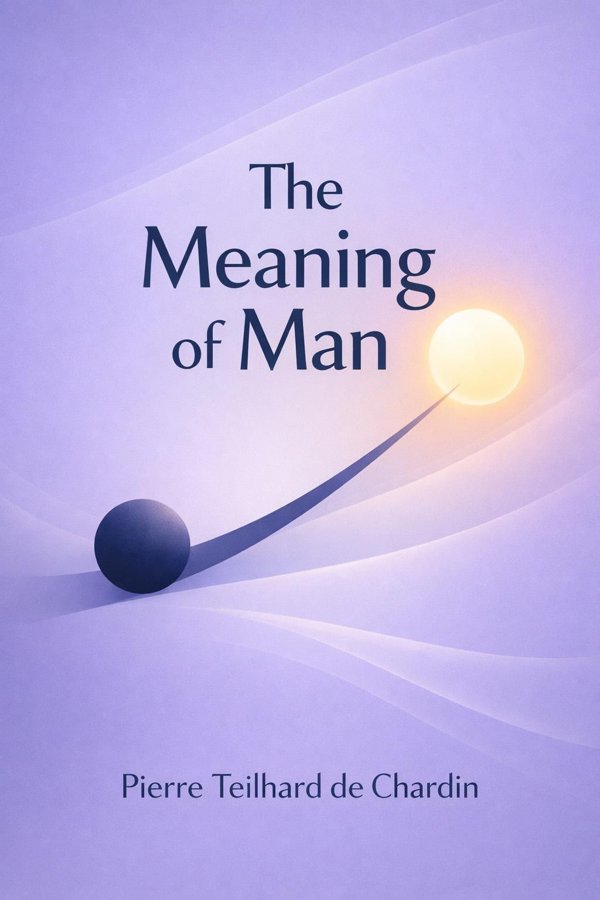
The Meaning of Man: Summary & Key Insights
 10 min9 chaptersAudio available
Key Takeaways from The Meaning of Man
A human being cannot be understood in isolation any more than a wave can be understood apart from the sea.
What if life is not a freak interruption in dead matter, but the natural deepening of matter’s own potential?
The decisive leap in evolution is not merely bigger brains, but reflection.
Once thought awakens, evolution begins to operate through minds linked together.
Intelligence alone does not fulfill human evolution; it must be joined to spirit.
What Is The Meaning of Man About?
The Meaning of Man by Pierre Teilhard de Chardin is a western_phil book spanning 9 pages. What does it mean to be human in a universe shaped by evolution, struggle, and spiritual longing? In The Meaning of Man, Pierre Teilhard de Chardin offers a bold answer: humanity is not an accidental byproduct of matter, but a decisive phase in the unfolding of the cosmos toward greater consciousness, unity, and spiritual depth. Drawing on his formation as both a Jesuit priest and a paleontologist, Teilhard develops a sweeping vision in which matter, life, mind, and spirit belong to one continuous process of development. Human beings matter because they are where the universe becomes aware of itself and begins to participate consciously in its own destiny. This book matters because it refuses the split between science and faith, mechanism and meaning, evolution and transcendence. Instead, it presents a universe still in the making, one in which thought, love, suffering, and collective responsibility all play essential roles. For readers interested in philosophy, religion, science, or the future of humanity, The Meaning of Man remains a challenging and deeply original meditation on our place in the whole.
This FizzRead summary covers all 9 key chapters of The Meaning of Man in approximately 10 minutes, distilling the most important ideas, arguments, and takeaways from Pierre Teilhard de Chardin's work. Also available as an audio summary and Key Quotes Podcast.
The Meaning of Man
What does it mean to be human in a universe shaped by evolution, struggle, and spiritual longing? In The Meaning of Man, Pierre Teilhard de Chardin offers a bold answer: humanity is not an accidental byproduct of matter, but a decisive phase in the unfolding of the cosmos toward greater consciousness, unity, and spiritual depth. Drawing on his formation as both a Jesuit priest and a paleontologist, Teilhard develops a sweeping vision in which matter, life, mind, and spirit belong to one continuous process of development. Human beings matter because they are where the universe becomes aware of itself and begins to participate consciously in its own destiny. This book matters because it refuses the split between science and faith, mechanism and meaning, evolution and transcendence. Instead, it presents a universe still in the making, one in which thought, love, suffering, and collective responsibility all play essential roles. For readers interested in philosophy, religion, science, or the future of humanity, The Meaning of Man remains a challenging and deeply original meditation on our place in the whole.
Who Should Read The Meaning of Man?
This book is perfect for anyone interested in western_phil and looking to gain actionable insights in a short read. Whether you're a student, professional, or lifelong learner, the key ideas from The Meaning of Man by Pierre Teilhard de Chardin will help you think differently.
- ✓Readers who enjoy western_phil and want practical takeaways
- ✓Professionals looking to apply new ideas to their work and life
- ✓Anyone who wants the core insights of The Meaning of Man in just 10 minutes
Want the full summary?
Get instant access to this book summary and 100K+ more with Fizz Moment.
Get Free SummaryAvailable on App Store • Free to download
Key Chapters
A human being cannot be understood in isolation any more than a wave can be understood apart from the sea. Teilhard’s first and most important move is to place humanity back into the full drama of the cosmos. He argues that if we ask what man is while ignoring the long history of matter, life, and evolution, we shrink the question to the scale of individual psychology or social convention. For him, man is a planetary and cosmic phenomenon: the latest expression of a universe that has been moving, over immense spans of time, toward greater complexity and inwardness.
This changes the meaning of anthropology. Humanity is not merely one species among others, nor simply a clever animal with advanced tools. Human beings are the point at which the universe has reached reflective consciousness, the ability not only to know but to know that it knows. To understand ourselves, we must therefore read our lives against the background of cosmic becoming.
In practical terms, this perspective challenges the narrow habits of modern life. We often define ourselves by career, status, politics, or consumption. Teilhard invites us to see these as secondary. A teacher shaping minds, a scientist investigating reality, or a parent nurturing a child is participating in a much larger movement of consciousness and unification.
The application is existential as well as intellectual: seeing yourself cosmically can make life feel less fragmented and more purposeful. Everyday work becomes part of a larger evolutionary task.
Actionable takeaway: When making major decisions, ask not only “What benefits me now?” but “How does this contribute to growth in consciousness, connection, and human flourishing?”
What if life is not a freak interruption in dead matter, but the natural deepening of matter’s own potential? Teilhard sees the emergence of life as a threshold event in a continuous process rather than an absolute break. Matter, in his account, is not merely passive stuff. As it organizes into greater complexity, it also develops a richer interiority. Life appears when material structures become sufficiently complex to sustain a new intensity of organization and responsiveness.
This idea allows Teilhard to read evolution as meaningful without abandoning science. He does not deny biological processes, mutation, or adaptation. Instead, he insists that beneath these mechanisms there is a broad tendency in the universe toward more intricate organization and more vivid forms of inner experience. The movement from atoms to molecules, from molecules to cells, and from cells to organisms is not random noise alone. It reveals an upward curve in complexity.
In everyday life, this insight encourages respect for development and process. Growth in a person, institution, or culture rarely happens by abrupt perfection. It comes through increasing organization, integration, and adaptation. A child learning language, a team learning trust, or a society building institutions of justice all illustrate how complexity can generate new capacities.
Teilhard’s view also counters despair. If life itself is the flowering of latent potential within matter, then reality may be more fertile than it first appears. The world is not closed and static; it is generative.
Actionable takeaway: In your own projects, focus less on quick results and more on building the structures, habits, and relationships that allow higher forms of life and intelligence to emerge over time.
The decisive leap in evolution is not merely bigger brains, but reflection. For Teilhard, the appearance of man matters because in humanity the universe crosses into a new mode of being: consciousness becomes conscious of itself. Animals perceive, react, and in many cases learn. Human beings, however, can step back from experience, form abstract concepts, imagine futures, evaluate values, and ask ultimate questions. We not only live; we interpret living.
This is why man holds a central place in Teilhard’s vision. Human beings are not outside nature, but neither are they reducible to the rest of nature. Reflection creates morality, science, art, history, and religion. It also creates anxiety, responsibility, and the burden of choice. Once consciousness reflects on itself, evolution is no longer only biological; it becomes cultural, intellectual, and spiritual.
You can see this shift in ordinary acts. Writing a journal, examining motives before speaking, revising a belief after evidence, or sacrificing short-term pleasure for long-term meaning all display reflective consciousness. These capacities make human life uniquely open-ended. They enable us to shape not only our environment, but ourselves.
Teilhard’s point is not that humans are automatically wise. Reflection gives power, but not guaranteed direction. It can produce compassion or manipulation, creativity or destruction. That is why human emergence is both a privilege and a crisis. We have become agents in evolution, capable of cooperating with it or resisting it.
Actionable takeaway: Practice reflection intentionally. Build regular habits such as journaling, meditation, or serious conversation so that your consciousness becomes more deliberate, integrated, and responsible rather than merely reactive.
Once thought awakens, evolution begins to operate through minds linked together. Teilhard names this new layer of planetary reality the noosphere: the sphere of human thought, culture, memory, invention, and communication that surrounds the Earth as the biosphere surrounds it with life. The noosphere is not just a metaphor. It describes the real network of mental and social interdependence created by language, education, institutions, technology, and shared symbols.
Human beings do not evolve only as isolated individuals. We become ourselves through participation in collective consciousness. Scientific knowledge accumulates across generations. Moral insight expands through dialogue and struggle. Art, religion, and law all belong to this growing web of mental and spiritual exchange. Teilhard saw this process intensifying in modernity, as transportation, media, and global contact knit humanity into a tighter unity.
Today his idea feels strikingly relevant. The internet, global research communities, transnational crises, and social movements all reveal a planetary thinking layer. Yet the noosphere is not automatically healthy. The same connectivity that spreads knowledge can spread panic, tribalism, and misinformation. More connection without more maturity can magnify fragmentation.
Teilhard therefore pushes us to think of communication as an ethical and evolutionary task. What kind of collective mind are we building? A workplace culture, a classroom, an online community, or a family system can all either deepen understanding or increase confusion.
Actionable takeaway: Treat your contributions to shared conversations as part of the noosphere. Before posting, teaching, leading, or speaking, ask whether you are adding clarity, truth, and unity or merely generating noise.
Intelligence alone does not fulfill human evolution; it must be joined to spirit. For Teilhard, thought is a remarkable breakthrough, but it reaches its true meaning only when it opens toward interior depth, freedom, and love. Spirit is not a ghostly substance separate from matter. It is the inward dimension of reality becoming more explicit as consciousness intensifies. In human beings, spirit appears as the capacity for truth, moral aspiration, self-gift, reverence, and union.
This makes love far more than emotion. Teilhard treats love as a real unifying force in evolution, the energy that allows persons to come together without losing their uniqueness. Coercion can create order, but only love creates genuine union. That is why the highest development of humanity is not domination or technical mastery alone, but personal communion.
In practical life, this insight corrects a common imbalance. Modern culture often prizes analysis, productivity, and control while neglecting inner life and relationship. A brilliant organization can still become spiritually barren if people are treated as interchangeable units. A highly informed person can remain inwardly shallow if knowledge never becomes wisdom or compassion.
Thought joined to love changes how we work, lead, and relate. A doctor who sees a patient as a person, a manager who develops people rather than merely extracting output, or a friend who listens deeply rather than arguing to win is participating in spiritual evolution.
Actionable takeaway: Pair every effort to become smarter with an equal effort to become more humane. Ask daily not only “What did I learn?” but also “How did I deepen in truthfulness, generosity, and genuine connection?”
A philosophy of evolution must face pain honestly, because growth in the real world comes through struggle, loss, and incompletion. Teilhard does not minimize evil or explain it away. He recognizes that a universe still in formation includes friction, failure, conflict, death, and moral distortion. If reality is unfinished, then disorder and suffering are part of the cost of becoming. This does not make them good in themselves, but it places them within a larger dynamic.
His approach is especially important because he refuses both naive optimism and pure despair. Suffering can destroy, embitter, and diminish. Yet it can also be taken up into a higher movement when it is endured, transformed, and offered toward greater life. On his view, spiritual maturity involves learning how to unite unavoidable suffering with purpose rather than letting it become meaningless fragmentation.
This has practical resonance. Illness may deepen compassion. Professional failure may strip away vanity and clarify vocation. Social injustice may awaken solidarity and reform. None of these outcomes erase the pain involved, but they show that suffering need not have the last word.
Teilhard’s perspective also implies responsibility. We should not romanticize suffering that can be prevented. Human beings must oppose cruelty, reduce unnecessary misery, and build conditions for fuller life. The point is not to admire pain, but to refuse the idea that pain makes meaning impossible.
Actionable takeaway: When facing hardship, ask two questions together: “What can I do to lessen this suffering?” and “How can this experience be transformed into greater depth, compassion, or commitment rather than bitterness?”
The most controversial claim in Teilhard’s vision is also the one that gives it power: evolution is not merely change, but oriented change. He argues that the history of the cosmos shows a broad movement toward increasing complexity, consciousness, and convergence. Distinct elements do not simply scatter; under the right conditions they organize into wholes of greater intensity. At the human level, this convergence takes social, cultural, and spiritual form.
For Teilhard, progress is not guaranteed in a simplistic sense. Civilizations can collapse, individuals can regress, and technologies can be used destructively. Yet beneath local breakdowns he sees an overall tendency toward union. This union is not sameness. True convergence preserves differentiation while integrating it into a richer whole, much as organs differ within a living body or voices harmonize in music.
This idea has practical implications for how we think about pluralism and global life. Diversity need not imply permanent fragmentation. Different disciplines, cultures, and persons can move toward deeper interrelation without losing identity. In business, this may mean collaboration across specialties. In civic life, it may mean institutions that hold disagreement within a shared commitment to truth and the common good.
Teilhard’s notion of direction also offers hope without complacency. If evolution trends toward convergence, then our task is to align with that movement through cooperation, dialogue, and shared creation rather than competition alone.
Actionable takeaway: In situations of division, look for forms of unity that do not erase difference. Practice convergence by identifying common purpose, strengthening mutual understanding, and building structures that enable cooperation.
A journey makes sense differently when it has a destination. Teilhard’s Omega Point is his name for the ultimate pole toward which evolution moves: the fullest possible unity of consciousness, personhood, and spirit. Omega is not merely a future state produced from below by human effort. It is also a transcendent attractor drawing the cosmos forward. In Christian terms, Teilhard associates Omega with the cosmic Christ, the divine center in whom all things are gathered and fulfilled.
Whether one reads this theologically or philosophically, the function of Omega is crucial. It prevents evolution from becoming an endless process with no meaning beyond motion itself. If consciousness is rising, there must be some deeper fulfillment of consciousness. If persons are converging, there must be some ultimate form of union that does not annihilate personality but completes it.
In practical life, Omega invites us to live teleologically, with an orientation toward higher ends. Many people today feel lost not because they lack activity, but because they lack a unifying aim. Careers, possessions, and achievements become exhausting when disconnected from an overarching sense of what life is for. Omega symbolizes that larger horizon.
Even for nonreligious readers, the idea can function as a discipline of ultimate concern. What kind of future is worthy of human development? What final good could integrate knowledge, morality, creativity, and love?
Actionable takeaway: Clarify your personal “omega” by naming the highest end you believe life should serve, then evaluate your habits, commitments, and ambitions by whether they move you and others closer to that end.
Once evolution becomes conscious in humanity, the future is no longer something that merely happens to us. We become participants in its direction. Teilhard therefore places enormous emphasis on responsibility. Human beings possess technical power, symbolic intelligence, and social influence on a planetary scale. These gifts make us co-creators of the next phase of evolution, but they also make us capable of unprecedented destruction.
This means ethics cannot remain private or local. Our choices in science, economics, politics, education, and culture all shape the noosphere and the conditions of future life. A researcher deciding how to use a discovery, a voter choosing between fear and solidarity, a leader designing institutions, or a citizen forming children through example is participating in the moral architecture of human development.
Teilhard’s sense of responsibility is hopeful rather than paralyzing. He does not argue that individuals must control history. Rather, each person is called to contribute consciously to a movement larger than the self. Faithfulness in one’s work, commitment to truth, openness to collaboration, and refusal of cynicism all matter because they help build a more integrated humanity.
This is especially relevant in an age of ecological strain, technological acceleration, and social polarization. The future depends not only on innovation, but on the spiritual quality of the beings who innovate.
Actionable takeaway: Identify one sphere you influence, such as family, work, community, or digital life, and commit to one concrete practice that increases truth, trust, and human dignity there. Responsibility begins where your real influence already exists.
All Chapters in The Meaning of Man
About the Author
Pierre Teilhard de Chardin (1881–1955) was a French Jesuit priest, paleontologist, theologian, and philosopher whose work sought to unite evolutionary science with Christian faith. Trained in both religious thought and natural science, he participated in important paleontological research and became known for his expansive vision of the cosmos as a process moving toward greater complexity and consciousness. He developed influential ideas such as the noosphere and the Omega Point, arguing that matter, life, mind, and spirit belong to one unfolding reality. Because some of his theological views were considered controversial, many of his writings were restricted during his lifetime and published only after his death. Today, he remains a major figure in twentieth-century spiritual and philosophical thought, especially in conversations about evolution, human purpose, and the relation between science and religion.
Get This Summary in Your Preferred Format
Read or listen to the The Meaning of Man summary by Pierre Teilhard de Chardin anytime, anywhere. FizzRead offers multiple formats so you can learn on your terms — all free.
Available formats: App · Audio · PDF · EPUB — All included free with FizzRead
Download The Meaning of Man PDF and EPUB Summary
Key Quotes from The Meaning of Man
“A human being cannot be understood in isolation any more than a wave can be understood apart from the sea.”
“What if life is not a freak interruption in dead matter, but the natural deepening of matter’s own potential?”
“The decisive leap in evolution is not merely bigger brains, but reflection.”
“Once thought awakens, evolution begins to operate through minds linked together.”
“Intelligence alone does not fulfill human evolution; it must be joined to spirit.”
Frequently Asked Questions about The Meaning of Man
The Meaning of Man by Pierre Teilhard de Chardin is a western_phil book that explores key ideas across 9 chapters. What does it mean to be human in a universe shaped by evolution, struggle, and spiritual longing? In The Meaning of Man, Pierre Teilhard de Chardin offers a bold answer: humanity is not an accidental byproduct of matter, but a decisive phase in the unfolding of the cosmos toward greater consciousness, unity, and spiritual depth. Drawing on his formation as both a Jesuit priest and a paleontologist, Teilhard develops a sweeping vision in which matter, life, mind, and spirit belong to one continuous process of development. Human beings matter because they are where the universe becomes aware of itself and begins to participate consciously in its own destiny. This book matters because it refuses the split between science and faith, mechanism and meaning, evolution and transcendence. Instead, it presents a universe still in the making, one in which thought, love, suffering, and collective responsibility all play essential roles. For readers interested in philosophy, religion, science, or the future of humanity, The Meaning of Man remains a challenging and deeply original meditation on our place in the whole.
More by Pierre Teilhard de Chardin
You Might Also Like
A Little History of Philosophy
Nigel Warburton
10 min
Areopagitica
John Milton
10 min
How To Think Like A Philosopher: Essential Principles For Clear Thinking
Peter Cave
10 min
Language, Truth and Logic
A. J. Ayer
10 min
The Age of Reason
Thomas Paine
10 min
The Essays
Michel De Montaigne
10 minBrowse by Category
Ready to read The Meaning of Man?
Get the full summary and 100K+ more books with Fizz Moment.