
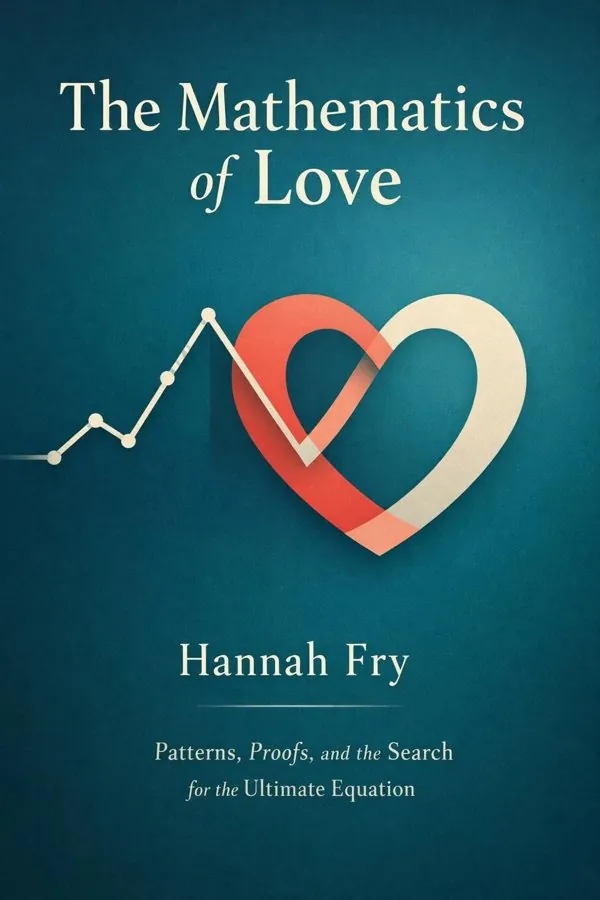
The Mathematics of Love: Patterns, Proofs, and the Search for the Ultimate Equation: Summary & Key Insights
by Hannah Fry
 10 min8 chapters
What Is The Mathematics of Love: Patterns, Proofs, and the Search for the Ultimate Equation About?
The Mathematics of Love: Patterns, Proofs, and the Search for the Ultimate Equation by Hannah Fry is a popular_sci book spanning 8 pages. In this witty and insightful exploration, mathematician Hannah Fry reveals how mathematics can illuminate the most human of experiences—love. From dating algorithms and online matching to the geometry of attraction and the statistics of long-term relationships, Fry demonstrates that numbers and patterns can help us understand the logic behind romance, heartbreak, and everything in between.
This FizzRead summary covers all 8 key chapters of The Mathematics of Love: Patterns, Proofs, and the Search for the Ultimate Equation in approximately 10 minutes, distilling the most important ideas, arguments, and takeaways from Hannah Fry's work.
The Mathematics of Love: Patterns, Proofs, and the Search for the Ultimate Equation
In this witty and insightful exploration, mathematician Hannah Fry reveals how mathematics can illuminate the most human of experiences—love. From dating algorithms and online matching to the geometry of attraction and the statistics of long-term relationships, Fry demonstrates that numbers and patterns can help us understand the logic behind romance, heartbreak, and everything in between.
Who Should Read The Mathematics of Love: Patterns, Proofs, and the Search for the Ultimate Equation?
This book is perfect for anyone interested in popular_sci and looking to gain actionable insights in a short read. Whether you're a student, professional, or lifelong learner, the key ideas from The Mathematics of Love: Patterns, Proofs, and the Search for the Ultimate Equation by Hannah Fry will help you think differently.
- ✓Readers who enjoy popular_sci and want practical takeaways
- ✓Professionals looking to apply new ideas to their work and life
- ✓Anyone who wants the core insights of The Mathematics of Love: Patterns, Proofs, and the Search for the Ultimate Equation in just 10 minutes
Want the full summary?
Get instant access to this book summary and 100K+ more with Fizz Moment.
Get Free SummaryAvailable on App Store • Free to download
Key Chapters
We begin with something seemingly simple: where and how we meet. Geometry plays a profound role in attraction, far beyond aesthetics or physical appearance—it influences the very probability of connection. Picture a crowded city, full of people moving through a network of streets and spaces. The closer two individuals are physically, the higher the chance their paths will intersect. In mathematics, this is spatial proximity, and it governs much of our romantic possibilities.
In truth, most couples meet not through fate, but through geometry. The circles we move in—the places we frequent, our workplaces, our social gatherings—form the boundaries of our romantic opportunities. Studies show that the majority of relationships begin between people who live or work nearby, because geometry dictates exposure. The mathematics of spatial probability makes it inevitable: we fall for people we encounter frequently enough for attraction to take root.
But geometry also helps us understand visual attraction. Symmetry, proportion, and ratios have fascinated artists and scientists alike for centuries. The so-called 'golden ratio' appears often in discussions of beauty, indicating how our preferences might align with mathematical patterns found in nature. Yet attraction isn’t pure geometry; it’s moderated by perception, emotion, and culture. Mathematics provides the framework—it describes how and where possibilities emerge—but it cannot prescribe the chemistry that ignites when two people meet.
For me, exploring attraction through geometric patterns is not about objectifying people; it’s about understanding how our realities are constructed. The spaces we inhabit mold the love stories we are likely to experience. To realize this is empowering. When we change our geometry—move cities, shift social circles—we alter the parameters of possibility. Love, therefore, is not just chance; it’s geometry in motion.
Dating feels uncertain—an endless sequence of chances, decisions, and missed connections—but statistics can give that uncertainty structure. Probability theory tells us that every romantic encounter is a data point, each decision shaping the distribution of possible outcomes. One of my favorite mathematical ideas here is known as the 'optimal stopping problem.' It’s a way of thinking about timing—how to know when to stop searching and choose the best available option.
In the context of dating, imagine you’ll meet a certain number of potential partners throughout your life. The theory suggests that if you could rank them from worst to best, then statistically, the ideal strategy is to reject the first 37% and choose the next one who’s better than all the previous ones. It sounds absurdly clinical, but there’s deep insight here: give yourself time to learn what you want, and don’t rush—but also don’t wait forever. Mathematics frames what intuition often tells us.
Beyond the stopping theory, statistics reveal patterns in how people approach relationships. For example, age, social context, and personal expectations all interact within probabilistic models to predict when and how people find partners. Data gathered from large populations shows predictable tendencies—but within those patterns are anomalies, surprises, and exceptions, mirroring love’s dual nature: structured yet uncertain.
When I analyze dating through statistics, my aim isn’t to quantify your heart but to unmask the trends we often ignore. Numbers help us see why some strategies succeed and others fail. They remind us that love is not magic freed from reason—it’s an intricate balance between probability and choice. The courage to risk rejection and the patience to wait for connection both exist within the equations of chance.
+ 6 more chapters — available in the FizzRead app
All Chapters in The Mathematics of Love: Patterns, Proofs, and the Search for the Ultimate Equation
About the Author
Hannah Fry is a British mathematician, author, and broadcaster known for her work on the mathematics of human behavior. She is a professor at University College London and has presented numerous science programs for the BBC, making complex mathematical ideas accessible to a broad audience.
Get This Summary in Your Preferred Format
Read or listen to the The Mathematics of Love: Patterns, Proofs, and the Search for the Ultimate Equation summary by Hannah Fry anytime, anywhere. FizzRead offers multiple formats so you can learn on your terms — all free.
Available formats: App · Audio · PDF · EPUB — All included free with FizzRead
Download The Mathematics of Love: Patterns, Proofs, and the Search for the Ultimate Equation PDF and EPUB Summary
Key Quotes from The Mathematics of Love: Patterns, Proofs, and the Search for the Ultimate Equation
“We begin with something seemingly simple: where and how we meet.”
“Dating feels uncertain—an endless sequence of chances, decisions, and missed connections—but statistics can give that uncertainty structure.”
Frequently Asked Questions about The Mathematics of Love: Patterns, Proofs, and the Search for the Ultimate Equation
The Mathematics of Love: Patterns, Proofs, and the Search for the Ultimate Equation by Hannah Fry is a popular_sci book that explores key ideas across 8 chapters. In this witty and insightful exploration, mathematician Hannah Fry reveals how mathematics can illuminate the most human of experiences—love. From dating algorithms and online matching to the geometry of attraction and the statistics of long-term relationships, Fry demonstrates that numbers and patterns can help us understand the logic behind romance, heartbreak, and everything in between.
More by Hannah Fry
You Might Also Like
Structures: Or Why Things Don"t Fall Down
J.E. Gordon
10 min
The Road to Wigan Pier
George Orwell
10 min
Bonk: The Curious Coupling of Science and Sex
Mary Roach
10 min
First Bite: How We Learn to Eat
Bee Wilson
10 min
In Pursuit Of The Unknown: 17 Equations That Changed The World
Ian Stewart
10 min
Napoleon's Buttons: 17 Molecules That Changed History
Penny Le Couteur and Jay Burreson
10 minBrowse by Category
Ready to read The Mathematics of Love: Patterns, Proofs, and the Search for the Ultimate Equation?
Get the full summary and 100K+ more books with Fizz Moment.